Table of Contents
Frequently Asked Questions
1. What is the employee grievance procedure in the UAE?
The employee grievance procedure is a formal process managed by MOHRE to resolve workplace disputes. Employees can file a complaint if issues such as unpaid salary, termination disagreements, or benefit disputes are not resolved internally. The case goes through mediation first, and if no agreement is reached, it may be referred to the Labour Court.
2. Can an employee file a complaint without informing the employer first?
Yes. Employees can approach MOHRE directly through the app, call centre, or a service centre. In practice, many complaints are filed without prior formal notice to the employer, which is why internal documentation and payroll accuracy are critical at all times.
3. How long does the grievance process take?
MOHRE typically initiates mediation within a few days of the complaint. If the issue is not resolved within about 14 days, the case is referred to the Labour Court, where timelines depend on the complexity of the dispute and the court schedule.
4. What types of issues are most commonly reported to MOHRE?
Most complaints relate to salary delays, unpaid dues, end-of-service benefits, and termination disputes. Issues involving commission, leave balances, or contract changes can also escalate if they are not properly documented.
5. What happens if the employer does not respond to a MOHRE complaint?
Failure to respond can weaken the employer’s position and may lead to the case being escalated quickly to court. MOHRE decisions and court outcomes are based on available records, so delayed or incomplete responses increase compliance risk.
6. Can a visa be cancelled while a grievance is ongoing?
In most cases, visa cancellation, employee transfer, and final settlement cannot be completed until the dispute is resolved. This can delay replacement hiring and affect operational planning if the role remains legally active.
7. What documents should employers keep to protect themselves in a dispute?
Employers should maintain signed employment contracts, WPS salary records, leave and attendance records, written performance warnings, and documented communication related to any changes or disputes. In the UAE system, decisions are based on evidence, not verbal agreements.
Topic Summary
1. Delayed Salary Payments
In the UAE, employees rely heavily on timely salary payments as their primary source of income. A delay, even if brief, can have significant financial repercussions, making it essential to address payment issues promptly through formal channels rather than informal discussions.
2. Discrepancies in Commission Calculations
Commission structures can be complex, and misunderstandings or errors in calculation often lead to disputes. Employers and employees should seek clear documentation and resolution processes to ensure commissions are computed accurately and transparently.
3. Inaccurate Leave Balances
Misalignment in leave entitlements or recorded balances can cause employee dissatisfaction. It is imperative for organisations to maintain precise leave records and rectify any discrepancies through formal HR procedures to maintain trust and compliance.
4. Hasty Termination Decisions
Terminations made abruptly, particularly during peak operational periods, may not only be unfair but could also lead to legal consequences. Such decisions should follow due process, including thorough review and documented justification, to protect both parties involved.
5. The Importance of Formal Employment Dispute Resolution
Given that expatriates constitute approximately 88.5% of the UAE’s population and employment is intrinsically linked to livelihood, even minor employment grievances should not be dismissed as internal matters. Formal mechanisms and legal frameworks must be utilised to address conflicts effectively and uphold employees’ rights.
Employee Grievance Procedures Under UAE Labour Law
A manager facing a sudden MOHRE complaint about unpaid overtime, a founder unsure whether a dismissal could be challenged as arbitrary, an HR lead wanting internal processes solid enough to resolve disputes before they ever reach a government complaint: all three are dealing with the same system, and getting your internal documentation right well before a dispute arises makes the real difference.
This guide covers what qualifies as a grievance in the UAE, the legal framework behind the process, the real financial risks employers face, and what you need in place to manage this risk properly from the start.
Key Stats at a Glance
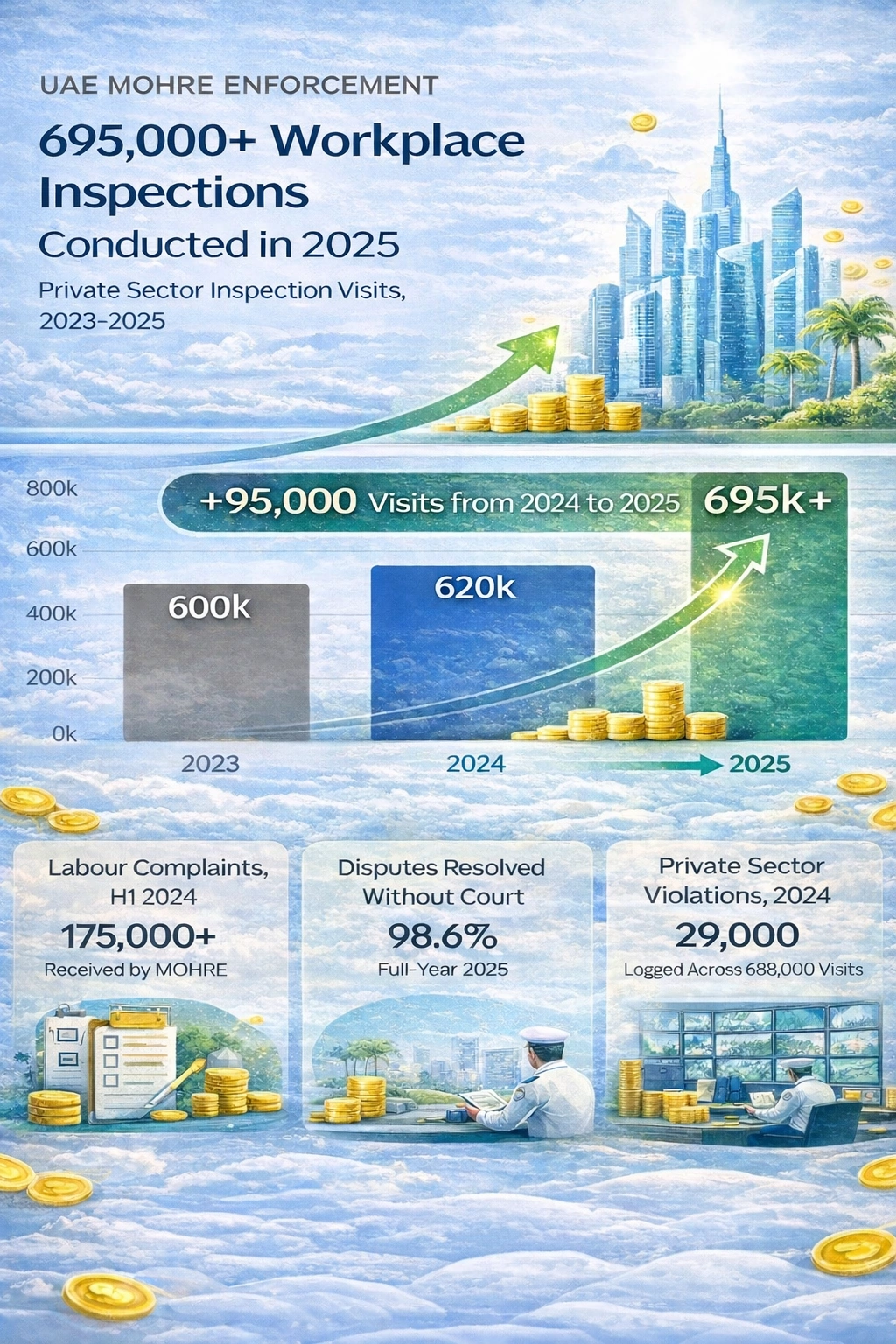
Sources: MOHRE official press release, March 2026; Gulf News, citing MOHRE and IMD World Competitiveness Yearbook, September 2025
What Qualifies as an Employee Grievance in the UAE
Unpaid or delayed salary, incorrect overtime or commission payments, disputes over annual or unpaid leave balances, disagreements over end-of-service benefit calculations, contract changes made without an employee's consent, and disputes over termination or notice periods all qualify as grievances an employee can raise formally.
Arbitrary dismissal claims sit among the most serious of these, since they carry their own compensation rules under UAE labour law.
With 88.5% of the UAE's population made up of expatriates, employment status is tied closely to both income and residency for the vast majority of the workforce, which is exactly why these grievance categories carry real weight rather than being treated as minor workplace friction.
A dispute over pay or dismissal can affect an employee's right to remain in the country, not just their income.
The Legal Framework Behind the Employee Grievance Procedure
Federal Decree Law No. 33 of 2021 governs employee grievances, with the Ministry of Human Resources and Emiratisation administering the process. Most complaints get filed without any prior formal notice to the employer, which is exactly why accurate payroll records and clear internal documentation matter so much: decisions in this system are based on evidence, not verbal agreements between employer and employee.
This lack of prior notice catches many employers off guard, since a business assuming it would get a chance to resolve an issue internally first may instead find a formal MOHRE case already open before anyone from HR even knew a problem existed.
The UAE Employee Grievance Procedure Explained
[blockCTACostCalculator]
Financial and Operational Risks for Employers
Court-ordered compensation, arbitrary dismissal payouts of up to 3 months' salary, administrative fines for labour violations, Wage Protection System penalties, legal and translation costs, and visa or hiring delays all sit on the table once a grievance escalates. A poor risk rating from repeated violations can also increase scrutiny on a business going forward, making every future interaction with MOHRE slower and more closely reviewed.
These costs rarely arrive alone. A single arbitrary dismissal case can trigger legal fees, translation costs for evidence, a court-ordered payout, and a delay in processing new visas all at once, so the true cost of one poorly handled dismissal often runs well beyond the headline compensation figure itself.
Compliance and What You Need in Place
Written employment contracts
Keep every employment contract written and aligned with actual pay practices, since a mismatch between a written contract and real payment behaviour is one of the fastest ways to lose a dispute.
Accurate Wage Protection System payments
Run your payroll through the Wage Protection System accurately and on time, since WPS records are exactly the kind of evidence MOHRE relies on when reviewing a complaint, and a clean payment history speaks for itself far more than any explanation offered after the fact.
Documented leave and approvals
Keep leave balances and approvals documented clearly, since a leave dispute without a paper trail almost always favours the employee's account of events.
Written performance records
Keep written performance warnings and records rather than relying on verbal conversations, since a dismissal challenged as arbitrary needs documented, dated evidence behind it to hold up, and a manager's memory alone rarely satisfies a labour relations officer reviewing the case.
Clear internal escalation channels
Build an internal grievance channel employees can use before going straight to MOHRE, since resolving an issue internally is faster and less costly than a formal complaint for both sides, and it signals to staff that concerns get taken seriously without needing to escalate externally.
Email and written communication habits
Put key workplace decisions and conversations in writing, since MOHRE and the courts weigh documented evidence far more heavily than a verbal account of what was agreed.
Market Opportunity
With 98% of disputes settled by MOHRE in 2025 and 688,000 private-sector inspections conducted in 2024 alone, this is an actively enforced system rather than a rarely used one, and an employer with weak documentation faces real risk the moment a complaint lands.
A Meydan Free Zone business that builds strong internal HR practices from the start avoids becoming one of the 29,000 labour law violations recorded in a single year.
The 98% settlement rate also shows that most cases resolve without ever reaching a courtroom, which rewards an employer who engages constructively with mediation rather than treating a complaint as an adversarial fight from the outset. A cooperative approach at the mediation stage tends to produce a faster, less costly outcome for both sides.
For a growing business, this discipline pays off beyond dispute avoidance too: clear contracts, accurate WPS payments, and documented performance records make every hiring, promotion, and termination decision faster and less risky to execute, whether or not a grievance ever comes up, and this same discipline tends to build a healthier workplace culture overall.
Conclusion
Employee grievance procedures in the UAE run on evidence, not verbal agreements, and the employers who avoid real financial and operational risk are the ones who keep clean, current documentation from day one.
Meydan Free Zone businesses that build strong contracts, accurate payroll records, and clear internal escalation channels are far better placed to resolve disputes early, or avoid them altogether, protecting both their finances and their standing with MOHRE over the long run.
[blockCTAContact]