






Table of Contents
Frequently Asked Questions
1. Can an existing free zone company be transferred to Meydan Free Zone?
Yes. UAE regulations allow an existing free zone company to transfer to Meydan Free Zone through a formal re-domiciliation process without closing or liquidating the company.
2. What is re-domiciliation in the UAE?
Re-domiciliation is the legal process of migrating an existing company from one free zone to another while preserving the same legal entity under a new licensing authority.
3. Does a free zone company need to be closed before moving to Meydan Free Zone?
No. The company does not need to be closed. However, it must obtain a No Objection Certificate and Exit Certificate from its current free zone before transferring.
4. How long does it take to transfer a free zone company to Meydan Free Zone?
There is no fixed timeline. The duration depends on how quickly the current free zone completes its exit procedures, including visa and establishment card cancellation.
5. Can business activities be changed during the transfer process?
No. Business activities, ownership, and capital structure cannot be amended during re-domiciliation. Any changes must be made before or after the transfer is completed.
6. Do visas and establishment cards transfer between free zones?
No. Visas and establishment cards are authority-specific and must be cancelled and re-issued under Meydan Free Zone after the transfer.
Topic Summary
1. Review Eligibility and Regulatory Requirements
Begin by verifying that your current company structure and trade activities comply with Meydan Free Zone’s regulations. Ensure your business qualifies for relocation by consulting Meydan Free Zone Authority guidelines.
2. Prepare and Submit Transfer Application
Complete the official transfer application through Meydan Free Zone’s online portal or customer service channels. Submit all required documents, such as your current trade license, shareholder certificates, and passport copies of company owners.
3. Obtain No Objection Certificate (NOC)
Request a No Objection Certificate from your existing free zone authority. This document permits the transfer of your company and is mandatory for processing within Meydan Free Zone.
4. Settle Financial Obligations and Fees
Clear all outstanding fees, fines, or penalties associated with your existing free zone license. Pay the applicable transfer and licensing fees required by Meydan Free Zone to initiate and complete the transfer process.
5. Finalize License Cancellation and New License Issuance
Complete the cancellation of your current license with the original free zone authority once Meydan Free Zone approves your transfer. Meydan Free Zone will issue a new trade license, allowing you to legally operate under their jurisdiction with access to their facilities and benefits.
How to Transfer Your Existing Free Zone Company to Meydan Free Zone in Dubai
Most founders don’t spend much time thinking about free zone jurisdictions at the beginning. They choose one, get licensed, and move on to building the business. Over time, though, the business license starts to shape everyday decisions: how easily the company can add activities, how smoothly banking and KYC processes run, how visas are issued, and how much of the administration can actually be handled online.
What initially worked often turns out to be a product of convenience rather than long-term fit, and as the business matures, that gap becomes harder to ignore.
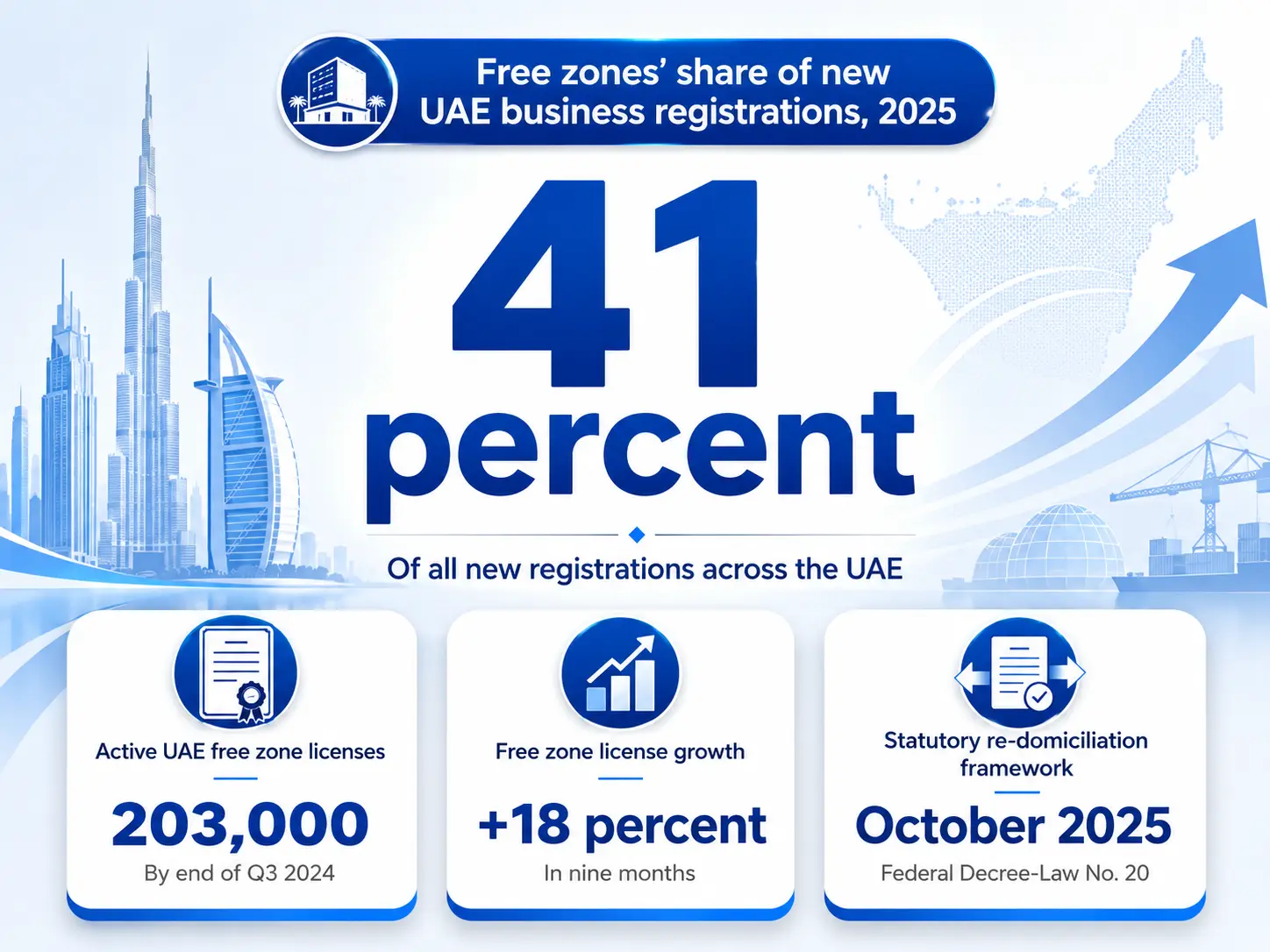
The good news is that founders now have a clear legal pathway to switch. Per Federal Decree-Law No. 20 of 2025 via Cleary Gottlieb¹, the UAE introduced a statutory framework for company re-domiciliation in October 2025, formally permitting companies to transfer their registration between competent licensing authorities, including between free zones, while retaining their legal personality, rights, and existing contracts.
The shift comes against a backdrop of significant free zone growth. Per the National Economic Registry via MENAFN², the UAE recorded nearly 203,000 active free zone licenses by the end of Q3 2024, an 18 percent rise over the first nine months of the year and roughly 22 percent of all licenses issued in the country.
[blockCTABizActivityList]
Free Zones Are Now the Default Choice
UAE founders are choosing free zones in record numbers, and the law now lets companies move between them without starting over.
What you only discover later is that an existing free zone company doesn’t have to stay where it started. UAE regulations allow companies to move between free zones through a formal re-domiciliation process, preserving the legal entity while shifting it into a jurisdiction that is better aligned with how the business now operates.
If you are a founder reassessing whether your current setup still supports speed, scale, and simplicity, understanding how a free zone company can be transferred to Meydan Free Zone becomes a practical and often overdue consideration.
[blockCTATradeLicense]
What Does It Mean to Transfer a Free Zone Company in Dubai?
Transferring a free zone company to Meydan Free Zone is legally known as re-domiciliation. It is not a business license amendment and not a new company incorporation. Instead, it is a jurisdictional migration where the company continues to exist as the same legal entity, but under a different licensing authority.
This distinction matters because, in the UAE, free zones are independent regulatory jurisdictions. When a company moves between them, the authority responsible for licensing, visas, and ongoing governance changes. As a result, some elements of the company continue uninterrupted, while others must be reset under the new free zone’s framework.
[blockCTAFawri]
Why Founders Consider Moving a Free Zone Company Later On
Re-domiciliation is rarely part of the original plan. Early-stage founders prioritise speed and cost, and most free zones can support a simple operating model. The question of moving only emerges once the business matures and structural friction becomes more visible.
At that stage, the business license begins to shape everyday decisions:
- Activity expansion: Adding adjacent business activities starts to feel constrained.
- Administrative coordination: Day-to-day tasks remain fragmented across separate systems.
- Banking reviews: KYC and compliance checks become more frequent.
- Digital integration: Processes that should be digital still require manual coordination.
None of these issues alone force a move, but together they prompt founders to reassess whether their current free zone still matches how the business actually runs.
This is typically when founders start looking for a jurisdiction that is more digitally integrated, operationally streamlined, and designed for ongoing governance rather than just initial setup. This is why Meydan Free Zone often enters the conversation at this point.
[blockCTABizSetupRemotely]
Can a Free Zone Company Be Transferred Without Closing It?
Yes. UAE regulations allow a free zone company to be transferred to another free zone without liquidation, provided the company follows the formal re-domiciliation process.
The key requirement is that the company must be formally released by its current free zone before it can be accepted by Meydan Free Zone. This ensures that the transfer is recognised by both authorities and that there is no overlap in jurisdiction.
[blockCTAmPlus]
What Must Happen Before Meydan Free Zone Can Accept the Company
The re-domiciliation process begins with the current free zone, not Meydan Free Zone.
Before a transfer can proceed, the existing free zone must issue:
- A No Objection Certificate (NOC) confirming there are no objections to the company exiting the jurisdiction
- An Exit Certificate, issued only after all exit requirements are completed
In practice, exit requirements usually include the cancellation of visas sponsored under the current free zone, cancellation of the establishment card, and completion of any authority-specific clearance steps. Because each free zone administers its own exit procedures, timelines vary and cannot be standardised.
[blockCTAmCore]
How Meydan Free Zone Reviews a Re-Domiciling Company
Once the Exit Certificate is issued, the company may apply to re-domicile into Meydan Free Zone. This stage is fundamentally different from a new company setup.
Rather than forming a new entity, Meydan Free Zone’s legal team reviews the existing company as it stands. The assessment focuses on ownership structure, capital structure, and licensed activities to ensure they align with Meydan Free Zone’s regulatory framework. Services designed for rapid new incorporations, such as the Fawri business license, are not applicable to re-domiciling companies.
An important constraint applies at this stage: the company’s structure cannot be changed during re-domiciliation. Any required amendments must be completed before starting the process or after the transfer is finalised.
[blockCTAmResidency]
Business Activities When Moving to Meydan Free Zone
A re-domiciling company may combine up to three activity groups under a single business license, provided its existing activities permit such grouping. This often allows founders to simplify how the business is licensed without changing what the company actually does.
However, re-domiciliation does not override regulatory restrictions. All limitations that apply to new business licenses apply equally to transferring companies. Activities regulated by external authorities remain subject to those rules, and incompatible activities cannot be combined.
With over 2,500 business activities, Meydan Free Zone offers a structured framework that many founders use to rationalise and future-proof their business license.
That breadth means you can add new lines as you grow, and a motion picture production license in Dubai is another activity Meydan Free Zone supports under the same framework.
[blockCTAmAssist]
What Carries Over and What Resets After the Transfer
Understanding continuity versus reset is critical when transferring a free zone company. The legal entity itself continues, but authority-linked elements reset under the new jurisdiction. Here is how each element is handled:
Visa processes can be managed through mResidency, Meydan Free Zone's digital visa system. For banking, many founders align re-domiciliation with a planned reset. Meydan Free Zone offers optional bank account support services to help companies onboard with partner banks and obtain a UAE IBAN under the new license.
[blockCTAmAccounting]
Is Transferring a Free Zone Company to Meydan Free Zone the Right Move?
Re-domiciliation is not about fixing a bad decision. Most founders chose their original free zone for valid reasons at the time. The decision to move usually reflects growth, more activity, more people, more banking interaction, and more operational complexity.
For founders who feel their current free zone no longer supports how the business actually operates, transferring a free zone company to Meydan Free Zone offers a way to realign the company’s legal and administrative framework without dismantling the entity itself.
[blockCTAContact]
Citations
¹ Federal Decree-Law No. 20 of 2025, via Cleary Gottlieb, "UAE Companies Law Update 2025: Multiple Share Classes and Other Modernized Tools for Investments and Exits," December 2025.
² National Economic Registry, via MENAFN, "Companies registered in UAE's free zone issue 203,000 licenses," October 2024.


.jpeg)




.webp)