Table of Contents
Frequently Asked Questions
1. What is the maximum probation period in the UAE?
The maximum probation period under UAE labour law is six months. It cannot be extended or renewed. If the employee continues working beyond six months, they are automatically considered confirmed.
2. Can an employer terminate an employee during probation without notice?
No. Employers must provide at least 14 days’ written notice during probation, unless the termination is due to serious misconduct under UAE labour law.
3. Can an employee resign during probation in the UAE?
Yes. Employees must provide 30 days’ notice if they are joining another UAE employer or 14 days’ notice if they are leaving the country.
4. Can employees change jobs during probation?
Yes. Employees can move to another employer during probation, provided they follow the required notice period and legal transfer procedures.
5. Who pays recruitment costs if an employee changes jobs during probation?
If an employee moves to another UAE employer during probation, the new employer may be required to reimburse the previous employer’s recruitment and visa costs.
6. Do employees receive salary and benefits during probation?
Yes. Employees are entitled to their full salary, a valid contract, a work permit, a residency visa, medical insurance, and workplace protections from the first day of employment.
7. Do probation rules differ in UAE free zones?
No. Most free zones follow the same six-month limit and notice requirements as federal labour law, although administrative processes such as visa handling are managed by the free zone authority.
Topic Summary
1. Swift Recruitment Across Borders
In the UAE, companies frequently recruit talent not only locally but also from international markets. This transnational approach enables businesses to access a diverse pool of skilled professionals and meet operational demands with remarkable speed.
2. Accelerated Onboarding and Operational Start
Once hired, employees often undergo rapid onboarding processes, allowing organisations to begin their operations within weeks. This efficiency is crucial in a competitive business landscape where time-to-market is a significant advantage.
3. Probation Period as a Critical Assessment Tool
Amidst rapid hiring and onboarding, the probation period serves as an essential phase for employers and employees to evaluate mutual compatibility. It provides a practical framework to ensure the right fit while maintaining business momentum.
4. Flexibility in Managing Multinational Teams
Given the UAE’s dynamic labour market, probation periods help manage multicultural and multidisciplinary teams effectively. This trial phase supports alignment on expectations, work culture, and performance standards across varied backgrounds.
5. Legal and Regulatory Compliance
The UAE Labour Law mandates probation periods to be transparent and time-bound, typically not exceeding six months. Both parties benefit from clear terms during this period, facilitating legal protection and reducing potential disputes.
Probation Period in the UAE: Rules, Duration, and Employee Rights
In the UAE, hiring decisions move quickly. Companies routinely recruit talent across borders, onboard quickly, and begin operations within weeks. According to Gulf News¹, the UAE's workforce grew 12.4 percent in 2025, with 99 percent of private sector workers now registered in the Wage Protection System, reflecting one of the most regulated and mobile labour markets globally.
You could be hiring employees locally, relocating IT specialists from overseas, or building a creative team drawn from multiple markets at once. In that environment, the probation period in the UAE is not just a formality; it is a practical tool that allows both employer and employee to assess fit while the business continues to move forward.
Behind every probation conversation sits a labour market that operates at world-leading scale and tightness.
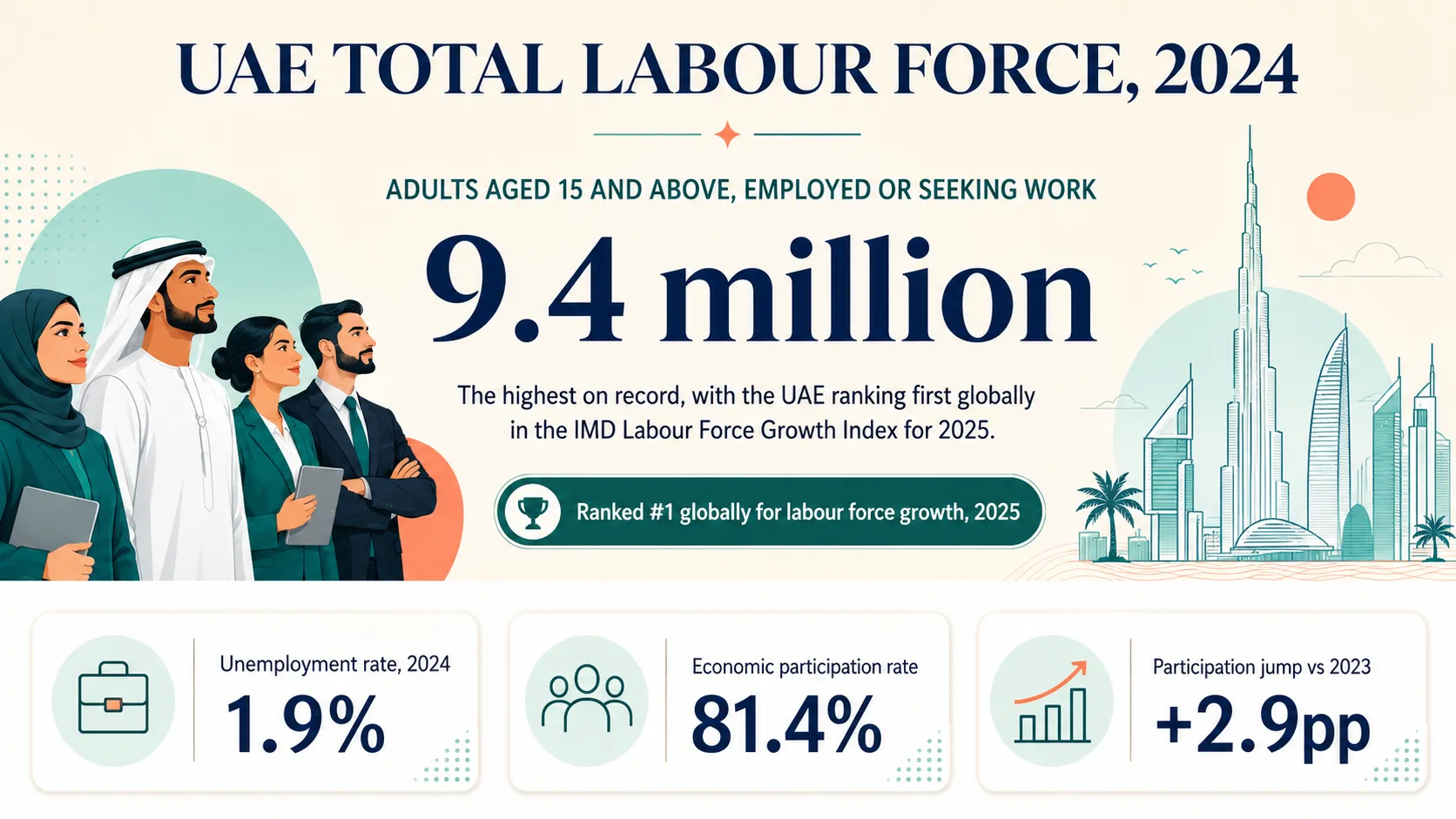
Source: Gulf News, October 2025, citing the Federal Competitiveness and Statistics Centre (FCSC) 2024 Labour Force Survey. Global ranking from the IMD World Competitiveness Yearbook 2025.
Many still assume probation is an informal trial phase where either side can exit without structure or consequence. In reality, the UAE's labour framework treats probation as a regulated stage of employment. Under Federal Decree Law No. 33 of 2021², it is time-bound and supported by defined notice, mobility, and cost recovery rules.
Used properly, probation gives employers a defined window to evaluate performance while allowing employees to assess long-term fit.
Understanding the UAE Probation Framework
Many employers still assume probation allows immediate termination, that employees cannot move to another job, and that formal obligations only begin after confirmation.
During probation:
- The maximum duration is six months.
- Notice is mandatory for both employers and employees, with specific timelines defined.
- Employees are legally allowed to change jobs, subject to notice requirements.
- If an employee leaves the UAE or transfers to another employer, the new employer may be required to reimburse recruitment costs.
The UAE labour framework allows employers flexibility to assess performance while protecting hiring investment and supporting workforce mobility.
Maximum Probation Period In The UAE
The maximum probation period allowed under UAE labour law is six months.
This applies across the private sector and cannot be extended under any circumstance. If an employee continues working after six months without termination, they are automatically considered a confirmed employee.
Key implications for employers:
- Probation cannot be renewed or restarted.
- Any extension clause in a contract is legally unenforceable.
- Performance evaluation must happen within the six-month window.
For employees:
- Confirmation is automatic after six months.
- No separate confirmation letter is legally required, though many companies issue one for internal records.
Navigating the Notice Period During Probation
Probation in the UAE is not a “same-day exit” arrangement. The law requires written notice in all cases to protect business continuity and recruitment investment.
If the employer terminates
- A minimum of 14 days’ written notice must be given.
- Immediate termination is only allowed in cases of serious misconduct under labour law.
- For example, if a new hire is underperforming after two months, the company must issue notice and keep the employee on payroll during the notice period.
If the employee resigns to join another UAE employer
- A minimum of 30 days’ written notice must be given.
- The new employer must compensate the current employer for recruitment and onboarding costs, unless both companies agree to waive this.
- For example, if an employee hired from overseas receives a new offer during probation, the new company may need to reimburse visa and hiring expenses.
If the employee leaves the UAE
- A minimum of 14 days’ written notice must be given.
- If the employee returns and joins another employer within three months, the new employer must reimburse the previous employer’s recruitment costs.
- For example, if an employee exits the country during probation but returns shortly for a new job; in this case, cost recovery provisions may apply.
Can an Employee Change Jobs During Probation?
Employees in the UAE can change employers during probation, provided they follow the required notice process.
This reflects the UAE’s labour reforms, which support workforce mobility without imposing labour bans, as long as legal conditions are met.
What matters in practice:
- 30 days’ notice is required if the employee is moving to another UAE employer
- Failure to provide proper notice may result in compensation liability
- The new employer may need to reimburse recruitment and visa costs to the previous employer
Think: if a new hire accepts another offer three months into probation, the move is allowed, but the notice period must be served, and the new company may need to cover hiring expenses.
Salary and Benefits During Probation
Probation affects termination flexibility, not employment status. Once an employee is hired, standard legal protections and employer obligations apply from day one.
What does not change during probation:
Employees are entitled to:
- Full agreed salary, paid on time through the Wage Protection System (WPS)
- A valid employment contract registered with MOHRE or a relevant free zone authority like Meydan Free Zone
- A work permit and residency visa sponsored by the employer
- Medical insurance
- Full workplace protections under UAE labour law
From a compliance perspective, probation is still a formal employment relationship. Employers cannot delay core obligations until confirmation.
What is limited during probation:
- Annual leave accrues, but taking leave depends on company approval and operational needs
- End-of-service gratuity does not apply unless the employee completes at least one year of continuous service
Employer Cost and Risk Exposure
For most roles, employers typically pay for:
- Work permit issuance
- Residency visa processing
- Medical fitness test and Emirates ID
- Mandatory health insurance
- Recruitment or relocation costs, especially for overseas hires
If the employee leaves during probation, those costs are not automatically recoverable. Reimbursement is only possible in specific situations defined under labour law. For example, when the employee moves to another UAE employer and cost recovery applies.
Managing these processes efficiently also matters. In a digital-first environment such as Meydan Free Zone, mResidency supports the full employee onboarding journey, from residency visa processing and medical fitness testing to biometrics, Emirates ID issuance, and connecting visa holders with approved health insurance providers.
[blockCTAmResidency]
Probation Period Rules in UAE Free Zones
Probation rules in most UAE free zones follow the same legal framework as federal labour law. The maximum six-month limit, mandatory notice periods, and employee mobility provisions apply in the same way.
In free zones, the authority typically manages the employment lifecycle, including:
- Issuing employment contracts
- Processing work permits and residency visas
- Handling visa cancellation and employee transfers
This centralised process reduces the need for separate government interactions and keeps employment actions within a single system.
In a digital-first environment such as Meydan Free Zone, founders manage their employees’ visa application, issuance, renewal, and cancellation through an online customer portal. This allows faster processing and clearer tracking of employee status during probation.
In Conclusion
In the UAE, probation is not a grey area. It is a defined window to make the right hiring decision, with clear limits, notice requirements, and cost implications.
For employers, the flexibility is real, but so is the investment. Visas, onboarding, and recruitment costs begin from day one, which makes early evaluation and timely decisions essential. For employees, probation does not reduce protection. Salary, legal rights, and job mobility all apply, but moves must be planned around notice and transfer rules.
The system is built to balance speed with stability. When managed properly, probation does what it is meant to do: reduce hiring risk, protect business investment, and help both sides decide whether the role is the right long-term fit.
Citations
¹ Gulf News, "UAE private sector operating at full capacity: MoHRE," 7 March 2026.
² u.ae, "UAE Labour Law," UAE Government Portal.