Table of Contents
Frequently Asked Questions
1. Who is eligible for a UAE retirement visa?
Expatriates aged 55 and above who meet financial requirements through property ownership, savings, or a stable monthly income can apply.
2. What is the minimum financial requirement for a UAE retirement visa?
Applicants must meet one of the following: property worth at least AED 1 million, AED 1 million in savings, or a monthly income of at least AED 20,000.
3. How long is the UAE retirement visa valid?
The retirement visa is issued for five years and can be renewed if the financial eligibility criteria continue to be met.
4. How long does the retirement visa application process take?
Initial approval usually takes 2–4 weeks, followed by 5–10 working days for medical testing and Emirates ID issuance.
5. Can retirement visa holders work in the UAE?
The retirement visa does not allow salaried employment. However, holders can manage investments, receive rental income, or act as shareholders in businesses.
6. Can family members be sponsored under a retirement visa?
Yes, retirement visa holders can sponsor their spouse and eligible dependants, subject to standard residency requirements.
7. What documents are required for a UAE retirement visa?
Applicants typically need a passport copy, proof of savings or income, property documents (if applicable), health insurance, and bank statements.
Topic Summary
1. Flexible Eligibility Criteria
To qualify for this five-year renewable residency, applicants must be at least 55 years old or have completed 15 years of service either within or outside the UAE. The core requirement is demonstrating long-term financial independence through one of several approved pathways, ensuring residents can support themselves without needing traditional employment.
2. Diverse Financial Pathways
Applicants can secure their stay by owning a completed UAE property worth at least AED 1 million, maintaining AED 1 million in a local fixed deposit, or proving a stable monthly income of AED 20,000 from pensions or investments. A combined option of savings and income is also available, providing a customizable route for those with diverse asset portfolios.
3. Independence from Employment
Unlike standard residency permits, the retirement visa is not tied to a workplace, allowing holders to live in the UAE without an employer sponsor. This provides the freedom to manage personal investments, receive rental income, or act as a business shareholder while maintaining full access to local banking, healthcare, and the ability to sponsor family members.
4. Structured Application Process
The application journey is determined by the chosen financial route, with property-based requests handled by the Dubai Land Department and savings-based requests managed by the GDRFA. While initial eligibility can sometimes be confirmed in 48 hours, the full process—including medical tests and Emirates ID issuance—typically spans two to four weeks.
5. Strategic Long-Term Stability
While it differs from the 10-year Golden Visa by having a specific age requirement and a 5-year validity, the retirement visa offers a more accessible entry point for established professionals. It serves as a vital bridge for the UAE's growing expatriate population, transforming the country from a temporary work destination into a permanent home for retirement.
UAE Retirement Visa: Eligibility Criteria and Application Process
There's a point when many founders and professionals start asking a different question about Dubai. Not "How fast can I grow here?" but "Can I stay here long-term?"
The question reflects a broader shift.The question reflects a broader shift. According to the Dubai Land Department¹, resident investors accounted for 56.6 percent of Dubai's AED 680 billion in real estate investments in 2025, with the average renter taking 4.8 years to become an investor. The numbers reflect a deepening long-term commitment from people already living in Dubai, the same audience the retirement visa is designed to retain.
The UAE retirement visa has become one such pathway. Designed for stability, it allows eligible residents aged 55 and above to remain in the country for five years, renewable, without needing an employer sponsor.
If you're planning long-term life in Dubai, whether through property, savings, or investment income, this guide explains the eligibility criteria, financial requirements, and application process for the UAE retirement visa based on official UAE frameworks.
Note: Meydan Free Zone does not issue or sponsor retirement visas.
What is the UAE Retirement Visa?
The UAE retirement visa is a renewable five-year residence permit for expatriates aged 55 and above who meet specific financial criteria. It allows long-term residents to remain in Dubai after their primary working years, without needing an employer or company to sponsor their stay.
The visa reflects a shift in how the UAE approaches long-term residents. Many applicants are not fully stepping away from economic activity. Instead, they are transitioning out of full-time employment while continuing to manage investments, rental income, savings, or business interests.
What makes the retirement visa different from standard residency is independence. Your residency is based on financial stability rather than employment. As long as you continue to meet the eligibility requirements at renewal, your stay remains secure.
With a retirement visa, residents can:
- Live in Dubai under a renewable 5-year residency
- Sponsor a spouse and eligible dependants
- Maintain bank accounts and access local services
- Manage property, investments, or business interests
This is residency, not citizenship. But for many long-term expatriates who have built their lives and assets in the UAE, it offers something important: the ability to stay without relying on a job to do so.
The retirement visa fits inside a broader long-term residency framework, set against a demographic backdrop that makes staying for decades realistic.
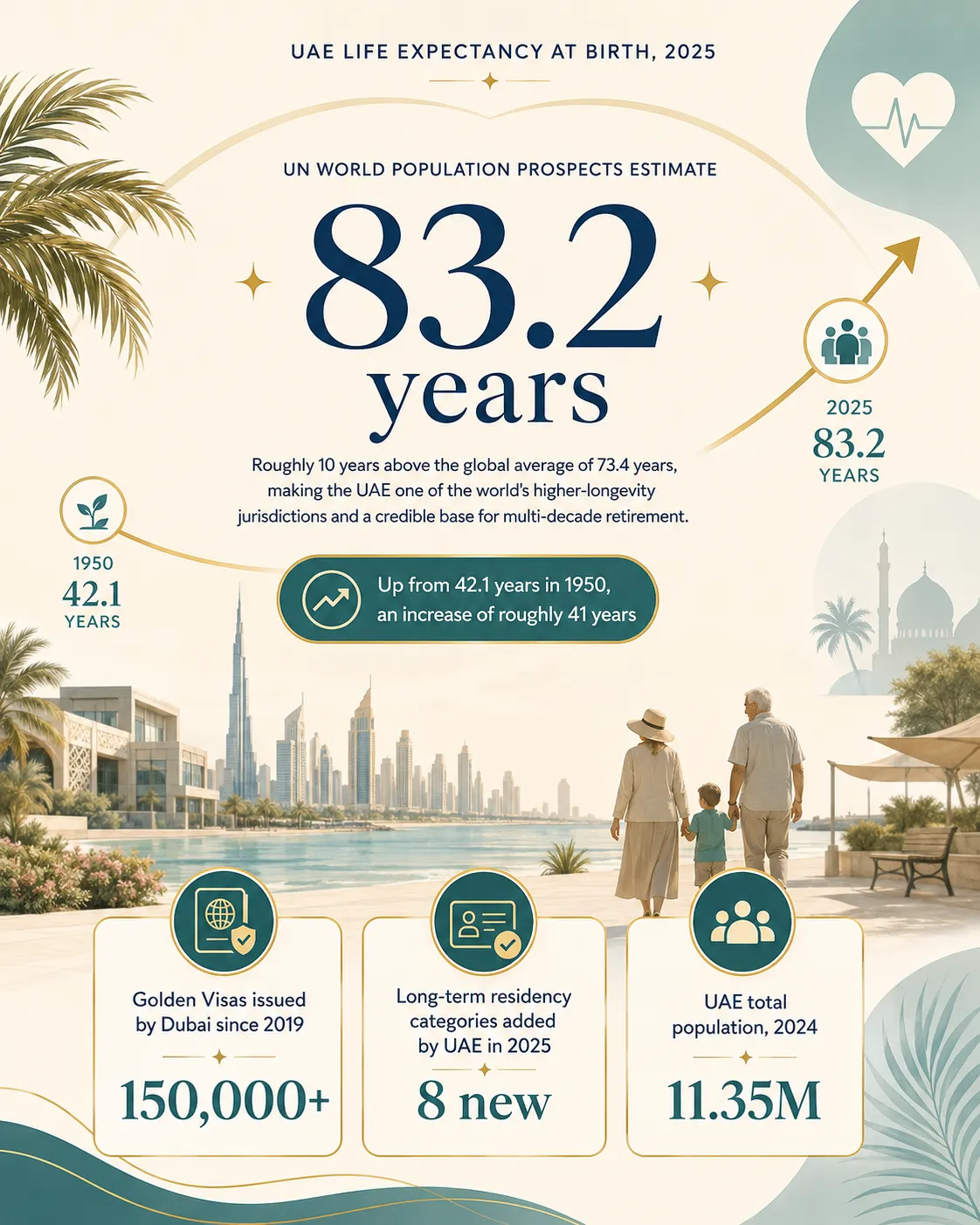
Sources: UN World Population Prospects 2024; Khaleej Times, citing Dubai GDRFA.
UAE Retirement Visa Eligibility Criteria
To qualify for the retirement visa, applicants must have either worked for not less than 15 years inside or outside the UAE or be 55 years or older and meet at least one of the approved financial pathways. The underlying principle is simple: the UAE wants to see long-term financial stability that allows you to live independently without relying on employment.
[blockFaqsCategory]
Documents Required for a UAE Retirement Visa
While exact requirements may vary depending on the application channel and personal situation, most applicants should prepare the following:
- Passport copy (valid for at least six months)
- Current UAE residence visa and Emirates ID (if already a resident)
- Bank statements or fixed deposit confirmation
- Property title deed, if applying under the property category
- Proof of income (pension certificates, rental agreements, investment statements)
- Valid UAE health insurance, which is mandatory for residency approval
After entry approval, applicants must complete the standard UAE residency formalities, including a medical fitness test and Emirates ID biometrics. These checks are part of the federal residency system and apply to all long-term residence visas.
Step-by-Step Application Process for a Retirement Visa in the UAE
The retirement visa process follows the standard UAE residency structure. Here’s how the process typically works.
[blockAccordionSteps]
How Long Does the UAE Retirement Visa Process Take?
Processing time depends on the application route and the completeness of your documents.
Initial eligibility review under the Retire in Dubai programme may be completed within 48 hours. However, the overall timeline is longer because additional steps are required.
In most cases:
- Property-based applications may take longer due to verification through the Dubai Land Department
- Medical testing and Emirates ID issuance typically take 5–10 working days
- Final visa issuance and status adjustment add additional processing time
In practice, the full process typically takes 2–4 weeks, depending on the application pathway and document readiness.
Can You Work or Run a Business on a Retirement Visa?
The UAE retirement visa is not employment-based and does not allow you to take up a salaried job with an employer.
However, visa holders can:
- Manage personal investments or property
- Receive rental or investment income
- Act as a shareholder or investor in a business
Residency must remain supported by the qualifying financial criteria rather than employment.
Note: Meydan Free Zone does not issue or sponsor retirement visas. The UAE retirement visa is granted directly by government authorities based on personal financial eligibility.
Understanding the Difference Between the Retirement Visa and the Golden Visa
For many long-term residents and investors, the choice isn’t just about staying in the UAE; it’s about choosing the right residency structure based on age, financial position, and long-term plans. Both the retirement visa and the Golden Visa offer extended residency without employer sponsorship, but they are designed for different life stages and financial profiles.
Both visas offer long-term residency without employer sponsorship, but they serve different profiles.
| Feature | Retirement Visa | Golden Visa |
|---|---|---|
| Validity | 5 years (renewable) | 10 years |
| Age requirement | 55+ | No age limit |
| Eligibility basis | Savings, property, or income | Investment, business, or professional criteria |
| Employment sponsor required | No | No |
For individuals over 55 with stable savings or property, the retirement visa is often the more straightforward option. Those with larger investments or qualifying professional profiles may consider the Golden Visa.
Final Thoughts
For many long-term expatriates, retirement in the UAE isn’t about slowing down; it’s about staying connected to a place where their financial, professional, and personal lives are already established.
The UAE retirement visa offers a practical pathway for residents aged 55 and above who want continuity without relying on employer sponsorship. With clear eligibility options based on property ownership, savings, or stable income, the framework is built around financial independence and long-term security.
For those who have built assets, investments, and roots in Dubai, the retirement visa provides a structured, renewable way to remain part of the country’s lifestyle, financial ecosystem, and long-term future.
Looking to start your company remotely in Dubai? Get in touch with our team today!
Citations
¹ Dubai Land Department, "Dubai's Real Estate Market Records New Historic Milestone with Transactions Exceeding AED 917 billion in 2025," January 2026.