

Table of Contents
Frequently Asked Questions
1. What does non-compliance mean in the UAE for businesses?
Non-compliance in the UAE occurs when a business fails to meet regulatory obligations related to tax, trade licensing, UBO disclosure, AML requirements, visas, or record-keeping. Because these systems are interconnected, an issue in one area often surfaces through banking, renewals, or immigration processes.
2. What are the penalties for corporate tax and VAT non-compliance in the UAE?
Penalties include fixed fines for late CT and VAT registration (such as AED 10,000), recurring penalties for late filings, and escalating fines for incorrect reporting. VAT non-compliance can also trigger additional penalties for late payment and poor record-keeping once the AED 375,000 threshold is crossed.
3. Can trade license non-compliance affect my bank account in the UAE?
Yes. Expired trade licenses, business activity mismatches, or missing approvals commonly trigger bank reviews, onboarding delays, or temporary account restrictions. In prolonged cases, businesses may face blocked renewals or even license suspension or cancellation.
4. What happens if a company fails to update UBO information in the UAE?
Failure to disclose or update Ultimate Beneficial Owner (UBO) details within the required timeframe can result in administrative fines of up to AED 100,000, delayed bank account openings, renewal issues, and increased regulatory scrutiny.
5. How can founders reduce non-compliance risks when setting up in the UAE?
Founders can reduce risk by choosing a structured, digital-first setup where compliance is built in from day one. Ecosystems like Meydan Free Zone support this through integrated services covering licensing accuracy, tax readiness, UBO, AML, and visa processes, helping businesses stay aligned as they scale.
Topic Summary
1. Blocked Bank Transactions
Non-compliance with financial regulations can lead to immediate freezing or blocking of bank transactions, disrupting cash flow and operational stability.
2. Rejected Visa Renewals
Failure to meet immigration requirements often results in visa renewal rejections, affecting employee residency status and business continuity.
3. Fines and Accrued Penalties
Unawareness or neglect of regulatory fines can cause initial penalties to escalate due to accumulating additional charges and interest.
4. Suspension or Non-Renewal of Trade Licenses
Missing mandatory compliance steps may result in the suspension or outright denial of trade license renewal, effectively halting business operations.
5. Interconnected Regulatory Enforcement
Due to the UAE's integrated compliance system, non-compliance in one area, such as tax or immigration, can trigger enforcement actions across banking and licensing authorities.
Penalties For Non-Compliance In The UAE
In the UAE, non-compliance shows up as a blocked bank transaction. A rejected visa renewal. A fine you didn’t know existed until it snowballs with penalties. Or worse, a trade license that can’t be renewed because something small was missed months ago.
Licensing, tax, immigration, and banking don’t operate in silos here. They’re connected, automated, and unforgiving of assumptions. The upside? The UAE’s compliance framework is transparent and rule-based. Once you understand how the system works, staying compliant becomes structured, predictable, and far easier to maintain than in many global markets.
Enforcement is accelerating: UAE regulators imposed over AED 380 million in AML-related fines in just the first eight months of 2025¹, across 1,063 recorded breaches in H1 alone. In the same period, the Ministry of Economy identified AED 42 million in fines across private sector entities for AML non-compliance.²
Business Setup in Dubai
Get Started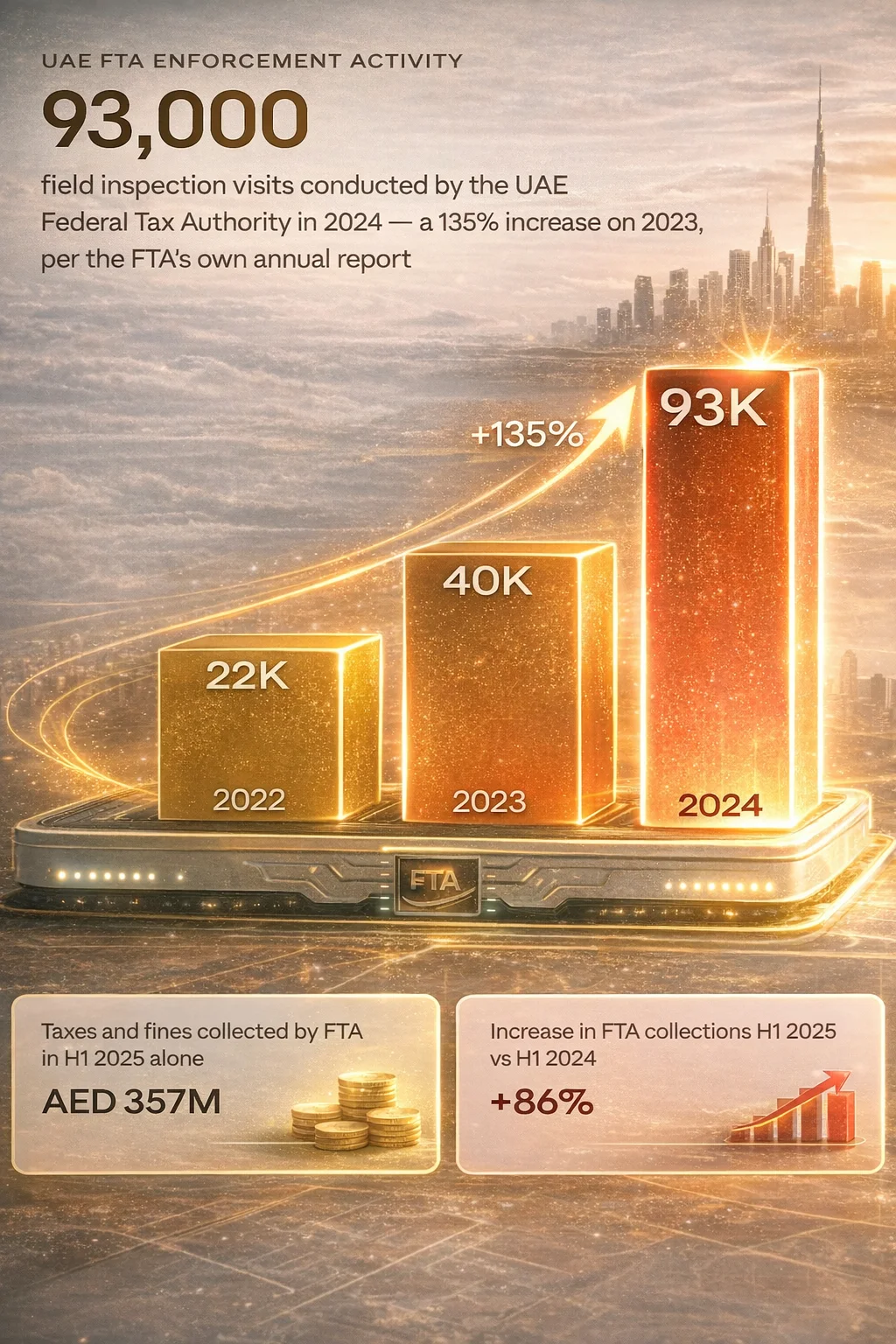
Founders who choose structured, digital-first ecosystems like Meydan Free Zone often avoid this friction early, because compliance touchpoints are built into the setup itself, not bolted on later. This guide breaks down what non-compliance in the UAE actually looks like, the penalties it triggers, and how to stay operationally calm as you scale with Meydan Free Zone.
Understanding Non-Compliance in the UAE
Non-compliance in the UAE happens when a business or individual fails to meet regulatory, tax, licensing, or immigration obligations set by UAE authorities.
Non-compliance commonly happens across:
- Corporate tax and VAT registration, filing, and reporting
- Trade license renewals and misaligned business activities
- Ultimate Beneficial Owner (UBO) declarations
- Anti-Money Laundering (AML) policy and reporting requirements
- Visa, Emirates ID, and immigration validity timelines
- Financial record bookkeeping (for a minimum of five years)
- Employment law violations and data breach protection
Although governed by different authorities, these areas are operationally linked. Non-compliance in one often surfaces through another.
| Area | Governing Authority | Key Penalty |
|---|---|---|
| Corporate Tax & VAT | Federal Tax Authority (FTA) | AED 10,000 late registration; AED 500/month late filing |
| Trade License | Meydan Free Zone / DED | AED 250–500/month late renewal; possible suspension |
| UBO Declaration | Ministry of Economy | Up to AED 100,000; license cancellation risk |
| AML Compliance | CBUAE / Ministry of Economy | AED 50,000–AED 5 million; license revocation |
| Visa & Immigration | GDRFA / ICP | AED 50/day overstay; AED 10,000+ for serious violations |
Final Thoughts
In the UAE, compliance isn’t about avoiding fines. It’s about protecting access.
Access to banking. Access to visas. Access to renewals, payments, and uninterrupted operations. And for founders, lost momentum is often more costly than any penalty.
The good news? The UAE’s compliance framework is designed to be predictable once you understand it. That’s why founders building through digital-first ecosystems like Meydan Free Zone can rely on mPlus, where accounting, tax readiness, UBO, AML, and visa processes are supported from the moment the company is set up, so compliance is baked in, not chased later.
If staying bankable, renewal-ready, and operationally calm matters to you, setting up with Meydan Free Zone is the smartest place to start.
Start Your UAE Company Remotely
Get in Touch NowCitations
¹ ADEPTS / Tax Adepts. UAE’s Stringent AML Enforcement: Analyzing Over AED 380M Fines in First Half of 2025. Tax Adepts, 2025.
² The National / UAE Ministry of Economy. UAE Imposes $11.4m in Fines During First Half of 2025 on Money Laundering Offenders. The National, July 2025.