
Table of Contents
Frequently Asked Questions
1. Is ISO certification mandatory in the UAE?
Not everywhere. But most government tenders and large procurement frameworks ask for it. It works as a pre-qualification for suppliers.
2. What is Dubai Municipality accreditation used for?
It covers product registration, food safety, cleaning approvals, and cosmetics clearance. These are local rules for consumer-facing businesses in Dubai.
3. Can a business hold both ISO and local accreditation?
Yes. Many UAE businesses hold ISO 9001 or ISO 14001 alongside local ones. Examples are Dubai Chamber export certificates or Dubai Municipality product approvals.
4. What is the difference between ISO 9001 and Dubai Chamber certification?
ISO 9001 is a global quality standard, checked through audits. Dubai Chamber certification confirms trade activity and export documents for the region.
5. Do I need ISO certification to operate in Meydan Free Zone?
It is not required for licensing. But it is strongly recommended for government contracts or international clients. Some regulated industries treat it as a requirement.
6. What happens if I don't get the right local accreditation?
You may face fines, license issues, or delays in approval and trade. Some government portals will not list your business without it.
7. How does Meydan Free Zone support certification and accreditation?
We help with activity selection, document processing, and government approvals. We also connect you with authorised ISO certification bodies.
Topic Summary
1. Scope and Recognition
ISO certification is an internationally recognised standard that demonstrates a company’s adherence to global best practices in quality management, environmental management, or other specific systems. In contrast, local business accreditation in Dubai is primarily recognised within the UAE and often focuses on compliance with regional regulations and market-specific criteria.
2. Certification Authorities
ISO certifications are granted by independent certification bodies accredited by international organisations such as the International Accreditation Forum (IAF). Local business accreditations, on the other hand, are typically issued by Dubai government entities such as the Dubai Chamber of Commerce or Dubai Economic Department, ensuring adherence to local business laws.
3. Process Complexity and Duration
Achieving ISO certification generally involves a comprehensive audit process, documentation review, and continuous improvement over time, which can extend over several months. Local business accreditation in Dubai usually entails meeting regulatory requirements and proof of compliance, often completed within a shorter timeframe.
4. Purpose and Benefits
ISO certification aims to elevate organisational processes to meet international standards, enhancing customer confidence and facilitating global trade. Local business accreditation supports companies in demonstrating legitimacy within Dubai’s market, improving access to local resources, and fostering trust among regional clients and partners.
5. Validity and Renewal
ISO certifications require periodic surveillance audits and re-certification every three years to maintain validity and ensure ongoing compliance. Local business accreditation in Dubai may have varying renewal periods depending on the issuing authority, often aligned with licence renewals or regulatory updates specific to the emirate’s business environment.
Compare ISO Certification and Local Business Accreditation in Dubai, UAE
When you set up a business in Dubai, you need to show quality and compliance. It builds trust with clients, government bodies, and international partners. Per the UAE Ministry of Economy via Gulf News¹, about 250,000 new companies were registered in 2025. That took the national total past 1.4 million.
In a market that busy, standing out matters. Per Global Growth Insights², 48 percent of UAE government contracts now ask for recognised certifications. ISO certification rates across the GCC grew 18 percent between 2023 and 2025.
There are two main routes to show this. One is ISO certification. The other is local business accreditation in Dubai. Both act as quality markers. But they differ in scope, recognition, and use.
At Meydan Free Zone, we help you find and obtain the right certifications for your business.
Understanding ISO Certification in Dubai
ISO certification in Dubai means globally recognised standards. They are set by the International Organisation for Standardisation.
These certifications confirm one thing. Your processes, systems, or products meet global benchmarks.
The most common ISO certifications in the UAE are:
- ISO 9001: Quality management. The most widely used standard across all industries.
- ISO 14001: Environmental management. Now often required for government and infrastructure contracts.
- ISO 45001: Health and safety. Key for construction, logistics, and facilities management.
- ISO 27001: Information security. Vital for technology, fintech, and data businesses.
These matter for companies in trade, tenders, or regulated industries. That includes healthcare, construction, manufacturing, logistics, and IT.
Certification comes through authorised bodies. It involves an audit, documents, staff training, and regular renewals.
What ISO Certification Actually Does for the Business
The data behind ISO 9001 is striking. Certified firms report real gains in sales, customer satisfaction, and retention.
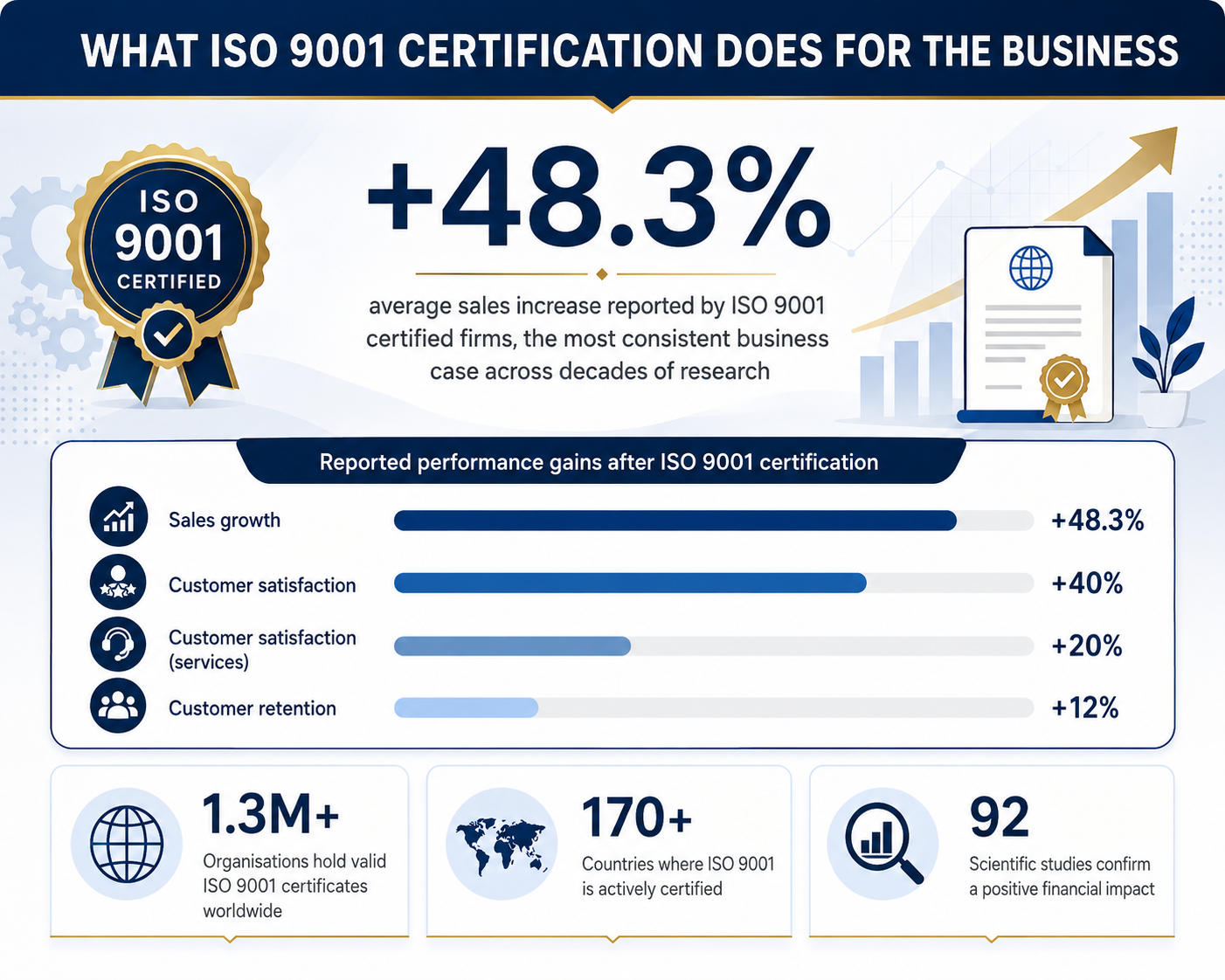
Source: ISO Survey 2024 and meta-analyses of ISO 9001 financial impact studies, via QMS UK
Overview of Local Business Accreditation in Dubai
Local business accreditation means UAE government approvals. Government bodies or sector authorities require or recognise them.
Some of the most common local accreditations are:
- Dubai Chamber of Commerce certification: Required for exporters. Recognised as proof of trade legitimacy in procurement.
- Dubai Municipality accreditation: Essential for food safety, cosmetics, cleaning services, or product registration.
- Emirates Authority for Standardisation and Metrology (ESMA): Covers consumer products, industrial equipment, and quality checks.
- Ministry of Health and Prevention (MOHAP): Required for medical, pharmaceutical, or wellness product approvals.
- Civil Defence approval: Needed for fire safety, construction, and building management.
These confirm you meet Dubai-specific rules, not global ISO standards.
They are essential for local businesses. This is especially true if you deal with residents, consumers, or infrastructure projects.
Key Differences Between ISO and Local Accreditations
The core differences come down to scope, authority, and where each one counts:
The two can work together. It depends on the sector. A food trading company is a good example. It might need ISO 22000 for food safety. It might also need Dubai Municipality accreditation for product approval.
Which Certification Path Is Right for Your Business?
The right choice depends on two things. Where your clients are. And how your industry is regulated.
[blockFaqsCategory]
[blockCTABizActivityList]
How Meydan Free Zone Helps with Certification and Accreditation
The right certifications start with the right business activity. Meydan Free Zone supports you from licensing to accreditation.
- Activity selection guidance: Your activity decides which certifications apply. We help you pick from over 2,500 activities with the rules in mind.
- Local accreditation support: Guidance on Dubai Chamber, Dubai Municipality, and other approvals for your sector.
- ISO certification sourcing: Help connecting with authorised ISO bodies. Your certificate then holds up in tenders and contracts.
- Document processing: Support with document prep, translation, and submission.
- Meydan Plus integration: Access to mAccounting for tax and compliance. Plus wider support through Meydan Plus.
[blockCTAContact]
Footnotes
¹ UAE Ministry of Economy, via Gulf News, "How UAE free zone businesses can operate in the mainland — New laws explained," January 2026.
² Global Growth Insights, "Certification Market Forecast and Insights Report 2026-2035," February 2026.