

Table of Contents
Frequently Asked Questions
Can i start my own business in the UAE as a foreigner?
Yes. The UAE allows foreign nationals to start and fully own businesses, either through free zone company registration or mainland company registration, depending on the business activity and structure.
What is the difference between free zone and mainland company registration?
A free zone company is registered under a specific free zone authority, while a mainland company is licensed through an Emirate’s economic authority. The two structures differ in operating frameworks, compliance requirements, and administrative processes.
Is 100% foreign ownership allowed in both free zone and mainland companies?
Yes. Free zones have long allowed 100% foreign ownership, and many mainland business activities now also permit full foreign ownership under UAE company law, depending on the activity.
Which option is better for someone starting a business for the first time?
There is no single “better” option. First-time founders often choose based on how certain they are about their business model, how quickly they want to start, and how much administrative complexity they want early on.
Do free zone and mainland companies follow the same tax rules?
All companies in the UAE fall under the same corporate tax and VAT framework. How tax applies depends on the company’s structure, activities, and whether specific conditions are met.
How do I decide which business structure is right for me?
The best way to decide is to consider your business activity, target market, growth plans, and how much operational flexibility you want in the first year. Comparing both options based on real operating needs usually makes the decision clearer.
Topic Summary
1. Business Scope and Market Access
Mainland companies can trade directly across the UAE market and engage with government contracts, whereas Free Zone companies primarily operate within their designated zones with export-focused or limited mainland trading capabilities.
2. Ownership and Shareholding
Mainland company formation typically requires a UAE national partner holding at least 51% of shares for certain business activities, while Free Zone companies allow 100% foreign ownership without the need for a local sponsor.
3. Office and Physical Presence Requirements
Free Zone companies must lease office space within the respective Free Zone, which often includes flexible desk solutions; mainland businesses are required to have a registered office in the Emirate of registration, meeting specified space and location criteria.
4. Visa and Employment Regulations
Both mainland and Free Zone companies sponsor visas, but mainland companies are subject to broader labor laws with more stringent quotas and employee requirements, whereas Free Zones offer streamlined visa issuance tailored to business size and zone regulations.
5. Regulatory Compliance and Renewals
Mainland companies deal with federal regulatory authorities, involving more complex renewal and auditing processes; Free Zone companies benefit from simplified registration and renewal procedures managed within the zone authority, often with fewer compliance obligations.
I Want To Start My Own Business In The UAE - Should I Choose Free Zone Company Registration Or Mainland?
If you’re saying, “I want to start my own business in the UAE,” you’re probably not stuck on motivation. You’re stuck on structure.
Because the UAE gives you more than one way to register a company, and the choice you make changes how you operate day-to-day: where you can trade, what you’ll need for compliance, how you handle visas, and how predictable your renewal and admin cycles feel.
According to Gulf News¹ reporting on the UAE Ministry of Economy and Tourism's amendments to the Commercial Companies Law, companies can now transfer their registration between emirates and free zones without liquidation, removing one of the biggest structural barriers for founders deciding between free zone and mainland setups.
Should you register in a free zone or on the mainland? What does that choice actually change once the business is live? And which option gives you the most flexibility when you’re still figuring things out?
For first-time founders especially, the free zone vs mainland question often gets reduced to surface-level differences. In reality, the decision shapes how your business operates day to day - how predictable compliance feels, how much admin you carry, and how easy it is to stay focused on building rather than managing processes.
This article breaks down the difference using official UAE rules, real operating considerations, and the questions founders tend to ask after the business license is issued - not just before.
Free Zone Vs Mainland In The UAE: The Core Difference
In plain terms:
- Free zone: your company is registered within a specific free zone authority and operates under that free zone’s framework.
- Mainland: your company is licensed through the Emirate’s economic authority (for Dubai, that’s Dubai’s Department of Economy & Tourism, DET) and follows mainland licensing requirements.
Both are legitimate. Both can work. The decision comes down to what you need the company to do in year one - and how much administrative weight you want to carry while you’re building.
Free zones do far more than offer faster setup, they carry a major share of UAE exports and economic activity.
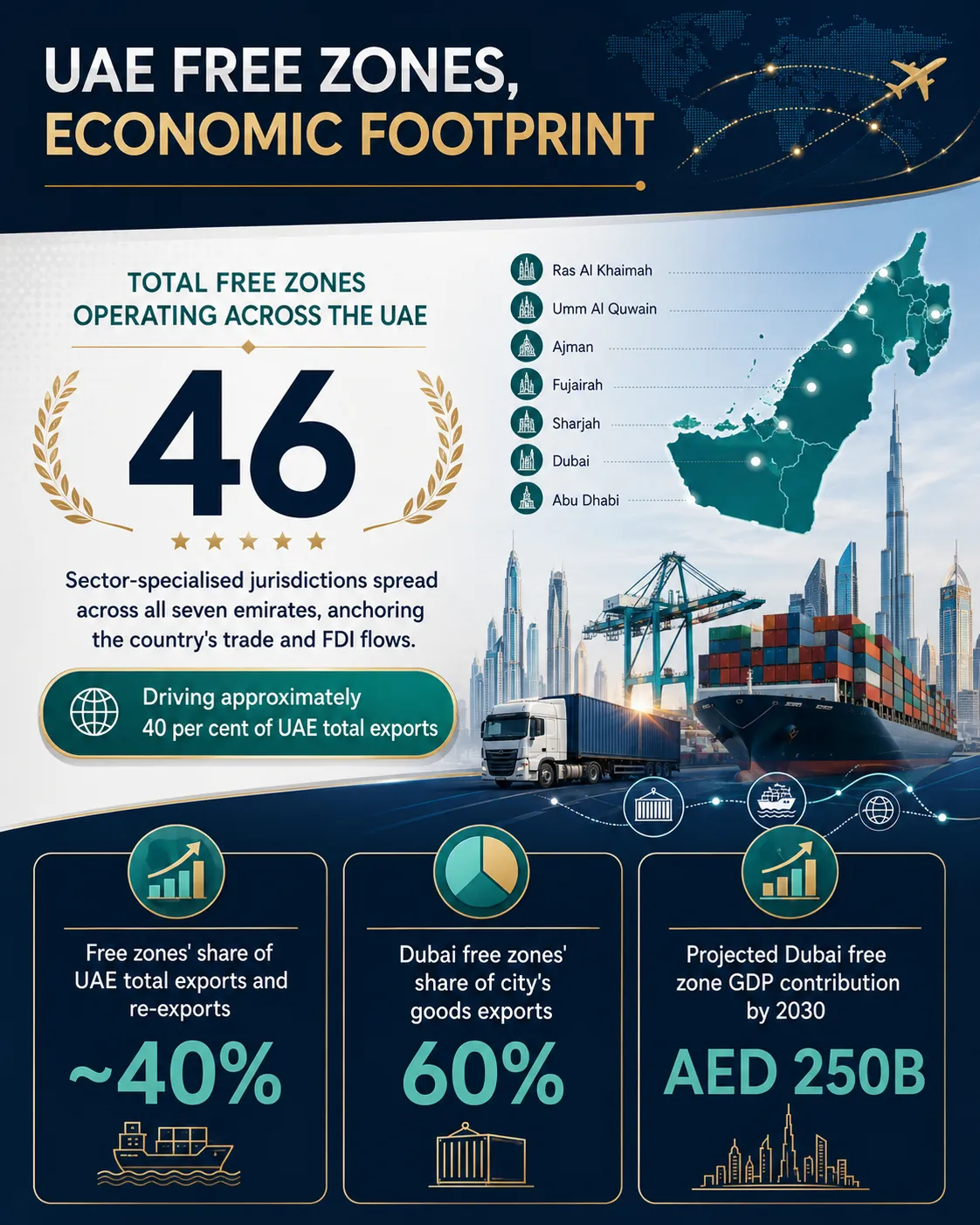
Source: UAE Embassy in Washington DC, citing UAE government export and free zone economic data.
Ownership: Can You Own 100% In Free Zone And Mainland?
Free zones have long been designed around 100% foreign ownership.
For mainland, the UAE has also expanded full foreign ownership for many activities. The UAE government’s official portal notes that foreigners can establish companies with 100% ownership based on changes to the Commercial Companies Law framework.
So the question isn’t only “can I own it?”
It’s “how do the operating conditions differ once I own it?”
Where You Can Trade: What Founders Often Miss
This is the real fork in the road. Match your business model to the right structure:
This is why most founders who want to start lean (and scale later) choose a free zone first, then expand operations as needed.
The same route works for everyday trading ideas, so a clothing trading license in Dubai is another activity founders commonly set up in a free zone before scaling.
Office And Address Requirements: The Practical Difference In Year One
One of the most common cost and stress drivers for new founders is the address/lease requirement.
The UAE Ministry of Economy states that companies must have an actual address for the economic activity and that a lease contract must be provided; in Dubai, the lease contract must be registered through Ejari. Dubai’s own business setup services for issuing a trade license also reference requirements like a site lease contract for a “normal license.”
That’s not “bad.” It’s just a reality: physical address expectations can add cost and admin earlier than many founders expect.
Free zones often give founders more flexible ways to meet operational requirements (especially for service and digital businesses), which is why they’re usually the cleaner starting point when you want to move quickly without building overhead too early.
Corporate Tax: What Changes, What Doesn’t
UAE Corporate Tax applies across the board, but the way it applies can differ depending on structure and qualification.
The UAE's Ministry of Finance corporate tax law (Federal Decree-Law No. 47 of 2022) specifies that a Qualifying Free Zone Person can be subject to:
- 0% on Qualifying Income
- 9% on non-qualifying taxable income
The Federal Tax Authority's guidance on Free Zone Persons explains how the regime works in practice and points to the relevant decisions that define qualifying income and conditions.
So, for founders, the headline isn't "free zones pay no tax." The real point: qualifying free zones such as Meydan Free Zone can provide a structured pathway to 0% on qualifying income, if you meet the conditions.
That's one of the biggest reasons founders who are building internationally-minded businesses often start in a free zone.
VAT: The Threshold Every Founder Should Know
VAT is not a free zone vs mainland debate - it’s a business activity and revenue reality.
The Federal Tax Authority states that VAT registration becomes mandatory when taxable supplies and imports exceed AED 375,000, and voluntary registration may be available at lower levels.
The “founder takeaway” here: whichever route you choose, you’ll eventually need clean bookkeeping if you scale. VAT readiness rewards businesses that don’t treat accounting as an afterthought.
Which One Fits A First-Year Founder?
Here’s the decision logic that tends to hold up in real life:
[blockFaqsCategory]
So, What Should You Choose If You’re Still Deciding?
If you’re early-stage, building something service-led, digital, trade-focused, or internationally oriented - and you want to start without unnecessary overhead - free zone company registration is usually the smarter first move.
Not because mainland is “bad” but because free zones are often simply designed for founders who want clarity and speed while they build.
And if you’re choosing a free zone, Meydan Free Zone is positioned exactly for that kind of founder: digital-first, fast setup, and structured support around the realities that come immediately after registration.
Citations
¹ Gulf News, "How UAE free zone businesses can operate in the mainland - New laws explained," 8 January 2026.