Table of Contents
Frequently Asked Questions
Is basmati rice demand in the UAE seasonal or year-round?
Basmati rice demand in the UAE is year-round. It is driven by daily household consumption, restaurants, hotels, and catering businesses, rather than seasonal or festival-based demand.
Which country is the largest supplier of rice to the UAE?
India is the largest supplier of rice to the UAE by both volume and value, accounting for a majority of the country’s total rice imports, followed by Pakistan, Vietnam, and Thailand.
What is the difference between basmati and non-basmati rice demand in the UAE?
Basmati rice demand in the UAE is driven by quality, ageing, and brand trust, while non-basmati rice demand is driven by price, volume, and supply consistency, particularly for institutional buyers.
Why do Indian rice traders set up businesses in Dubai instead of only exporting?
Indian rice traders often set up businesses in Dubai to invoice locally, manage warehousing, build direct buyer relationships, and improve operational control compared to agent-led exports.
Is the UAE a good base for regional rice distribution?
Yes. Dubai functions as a regional trade and logistics hub, allowing rice imported into the UAE to be distributed locally or re-exported to Africa and neighbouring GCC markets.
What type of business license is needed to trade rice in Dubai?
To trade rice in Dubai, a company requires a trade license that covers food or agricultural commodity trading, along with compliance with UAE food import regulations and local authority requirements.
Topic Summary
1. Consistent Consumption Patterns
The UAE exhibits steady demand for both basmati and non-basmati rice year-round, unaffected by seasonal harvest fluctuations common in India.
2. Significant Import Volumes
Indian rice varieties rank among the top imports in the UAE, reflecting substantial and sustained consumption driven by diverse expatriate communities.
3. Predictability of Market Demand
Unlike many export destinations, the UAE market offers reliable demand forecasts, facilitating streamlined supply chain planning for Indian rice exporters.
4. Diverse Consumer Preferences
The UAE market accommodates wide-ranging preferences, with basmati rice favored for premium and festive use, while non-basmati varieties serve daily staple needs.
5. Strategic Supply Chain Integration
Indian rice suppliers view the UAE as integral to their distribution networks, not merely an export opportunity, ensuring continuous market engagement and operational presence.
Demand For Basmati And Non-Basmati Rice In UAE: Market Overview
If you trade rice in India, the UAE isn’t an “export opportunity”, it’s already part of your supply map, whether you’re active there or not. Indian basmati and non-basmati rice are consumed in the UAE every single day, at volumes that don’t fluctuate with harvest seasons or domestic crop cycles the way they do back home.
UN Comtrade data via the World Bank's WITS¹ shows India exported 598 million kilograms of rice to the UAE in 2024, worth USD 487.88 million. With no domestic rice production, the UAE's import dependence isn't cyclical, it's structural.
What makes the UAE different from other export destinations is predictability. Demand is stable, cash cycles are faster, and pricing is less volatile than in many African or South-East Asian markets. Basmati moves on quality, ageing, and brand trust. Non-basmati moves on consistency, logistics, and volume discipline. Both move year-round.
If you’ve dealt with price swings, state-level movement restrictions, export notifications, or last-minute policy changes in India, the UAE market feels refreshingly rules-driven. The country doesn’t grow rice, creating a market where reliable suppliers win shelf space, contracts, and repeat buyers.
The UAE is the Middle East's biggest buyer of basmati rice - and the market is growing fast. Here's the scale of demand Indian exporters are tapping into.
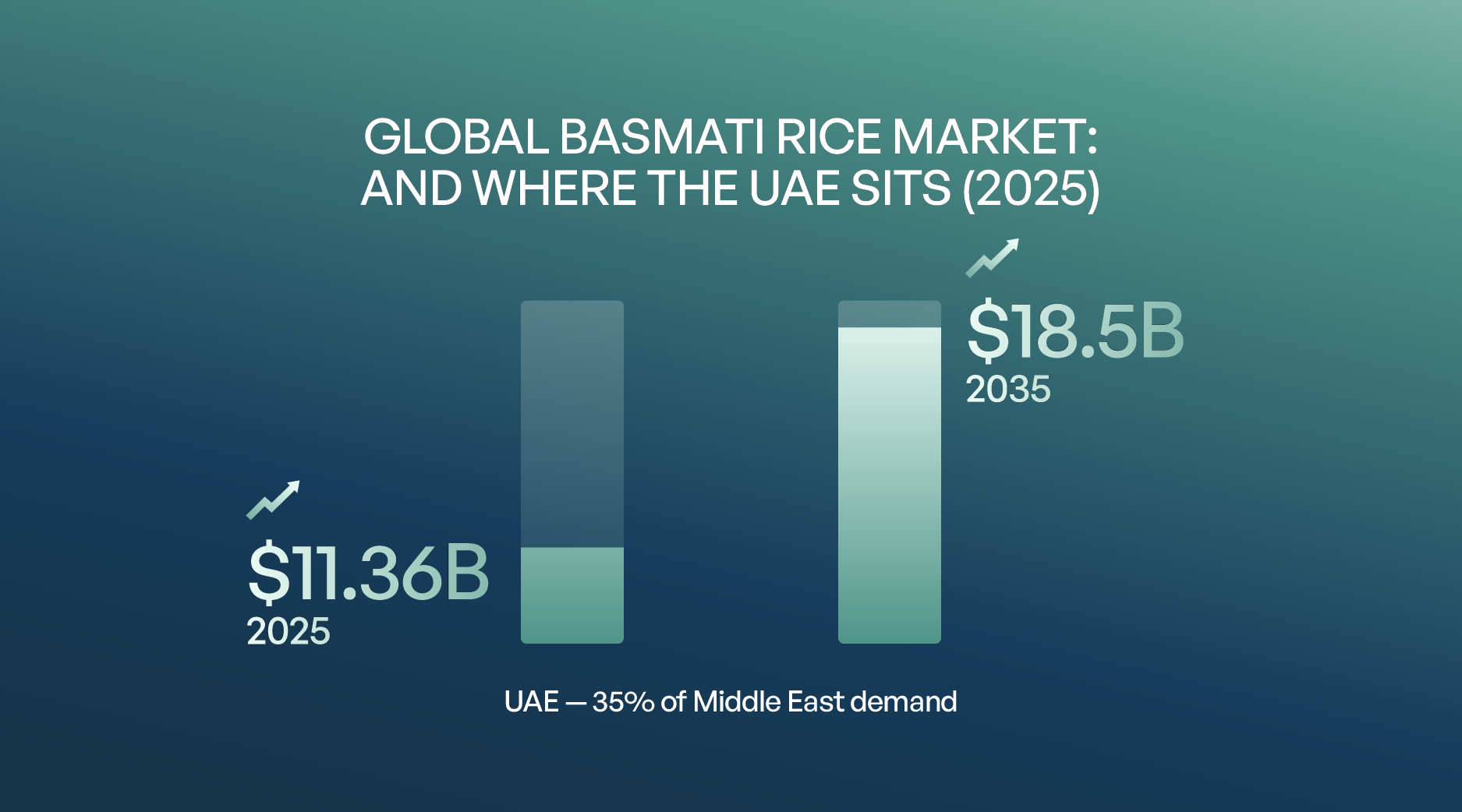
Data sourced from Expert Market Research Global Basmati Rice Market Report (2025) and Market Research Future (2025).
This overview breaks down how basmati and non-basmati rice demand actually behaves in the UAE, where the margins sit, and what Indian exporters need to understand before treating Dubai as more than just another shipment destination.
[blockCTABizSetupRemotely]
Why Rice Demand in the UAE Behaves Differently From India
The most important structural difference is agricultural. The UAE has no domestic rice production. Climatic and water constraints make local cultivation unviable, so the country relies almost entirely on imports for supply.
Trade data makes this dependence clear. UN Comtrade data via the World Bank's WITS¹ shows India's rice exports to the UAE growing steadily from 456 million kg in 2022 to 552 million kg in 2023, reaching 598 million kg in 2024, the largest rice trade flow by volume into the UAE from any single country.
Unlike India, where supply shocks can originate from weather, procurement policy, or export controls, UAE demand is anchored in consumption - households, restaurants, hotels, and catering operations that function continuously.
What “Basmati vs Non-Basmati” Actually Means in the UAE Market
In India, the distinction between basmati and non-basmati is often framed around price realisation and export margins. In the UAE, the distinction is more operational.
[blockFaqsCategory]
A Practical Comparison for Rice Traders
This distinction matters because many Indian exporters fail in the UAE by treating both segments the same way.
Why Indian Rice Traders Set Up Operations in Dubai
Most Indian rice businesses begin with exports routed through agents or distributors. That model works initially. But as volumes increase, its limitations show.
UAE buyers - especially retail chains and Horeca groups - prefer dealing with locally established trading entities. Local invoicing, warehousing, and faster response times reduce friction for both sides.
Dubai also functions as a regional redistribution hub, with rice moving onward to Africa and neighbouring GCC markets.
For traders thinking beyond one or two buyers, operating from Dubai rather than shipping into it becomes a strategic shift.
Why Business Structure Matters in the UAE Rice Trade
At this stage, most founders are no longer asking whether demand exists. They are asking:
- what does it cost to set up properly?
- how fast can operations begin?
- will banks and buyers take the entity seriously?
This is where business structure becomes decisive.
Rice trading is a regulated activity. Importing, storing, and reselling food products requires:
- clear activity classification on the business license
- banking readiness for trade flows
- documentation that stands up to buyer and regulatory scrutiny
[blockCTABizActivityList]
This is why many Indian traders choose a Free Zone structure when establishing in Dubai. It allows international trading activity, local operations, and cleaner separation from the India entity.
A digital-first free zone such as Meydan Free Zone fits naturally into this picture. It supports trading activities, enables fully digital company formation, and allows founders to model costs clearly upfront - including trade license fees, visas, and operating setup - through tools like the Setup Cost Calculator.
[blockCTACostCalculator]
For founders used to navigating GST registrations, TDS compliance, and RBI reporting, this kind of structural clarity is not a luxury; it is operational comfort.
Conclusion: Choosing Execution Over Speculation
Basmati rice demand in the UAE is strong because it is culturally embedded and quality-driven. Non-basmati rice anchors everyday consumption through institutions and mass buyers. The entire market is import-dependent, rules-based, and structurally predictable.
For Indian rice traders, the real decision is no longer whether the UAE is worth supplying. It is whether to treat it as a shipment destination or a business base.
Those who invest in the right structure - with clear licensing, banking readiness, and operational flexibility - are the ones who build repeatable, scalable businesses here. That is where a free zone setup, and tools that make costs and timelines transparent from day one, stop being administrative details and start becoming commercial advantages.
[blockCTATradeLicense]
Planning to set up your business in Dubai? Explore our comprehensive guide on On Demand Labors Supply Temporary Employment License in Dubai, covering licensing requirements, costs, approvals, and the step-by-step business setup process.
Citations
¹ UN Comtrade data via World Bank, "India Rice Exports to UAE 2024: World Integrated Trade Solution (WITS)," 2024.
² IMARC Group, "GCC Basmati Rice Market," 2024.
³ Volza, "Basmati and Non-Basmati Rice Import Data to United Arab Emirates," 2024.