
Table of Contents
Frequently Asked Questions
1. Why do Indian startups register in Dubai?
Indian startups register in Dubai to access global markets faster, reduce compliance friction, simplify international payments, improve investor perception, and secure founder residency. The business environment is significantly more predictable compared to India.
2. Is Dubai a good place for Indian startups to scale globally?
Yes. Dubai offers strategic location, global talent, simpler regulations, strong banking infrastructure, and credibility with international clients. It’s especially effective when combined with India-based development teams.
3. Can Indian founders live in Dubai if their company is registered there?
Yes. A free zone company, such as one registered in Meydan Free Zone, can sponsor investor visas and dependent visas. This gives founders long-term residency and mobility.
4. Does a Dubai company help with fundraising?
Often yes. Many international investors prefer dealing with entities based in Dubai because of predictable compliance, clear structures, and global-friendly corporate frameworks.
5. Do Indian startups still keep teams in India after registering in Dubai?
Absolutely. Most Indian startups maintain product and engineering teams in India while using Dubai as their global HQ for contracts, billing, sales, and investor relations.
Topic Summary
1. Streamlined Company Formation
Dubai offers a quick and efficient company registration process, often completed within a few days. This allows startups to rapidly establish a formal presence and access global markets without lengthy bureaucratic delays.
2. Access to International Banking and Payment Systems
Dubai’s robust, internationally connected banking infrastructure enables startups to manage global payments smoothly. This helps Indian founders avoid common payment gateway restrictions experienced when operating solely from India.
3. Favorable Tax Regime
With zero personal income tax and corporate taxes limited to specific sectors, Dubai offers a tax-friendly environment. This increases startup profitability and frees up capital for reinvestment and scaling activities.
4. Attracting and Retaining Talent
Dubai’s liberal visa policies and cosmopolitan lifestyle make it an attractive destination for global talent. Startups can more easily recruit skilled professionals, crucial for rapid growth and innovation.
5. Regulatory Clarity and Stability
Dubai provides clear regulatory frameworks and political stability, reducing compliance risks. Startups benefit from transparent laws governing intellectual property, data protection, and business operations, fostering investor confidence and smoother expansion.
How Indian Startups Can Scale Faster By Registering In Dubai
For Indian startup founders, speed has always been the difference between winning and becoming invisible. You can build a brilliant product in Bengaluru or Gurgaon - but if compliance delays, global payment restrictions, talent issues, or regulatory friction slow you down, you lose momentum.
Per Dubai Chamber of Commerce¹, 9,038 new Indian companies joined the chamber in H1 2025 alone, reflecting 14.9% year-on-year growth and confirming Indian founders as the largest foreign business community in Dubai. Per Dubai Founders HQ², Dubai's startup ecosystem is now valued at over USD 51 billion, with more than 2,000 funded startups and 90+ incubators and accelerators across the city.
Indian founders aren't choosing Dubai because India isn't a great place to build products. They're choosing Dubai because India can be a difficult place to scale, especially if your customers or investors are outside the country, or you're handling global transactions.
Dubai, particularly through its free zones such as Meydan Free Zone, gives Indian startups a faster path to scale: simpler compliance, global credibility, easier payment flows, residency stability, and a business environment designed for growth, not obstruction.
If you’re already considering it, you can book a business setup consultation with Meydan Free Zone while you read.
Before the qualitative case, the credentials: Dubai sits second in the MENA region's startup rankings and scores a perfect ten on early-stage funding in the world's most-cited startup ecosystem report.
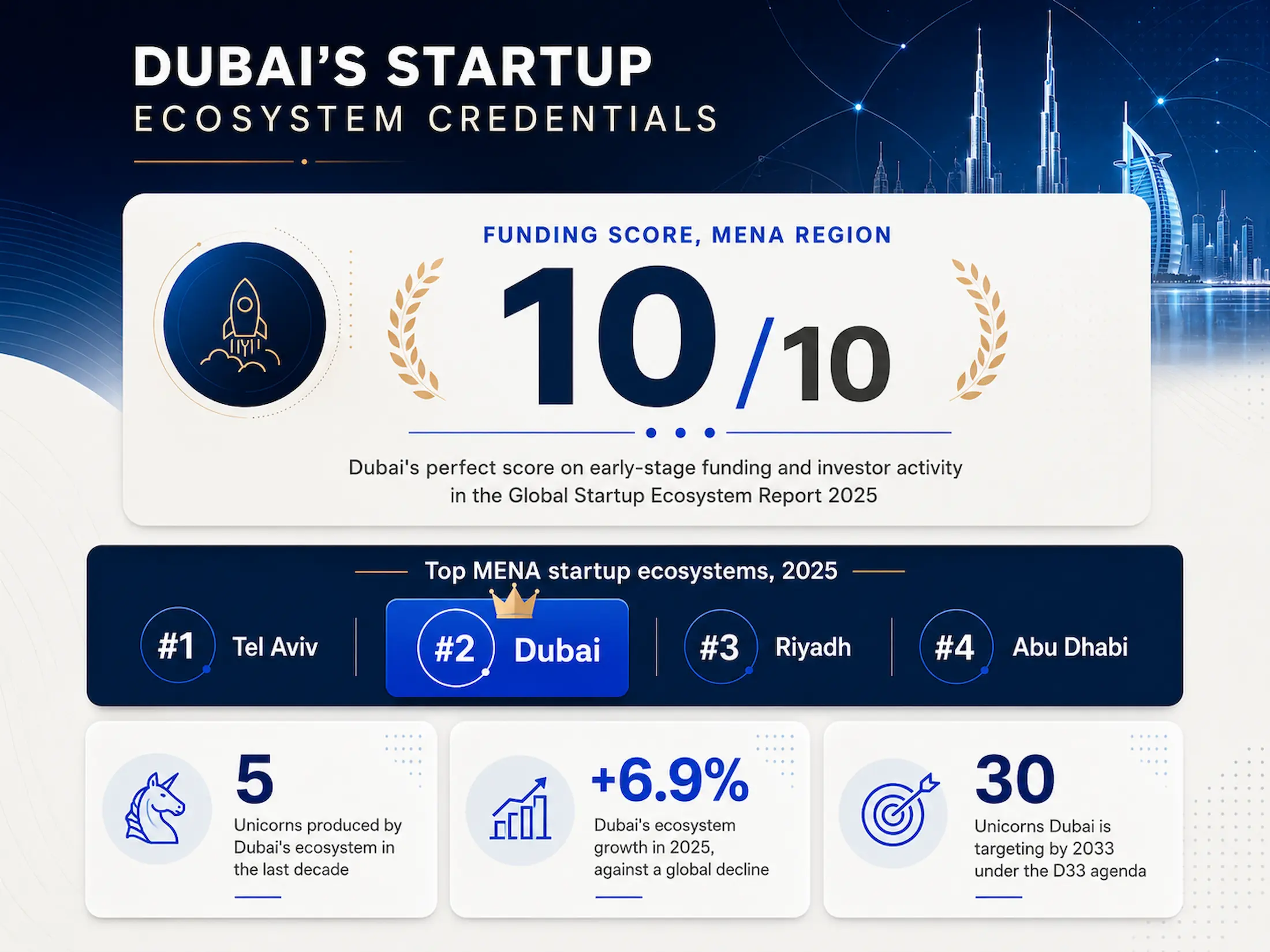
Source: Startup Genome Global Startup Ecosystem Report 2025 and StartupBlink Global Startup Ecosystem Index, via Startup Genome
Why Indian Startups Are Looking Beyond India for Scale
Indian startup founders aren’t leaving because the ecosystem is weak. They’re leaving because the ecosystem can’t keep up with their speed.
Here are the realities Indian founders quietly discuss, but rarely put in public:
[blockFaqsCategory]
This is why Indian startups increasingly structure their international operations out of Dubai, while keeping development teams in India.
[blockCTABizSetupRemotely]
Why Dubai Helps Indian Startups Scale Faster
Dubai’s startup environment is deliberately engineered: less friction, more clarity, and global optics that help you move fast.
Here’s how Dubai fixes the exact pain points you struggle with, as an Indian founder:
1. Compliance Becomes Predictable, Not a Distraction
Dubai operates on low-frequency, high-clarity compliance.
There is no equivalent of:
- GST
- TDS
- Advance tax
- Constant audits
- Inspector Raj
Founders get to focus on product, not paperwork.
A free zone such as Meydan Free Zone is especially attractive for Indian founders because it operates digitally, with:
- online company registration
- online license renewals
- centralised communication
- fewer in-person visits
- minimal document chasing
The contrast with Indian compliance fatigue is huge — and founders feel it immediately.
[blockCTATradeLicense]
2. Receiving Global Payments Is Far Simpler
One of the biggest advantages for Indian startups is: Dubai removes cross-border payment bottlenecks.
With a Dubai free zone company:
- You can invoice clients in USD, GBP, EUR, AED.
- Banks recognise your entity without complicated FEMA steps.
- Payments settle faster.
- Clients perceive your business as “international” by default.
This alone can speed up working capital cycles for Indian founders.
Banking still requires proper KYC and documentation, but a well-regarded Dubai free zone such as Meydan Free Zone is familiar to UAE banks, which removes unnecessary friction from day one and gives you a guaranteed IBAN.
3. Better Global Credibility in Contracts and Investor Due Diligence
International clients sometimes hesitate to sign contracts with Indian entities due to:
- outdated perceptions
- compliance fears
- data protection concerns
- lengthy paperwork
A Dubai-registered company solves this instantly.
Even global investors - especially those in the Gulf, Europe, and Southeast Asia - often find Dubai entities easier to work with.
For Indian founders courting international capital, this boost in perception can translate into faster fundraising cycles.
4. Founder Residency = Stability, Mobility, and Peace of Mind
Indian startups don’t talk about this enough:
Having the founder based in Dubai is often a superpower.
A Dubai free zone like Meydan Free Zone provides a pathway to:
- a founder/investor visa
- residency for spouse and children
- long-term stability
- easy international travel
- quick access to GCC and Africa markets
More importantly, it removes the India-based anxiety of:
- unpredictable tax notices
- bank freezes
- compliance knocks
- constant paperwork
With Meydan Free Zone, this process flows through the mResidency digital visa service, which removes the typical fragmentation Indian founders dislike.
5. Dubai’s Location Is Incredibly Strategic for Indian Startups
Indian founders tend to scale in three directions:
- Middle East (GCC)
- Europe
- Africa
Dubai sits at the intersection of all three, with:
- easier travel
- fewer visa restrictions
- proximity to clients
- cultural alignment
- strong presence of global HQs
For startups selling to GCC governments or enterprises, having a Dubai entity is almost a requirement.
6. Talent Becomes Borderless
Dubai’s talent market offers:
- multicultural teams
- regional experience
- flexible hiring
- freelancer availability
- straightforward visas
- access to specialised talent not easily found in India
If the founder is based in Dubai and the product team remains in India, the model works beautifully.
7. Indian Startups Can Scale Globally Without Leaving India Behind
A Dubai entity doesn’t replace your India operations.
It becomes your growth engine, while India remains your development hub.
The hybrid model looks like this:
- India → engineering, product, operations
- Dubai → HQ, invoicing, global business, investor relations, founder residency
This structure is becoming increasingly common across Indian SaaS, fintech, AI, consulting, and e-commerce.
Why Meydan Free Zone Works Especially Well for Indian Startups
Among all the Dubai options, Indian founders often gravitate to Meydan Free Zone for very practical reasons:
If you're weighing Dubai as your launchpad, you can explore more on the Meydan Free Zone business setup in Dubai page.
How Indian Startups Use Dubai to Scale Faster
Here’s how founders are actually using Dubai strategically:
[blockTabulatorBorder1]
So Should Your Indian Startup Register in Dubai to Scale Faster?
If your startup:
- earns globally,
- serves global clients,
- wants to look international,
- needs frictionless payments, or
- requires founder mobility,
Then yes - a Dubai free zone like Meydan Free Zone can significantly accelerate your scale journey.
If your model is physical, local, and India-only - then a Dubai entity may not be urgent.
But if your ambitions involve global clients, GCC enterprise customers, or international investment, Dubai isn’t just an option - it’s a force multiplier.
You can book a business setup consultation with Meydan Free Zone or speak to the team to map the right structure.
Citations
¹ Dubai Chamber of Commerce, "Indian businesses top list of nationalities of new companies joining Dubai Chamber of Commerce during H1 2025 with over 9,000 companies registered, reflecting 14.9% YoY growth," August 2025.
² Dubai Founders HQ, via Dubai Chamber of Digital Economy, "Dubai Founders HQ Launch: Dubai's Startup Ecosystem Valued at Over $51 Billion," November 2025.