

Table of Contents
Frequently Asked Questions
FAQs
1. How long does it take to set up a business in India?
Company incorporation in India typically takes 7–15 working days, but full operational readiness, including banking and GST registration, often takes 3–6 weeks.
2. How long does it take to set up a business in Dubai?
In Meydan Free Zone, a standard business license is issued within one working day. With the Fawri service, a license can be issued in under 60 minutes.
3. Is business setup in Dubai completely online?
Yes. Business licensing in Meydan Free Zone can be completed fully online without the founder being physically present in the UAE.
4. Is GST registration mandatory in India for new businesses?
GST registration is mandatory for most trading and services businesses in India and usually takes 7–20 working days to complete.
5. Is VAT registration mandatory in Dubai for all businesses?
VAT registration in Dubai is required only if a business meets the mandatory registration threshold or opts for voluntary registration; it typically takes around 20 business days.
6. Do Indian residents need UAE residency to set up a business in Dubai?
No. Indian residents can set up a business in Dubai remotely. UAE residency is optional and only required for certain operational or banking activities.
7. Which country offers more predictable business setup timelines?
Dubai offers more predictable timelines due to single-authority processing and overlapping setup steps, while India’s timelines are more elastic because approvals run sequentially.
Topic Summary
1. Name Approval Process
In India, business name approval through the Ministry of Corporate Affairs can extend beyond initial estimates due to duplications or need for clarifications. Conversely, Dubai’s Department of Economic Development aims for expedited name registration, often concluding within a few days when documentation is complete.
2. Document Verification and Clarifications
Indian regulatory bodies frequently require additional documentation or clarifications during company registration, contributing to unpredictable delays. Dubai’s streamlined processes and digitized platforms reduce repetitive inquiries, enabling faster verification cycles.
3. Bank Account Opening
Opening a business bank account in India may involve prolonged procedures, including multiple rounds of due diligence and compliance checks. Dubai banks are known for a more structured and faster onboarding process, particularly within free zones where banking relationships are integrated with licensing authorities.
4. Regulatory Review and Approvals
In India, registrations such as GST or import-export licenses can face lengthy review times without clear communication on status, causing planning challenges for founders. Dubai’s regulatory authorities typically provide transparent timelines and status updates, facilitating consistent progress tracking.
5. Overall Setup Duration and Buffer Times
Indian founders often build significant buffers into their setups to accommodate unpredictable delays inherent in bureaucratic processes. In contrast, Dubai’s focused approach toward business facilitation offers more predictable timelines, enabling founders to plan closer to actual completion dates.
Timeline Comparison: Business Setup in India vs Dubai
Indian founders don’t plan businesses around best-case timelines. We plan around what usually slips.
A business name approval that takes longer than expected. A bank that asks for one more clarification. A registration that sits in review without a clear reason. None of this is exceptional. It’s familiar. Over time, founders learn to build buffer into calendars because the system quietly demands it.
Dubai approaches business setup from the opposite direction. It assumes time should be bounded, not elastic. Per the UAE Minister of Economy via Dubai.News¹, the UAE added 250,000 new companies in 2025, pushing total registered businesses past 1.4 million, with a target of 2 million by 2035. That scale only works because the goal isn't to make compliance lighter, but to make timelines predictable.
This is a timeline comparison of business setup in India vs Dubai, and looking at how long it takes to move from decision to execution.
Total time from "decide to incorporate" to "first invoice issued" runs roughly seven times shorter in Dubai than in India, and that gap is the real difference founders feel.
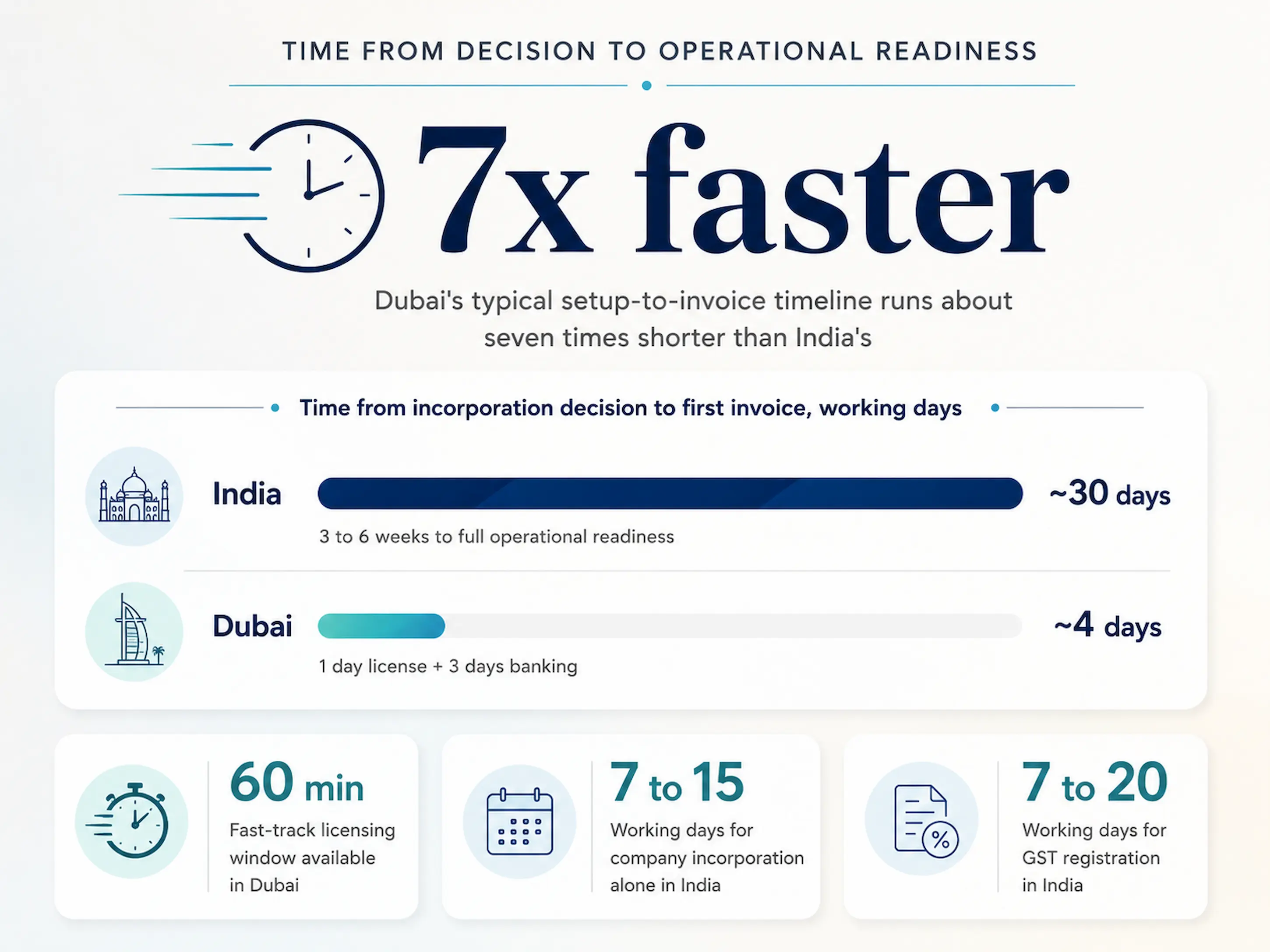
Source: India Ministry of Corporate Affairs (SPICe+ framework), Reserve Bank of India banking guidelines, and UAE business registration data, via RegisterKaro India
The India Setup Sequence
In India, company formation is governed by the Ministry of Corporate Affairs (MCA) through the SPICe+ framework. While filings are digital, the structure remains sequential.
- Obtain digital signatures: Directors secure digital signatures (DSCs).
- Submit company name for approval: Name is filed through the MCA's SPICe+ portal.
- File incorporation documents: Once the name clears, incorporation documents are filed.
- Receive PAN and TAN: Issued post-incorporation.
- Open bank account: Banking application only begins after incorporation.
- Register for GST: Runs on a separate track, often involving state-level verification.
When all documentation is in order and filed correctly through the Ministry of Corporate Affairs’ SPICe+ portal, the company incorporation process in India is typically completed within about 7–15 working days, depending on Registrar of Companies processing times and the absence of resubmission requests. That milestone is often mistaken for readiness. It isn’t.
In India, business bank account opening sits entirely outside the Ministry of Corporate Affairs and is governed by individual banks’ application of Know-Your-Customer (KYC) and due-diligence norms under Reserve Bank of India guidelines; as a result, founders should expect some procedural delays, with account activation frequently taking around one to three weeks depending on the bank’s internal processes and completeness of documentation, rather than being immediate upon submission.
GST registration - mandatory for most trading and services businesses in India - typically takes about 7–20 working days to complete, depending on officer review, whether Aadhaar authentication or physical verification is required and how quickly any queries are resolved, with some applications approved in roughly a week and others extending toward several weeks in practice.
Put together, many founders reach true operational readiness, the point where they can invoice, collect payments, and onboard platforms, three to six weeks after deciding to incorporate.
This is simply how a multi-agency system behaves. When one step slows, everything behind it waits.
The Dubai Setup Sequence
Meydan Free Zone’s model removes sequential dependency. Licensing, name validation, and compliance initiation are handled by a single authority through a digital-first process.
Using Meydan Free Zone as the reference point, a standard business license is issued within one working day once documents are complete. Where timing is critical - a contract awaiting signature, a platform onboarding deadline, or a deal that depends on immediate company details - the Fawri option compresses this further, issuing a business license in under 60 minutes.
Company name reservation is validated by the same authority that issues the license, typically within one working day. There is no pause between approvals, and no reset when responsibility shifts between departments.
The distinction isn’t just speed. It’s continuity. The calendar keeps moving.
[blockCTATradeLicense]
Banking and Tax Setup: Fewer Idle Days
In India, banking begins only after incorporation and operates independently of the MCA. Even with complete documentation, founders plan for uncertainty because account opening depends on branch-level reviews and internal bank processes.
With Meydan Free Zone, banking preparation begins immediately after licensing. A guaranteed IBAN option allows founders to secure a business bank account within roughly three business days, often enough to begin commercial discussions and platform onboarding. Final account approval still rests with the financial institution, but the dead time between “company formed” and “banking started” is largely removed.
Timeline Comparison: Where Days Slip, and Where They Don’t
In India, steps wait for closure. In Meydan Free Zone, steps overlap. Even when one part takes longer, the rest continue moving.
In Conclusion: This Is About Control Over Time, Not Speed
For Indian founders, the decision is rarely India or Dubai. It’s usually India first, and Dubai when the business needs to move differently.
India remains a strong base for domestic execution. Its timelines are familiar, and founders know how to work around them. Buffer becomes part of planning.
Dubai enters the conversation when time stops being flexible. When contracts depend on how quickly you can issue an invoice. When overseas clients expect banking to be live before they commit. When platforms and partners won’t wait for another approval cycle.
In those moments, setup time stops being administrative and starts becoming commercial.
A digital-first structure like Meydan Free Zone doesn’t offer shortcuts. What it offers is bounded timelines - fewer handoffs, fewer pauses, and fewer dead days between decision and action.
The real question isn’t where your business should be registered.
It’s how much waiting your next phase can afford.
Citations
¹ Abdulla bin Touq Al Marri, UAE Minister of Economy and Tourism, via Dubai.News, "UAE Registers 250,000 New Companies in 2025, Targets 2 Million by 2035," January 2026.