Table of Contents
Frequently Asked Questions
1. What is the UAE cold chain logistics market size in 2025?
The UAE cold chain logistics market was valued at approximately USD 0.71 billion in 2025 and is projected to reach around USD 1.15 billion by 2030, reflecting steady annual growth driven by food imports and pharmaceutical demand. Broader 2024 market estimates place the total sector closer to USD 2.5 billion, with continued infrastructure expansion under the UAE’s National Food Security Strategy.
2. Why is cold chain logistics critical for Indian exports to the UAE?
Cold chain logistics is critical because the UAE imports over 90% of its food and enforces structured inspection protocols at entry points such as Jebel Ali. Temperature deviations, documentation inconsistencies, or pesticide residue breaches can result in shipment holds or rejection. For Indian exporters, most cold chain failures originate upstream in India, not at the UAE port.
3. What are the Maximum Residue Limit (MRL) requirements for exporting vegetables to the UAE?
The UAE enforces strict Maximum Residue Limit standards aligned with GCC food safety regulations. Imported produce must comply with approved pesticide residue thresholds, and non-compliant consignments may be held or rejected upon inspection. Indian exporters are expected to conduct batch-level MRL testing and ensure phytosanitary documentation aligns with declared shipment details.
4. How long does sea freight take from India to Dubai?
Sea freight from Nhava Sheva or Mundra to Jebel Ali typically takes 6–18 days. This transit time provides Indian exporters with a competitive advantage for perishable goods, supporting shelf-life preservation under cold chain logistics UAE requirements.
5. Why do consignments get rejected at UAE ports?
Consignments are most commonly rejected due to MRL non-compliance, mismatches in phytosanitary documentation, weight or lot number discrepancies, temperature excursions during transit, or missing or expired MOCCAE permits and FIRS registrations. Prevention requires strict pre-shipment documentation checks and continuous temperature monitoring from pack house to port.
6. Should an Indian exporter set up a UAE company or use a local distributor?
Using a distributor is generally more efficient at low shipment volumes, particularly during initial market entry. As volumes increase, establishing a UAE trading entity can provide greater control over pricing, buyer relationships, and compliance records. Setting up through Meydan Free Zone allows exporters to obtain a business license and operate through a structured UAE company, subject to alignment with the appropriate trading activity.
Topic Summary
1. Cold Chain Overlooked in Strategic Planning
For many Indian exporters, the cold chain is perceived merely as an operational task managed by logistics providers or pack houses. This narrow viewpoint neglects its strategic significance in maintaining product quality from farm to destination, potentially undermining export success.
2. Temperature Control Impacts Consignment Integrity
Temperature instability during transit often leads to consignments being discounted, delayed, or outright rejected. Such issues frequently originate well before the shipment arrives at the port, underscoring the necessity of vigilant temperature monitoring throughout the supply chain.
3. Documentation Consistency is Equally Crucial
Apart from temperature regulation, inconsistent or inaccurate documentation can cause significant hurdles at customs and import checkpoints. Proper record-keeping and compliance with international standards are imperative to prevent avoidable rejections and delays.
4. Post-Harvest Losses in Indian Horticulture are Substantial
Research by ICAR-CIPHET highlights that post-harvest losses for fruits and vegetables in India can range between 18% to 30%, largely due to inadequate cold chain infrastructure. This translates into considerable economic loss and reduced export competitiveness.
5. Investing in Cold Chain Infrastructure Yields Returns
Strengthening cold chain capabilities—including refrigerated storage, transportation, and real-time temperature tracking—not only preserves product quality but also builds exporter credibility in global markets. A strategic focus on cold chain management is essential for enhancing the overall performance of temperature-sensitive exports.
Cold Chain Logistics UAE: How Indian Exporters Can Upgrade for UAE Markets
For Indian exporters of fresh produce and chilled goods, the cold chain rarely comes up in strategy meetings. It is treated as an operational detail. The logistics partner or the pack house handles it. But consignments still get discounted, delayed, or rejected. The cause is often temperature instability or a documentation mismatch. And it usually happened long before the container reached the port.
The losses are real. Per ICAR-CIPHET (Indian Council of Agricultural Research) via Mordor Intelligence¹, post-harvest losses for fruits and vegetables in India run from 4.58% to 15.88%. That means product degradation, shorter shelf life, and weaker bargaining power with distributors. India's cold chain sector is also highly fragmented. Infrastructure is spread unevenly across key producing states. For exporters, variability is built into the supply chain before the cargo is even sealed.
Then you ship into a market like the UAE. The country imports close to 90% of its food, per the UN Food Systems Hub². It also enforces strict food safety rules. UAE cold chain compliance standards do not add new risks. They expose the ones already there.
The opportunity in Dubai is significant. The bar for execution is higher.
India's Structural Position in the UAE Market
India is not a minor supplier to the UAE. It is one of its most natural trading partners.
Sea freight from Nhava Sheva or Mundra to Jebel Ali takes 6 to 10 days. For perishable goods, that short transit window is a clear edge over suppliers in Europe or South America. The India-UAE Comprehensive Economic Partnership Agreement (CEPA) has helped too. Per the UAE Ministry of Economy³, it took effect in May 2022 and cut tariffs across a wide range of goods. That has strengthened trade flows between the two countries.
The demand is just as clear. The UAE imports more than 90% of its food. Around 4.36 million Indians live in the country, per Consul General of India Satish Sivan via Gulf News⁴. They are the largest expatriate group. They sustain demand for Indian products on retail shelves. So India benefits from proximity, policy alignment, and consumer familiarity.
But structural alignment does not automatically win long-term contracts. UAE retailers work within compliance-driven systems. Repeat business depends less on origin. It depends more on consistency.
Where Cold Chain Risk Actually Materialises
When consignments face delays or rejections in the UAE, the port is rarely the cause. The problem usually traces back upstream.
Cold chain pressure points show up most often in four areas:
- Pre-cooling and pack house handling: Slow or uneven temperature stabilisation at source cuts shelf life before the shipment even begins.
- Inland reefer transport: Gaps in monitoring and equipment reliability during road transit to port raise the risk.
- Port-side staging and container sealing: Long waits before sealing can cause temperature swings.
- Documentation alignment: Mismatches between phytosanitary certificates, lot numbers, weight declarations, and MRL reports can trigger inspection holds.
India's cold chain infrastructure has grown a lot in recent years. But it was built mainly for domestic bulk storage. So export-ready, multi-commodity corridors are still uneven across states. For exporters shipping into regulated markets, that unevenness becomes shipment-level risk.
In the UAE, federal and municipal authorities run the inspections. They check both documentation accuracy and product integrity. If they find temperature deviations or compliance gaps, consignments can be held, tested, or rejected. The cost goes beyond one shipment. It hits distributor confidence and future reorders.
The link between cold chain discipline and market access is simple:
So UAE cold chain compliance is decided well before the container reaches Dubai. The inspection process reveals weaknesses. It does not create them.
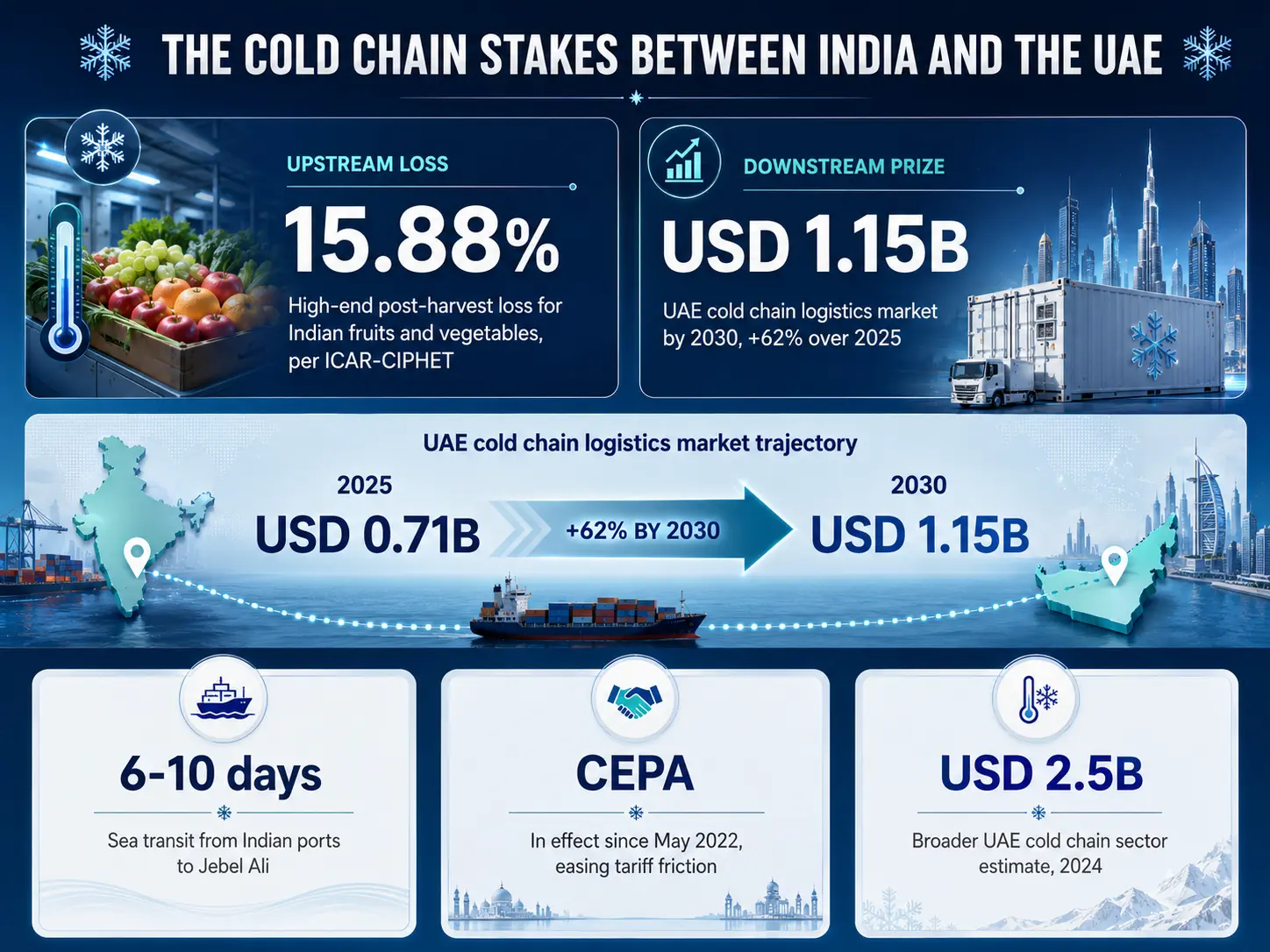
Source: ICAR-CIPHET via Mordor Intelligence India Cold Chain Report, Nexdigm UAE Cold Chain Market Research, and UAE Ministry of Economy CEPA documentation, via Mordor Intelligence
What UAE Retailers Prioritise
Large UAE retailers run structured procurement systems. These are built to avoid supply disruption. Buyers judge suppliers on repeat performance, not one-off pricing.
Key factors usually include:
- Consistent temperature control within declared limits
- Accurate and complete documentation
- Registration that aligns with import systems
- On-time replenishment
- Traceability in case of a quality review
In this setting, reliability compounds. Suppliers who keep meeting standards become preferred vendors. Those who bring variability get deprioritised. The shift is rarely dramatic. It happens through reorder patterns.
For Indian exporters, cold chain capability is more than compliance hygiene. It is a differentiator in vendor evaluation.
Distributor Model Versus Direct Market Presence
Many Indian exporters first reach the UAE market through local distributors. At lower volumes, this cuts admin complexity. The distributor handles import workflows, documents, and retailer relationships.
But as volumes grow, trade-offs appear.
[blockTabulatorBorder1]
This gap widens as shipment frequency rises. At small scale, distributor support is efficient. At higher cadence, control and margin visibility often justify a rethink.
Cold chain performance still matters in both cases. The real question is who owns the commercial relationship behind it.
Establishing a UAE Structure Through Meydan Free Zone
For exporters ready to move past distributor-led trading, the hesitation is rarely about demand. It is about structure. Setting up in another country can feel complex. Founders often assume it means local sponsors, office leases, and long timelines before they can trade.
In the UAE, trading directly needs two things. A registered company. And a valid business license that matches the activity. Depending on the product and how goods enter the country, extra registrations or approvals may apply. These are product-specific. They must match the actual commercial operation.
Meydan Free Zone simplifies the foundation layer.
It offers a fully digital, 100% online company formation route. Founders can set up a Dubai-registered entity with full foreign ownership. The process is designed to be simple. Documentation requirements are clear, and the incorporation journey is streamlined. For exporters, the value is not symbolic presence. It is operational readiness.
With a UAE entity in place, exporters can:
- Contract directly with buyers and retailers
- Issue invoices under a UAE-registered company
- Open a corporate bank account for local transactions
- Align regulatory registrations in their own company name
The company becomes the base for building market relationships. The business activity you pick, and any sector approvals, must always match the product and trading route. Meydan Free Zone provides the structural platform. Regulatory compliance stays tied to the goods being traded.
The strategic shift is significant. Combine disciplined upstream cold chain management with a structured UAE presence. The exporter moves from remote supplier to locally accountable trading partner. That distinction often decides how seriously buyers engage. It shapes how contracts are structured, and how consistently orders repeat.
In Conclusion
The UAE market offers Indian exporters real structural advantages. Short transit times. Tariff alignment under CEPA. Steady demand from a large resident Indian population. These are not speculative conditions. They are documented trade realities.
So what separates exporters who test the market from those who build a position in it? Execution. UAE cold chain standards are enforced because the country leans heavily on imported supply. Temperature stability, documentation accuracy, and traceability are not side issues. They underpin continued access to shelves and procurement systems.
Some exporters strengthen upstream cold chain discipline and set up a compliant UAE trading structure. They place themselves in a different category. They move from shipment-based selling to relationship-based supply. They gain pricing visibility, direct buyer engagement, and long-term positioning.
Are you ready to engage the UAE market directly? The next step is structural. Set up a UAE entity with Meydan Free Zone. Obtain the business license that matches your trading activity. Build from a platform designed for operational clarity.
[blockCTACostCalculator]
Footnotes
¹ ICAR-CIPHET (Indian Council of Agricultural Research, Central Institute of Post-Harvest Engineering and Technology), via Mordor Intelligence, "India Cold Chain Logistics Market Report," 2025.
² UN Food Systems Hub, "United Arab Emirates National Pathways," 2021.
³ UAE Ministry of Economy, "UAE-India Comprehensive Economic Partnership Agreement," 2022.
⁴ Consul General of India Satish Sivan, via Gulf News, "Indian Expat Population in UAE Doubles to 4.36 Million; More Than Half Live in Dubai," 2025.