Table of Contents
Frequently Asked Questions
1. What is the safest way to send money from Dubai to India?
The safest way is through licensed exchange houses or fintech platforms connected with Meydan Free Zone’s verified partner network. These platforms display live AED-INR rates, issue official receipts, and ensure your transfer follows UAE and Indian regulations. Always double-check sender and recipient details before confirming a transaction.
2. Are remittances from Dubai to India taxable?
No. Income earned abroad is not taxable in India if the sender qualifies as an NRI. However, gifts to non-relatives above ₹50,000 in a financial year may attract tax.
3. What’s the best time to send money to get higher INR value?
Many Indian expats monitor AED-INR trends and send funds when the rupee weakens, meaning you’ll receive more rupees per dirham. Using live-rate tools helps track daily fluctuations and lock in the best forex rates for Indians in Dubai.
4. Can entrepreneurs in Dubai transfer business income to India?
Yes, through authorised dealer banks. Ensure invoices, contracts, and FEMA purpose codes are properly documented for compliance.
5. Do I need a business license to use forex or remittance services in Dubai?
No, individuals can use personal forex and remittance services freely. But if you plan to send or receive business payments, you’ll need a valid trade license, and Meydan Free Zone offers a fully digital setup with access to trusted forex services for Indians in Dubai and partner banks.
Topic Summary
1. Open a Local Bank Account Promptly
Upon relocating to Dubai, securing a local bank account is essential for efficient currency exchange and remittance. Choose banks that offer competitive forex rates and seamless online banking services to simplify transferring funds to India.
2. Understand the UAE Dirham and Exchange Rates
The UAE Dirham (AED) is pegged to the US Dollar, providing currency stability. Monitor exchange rates regularly through reliable financial platforms to optimise the timing of your transfers and maximise the value received by your beneficiaries.
3. Utilise Regulated Money Transfer Services
Opt for licensed and regulated money transfer operators who comply with Central Bank of UAE guidelines. These providers often offer lower fees, faster transfers, and better exchange rates compared to conventional banking channels.
4. Leverage Digital Remittance Platforms
Digital platforms and mobile apps provide convenience and transparency when sending money home. Many such services allow real-time tracking, instant notifications, and competitive rates, making cross-border transactions more efficient.
5. Complete Required Legal Formalities Early
Ensure you have obtained your UAE residence visa and relevant documentation early, as these are prerequisites for opening bank accounts and conducting financial transactions. Compliance with regulatory requirements safeguards your funds and establishes credibility with financial institutions.
Foreign Exchange in Dubai: Smart Tips for Indians Sending Money Home
When you relocate from India to Dubai, one of your first financial priorities is understanding foreign exchange in Dubai, from opening a bank account to managing cross-border remittances. With the UAE’s stable currency, transparent regulations, and easy digital systems, Dubai offers some of the best forex rates for Indians in Dubai.
According to the Reserve Bank of India¹, Indians working abroad sent home a record USD 135.46 billion in FY 2024-25, a 14 percent year-on-year increase. The UAE remains India's second-largest source country², contributing 19.2 percent of total inflows. For Indians moving to Dubai, this isn't an abstract trend; it's the everyday financial pipeline you'll be plugging into.
Before settling in, you’ll need to complete key steps such as obtaining a residence visa, setting up a compliant business license in under 60 minutes, and ensuring smooth currency transfers. Whether you’re exchanging earnings or managing business funds, knowing how currency exchange for Indian rupees in Dubai works helps you save on conversion costs and secure faster transfers.
That’s where Meydan Free Zone becomes an ideal starting point. Designed for modern entrepreneurs, Meydan Free Zone simplifies the entire business setup in Dubai and relocation process, from getting your license to assisting with visa applications, banking introductions, and even access to trusted forex and remittance partners. With fewer approvals and a fully digital system, it’s one of Dubai’s fastest, most accessible options for Indian residents ready to start abroad.
Dubai’s stable currency framework adds to this ease. The UAE Governmentensures transparent forex regulations, while the Central Bank of the UAE maintains the AED’s fixed peg to the US dollar and updates exchange rates daily. Combined with Meydan Free Zone’s banking and forex network, these systems make it simple for Indians abroad to settle, send, and scale with confidence.
Understanding Foreign Exchange in Dubai
Dubai runs on the UAE Dirham (AED), a currency known for its reliability. Pegged to the US dollar at 1 USD = 3.6725 AED, it provides long-term stability for residents managing international income and remittances.
For Indian residents and entrepreneurs, this peg means predictable transfers when sending AED to INR or managing business payments to Indian suppliers. You won’t face sharp fluctuations, and your financial planning remains consistent.
At Meydan Free Zone, this predictability supports smooth operations. Every transaction, from paying Indian partners to receiving global client payments, runs through regulated, transparent channels. With services like Meydan Plus, you can connect with verified banking and remittance partners to manage AED, USD, and INR accounts in one place.
The AED-USD peg combined with India's gradual rupee depreciation means a Dubai salary today buys structurally more INR than the same salary did a decade ago.
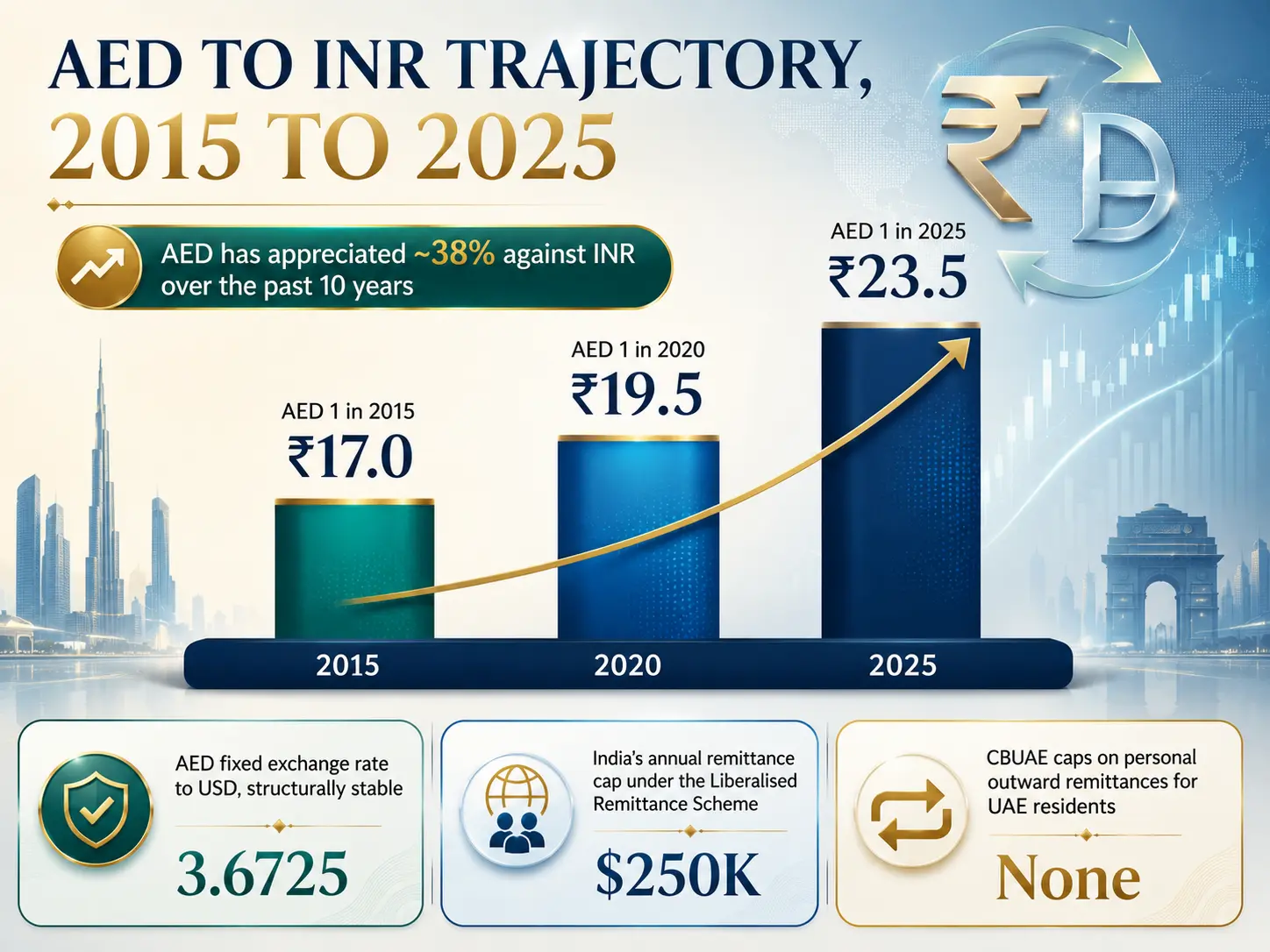
Source: Reserve Bank of India reference rates, with AED-USD peg from Central Bank of UAE and LRS cap from RBI master direction on liberalised remittances.
The Regulatory Environment in the UAE
The UAE does not impose foreign exchange restrictions that prevent residents from sending money abroad, though standard anti-money-laundering (AML) checks apply. This means Indian expats can use forex services for Indians in Dubai without restriction, provided transfers are made through licensed banks or exchange houses and large amounts are properly documented.
Typical remittance situations include:
- Sending personal remittances to family in India.
- Exchanging AED into INR for savings or investments.
- Running business transfers, such as vendor or supplier payments.
In every case, using authorised institutions and maintaining clear documentation ensures compliance with both UAE regulations and India’s Foreign Exchange Management Act (FEMA).
Forex Services for Indians in Dubai
Finding dependable forex services for Indians in Dubai is straightforward. Dubai offers one of the world’s most advanced exchange networks, supported by both traditional providers and digital platforms.
Popular Exchange Houses & Remittance providers in Dubai
In Dubai, you will find a number of reliable exchange houses that cater to Indian expatriates. They often offer direct AED-to-INR transfers, partner with Indian banks, and have mobile-app functionality for tracking. Examples include:
- Al Ansari Exchange – instant account credit to Indian banks.
- LuLu Exchange – strong track record for Indian remittances.
- Al Rostamani International Exchange and Index Exchange – transparent rate listings and reliable service.
These providers typically allow:
- AED → INR transfers with direct credit to Indian bank accounts.
- Real-time tracking and instant confirmation.
- Partnerships with major Indian banks, such as ICICI Bank, HDFC Bank, and State Bank of India, for smoother transfers.
Dubai Trade License from AED 12,500
Get Your LicenseChoosing the Right Provider for Foreign Exchange in Dubai
When selecting a forex/remittance service in Dubai, be sure to consider:
- Does the provider display live AED-INR rates (or update frequently)?
- What fee/markup is being charged above the inter-bank rate?
- How quickly does the money reach India (minutes vs hours vs days)?
- Which Indian banks are supported for credit?
- Are there any hidden charges or sub-optimal transfer steps?
Because you want to make the most of your funds, especially when sending support home, choosing the provider wisely means more rupees in the end.
Meydan Free Zone’s connected network streamlines these processes by embedding forex and remittance access directly into your business ecosystem.
As a Meydan Free Zone licence holder, you can:
- Enjoy lower transaction fees and faster processing.
- Access digital tracking, instant confirmations, and automated documentation.
- Stay fully compliant with both UAE and Indian financial regulations.
Currency Exchange for Indian Rupees in Dubai
If you’re exchanging cash or converting AED into INR for savings, you’ll find plenty of safe and licensed options for currency exchange for Indian rupees in Dubai. Some exchange houses in Dubai may quote slightly different rates (higher or lower) depending on demand, business, overheads and branch location. For example, when the rupee weakens, the conversion value for you improves.
Best Places to Exchange Indian Rupee in Dubai: Physical Vs. Digital
- Physical branches/exchange houses: These are abundant in malls, business districts and airports. However, airport kiosks often carry higher mark-ups and less favourable rates, best avoided if you have the time.
- Digital platforms/fintech apps: Increasingly popular for convenience and transparency. Some offer live rate tracking, lower mark-ups, and instant remittance to India.
Getting the Best Forex Rates for Indians in Dubai
Securing the best forex rates for Indians in Dubai is about timing, awareness, and choosing the right provider. Even small differences in rates can have a large impact when sending higher amounts.
Here’s a comparison table of typical factors you might check among providers:
| Provider Type | Sample Rate | Fees / Charges | Time to Credit India | Why Choose It |
|---|---|---|---|---|
| Airport Kiosk | e.g., AED 1 = INR 23.30 | High (0.5-1%). | Minutes | Convenient but costlier |
| Mall/Shop Exchange House | AED 1 = INR 23.90 | Moderate (0.25- 0.4%) | Minutes | Good balance of value & location |
| Trusted Dubai Branch (e.g., Wall street /Lari Exchange) | AED 1 = INR 24.20–24.50 | Low (0.1-0.2%) | Minutes to <1 hour | Reliable, transparent |
| Digital Platform / App | AED 1 = INR 24.40–24.65 | Very low / zero hidden fees | Minutes to <1 hour | Best for repeat transfers, automation |
Rates indicative, will vary daily according to market.
How to maximise your rate
- Track AED-INR movements using live market tools.
- Pick providers with transparent, low-fee structures.
- Leverage first-time or referral offers from digital apps.
- Send funds midweek to avoid weekend spreads.
- Time transfers when the INR weakens to increase rupee value.
Transferring Money From Dubai to India
The process of sending money home is quick and straightforward.
Business Activities List
Explore Over 2,500+Compliance, Limits, and Tax Clarity
Understanding both Indian and UAE regulations keeps your transfers stress-free.
In the UAE
From the UAE, there’s no legal cap on personal outward remittances, if funds come from legitimate income. However, exchange houses may set daily operational limits between AED 25,000–50,000.
Checklist for remitter in Dubai (personal/business):
- Valid Emirates ID + passport copy
- Proof of UAE income or business licence (if entrepreneur)
- Recipient’s Indian bank details: account number, IFSC, branch name
- Documentation of the source of funds (salary slip, business revenue, etc.)
- The purpose of remittance is clearly declared
In India
- The Reserve Bank of India (RBI) governs remittances and inward flows via the Foreign Exchange Management Act (FEMA) 1999.
- Under the LRS, resident individuals in India (not NRIs) can remit up to USD 250,000 per financial year. FAQ
- For NRIs sending money into India, inward remittances must be routed via an authorised dealer bank and receive a FIRC if required.
- Purpose codes must be used correctly for business/investment flows.
Taxation for NRIs
- Amounts transferred to India that originate from foreign income (earned abroad) are not taxable in India for the recipient, if the sender qualifies as an NRI (i.e., has been abroad for 182+ days in the year).
- Gifts to relatives are typically exempt; gift amounts to non-relatives above ₹50,000 in a year may be taxable.
- Large inward transfers will show up automatically in the Statement of Financial Transactions (SFT) via your Indian bank—so ensure your documentation is correct.
- If any portion of the amount stems from Indian income (e.g., rent/capital gains), it must be declared.
Business/investor remittances
Entrepreneurs must ensure:
- Correct purpose code for inward remittance (e.g., export payment, service income).
- Maintain invoices/contracts, shipping or service delivery proof if goods/services.
- Generate FIRC/FIRA for accounting and audit use.
- Follow timelines (for example, export proceeds realisation deadlines).
- Correct segregation: NRE/NRO/FCNR accounts vs Indian current accounts.
Meydan Free Zone’s advisory support ensures your transfers meet both UAE and Indian compliance requirements, from NRE/NRO account coordination to correct invoice declarations and proof of fund origin.
Free Company Name Check
Check NowIntegrated Forex and Banking Partnerships at Meydan Free Zone
One of the strongest advantages of setting up your business with Meydan Free Zone is its connected financial network. Every business license automatically links you to a curated ecosystem of forex and remittance providers trusted across the UAE.
Meydan Free Zone collaborates with leading exchange houses and fintech platforms to support fast international money transfers and competitive FX rates. Some of the listed partners include GCC Exchange, Lari Exchange, Economic Exchange, Wall Street Exchange, and CurrencyFair, all of which are part of Meydan Free Zone’s official partner network for remittance and foreign currency transactions.
These partnerships provide Meydan Free Zone license holders direct access to trusted providers for global remittance, competitive conversion rates, and multi-currency financial services, enabling easy and compliant cross-border payments.
Through these alliances, entrepreneurs can transfer earnings, manage supplier payments, and receive international client funds quickly, all through secure, pre- approved channels connected to Meydan Free Zone’s digital setup process. This integration eliminates the need for multiple applications, branch visits, or manual form submissions, making Meydan Free Zone one of the most seamless financial ecosystems for Indian founders in Dubai.
Note: Meydan Free Zone does not provide licensed forex or banking services but facilitates access through regulated partners.
From Relocation to Financial Freedom With Meydan Free Zone
For Indians relocating to Dubai, mastering foreign exchange Dubai is part of the bigger journey toward independence and growth. With Meydan Free Zone, you don’t just start a company, you build a bridge between Dubai’s financial strength and India’s opportunities. Every Meydan Free Zone license connects you to world-class forex services for Indians in Dubai, fast remittance channels, and banking solutions designed to help you move capital confidently.
From currency exchange for Indian rupees in Dubai to securing the best forex rates for Indians in Dubai, and even exploring Forex trading platforms for Indians in Dubai, Meydan Free Zone gives you the digital tools, partnerships, and compliance support to manage your wealth globally.
With your business licensed in under 60 minutes and your remittance channels ready on day one, you can focus on what matters most, building, expanding, and thriving in Dubai. Meydan Free Zone makes that journey not just possible, but effortless.
Footnotes
¹ Reserve Bank of India (RBI), "Remittances by Indians working abroad scale record high of USD 135 billion in FY25," via News On Air, July 2025.
² Reserve Bank of India (RBI), "Sixth Round of India's Remittances Survey 2023-24," via Khaleej Times, April 2025.