
Table of Contents
Frequently Asked Questions
1. Is onion export from India to Dubai currently allowed?
Yes. As of 1 April 2025, the 20% export duty on onions has been removed. No Minimum Export Price (MEP) currently applies to exports to the UAE. Standard export documentation and phytosanitary requirements remain mandatory.
2. What documents are required to export onions from India to Dubai?
From India: IEC, phytosanitary certificate, certificate of origin, commercial invoice and packing list.
In the UAE: valid food trading license, customs importer code, MOCCAE import permit issued before loading, and FIRS registration prior to arrival.
3. Is a MOCCAE import permit required before shipment?
Yes. The UAE import permit must be issued before the vessel departs. Applying after cargo departure can lead to clearance delays or shipment holds.
4. What is FIRS and why is it important?
FIRS (Food Import and Re-export System) is Dubai Municipality’s portal for declaring and registering food shipments. The shipment must be declared in FIRS before arrival for clearance to proceed smoothly.
5. How long does onion clearance take at Jebel Ali?
If documentation is accurate and permits are in place before arrival, clearance typically occurs within 24–48 hours. First shipments from new importers may receive closer inspection under the UAE’s risk-based model.
6. Do I need a UAE company to import onions directly?
Yes. To act as importer of record, you must hold a UAE-registered trading entity with a valid foodstuff trading activity and linked customs importer code.
7. Can onions imported into Dubai be re-exported to other GCC countries?
Yes. A UAE trading entity can re-export onions to markets such as Saudi Arabia, Oman, Kuwait and Bahrain under its own commercial invoice, subject to the destination country’s import rules.
Topic Summary
1. Export Permissions and Regulatory Compliance
Importers must ensure that Indian onions comply with the Agricultural and Processed Food Products Export Development Authority (APEDA) guidelines. Exporters need valid licenses issued by the Directorate General of Foreign Trade (DGFT) and must adhere to any export bans or restrictions stipulated by the Indian government.
2. Quality Standards and Phytosanitary Certificates
Onions intended for export to Dubai must meet quality and packaging standards defined by both Indian authorities and Dubai Municipality. A phytosanitary certificate issued by the Plant Quarantine Department in India is mandatory to confirm the produce is free from pests and diseases.
3. Minimum Export Price (MEP) and Duty Structures
The Indian government periodically sets a Minimum Export Price (MEP) for onions to stabilize domestic markets. Exporters must declare this price, and Customs authorities in India will monitor compliance. Importers should also be aware of any applicable customs duty or tariff adjustments upon entry into Dubai.
4. Customs Documentation for Dubai Import
Importers need to prepare essential documents including the commercial invoice, packing list, bill of lading or airway bill, certificate of origin, and the phytosanitary certificate. All documents must be accurate and submitted in alignment with Dubai Customs regulations to facilitate smooth clearance.
5. Adherence to Dubai Food Safety Regulations
Upon arrival, onions are subject to inspection by Dubai Municipality’s Food Safety Department to ensure compliance with local food safety standards. Importers should ensure product traceability, proper labeling, and adherence to any permissible pesticide residue limits to avoid rejection or penalties.
Importing Onions From India To Dubai: Updated Rules and Documents
Ask any Indian household what sits at the base of its cooking, and the answer is immediate: onion. It is the first ingredient in the pan and, in export terms, often the first line item in a fresh produce container leaving Maharashtra.
But in trade, onions are not sentimental. They are policy-sensitive commodities.
Per APEDA¹, India shipped approximately 1.5 million metric tonnes of fresh onions in FY 2024-25, with projections rising to 1.8-2.2 million MT in FY 2025-26 following the removal of the 20% export duty. The UAE consistently ranks among India's top six onion export destinations.
In the past few years, Indian exporters have seen export bans, minimum export prices, and shifting duties alter shipment economics overnight. A container priced on Monday could lose margin by Friday if policy moved. For traders supplying markets like Dubai, where volumes are high and clearance speed determines price realisation, volatility at origin travels with the cargo.
As of 1 April 2025, the Press Information Bureau confirmed India removed the 20% export duty on onions². The corridor to the UAE has reopened under standard trade conditions. Demand in Dubai is not the constraint, clearance sequence and importer structure are.
Importing onions from India to Dubai is not about finding buyers. It is about documentation accuracy, phytosanitary compliance, and ensuring the UAE importer-of-record is aligned before the shipment loads. When shelf life is finite and wholesale prices move daily, a one-day delay at port is not administrative inconvenience. It is margin compression.
This guide explains the updated rules, required documents, and structural decisions that determine whether an Indian onion shipment clears predictably into Dubai or loses value in transit.
India’s Structural Position in the UAE Onion Market
Ask why Indian onions dominate Gulf wholesale markets, and the answer is not cultural preference, it is structure. India is the world’s second-largest onion producer after China and the largest exporter by volume. According to APEDA, Maharashtra alone accounts for 35.45% of national output¹, with Nashik as the principal aggregation and trading centre.
Per APEDA¹, the rabi crop - harvested between January and May - represents 70 to 75% of annual production. It is the crop that matters for export. Its storage characteristics allow for sea transit without rapid spoilage, making containerised movement commercially viable.
Freight from Nhava Sheva or Mundra to Jebel Ali typically takes three to five days. In perishable commodity terms, that is not convenience, it is structural advantage. No European supplier can match it. Egyptian onions, the primary Gulf alternative, require longer transit and often arrive with less consistent grading for retail specification.
The India-UAE Comprehensive Economic Partnership Agreement, confirmed by the UAE Ministry of Foreign Affairs³ and operational since May 2022, has reduced tariff friction across agricultural categories and stabilised bilateral trade channels. The GCC import duty of 5% at Jebel Ali applies to CIF value. It is fixed, known, and priced into contracts.
In the UAE market, repeat purchase orders go to the trader who ships predictably, documents precisely and registers product correctly under the right entity. The system behind the consignment matters as much as the crop itself.
The Regulatory Cycle: What Changed and Where It Stands
Onion trade from India operates in cycles. Between December 2023 and April 2025, export policy moved through four distinct phases. That sequence matters because it frames today’s opportunity and its limits.
On 8 December 2023, the government imposed a complete export ban to protect domestic supply following a weak kharif harvest. That ban remained until 3 May 2024 per the Press Information Bureau², when exports resumed under a Minimum Export Price of USD 550 per tonne and a 40% export duty.
From September 2024, the duty was reduced to 20%. On 1 April 2025, the remaining 20% duty was removed entirely through Customs Notification No. 19/2025, as reported by Taxscan⁴. No MEP currently applies to exports to the UAE. That is the operative position at the time of writing.
The lesson from this cycle is not that policy is erratic. It is that onion exports will always be calibrated to domestic retail price sensitivity.
The exporters who survive these calibrations are not those who speculate on timing. They are those who operate within compliant, documented trade structures that can absorb policy tightening without losing buyer confidence.
Sixteen months of policy turbulence ended with the April 2025 duty removal, leaving Indian onion exporters with a clean structural setup: Maharashtra's production scale, three-to-five-day transit to Jebel Ali, and a fixed 5% GCC import duty on arrival.
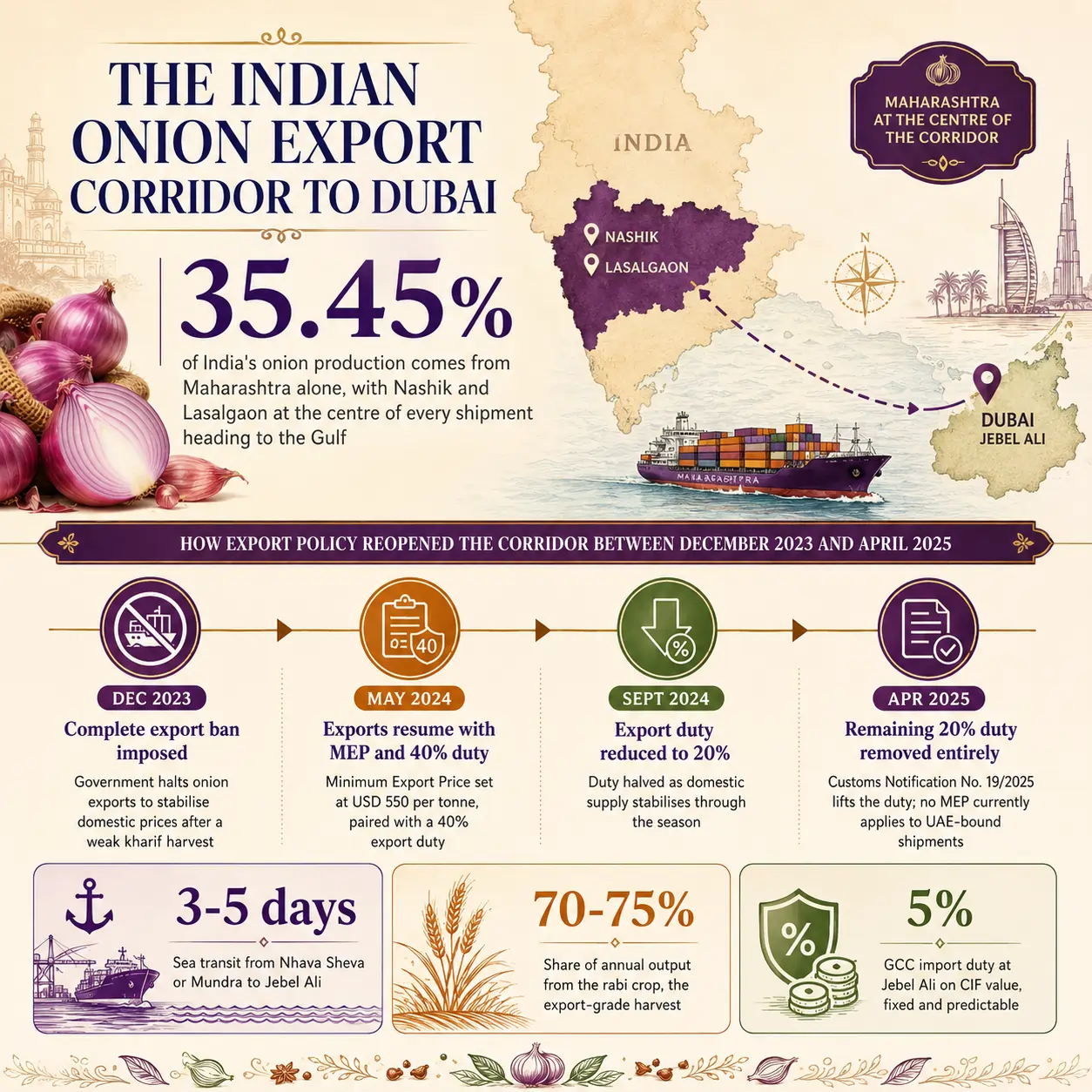
Source: Press Information Bureau of India, APEDA, and Customs Notification No. 19/2025, via PIB India
Import Indian Onions to Dubai: The Complete Document Checklist
There are two parallel sets of requirements: what the Indian exporter must produce, and what the UAE-side entity must hold. Both must be in place before the vessel departs.
A deficiency on either side can result in the consignment being held at Jebel Ali, where port storage charges accumulate daily and spoilage risk compounds.
From the India side:
| Document | Issuing Authority | What to Know |
|---|---|---|
| Phytosanitary Certificate | PQIS, Ministry of Agriculture | Valid 7 days for perishables. Apply 2–3 days before vessel departure. Every field — lot number, weight, species (Allium cepa), origin state — must match the Commercial Invoice and Packing List exactly. |
| Certificate of Origin | Export Inspection Council / Chamber of Commerce | Required for GCC customs clearance. Confirms Indian origin for preferential treatment under CEPA. |
| Commercial Invoice | Exporter | Addressed to the UAE importer. Quantity, unit price, and total value must be consistent across all documents. |
| Packing List | Exporter | Must specify net weight, gross weight, bag count, size grade (typically 45–55mm for Gulf retail), and lot references. |
| Bill of Lading | Shipping line | Confirm HS Code 07031010 (fresh onions and shallots). Errors in HS classification cause misapplied duty rates. |
| IEC (Import Export Code) | DGFT | Mandatory for all Indian exporters. Apply at dgft.gov.in if not already registered. |
| APEDA Registration | APEDA | Required for agricultural exports. Also covers MRL compliance documentation and pack house certification. |
| FSSAI Export Certificate | FSSAI | Confirms food safety standards are met for the export consignment. |
From the UAE side:
| Document / Registration | Issuing Authority | What to Know |
|---|---|---|
| UAE Import Permit | MOCCAE — Ministry of Climate Change and Environment | Valid 6 months from issue. Must be held before the vessel departs India. Separate from Dubai Customs clearance. |
| FIRS Registration | Dubai Municipality Food Control Department | Food Import and Re-export System. The importing entity must be registered before receiving shipments. Matched against incoming declarations at Jebel Ali. |
| UAE Trade License (food trading) | Free Zone Authority or DED | The entity acting as importer of record must hold a license that covers food or produce trading. Business activity scope determines what the entity can legally import. |
| UAE Customs Importer Code | Federal Customs Authority | Links the trade license to the customs system. Required to act as the importer of record. |
| Cargo Insurance Certificate | Insurer | Covers spoilage, transit damage, and customs dispute costs. Costs fall on the importer if a consignment is held or rejected. |
How Agricultural Consignments Enter Dubai
All agricultural imports pass through Gate 8 of the Jebel Ali Free Zone, operated by Dubai Municipality’s Food Safety Department. The gate operates Monday to Friday from 8:00 AM to 9:00 PM and Saturday from 8:00 AM to 5:00 PM. Every consignment is assessed for physical condition, labelling accuracy and maximum residue level (MRL) compliance. When documentation does not align with the declared cargo, the shipment is held.
This is where sequencing becomes commercial.
Gulf retail buyers, including UAE supermarkets, typically specify medium to large onion bulbs in the 45–55mm range. Packaging must carry:
- Bilingual labelling: Arabic and English text on every package.
- Country of origin: Clearly stated as India on the label.
- Net weight: Accurate to the consignment.
- Product description: Matches the commercial invoice and packing list.
- UAE importer details: Name and registration aligned with the FIRS record.
Post-arrival stickering is sometimes permitted, but it increases handling time and inspection exposure. Product that is correctly labelled before shipment moves faster through the system.
The UAE operates a risk-based inspection model. First shipments from a new exporter - or under a newly registered FIRS record - receive closer scrutiny. Once an importer establishes a clean compliance history, with consistent documentation, no MRL flags and no weight discrepancies, repeat shipments typically clear more predictably.
In onion trade, inspection timing is pricing exposure.
Business Structure and Why It Determines More Than You Expect
In the UAE, food import approvals sit with the importer of record - the UAE-registered entity holding the MOCCAE import permit, FIRS registration and customs importer code. If that entity is a local distributor, then the registrations, compliance history and buyer-facing record belong to the distributor, not the Indian exporter.
At modest shipment volumes, this structure is efficient. The distributor manages the compliance layer, retailer relationships and regulatory submissions. For occasional consignments, this reduces administrative burden.
As volumes increase, the trade-offs become visible. Pricing transparency narrows, buyer access remains indirect. The compliance history that determines how quickly future shipments clear belongs to another company.
Establishing a UAE trading entity changes that equation. The exporter becomes the importer of record. Permits are held in their own company name. Products are registered directly with Dubai Municipality. Buyers are invoiced under their own trade license. The compliance record that reduces inspection intensity over time belongs to the business that built it.
This is the difference between shipment-based selling and system-based supply.
[blockCTATradeLicense]
Where Meydan Free Zone Fits Into That Structure
For Indian exporters seeking direct importer-of-record control, structure must exist before cargo moves.
Meydan Free Zone provides a framework for establishing that presence:
[blockFaqsCategory]
With a Meydan Free Zone entity in place, the exporter can apply for MOCCAE permits and FIRS registrations under their own company name, link a customs importer code directly to their trade license and receive retailer payments into their own corporate account.
The compliance system sits with the business that controls the trade.
[blockCTABizSetupRemotely]
In Conclusion
The India–Dubai onion corridor is established, not speculative. India’s production scale, the rabi crop’s export suitability, the three-to-five-day transit window and the CEPA framework create structural advantage. The removal of the 20% export duty in April 2025 restored price competitiveness. It did not reduce compliance intensity.
MOCCAE permits, FIRS registration, accurate phytosanitary documentation and a legally registered importer of record remain non-negotiable. Traders who treat these as operating infrastructure - not administrative hurdles - are the ones who secure repeat supply relationships.
In onion trade, structure determines margin.
Citations
¹ APEDA, Government of India, "Fresh Onions Export Data," 2024-25.
² Press Information Bureau, Government of India, "Centre Lifts Export Duty on Onions Effective April 1, 2025," March 2025.
³ Ministry of Foreign Affairs and International Cooperation (MOFAIC), UAE, "India-UAE Comprehensive Economic Partnership Agreement," May 2022.
⁴ Taxscan, "Centre Lifts Export Duty on Onions Effective April 1, 2025," March 2025.