
Table of Contents
Frequently Asked Questions
1. Which Indian vegetables generate the highest margins in the UAE?
Onions, okra, and green chillies typically deliver the strongest returns due to high demand, short transit advantages, and limited substitutes. Specialty products like bitter gourd, curry leaves, and fresh herbs also command premium pricing in niche segments.
2. Why is Dubai a high-potential market for Indian vegetable exporters?
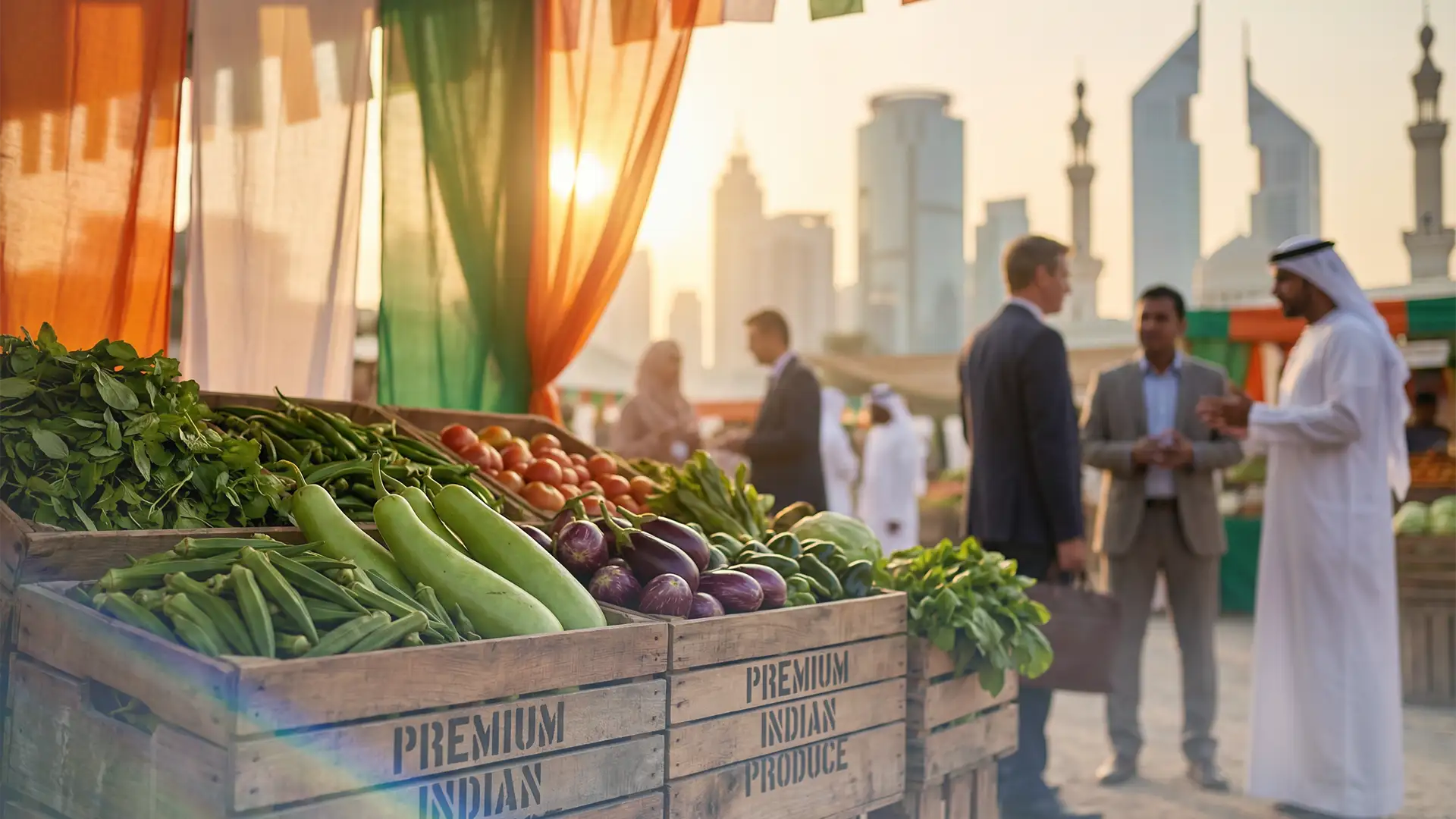
The UAE imports around 90% of its food and has a large Indian diaspora, a strong hospitality sector, and active wholesale markets. Dubai also serves as a redistribution hub supplying the wider GCC region.
3. How long does it take to transport vegetables from India to Dubai?
Sea freight from major ports such as Nhava Sheva or Mundra to Jebel Ali typically takes 3–5 days. The short transit window helps maintain freshness and increases the usable shelf life at the destination.
4. Do Indian vegetable exports receive tariff benefits in the UAE?
Yes. Under the India–UAE CEPA agreement, duties have been eliminated on over 97% of tariff lines covering most Indian exports, giving Indian vegetables a clear landed cost advantage.
5. What operational factor most affects profitability in fresh vegetable exports?
Cold chain integrity is critical. Consistent temperature control from packhouse to delivery prevents quality loss, reduces rejection risk, and protects retail-grade pricing at the destination.
6. Is a UAE-registered company necessary to work with large buyers?
Most supermarkets, hotel groups, and re-export traders prefer suppliers who can invoice locally in AED and meet FIRS and compliance requirements through a UAE entity.
7. How can Meydan Free Zone support Indian vegetable traders entering the market?
Meydan Free Zone enables fast digital company setup with MoFA-recognised licensing (in under 60 minutes with Fawri), suitable business activity mapping for fresh produce trading, and a guaranteed IBAN, allowing exporters to operate locally and access higher-value buyer channels directly.
Topic Summary
1. Onions
Nashik onions are highly sought after in Dubai due to their quality and availability. With efficient supply chain management, exporters can achieve margins exceeding 45%, making onions one of the most profitable vegetables to export.
2. Tomatoes
India’s diverse tomato varieties meet the UAE's demand for freshness and quality. Tomatoes have a steady export market in Dubai, offering good returns owing to consistent demand in both retail and hospitality sectors.
3. Okra (Lady’s Finger)
Okra from Indian regions like Gujarat and Maharashtra is favored in Dubai’s markets. Its relatively long shelf life and high demand in Middle Eastern cuisine make it a lucrative export vegetable.
4. Brinjal (Eggplant)
Brinjal varieties grown in India are popular in Dubai thanks to their texture and flavor. Exporters benefit from high consumer demand across supermarkets and local markets, ensuring profitable deals.
5. Capsicum (Bell Peppers)
Indian capsicum exports to Dubai command good prices due to the increasing health consciousness and demand for fresh produce. The vegetable’s colorful varieties add to its strong market appeal and profitability.
Most Profitable Indian Vegetables To Export To Dubai
A 20-tonne container of Nashik onions lands at Jebel Ali. Five days earlier, it was packed at a facility outside Mumbai. By the time it clears customs in Dubai, the margin on that single shipment can exceed INR 5 lakh, roughly 45% above total cost.
Nashik onions are the clearest example of this margin structure, and the step-by-step process to import Indian onions to Dubai walks through the permits and customs clearance behind that shipment.
That number is not exceptional. It is the structural arithmetic of selling Indian vegetables into a market that imports the vast majority of what it eats. Per the USDA Foreign Agricultural Service¹, the UAE imports approximately 90% of its food. India is the world's largest producer of onions and okra and the second largest in potatoes, tomatoes, cauliflower, and cabbage. Production is not the constraint.
The constraint is where the margin sits. Domestic farm-gate prices are compressed by fragmented supply chains and seasonal oversupply. The arithmetic changes when the same product crosses a border.
Farmer Producer Organisations in Odisha exporting okra, bitter gourd, and long beans to Dubai have reported 30 to 40% higher price realisation compared to domestic sales. Per India's Press Information Bureau², India's fresh fruit and vegetable exports grew 47.3% by volume between 2019-20 and 2023-24.
The corridor is expanding. The question is which vegetables, shipped where, under what structure, generate the strongest return.
This guide breaks down the most profitable vegetables to export to the UAE, the demand drivers behind them, and the commercial structure required to capture those margins at scale.
Why Dubai Anchors the Margin Equation
The UAE imports approximately 90% of its food requirements¹. Per World Bank data, its agricultural sector contributes just 0.7% of GDP³.According to Food Export Association research, consumer-oriented food imports alone reached USD 13.6 billion in 2023⁴.
Within that, Mordor Intelligence projects the UAE fruits and vegetables market to stand at USD 6.81 billion in 2025 and reach USD 9.82 billion by 2030, growing at 7.6% annually⁵.
These are not aspirational projections. They reflect a structural dependency. Every onion, every potato, every crate of okra on a retail shelf or in a hotel kitchen arrived through an import channel.
For Indian exporters specifically, three factors compress the distance between cost and margin.
| Transit | Tariffs | Demand diversification | |
|---|---|---|---|
| What it is | Sea freight from Nhava Sheva or Mundra to Jebel Ali runs 3 to 5 days | Standard 5% tariff, with over 97% of tariff lines eliminated under India-UAE CEPA covering 99% of Indian exports by value | Dubai operates as a consumption base, hospitality procurement centre, and regional redistribution hub |
| Why it matters | Shorter than Egypt, dramatically shorter than China, the Netherlands, or South America. More shelf life on arrival, fewer quality downgrades, stronger pricing power | Indian vegetables enter at a cost advantage that Egyptian, Jordanian, and Chinese competitors cannot match on equivalent terms | Layered demand reduces single-buyer dependency and stabilises volume across cycles |
| Buyer impact | Premium pricing on retail-grade consignments | Improved landed cost position in every channel | Access to diaspora retail, institutional food service, and re-export corridors into Saudi Arabia, Oman, Qatar, Bahrain, Kuwait, and parts of Africa |
Before getting into individual vegetables, here are the four numbers that shape every Indian exporter's economics in the UAE market

Source: USDA Foreign Agricultural Service, IMARC, Tridge, APEDA, and Press Information Bureau of India, via Food Export Association
[blockCTACostCalculator]
The Vegetables That Generate the Strongest Returns
The profitable vegetables to export to the UAE share a common profile: high and consistent demand in the destination market, a production or quality advantage at origin, competitive transit economics, and a pricing structure that rewards reliability over spot trading.
Five categories dominate the India-to-UAE corridor. Each has a distinct margin driver.
1. Onions
Onions are the highest-volume vegetable in the India-to-UAE corridor. According to APEDA data, the UAE imports approximately 403,000 metric tonnes of Indian onions annually⁶. The Press Information Bureau reports that India exported fresh onions worth approximately USD 474 million in 2023-24⁷, with the UAE consistently among the top three destinations.
What makes onions a margin story is a limitation of direct substitutes. Indian red onions serve a culinary function in South Asian and Middle Eastern cooking that white and yellow varieties from competing origins do not perform. That specificity limits buyer switching, which in turn protects pricing even during periods of supply volatility.
The margin structure is compelling. According to the Press Information Bureau, India's net onion export earnings reached INR 4,525 crore in 2022-23⁸, a figure that reflects the significant gap between what onions cost at Indian farmgate and what they command at destination. In the UAE, that gap is amplified by short transit, low tariffs, and steady demand across multiple buyer channels. Those margins widen further when exporters operate through a UAE-registered entity and sell directly into retail, hospitality, or re-export channels rather than through intermediary distributors.
2. Potatoes
According to APEDA, potatoes account for approximately 25% of Indian vegetable exports to the UAE⁹. India is the world's second-largest potato producer per APEDA¹⁰, and the export corridor to Dubai benefits from the same transit advantage that supports onions.
Demand in the UAE is driven by both household consumption and the food service sector, valued at USD 16.58 billion by IMARC Group¹¹. Hotels, quick-service restaurants, and catering companies procure potatoes on volume contracts with tight grading specifications. The institutional channel values consistency over price, which favours suppliers who can maintain grading standards and delivery frequency across weeks.
For exporters, potatoes offer lower per-kilo margins than onions but higher volume stability. The product is less perishable than leafy vegetables, tolerates longer storage windows, and faces fewer policy disruptions at origin. Potatoes are a volume anchor: they steady the export portfolio while higher-margin products generate the premium.
3. Okra
Okra is where the margin equation tilts sharply in India’s favour. Per Tridge, India accounts for 62.12% of global fresh okra production¹². No other origin comes close. That production monopoly translates into pricing power that does not exist in commoditised categories like potatoes.
Per APEDA, India remains the world's largest okra producer¹⁰, with steady supply into the UAE anchored by the 4.36 million-strong Indian diaspora¹³ and Middle Eastern food service demand. The product is lightweight relative to its value, which means air freight economics can support premium pricing for top-grade consignments.
The perishability of okra is both the risk and the margin driver. Exporters who maintain documented cold chain integrity from packhouse to arrival, with consistent temperature management at 7 to 10°C, protect shelf life and command retail-grade pricing. Those who do not face downgrades at the destination.
4. Green Chillies and Tomatoes
Green chillies and tomatoes are consistently among the most profitable vegetable exports from India to the GCC; both feature as top vegetable export categories alongside onions and potatoes. Both are foundational to South Asian and Middle Eastern cooking, and demand is year-round.
Green chillies carry the stronger margin profile of the two. They are lightweight, high-value per kilo, and face limited competition from non-Indian origins in the specific varieties that the UAE market demands. The buyer has few alternatives, which insulates the exporter's pricing.
Tomatoes operate at tighter margins but move at scale. The food service channel, hotels, catering companies, and restaurant groups, procure tomatoes on weekly volume contracts where delivery consistency matters more than price negotiation. For exporters with reliable logistics, tomatoes generate steady revenue that supports the fixed costs of maintaining a UAE supply operation.
Both products require rigorous cold chain management. Temperature-controlled logistics at 5 to 8°C in reefer containers are non-negotiable. Produce that arrives with compromised quality does not get renegotiated. It gets rejected.
5. Cauliflower, Beans, Bitter Gourd, and Leafy Herbs
Beyond the top four, a second tier of vegetables is building margin for Indian exporters in the UAE. Cauliflower, French beans, bitter gourd, long beans, and leafy herbs like coriander and curry leaves are moving in growing volumes, particularly through air freight.
These are not mass-market categories. They are niche products with loyal buyer segments and near-zero competition from non-Asian origins. Bitter gourd and curry leaves, for example, have no meaningful substitutes in the UAE market. The buyer base is smaller, but the per-consignment margin can exceed that of bulk commodity shipments precisely because supply is limited and switching costs are high.
FPOs and mid-scale exporters have found this tier particularly accessible. The volumes are manageable, the quality requirements are well-defined, and the entry barrier is operational discipline rather than capital scale.
[blockCTANameCheck]
Why Product Selection Is Not Enough
Identifying the right vegetables is the beginning of the margin conversation. It is not the end.
Indian exporters routinely ship high-demand products into the UAE and still capture only a fraction of the available margin. The product reaches the market. The value does not reach the exporter. The gap is not about quality or pricing. It is about how the sale is structured.
The UAE fresh produce market does not operate as a single channel.
- Supermarket chains: Centralised procurement with approved vendor lists and FIRS registration requirements.
- Hotel groups and catering companies: Recurring contracts that assume local invoicing in AED and scheduled delivery from a licensed supplier.
- Re-export operators: Moving volume through Jebel Ali into the broader GCC, a market valued at approximately USD 16.75 billion in 2025 per Mordor Intelligence¹⁴, on structured commercial terms.
Most of these channels require a UAE-registered entity to transact directly. Without one, those relationships are intermediated. With one, the exporter controls them.
That is where the margin moves from the product to the structure.
[blockCTABizActivityList]
Establishing the Commercial Base with Meydan Free Zone
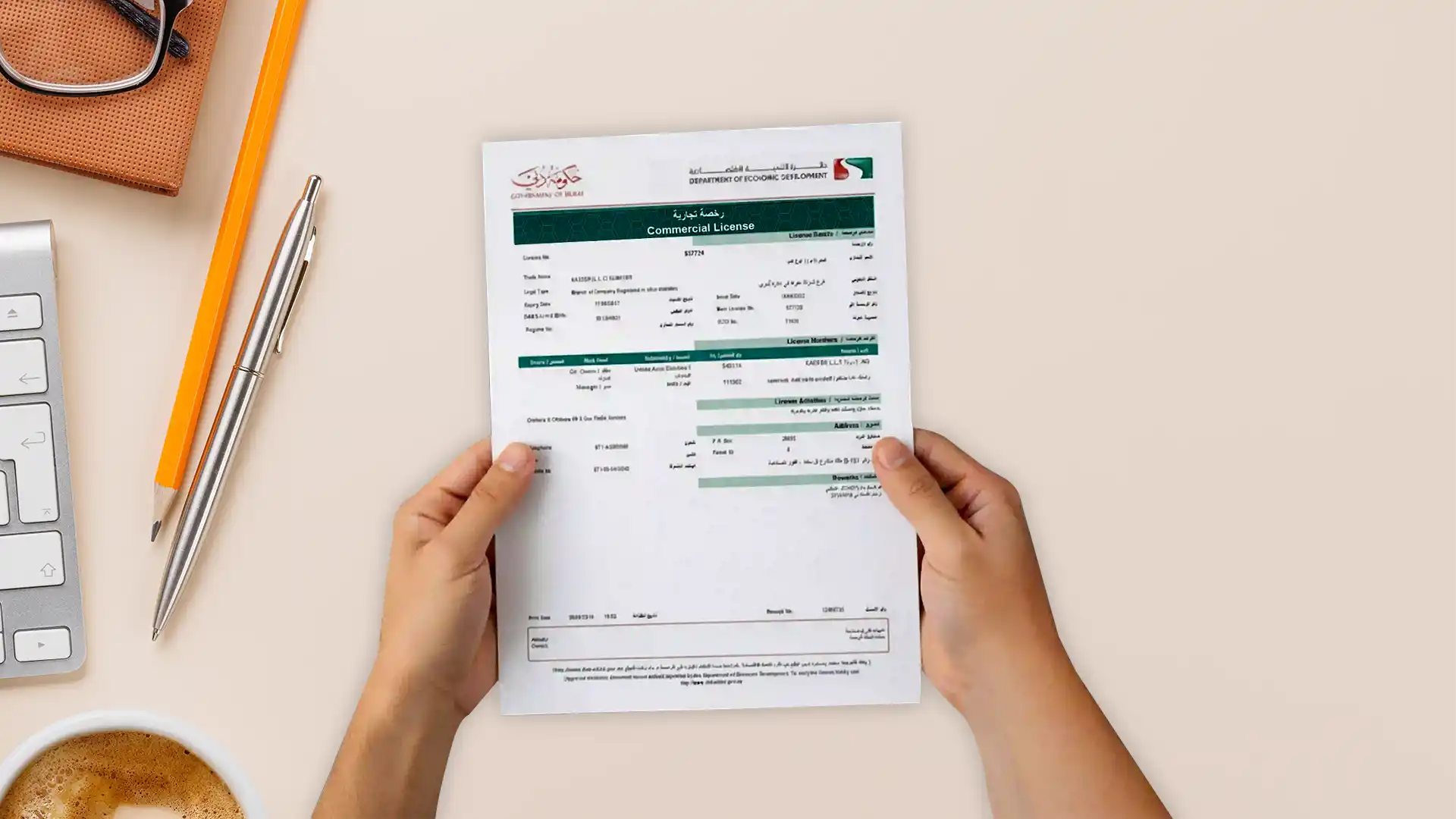
Meydan Free Zone offers a digital company formation pathway that allows Indian founders to establish a UAE-registered trading entity with 100% foreign ownership; no local sponsor is required. The licensing framework includes correct business activity mapping with activities like Fruit and Vegetable Trading (Activity Code 4721.67), which aligns directly with import, export, and distribution operations in fresh produce.
What matters for exporters managing tight harvest-to-shipment windows is execution speed.
- Fawri business license: Digital incorporation in under 60 minutes.
- Regular business license: Issuance within one business day.
- Both routes include: MoFA-recognised trading license accredited by the Dubai Chamber of Commerce, plus a guaranteed IBAN pathway through partner banks.
This means closing the gap between company formation and the ability to actually invoice buyers and receive payment.
For exporters already navigating APEDA registrations, phytosanitary certifications, and FSSAI compliance at origin, the UAE setup should not introduce a second layer of friction. That is the point of the structure: a licensed entity, a functional bank account, and the commercial standing to access the buyer channels where margins are strongest.
Founders can estimate total setup costs through Meydan Free Zone's online Cost Calculator before making the commitment.
[blockCTATradeLicense]
In Conclusion
India's fresh fruit and vegetable export volumes grew 47.3% between 2019-20 and 2023-24 per the Press Information Bureau². The UAE’s fresh produce import dependency is structural and permanent. The trade corridor between the two is supported by short transit windows, preferential tariff treatment under CEPA, and a demand base that operates across retail, food service, and regional redistribution simultaneously.
The most profitable vegetables to export to the UAE — onions, potatoes, okra, green chillies, tomatoes, and the emerging tier of cauliflower, beans, and herbs — are not just profitable because of commodity pricing. They are profitable because the right commercial structure allows Indian exporters to capture the full spread between Indian farm-gate cost and UAE end-buyer value.
Product selection determines what you ship. Commercial structure determines what you earn.