Table of Contents
Frequently Asked Questions
1. Is a Dubai free zone better than mainland for Indian entrepreneurs?
For many Indian founders in consulting, IT, digital, or global trading, a free zone is usually better because it offers 100% ownership, simpler setup, and lean operating costs. Mainland is more suitable when your business depends on physical presence and selling directly in the UAE market.
2. Can a free zone company in Dubai work with Indian and international clients?
Yes. Free zone companies are designed for international business. You can contract with clients in India, the Gulf, Europe, or any other market, invoice them from Dubai, and use UAE banking channels for cross-border payments, subject to normal compliance checks.
3. Can a free zone company trade directly with customers in Dubai mainland?
A free zone company cannot trade directly with mainland customers in the same way a mainland company can. Instead, you typically work through distributors, agents, or structured arrangements. If local retail or on-ground trading is your core model, mainland is a better fit.
4. Do both free zone and mainland companies allow Indian owners to hold 100% shares?
Yes. Current UAE rules allow 100% foreign ownership for most activities in both free zones and on the mainland. The distinction today is less about ownership and more about market access, operational style, and taxation.
5. Which is easier for Indian entrepreneurs to set up: free zone or mainland?
In most cases, free zones are easier. They offer digital-first applications, clear document lists, and fewer in-person visits. A free zone such as Meydan Free Zone is built around a streamlined, online journey, which is especially convenient if you’re still partly based in India.
Topic Summary
1. Ownership Structure
In Dubai Free Zones, Indian entrepreneurs can enjoy 100% foreign ownership, giving full control without the need for a local partner. In contrast, Mainland companies traditionally require a local sponsor holding at least 51% ownership, although recent reforms have relaxed this for certain activities.
2. Business Activities
Free Zones are tailored for specific industries like IT, media, finance, and trading, with restrictions on doing business directly within the UAE market. Mainland companies have the flexibility to operate anywhere in Dubai and cater directly to the UAE customer base.
3. Office Space Requirements
Free Zone companies must lease office space within the designated free zone area or use flexi-desk options. Mainland companies have broader options for office locations anywhere in Dubai and can opt for physical offices or co-working spaces.
4. Cost Considerations
Setting up in a Free Zone generally involves lower business setup costs and faster licensing processes, ideal for startups and lean operations. Mainland setups might incur higher costs due to local sponsor fees and broader regulatory requirements but offer greater market access.
5. Visa and Immigration
Free Zone visas are linked to the free zone authority and typically allow sponsoring fewer employees per license. Mainland companies can sponsor more employees based on the office size, supporting larger workforce needs aligned with on-ground operations.
Dubai Free Zone vs Mainland: What Indian Entrepreneurs Must Know
If you’re an Indian entrepreneur planning to move your business or launch a new venture in Dubai, one decision will shape everything that follows: free zone vs mainland Dubai.
According to Dubai Chamber of Commerce data¹, 13,851 new Indian-owned companies registered with the chamber in the first nine months of 2025, a 13.9 percent year-on-year increase, with India remaining the number one country of origin for new foreign company registrations in Dubai.
Each of those founders had to make the same choice you're about to make: free zone or mainland.
On paper, both look attractive. In reality, they suit very different founder mindsets. One is built for lean, controlled, global-first businesses. The other is designed for on-ground, UAE-facing operations.
Two ecosystems serve very different business gravities. The numbers show why the choice is rarely close once you know your model.
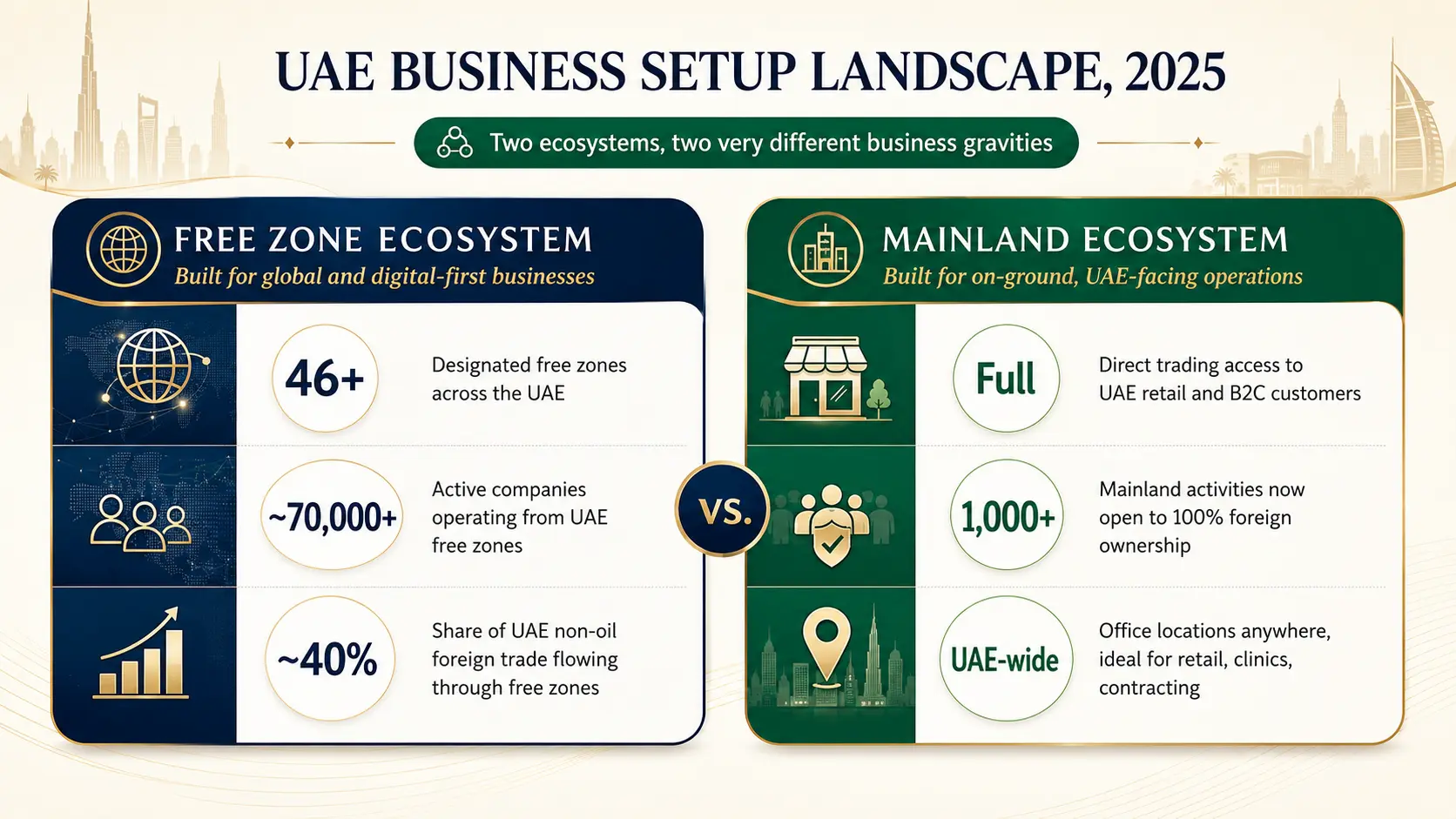
Source: UAE Ministry of Economy, with free zone trade share data from UAE Federal Competitiveness and Statistics Centre, and ownership reforms from UAE Cabinet (2021).
Most Indian entrepreneurs — especially those used to navigating Indian regulations, GST, and frequent RBI/KYC updates — want clarity, control, and as little bureaucratic friction as possible.
That’s why, for many Indians, a Dubai free zone, such as Meydan Free Zone, becomes the more natural starting point, while mainland fits a narrower but important set of business models.
If you’d like tailored guidance, you can book a business setup consultation with Meydan Free Zone.
How Dubai Free Zones and Mainland Work in Reality for Indians
On a regulatory level:
- Mainland companies are licensed by the Dubai Department of Economy & Tourism (DET).
- Free zone companies are licensed by individual free zone authorities.
But that’s just the legal label. What Indian entrepreneurs care about is:
- Can I own 100% of my company?
- Will I be stuck depending on a local partner or PRO?
- Will UAE banks see my structure as credible?
- How fast can I get my visa, bring my family, and open a bank account?
- If my clients are in India, the Gulf, UK, or US, do I really need mainland?
This is where free zones — especially a central, Dubai-based one like Meydan Free Zone — often line up more closely with Indian expectations of control and predictability.
Why Indian Entrepreneurs Gravitate Towards Free Zones First
Think about how most Indian businesses evolve:
- A consultant or freelancer goes from individual GST registration to a private limited or LLP.
- An SME exporter in Surat or Ludhiana tests a new market before committing to warehouses and staff.
- A tech founder in Bengaluru starts with remote clients before opening a local office.
Free zones fit this “start lean, scale smart” philosophy.
Key reasons Indian founders prefer free zones:
[blockFaqsCategory]
[blockCTATradeLicense]
Where Mainland Still Matters — But Often for a Different Kind of Indian Business
Mainland is not “worse” than free zones; it’s built for different use-cases.
It becomes relevant when:
- You’re opening a restaurant, café, supermarket, clinic, or salon.
- You want a retail presence in a busy Dubai locality.
- You’re involved in logistics, transport, construction, or on-ground services.
- You plan to regularly bid on UAE government tenders.
In those scenarios, the ability to trade directly with UAE customers without intermediaries is critical.
That said, even in these cases, some Indian groups start with a free zone holding or services entity for strategic reasons, and then add a mainland arm later. It’s a layered approach: free zone for group structure and global operations, mainland for local retail or execution.
Dubai Free Zone vs Mainland for Indians: A Side-by-Side View
Here’s a comparison:
[blockCTABizActivityList]
Taxation: How Free Zones and Mainland Actually Feel for Indians
Indians are used to income tax slabs, GST, TDS, and frequent changes. Dubai’s system is simpler, but corporate tax does exist.
- Personal income tax: None, for both free zone and mainland.
- Corporate tax: Applies above certain profit thresholds, with different treatment for qualifying free zone entities.
For a qualifying free zone business that meets the UAE rules, the structure can be extremely tax-efficient when set up and managed correctly. If you mostly serve international clients and keep your operations compliant, this is a big reason many Indian entrepreneurs prefer a free zone model.
Mainland companies follow the standard corporate tax rules once they cross profit thresholds. It’s not a reason to avoid mainland if your business genuinely needs physical local operations — but if you don’t, a free zone can offer more optimised outcomes.
For official rules, you can always cross-check on the UAE Ministry of Finance website.
Visas, Family, and Other Priorities
Most Indian founders don’t think only about the company. They think about:
- “Can I bring my spouse and kids soon?”
- “Will my child’s schooling be affected?”
- “If parents need to visit frequently, how easy is that?”
Both free zone and mainland companies can sponsor investor and employee visas. What differs is the structure and experience.
From a free zone like Meydan Free Zone:
- You get an investor visa path linked to your company.
- You can sponsor your family once your residency is active.
- You deal primarily with one authority, not multiple detached offices.
- Through mResidency, your visa journey stays in one ecosystem — useful if you’re coordinating things while still flying in and out of India.
On mainland, the visa ecosystem is more distributed and often handled through multiple service providers, which works fine, but may feel less “one-window” than a well-run free zone.
[blockCTANameCheck]
Bank Accounts, KYC, and the Indian Reality
Let’s be honest: Indian entrepreneurs are used to long KYC forms, repeated bank visits, and compliance questions. UAE banks are also cautious, particularly around:
- Source of funds
- Nature of business
- Expected transaction volumes
- Cross-border flows involving India
Here’s where the licensing authority you choose matters. A Dubai-based free zone with strong governance and a clear reputation — like Meydan Free Zone — gives banks greater comfort that your business has been properly vetted at the licensing stage.
You’ll still need to provide documents, financial proofs, and a clear business plan, but your jurisdiction itself will not be a barrier. Many Indian founders appreciate this when they see how closely UAE banks look at the details.
So Which Should Indian Entrepreneurs Choose: Free Zone or Mainland?
[blockTabulatorSolid1]
[blockCTACostCalculator]
In Conclusion: Start with Your Business Reality, Not the Hype
For Indian entrepreneurs, Dubai is not just about lower tax or a nicer skyline. It’s about:
- A place where your hard work compounds faster,
- your family feels safe and settled, and
- your business is not slowed down by the kind of administrative delays you may be used to back home.
If your model is global-first or service-led, a Dubai free zone such as Meydan Free Zone is usually the smarter, more flexible, and more Indian-friendly entry route. Mainland remains powerful, but more suitable once you’re committed to local, on-ground operations.
When you’re ready to move from research to action, you can book a business setup consultation or speak to the Meydan Free Zone team to map this decision to your exact business plan.
Citations
¹ Dubai Chamber of Commerce, "13,851 Indian companies join Dubai Chamber in 9M 2025," via Economy Middle East, December 2025.