Table of Contents
Frequently Asked Questions
1. Why do Indian exporters use Dubai for fresh produce distribution instead of shipping directly to buyers?
Direct shipping works when volumes are committed to a single buyer and market. Dubai becomes relevant when exporters serve multiple regions or face demand variability. A distribution base allows inventory to be redirected across the GCC, Africa, or nearby markets after arrival, reducing the risk of distress selling, rejection, or quality loss during long transit cycles.
2. Does using Dubai increase shelf life for fresh produce?
No. Dubai does not extend the biological shelf life of fruits or vegetables. Its advantages are operational, faster clearance, shorter redistribution time, and controlled cold-chain handling. The value comes from reducing delays between arrival and final delivery, which helps preserve marketable quality.
3. What types of fresh produce benefit most from a Dubai distribution model?
Indian fresh produce products with short selling windows or high-grade sensitivity benefit the most. This includes table grapes, premium mangoes, berries, leafy herbs, okra, pomegranates, and other perishables where small delays can lead to price downgrades, rejection, or increased waste.
4. How long does it take to set up an entity in Dubai for fresh produce trading and start operations?
Setup timelines depend on the license route you choose. With Meydan Free Zone’s Fawri business license, eligible companies can be incorporated in under 60 minutes. If you opt for the Regular license, company formation is typically completed within one business day. To plan costs in advance, founders can use Meydan Free Zone’s online Setup Cost Calculator to estimate total fees based on license type, business activities, visa requirements, and operational needs.
5. Why is a UAE-based trading entity often required for fresh produce distribution in Dubai?
Operating through a local entity allows exporters to invoice regional buyers, manage multiple customers, and hold inventory within the UAE for redistribution. It also supports faster buyer onboarding and more predictable settlement since banks and counterparties assess risk based on local documentation and jurisdictional clarity.
Topic Summary
1. Strategic Geographical Location
Dubai’s position at the crossroads of Europe, Asia, and Africa allows for rapid access to major global markets, reducing transit times significantly.
2. World-Class Logistics Infrastructure
With state-of-the-art port facilities, dedicated cold chain warehouses, and efficient air cargo hubs, Dubai ensures optimal handling and minimal temperature breaks for fresh produce.
3. Streamlined Customs and Regulatory Processes
Dubai offers efficient customs clearance procedures, minimizing port dwell time and reducing delays that can compromise produce quality.
4. Advanced Cold Chain Capabilities
Sophisticated temperature-controlled storage and transportation systems in Dubai maintain produce freshness, extending shelf life and reducing losses.
5. Robust Financial and Payment Systems
Dubai’s secure and reliable payment infrastructure facilitates timely transactions, minimizing financial risks associated with delayed payments in fresh produce trade.
Why Dubai Is The Best Location For Global Fresh Produce Distribution
Fresh produce exporters don’t lose money on demand. They lose it on time, temperature breaks, and payment delays. In India, the friction shows up as port dwell time, missed air cut-offs, multi-stage handling, and the familiar risk of shipments in transit while cash remains uncertain. Once produce leaves the packhouse, control drops quickly. Every additional hour outside optimal conditions increases the chance of quality downgrades, buyer claims, or price renegotiation.
Fruits, vegetables, herbs, and other perishables are time-sensitive assets. Shelf life shortens continuously, and even minor delays can shift a shipment from premium grade to clearance pricing. Global buyers don’t adjust for origin constraints. They expect frequent arrivals, consistent quality, and short lead times, and they price variability accordingly.
Per APEDA (Ministry of Commerce)¹, India exported fresh fruits and vegetables worth USD 1.82 billion in FY 2024-25, with the UAE among the top six destinations alongside the USA, Bangladesh, China, Saudi Arabia, and the UK. India is the world's largest producer of mangoes, bananas, onions, and okra.
This is where fresh produce distribution in Dubai can change your operating model. Per the UN Food Systems Hub², the UAE imports close to 90% of its food requirements, creating constant demand and rapid turnover. With integrated cold-chain infrastructure, faster clearance, and access to multiple regional markets within hours, Dubai reduces execution risk between harvest and payment, the point where most exporter margins are actually won or lost.
The structural argument for fresh produce isn't just port quality or cold chain, it's the geographic reach that opens up once a shipment lands in Dubai. Most of the world's major produce markets sit within roughly eight hours by air.
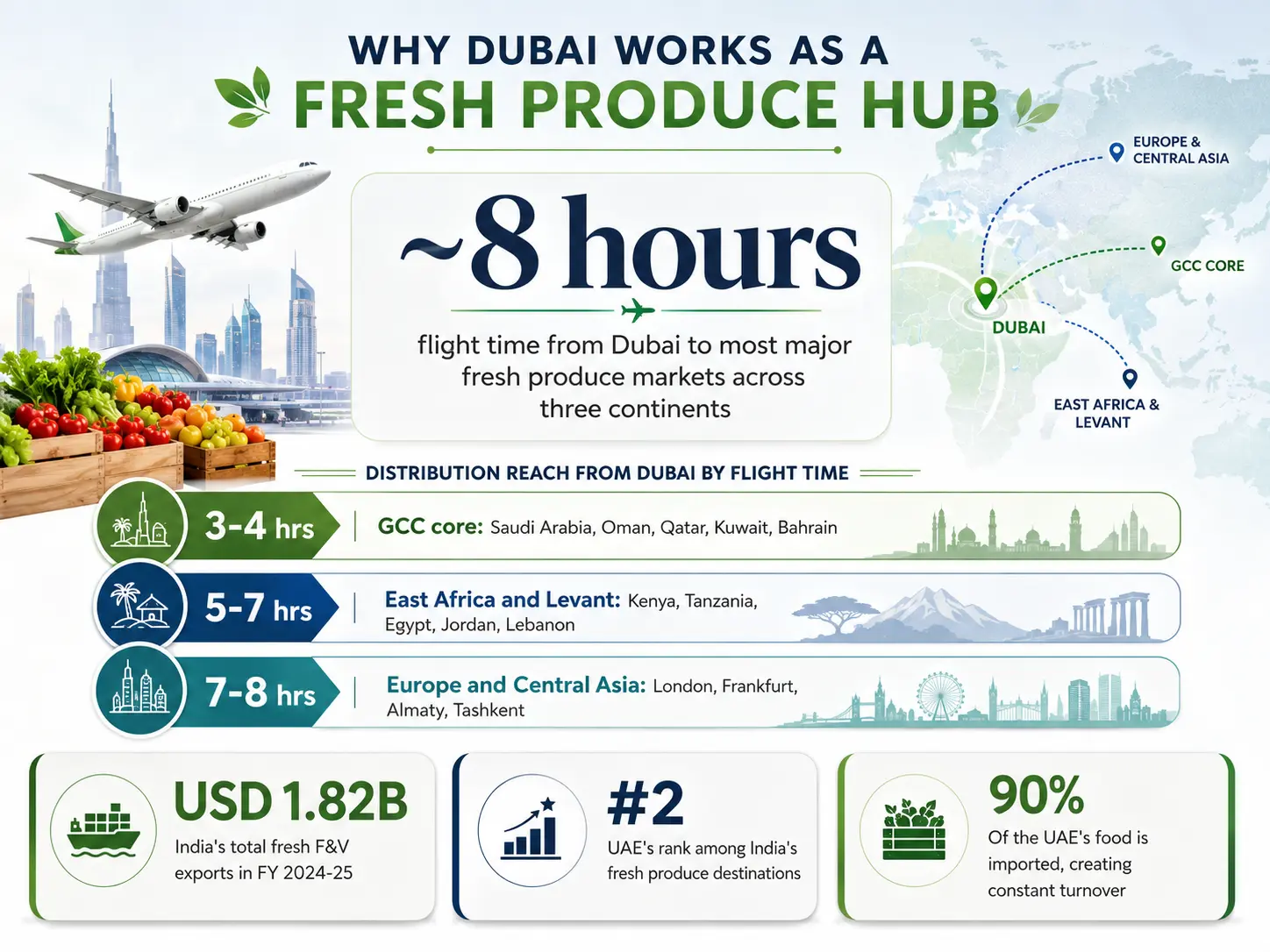
Source: APEDA, UN COMTRADE, UN Food Systems Hub, and Dubai Airports operational data, via APEDA India
The Hidden Cost of Delay in Indian Fresh Produce Exports
For Indian exporters, delays translate directly into margin loss.
This pressure is visible across India’s core export categories: Nashik grapes, Alphonso and Banganapalli mangoes, pomegranates, okra, green chillies, coriander, and curry leaves. These products move within tight harvest windows and depend on uninterrupted cold-chain handling. Once the shipment leaves India, port delays, missed air connections, or temperature breaks quickly show up at the destination as softer fruit, weight loss, or reduced shelf life.
The key trade-off is simple: bulk shipping rewards volume economics, but perishables reward reliability economics. For short-window products like grapes, premium mangoes, or leafy herbs, the cheapest route often becomes the most expensive once you factor in:
- Quality downgrades and price adjustments
- Chargebacks for delays or temperature deviations
- Working capital locked during quality disputes
Buyers in the GCC and Europe now prefer smaller, frequent replenishment to manage their own risk. Centralised distribution hubs like Dubai allow exporters to hold inventory closer to demand and release it based on confirmed orders, not forecast assumptions.
[blockCTATradeLicense]
Where Most Indian-Origin-Based Export Models Lose Control
Indian exporters typically run tight upstream operations: sourcing, grading, pre-cooling, and packing. The challenge begins after dispatch. When transit conditions change, through a connection delay, inspection hold, or revised receiving slot, flexibility is limited.
The exposure usually shows up in four areas:
- Long transit distance: Separate direct shipments to the US, EU, and GCC increase timing variability.
- Single-destination dependence: If the buyer delays or rejects, rerouting is difficult without quality loss.
- Handling risk in transit: Each transfer point increases the chance of temperature deviation.
- Working capital in motion: Payments to growers and logistics are committed while settlement remains pending.
Fresh Produce Distribution in Dubai for Indian Exporters: The Structural Advantage
Dubai works well as a distribution base because it compresses distance to multiple end markets. For Indian exporters, this means fewer days in transit, fewer uncontrolled handovers, and the ability to redirect inventory when demand shifts.
[blockFaqsCategory]
Tapping Into Dubai’s Re-Export Flexibility and Price Control
For Indian exporters, the risk is rarely lack of demand. The real risk is being locked into one buyer or one market while the product’s quality window keeps shrinking.
Dubai, as a distribution hub, changes that. Instead of committing the entire shipment from India to a single destination, you can land volume in Dubai, then grade, repack, and dispatch based on actual demand.
This affects pricing in practical ways:
- Market choice after arrival: The same shipment can be allocated across the GCC, Africa, Europe, or nearby regions depending on where demand is strongest.
- Less pressure to discount: If one buyer delays or reduces intake, the product can be moved to another channel before quality drops.
- Better grade management: Top-grade fruit can go to retail programmes, while secondary grades move through wholesale without pulling down the overall price.
In fresh produce, the ability to redirect quickly often determines whether you sell at market price or negotiate after quality has already slipped.
Why Business Structure Matters for Global Fresh Produce Distribution
A distribution hub only works if the commercial structure supports how you actually sell. In many multi-market models, this means operating through a UAE-based trading entity that enables:
The practical question is simple: does this structure reduce more loss from spoilage, rejection, or delayed payment than it adds in operating cost?
For Indian fresh produce exporters, that’s where the choice of jurisdiction matters and where the value of a free zone comes in.
Indian trading operators opt for a jurisdiction like Meydan Free Zone when speed and execution matter. It’s structured to reduce setup friction through:
- Fully digital company formation, avoiding travel and physical documentation delays
- Passport-only setup
- Trading business activities that align with import, export, and distribution operations
- A guaranteed IBAN through partner UAE banks, helping close the common gap between company formation and banking readiness
- Upfront cost visibility (trade license, visas, business activities, operational fees) through an online Cost Calculator
- A rapid setup route through Fawri, positioned for company formation in under 60 minutes
For Indian founders used to managing APEDA registrations, phytosanitary certifications, port inspections, and tight harvest-to-shipment timelines, this kind of structural clarity isn’t a convenience; it’s operational control during the narrow window when fresh produce still holds its value.
[blockCTABizActivityList]
In Conclusion
For Indian exporters, production strength is rarely the constraint. The risk sits downstream: long transit exposure, single-market dependence, and limited control once the shipment leaves.
The decision, then, is no longer just about where to sell. It is about whether to treat each shipment as a one-time destination or to operate from a base that allows inventory, pricing, and buyer allocation to be managed in real time.
Exporters who build the right structure, with flexible licensing, local invoicing capability, banking readiness, and the ability to serve multiple markets, are better positioned to protect margins when conditions change. At that point, the choice of jurisdiction and setup speed stops being administrative. It becomes part of the commercial model that determines how consistently value is preserved between harvest and payment.
Citations
¹ APEDA (Agricultural and Processed Food Products Export Development Authority), Ministry of Commerce, Government of India, "Fresh Fruits & Vegetables," FY 2024-25.
² UN Food Systems Hub, "United Arab Emirates National Pathways," 2021.