

Table of Contents
Frequently Asked Questions
FAQs
1. What is the easiest way for Indians to start a business in Dubai from India?
The easiest route is to set up through a Dubai free zone that allows fully digital formation. For most Indians, the process involves submitting your passport and KYC online, choosing your business activities, receiving your license digitally, and then opening a UAE corporate bank account. No travel is required initially.
2. Do I need to be in Dubai to start the company?
No. Indians can start a Dubai company completely remotely. You only need to visit Dubai later if you choose to apply for a residency visa or if your selected bank requires an in-person verification.
3. How much does it cost for Indians to start a Dubai company?
Most Indian founders pay between AED 12,500 and AED 15,000 for a Meydan Free Zone business license in Dubai. Visa costs, Emirates ID fees and bank minimum balance requirements vary depending on your structure and activity.
4. What documents do Indians need for Dubai business setup?
In most free zones, you only need a valid passport, a passport-size photograph, your chosen business activities and basic KYC details. You do not need PAN, Aadhaar, GST, Indian bank statements or notarised documents for a standard free zone setup.
5. Can Indians own 100% of a Dubai company?
Yes. Dubai free zones allow 100% foreign ownership, and current UAE regulations also permit full ownership for most mainland activities. There is no requirement for a local partner for most business types.
6. Can I run my Dubai company from India?
Yes. Many Indian entrepreneurs operate remotely while serving UAE, GCC and global clients. You can add a UAE residency visa later if you plan to spend more time in Dubai or hire employees.
Topic Summary
1. Research and Choose the Right Business Activity
Begin by identifying the business activity you want to pursue in Dubai. The Dubai Department of Economic Development (DED) classifies activities into commercial, industrial, professional, and tourism sectors. Your choice will determine licensing requirements and permissible locations.
2. Select a Suitable Business Jurisdiction
Dubai offers three main jurisdictions: Mainland, Free Zone, and Offshore. Mainland businesses allow you to trade within the UAE market directly, Free Zones offer tax benefits and full ownership but restrict domestic trade, while Offshore setups are ideal for asset management and international business.
3. Apply for the Required Trade License
Obtain the necessary trade license from the relevant authority based on your chosen jurisdiction and business activity. Licenses include commercial, professional, industrial, and tourism licenses. Prepare all required documents like passport copies, business plans, and proof of address.
4. Register Your Business and Secure Visas
Submit your application to the appropriate authorities (DED, Free Zone Authority, or Offshore Registrar). Once approved, complete the registration process, which includes signing the Memorandum of Association (MOA) if applicable. After company registration, apply for residency visas for yourself and your employees.
5. Open a Corporate Bank Account
Choose a reputable bank in Dubai to open your business account. Banks require company documents, trade licenses, shareholder information, and proof of residence. Some banks also have compliance requirements specific to Indian nationals, so prepare for possible additional documentation.
Starting a business in Dubai from India involves careful planning and compliance with local regulations, but with the right approach, it offers significant growth potential and international exposure.
How to Start a Business in Dubai from India: The Complete 2026 Guide
If you’re an Indian entrepreneur, chances are Dubai has been sitting in the back of your mind for a while.
Maybe it’s the constant unpredictability of Indian compliance, GST portals crashing on filing day, MCA websites going into downtime exactly when you need a certificate, or banks asking for “one more document” every time a form gets updated.
Or maybe it’s the simple desire to build something global without having to fight administrative fires at every step.
Dubai offers an antidote to that reality.
It is close enough to India to feel familiar, yet structured enough to give founders the regulatory clarity they rarely experience at home. And in the last few years, the connection between India and the UAE has deepened to the point that Dubai is almost becoming India’s global office.
According to the UAE-India Business Council via Times of Oman¹, India-UAE bilateral trade crossed USD 101.25 billion in FY 2025-26, making the UAE one of India's biggest partners and putting the two economies firmly on track to hit their joint USD 100 billion non-oil trade target.
Meanwhile, Dubai has doubled down on its ambition to be a digital-first global hub. According to the UAE Government's official Digital Economy Strategy², the UAE aims to double the digital economy's contribution to GDP from 9.7 percent in 2022 to 19.4 percent by 2031, positioning the country as a regional and global hub for the digital economy.
UAE's digital infrastructure isn't an add-on, it's the strategic backbone of the country's economy. The federal government is committed to nearly doubling the digital economy's GDP share by 2031.
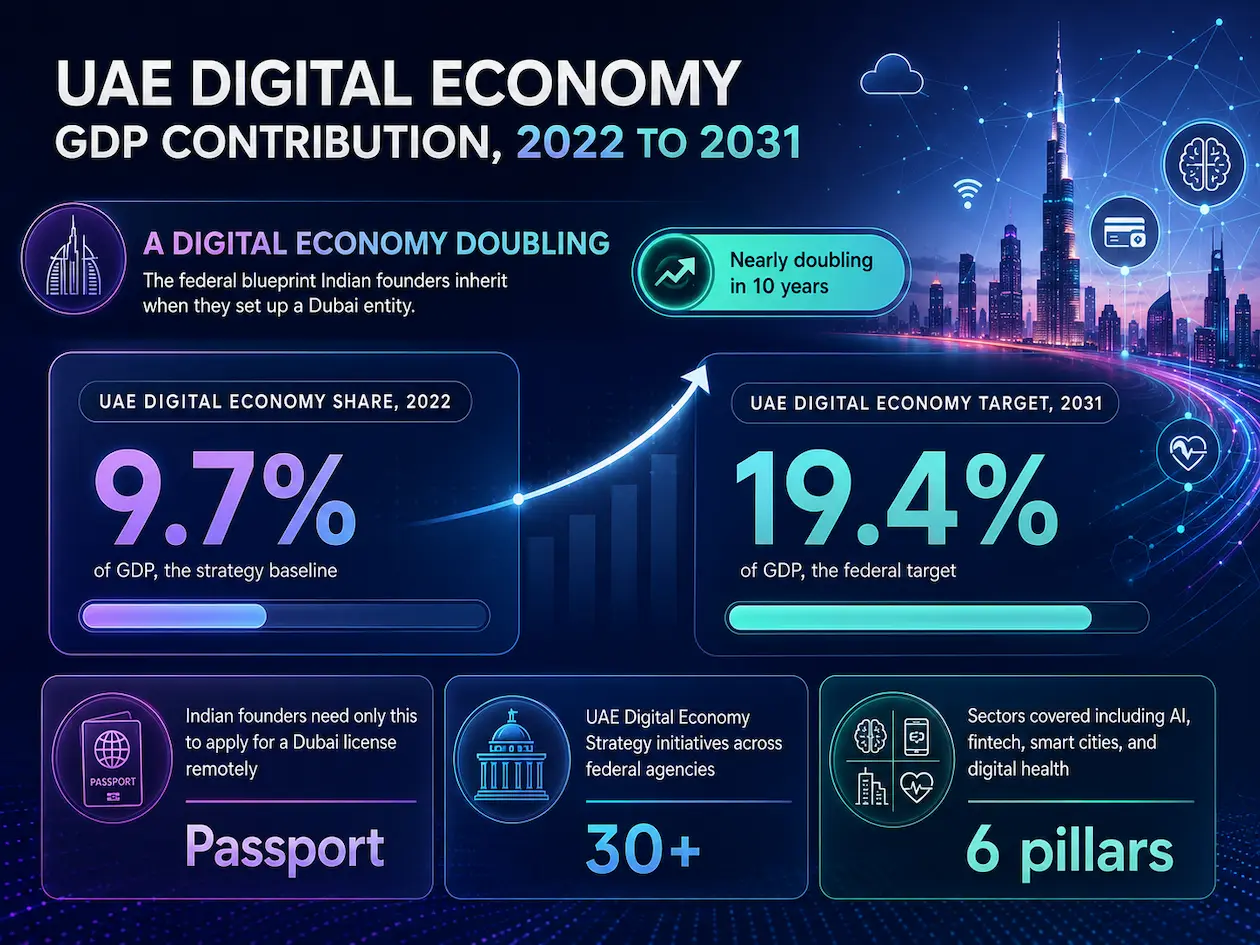
Source: UAE Digital Economy Strategy, UAE Cabinet via WAM, launched April 2022.
This combination, predictable regulation, global access, proximity and economic synergy, is why Indian entrepreneurs are setting up Dubai companies not as a relocation plan, but as a growth strategy.
[blockCTATradeLicense]
Why Dubai Works for Indian Founders in a Way Other Countries Don’t
Dubai is not like incorporating in Singapore or the UK. For Indians, it’s closer, geographically and culturally, and far more practical.
You work in Indian Standard Time plus 1.5 hours. You fly in three hours. You meet clients who already understand Indian expertise. You operate in a tax framework where personal income tax does not exist, corporate tax is clearly defined at 9% and qualifying free zone income can — under UAE rules — be taxed at 0%.
But perhaps the biggest difference is operational. Indian entrepreneurs are used to navigating government doors that open and close inconsistently. Dubai, in contrast, is cleanly digital. Trade license applications, approvals, document retrieval, visa requests — everything sits in structured, predictable systems.
This predictability is why Indians increasingly run dual-ecosystem businesses: operations continue in India, while global contracts, GCC expansion, and cross-border payments flow through a Dubai entity.
[blockCTABizActivityList]
Free Zone or Mainland: The Decision That Shapes Everything
Most Indian founders begin with the question: “Should I choose free zone or mainland?”
The honest answer depends on your business model, not the perceived prestige of either structure. Mainland licenses are ideal when your business relies on a physical presence in the UAE — retail, restaurants, clinics, contracting, salons, logistics or on-ground staff.
Among Dubai’s free zones, Meydan Free Zone is one of the most Indian-friendly for very specific reasons: it offers a fully digital company formation pathway, MoFA-accredited licenses, over 2,500 business activities, and a guided IBAN setup through partner banks familiar with Indian founders.
For Indians who fear banking hurdles more than licensing, that last part is critical.
The Actual Process: How Indians Start a Dubai Company From India
Most Indian founders don’t believe this until they see it: you can start a business in Dubai from India with a passport, an internet connection and about an hour of your time.
[blockAccordionSteps]
[blockCTANameCheck]
How Indians Actually Use Their Dubai Company
What makes Dubai uniquely suited for Indian founders is its compatibility with the Indian ecosystem. Almost every major Indian city has a business segment that scales beautifully with a Dubai entity:
- Bengaluru / Hyderabad – SaaS, data, cyber, AI, devops teams needing a global billing layer
- Delhi / Mumbai – consulting firms, agencies, coaches, investment professionals
- Surat / Tiruppur / Ludhiana – textile exporters using Dubai as a re-export hub
- Kochi / Chennai – shipping, logistics, marine services
- Pune / Gurgaon – tech-led SME operations, B2B advisors, digital studios
In each case, India remains the engine.
Dubai becomes the global gateway.
Costs, Timelines and Realistic Expectations
A Dubai business setup is not “cheap”, but it is predictable, something Indian founders deeply value.
A typical timeline looks like this:
- Business license: less than an hour (with Fawri) to a couple of days
- Bank account: 5–20 working days
- Investor visa: ~2–4 weeks (if you choose to take one)
A realistic cost structure includes the license fee, optional visa charges, Emirates ID, medical exams, and bank minimum balance requirements depending on the chosen bank.
Unlike India, you won’t face hidden compliance or new surprise filings every quarter.
Starting a Dubai Company From India Is Not a Leap, It’s a Lift
For Indian founders, Dubai is not an escape from India. It’s an expansion.
It gives you a stable regulatory home for your global ambitions while allowing you to keep your Indian operations, teams, and roots intact.
If your business is digital-first, cross-border, consulting-led, trading-oriented, or global in ambition, Dubai offers something unique: the ability to build globally without relocating immediately.
And if you want a smooth, digital-first setup that matches Indian working styles, Meydan Free Zone offers a direct route into Dubai’s ecosystem through transparent licensing, 2,500+ business activity options, and a guaranteed IBAN that removes the friction Indian founders fear most.
You can begin your journey here, book a business setup consultation or explore costs with the Meydan Free Zone cost calculator.
Dubai may be three hours away.
Your global business, even closer.
[blockCTACostCalculator]
Planning to set up your business in Dubai? Explore our comprehensive guide on Shipping from India to Dubai, covering licensing requirements, costs, approvals, and the step-by-step business setup process.
Citations
¹ UAE-India Business Council (UICC), "The UAE-India CEPA at Four: Bilateral Trade Crosses USD 100 Billion for Second Year," via Times of Oman, May 2026.
² UAE Government, "Digital Economy Strategy," via The Official Platform of the UAE Government, April 2022.