
Table of Contents
Frequently Asked Questions
1. Do I need a UAE company to import vegetables from India?
Not necessarily. You can supply through a UAE distributor who acts as the importer of record. However, the distributor controls product registrations, import permits, and compliance history. If you want direct buyer access, pricing control, and clearance predictability under your own record, setting up a UAE trading entity, such as through Meydan Free Zone, allows you to operate as the importer of record.
2. What licenses are required to import fresh vegetables into Dubai?
The importer must hold a UAE trade license that includes food trading or fruit and vegetable trading activity. This license must be active before applying for a customs importer code, registering products in FIRS, or submitting import requests for shipments.
3. Is FIRS registration required for every shipment?
Product registration in FIRS is completed once per product. However, an import request must be submitted and approved in FIRS for each consignment. If a shipment arrives without an approved request, it will be held at the port until clearance is granted.
4. What documents are required from the India side for each consignment?
Each shipment must include a phytosanitary certificate, commercial invoice, packing list, bill of lading or airway bill, and certificate of origin. Product description, quantity, weight, and consignee details must match the UAE import request and FIRS record to avoid inspection delays.
5. How long does it take to get a customs importer code in Dubai?
After the UAE trade license is issued, the customs importer code is typically processed within a few days, depending on documentation and system activation. Shipments cannot be cleared without an active importer code. With mPlus, Meydan Free Zone supports the process, enabling customs code activation in as little as three days.
6. What is the biggest risk when importing fresh vegetables into the UAE?
The primary risk is delay. Cold chain breaks, document mismatches, expired phytosanitary certificates, or missing FIRS approvals can hold shipments at port. For perishable vegetables, clearance delays reduce shelf life and directly affect selling price.
7. Why do many exporters set up their own UAE trading entity instead of relying on distributors?
Operating through your own entity allows product registrations, import permits, and compliance history to sit under your business, improving clearance predictability over time. It also enables direct invoicing to buyers and local banking access. Free zones such as Meydan Free Zone allow Indian exporters to establish this structure quickly through a Fawri business license issued in under 60 minutes and operate as the importer of record.
Topic Summary
1. Valid Trade License
The importer of record must possess a valid trade licence registered in the UAE. This licence authorises the importation of goods and links the entity legally to the shipment.
2. Customs Code Registration
The importing entity must be registered with the UAE Customs, obtaining a customs code. This code is essential for customs clearance and monitoring the movement of goods.
3. FIRS Registration
Registration with the Federal Import and Re-export System (FIRS) is mandatory. The importer must use their FIRS account to submit import requests and manage approval processes for each shipment.
4. Import Permit
Prior to the arrival of goods, the importer must apply for an import permit through FIRS. This process requires submission of documentation including the phytosanitary certificate (where applicable), commercial invoice, packing list, and bill of lading details.
5. Compliance with Regulatory Approvals
The importer must ensure all regulatory approvals related to the specific goods are secured. This may include clearance from ministries such as the Ministry of Climate Change and Environment or the Ministry of Health, depending on the nature of the imports.
Importing Fresh Vegetables from India to UAE: License and Compliance Guide
If you're sourcing onions from Nashik, okra from Gujarat, green chillies from Andhra, or tomatoes from Karnataka and want to land them in Dubai, the commercial logic is straightforward. Per the Atlantic Council¹, the UAE imports over 90% of its food, not by choice, but by geography.
Desert climate, almost no arable land, and a population that expects fresh produce on supermarket shelves every morning. India fills that gap. Per Volza trade data², 79,395 shipments of fresh vegetables moved from India to the UAE in a single twelve-month window, pushed by 1,830 Indian exporters into the hands of 2,576 UAE-based buyers.
The products aren't exotic. They're staples. Onions, potatoes, tomatoes, cauliflower, okra, and leafy greens. The same vegetables that move through Azadpur Mandi every morning are clearing customs at Jebel Ali every evening.
Onions are the single highest-volume line in this trade, and our dedicated guide on how to import Indian onions to Dubai covers the APEDA rules, phytosanitary certificate, and Minimum Export Price declarations specific to that product.
Per Gulf News³, 4.3 million Indian nationals live in the UAE, making up 35% of the country's total population. They're not switching to imported European vegetables. They want the same sabzi they grew up cooking. Add to that the hotels, restaurants, catering companies, and cloud kitchens across Dubai and Abu Dhabi that serve Indian cuisine at scale, and you have a demand base that doesn't fluctuate with seasons or trends.
The friction isn't market access. It's the compliance stack on both ends, India's export licensing and the UAE's import registration, and the sequence in which you execute them. If you want to import vegetables from India to the UAE, this guide covers the licensing architecture, what each approval actually controls, and where the execution risk sits for an Indian operator setting up a fresh vegetable import business in the UAE.
The India-to-UAE fresh vegetable trade is already a fragmented, established corridor with 1,830 exporters and 2,576 buyers, all moving inside a wider $100 billion bilateral trade relationship that the two governments are working to double by 2032.
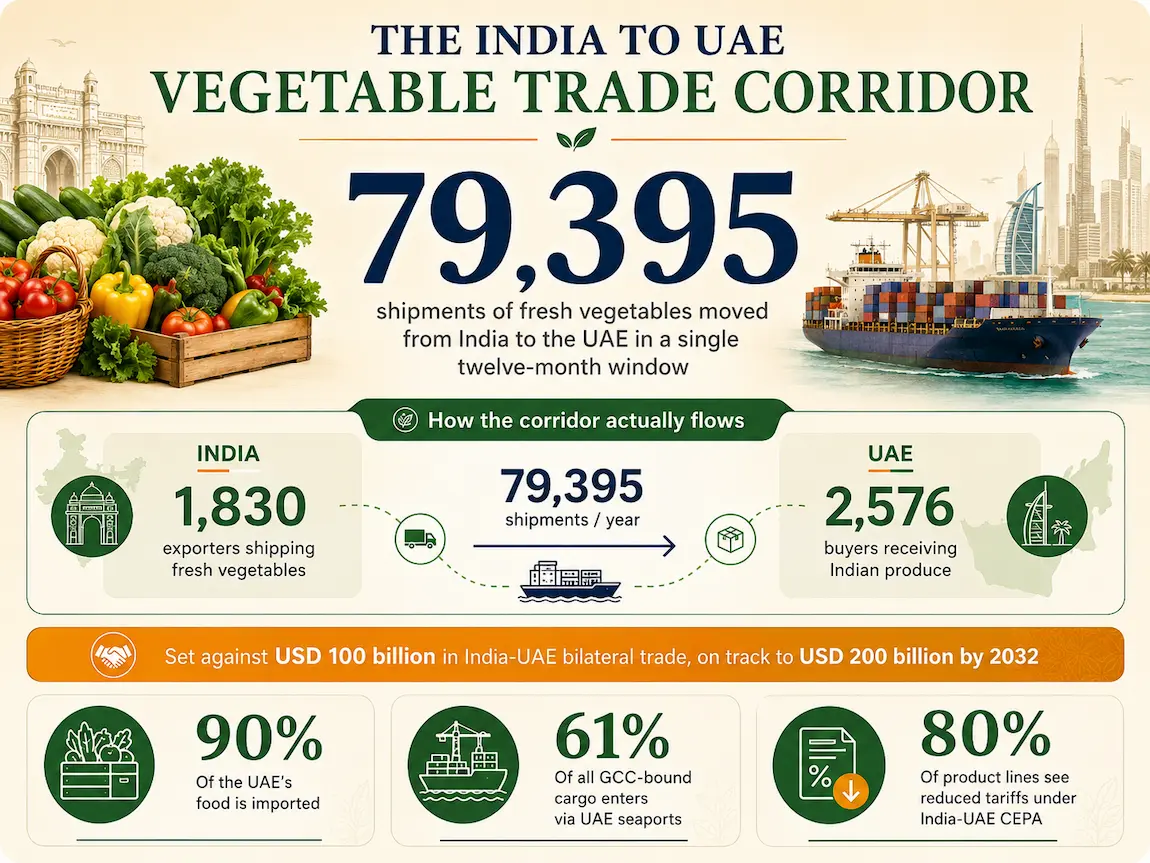
Source: India Brand Equity Foundation (IBEF), USDA Foreign Agricultural Service, and Atlantic Council, via IBEF
[blockCTATradeLicense]
Why India-to-UAE Is the Right Trade Corridor for Fresh Vegetables
The India Brand Equity Foundation reports that India-UAE bilateral trade crossed USD 100 billion in FY 2024-25, up 19.6% year-on-year⁴. Middle East Briefing notes that both governments are now targeting USD 200 billion by 2032⁵. Agri-food sits in a structurally privileged position within that number. The India-UAE Comprehensive Economic Partnership Agreement (CEPA), in force since May 2022, reduced tariffs on over 80% of product lines, including agricultural goods.
What that means in plain terms: if you're shipping okra from India and your competitor is shipping from a non-CEPA country, your landed cost in Dubai is lower before you've negotiated a single freight rate. The tariff advantage is baked into the trade agreement.
Three things matter if you want to import vegetables from India to the UAE:
- You're tapping into a gateway, not just a market: Gulfood confirms the UAE is the largest market for APEDA's scheduled products, including fresh fruits and vegetables⁶, and USDA FAS data shows 61% of all cargo destined for GCC states enters through UAE seaports⁷. Set up in Dubai, and you're serving Saudi, Oman, Qatar, Kuwait, and Bahrain from the same entity.
- Structural demand, not seasonal: The UAE's National Food Security Strategy 2051 explicitly prioritises diversifying food import sources. The World Economic Forum reports GCC countries import up to 85% of their food⁸. This isn't a trade cycle, it's geography and government policy working in your favour.
- Built-in consumption base: There are 4.3 million Indian nationals in the UAE³. Hotels, cloud kitchens, and catering companies serving Indian food at scale add bulk demand on top.
What You Need on the India Side Before You Ship
Before a single kilogram leaves India, your export entity needs five things in place, in this order:
[blockFaqsCategory]
If you're already running a domestic vegetable trading business in India, IEC and GST are probably in place. APEDA and FSSAI are the two that catch first-time exporters off guard, usually when the first shipment is already packed and waiting.
What You Need on the UAE Side Before You Import
In the UAE, all approvals sit with the importer of record: the entity whose trade license, customs code, and FIRS registrations are used to clear the shipment. Every requirement below applies to that entity. Here's what you need to secure:
[blockFaqsRequirements]
[blockCTABizActivityList]
Navigating Execution Risk for Fresh Vegetable Shipments
Cold chain breaks are the first exposure. Okra, leafy greens, coriander, and beans lose market quality fast if temperature control is interrupted during inland transport, port handling, or customs waiting time. Even durable items like onions and potatoes lose weight and visual quality in heat. UAE inspections assess physical condition on arrival; if the product has deteriorated, the consignment gets downgraded or rejected regardless of paperwork.
Document validity versus transit time is the second risk. Phytosanitary certificates are evaluated at arrival, not dispatch. If vessel delays or port congestion push the shipment outside the acceptable validity window, authorities may require re-inspection or place the cargo on hold. For short-shelf-life vegetables, even a one-day delay materially reduces saleable life. System sequencing creates similar exposure. If your product record or shipment approval isn't active in FIRS when the container lands, the cargo waits. Regular items become routine, but new varieties, seasonal additions, or supplier changes often introduce unplanned clearance time.
Label corrections are the most avoidable delay. If packaging needs modification after arrival, the cargo moves into rework instead of direct release, and every additional handling step eats into the selling window.
Deciding Your Business Structure: Distributor Model vs Import Control
In the UAE, the importer of record owns the approvals, product registrations, and compliance history. The structure you choose determines who controls future shipments and how predictable clearance becomes.
| Distributor model | Own UAE trading entity | |
|---|---|---|
| Product registration | FIRS product registrations sit under the distributor's company | Products registered in your company name |
| Import permits | Filed in the distributor's name | Stay within your own structure |
| Inspection history | Belongs to the distributor's municipal risk profile | Builds against your shipments over time |
| Buyer relationships | Retail access and pricing visibility remain indirect | Buyers are invoiced directly under your trade license |
| Switching cost | Rebuilding product registrations and compliance history if you change distributors | Compliance history stays portable as you scale |
| Clearance predictability | Subject to the distributor's track record | Typically stabilises as your record remains clean |
[blockCTANameCheck]
Where Meydan Free Zone Fits in a Fresh Vegetable Operation
In fresh vegetable trade, the risk is timing. Product registration, import permits, customs activation, and banking must be ready before the first container arrives. If the UAE entity is still being set up when the shipment lands, the cargo waits, and waiting reduces saleable life.
Meydan Free Zone is built to shorten that setup window. Through Fawri, your LLC trade license can be issued 100% digitally in under 60 minutes once documentation is complete.
For vegetable imports, the license must include the correct business activity:
Fruit and Vegetable Trading (Activity Code 4721.67).
This alignment matters because FIRS registration, municipal approvals, and customs activation are validated against the licensed activity. If the classification does not match the cargo, the delay appears at clearance.
Once the license is active, the operational pieces can move quickly:
- Customs importer code processed in as little as 3 days
- Vegetable products registered in FIRS under your company
- Import permits filed directly for each shipment
- Dubai Municipality inspection history built against your entity
Banking is the second operational constraint. Meydan Free Zone offers a guaranteed IBAN pathway through partner banks, allowing payments from UAE buyers to flow directly into your corporate account. In a wholesale vegetable business where inventory turns quickly, faster settlement means tighter working capital control.
With the structure in place:
- Buyers pay your company directly
- Compliance records stay under your license
- Clearance predictability improves as your shipment history remains clean
In fresh vegetables, the value of the structure is practical. Approvals, banking, and compliance sit within the same entity, reducing delays and improving the chances that the product reaches the market while it is still saleable.
[blockCTACostCalculator]
In Conclusion
The India–UAE vegetable trade is not constrained by demand. The market is established, the tariff environment is favourable, and consumption is structural. What determines profitability is execution. Fresh vegetables move on a shelf-life clock, which means the UAE entity, product registrations, import approvals, and buyer readiness must all be in place before the shipment lands.
The key decision is control: who holds the importer-of-record status, where the compliance history sits, and how quickly shipments clear and payments return. In fresh produce, margin comes from predictability. Set up your structure before your first shipment moves.
Citations
¹ Atlantic Council, "The UAE's food security challenge," 2024.
³ Gulf News, "UAE president's historic India visit: USD 100 billion trade ties and 4.3 million Indian expats cement unbreakable bond," 2025.
⁴ India Brand Equity Foundation (IBEF), "India-UAE Convene Third CEPA Joint Committee Meeting; Bilateral Trade Crosses US$ 100 Billion," 2025.
⁵ Middle East Briefing, "UAE President's India visit yields trade investment push," 2024.
⁶ Gulfood, "India as Country Partner," 2024.
⁸ World Economic Forum, "Gulf food security innovation," 2025.