Table of Contents
Frequently Asked Questions
1. Why is demand for Indian onions high in the UAE?
Demand is driven by three structural channels: a large Indian diaspora population of approximately 4.36 million residents, a USD 16.58 billion food service sector that uses Indian red onions in high volumes, and the UAE’s role as a re-export hub supplying other GCC markets. These demand streams operate simultaneously and reinforce each other.
2. How much onion does the UAE import from India annually?
The UAE imports approximately 403,000 metric tonnes of Indian onions per year, making it one of India’s largest onion export destinations globally.
3. Does UAE demand for Indian onions fluctuate seasonally?
Retail demand remains relatively stable due to household consumption patterns. Hospitality demand may shift slightly with tourism cycles, but overall volume remains consistent because multiple demand engines operate simultaneously.
4. Why does the UAE act as a gateway for Indian onion exports to the GCC?
Jebel Ali Port functions as a major re-export hub. Onions imported into Dubai are often graded, repackaged and redistributed to Saudi Arabia, Oman, Kuwait, Bahrain and other regional markets, expanding total demand beyond domestic UAE consumption.
5. How does policy in India affect onion demand in the UAE?
Export restrictions, duties and Minimum Export Prices (MEP) can temporarily affect supply volume and pricing. However, structural demand in the UAE remains intact due to diaspora consumption, institutional procurement and regional redistribution.
6. Do Indian exporters need a UAE entity to access all demand channels?
To engage directly with supermarkets, hospitality procurement teams and re-export distributors, exporters typically require a UAE-registered trading entity with proper licensing and compliance registrations. Without one, participation is usually routed through local distributors.
Topic Summary
1. Diaspora Retail
The sizeable Indian expatriate community in the UAE forms a stable and consistent demand base. This segment purchases onions primarily through retail outlets, catering to household consumption patterns rooted in traditional Indian cuisine which relies heavily on onions.
2. Wholesale Trade and Foodservice
Wholesale traders and the foodservice sector constitute a substantial portion of the market. Restaurants, catering services, and hotels maintain steady demand, reacting dynamically to economic conditions, tourism trends, and dining patterns within the UAE.
3. Industrial Processing
Onions are utilised extensively in industrial food processing, including frozen, ready-to-eat meals, and condiment manufacturing. This segment operates on contracts and large-volume purchases, providing a dependable demand engine that is less sensitive to short-term price variations.
4. Supermarket Chains and Hypermarkets
Modern retail formats such as supermarkets and hypermarkets serve both expatriate and local populations. These channels contribute to demand diversification by targeting a broad consumer base with varying preferences, thus stabilising consumption levels.
5. Institutional Procurement
Government institutions, schools, hospitals, and corporate cafeterias procure onions in sizeable quantities to meet daily operational needs. This segment adds to market resilience as procurement is often contract-based and less influenced by retail price volatility.
Why Indian Onions Have Huge Demand in the GCC Market
Every morning in Dubai, before hotels serve breakfast and before restaurants begin prep, onions are already being unloaded.
They arrive from Nashik and Lasalgaon in steady volumes — container after container — and they do not sit idle. They move into retail shelves, hotel kitchens, wholesale markets, and onward trucks bound for Saudi Arabia and Oman.
The demand for Indian onions in the UAE is not seasonal curiosity. It is structural.
Statista, citing APEDA, reports the UAE imports roughly 403,000 metric tonnes of Indian onions annually, making it the third-largest export destination after Bangladesh and Malaysia.¹ But that volume is not driven by a single buyer type or a single consumption pattern. It is sustained by three independent demand engines operating simultaneously.
When one channel slows, the others continue. That layered structure is what makes the GCC market durable.
Understanding those engines is the difference between shipping when prices are attractive and building a position that survives policy cycles, harvest variation, and competition from Egypt, China, and Europe.
This is not simply a question of volume. It is a question of structure.
What makes UAE demand for Indian onions hold steady through price swings and export bans is not its size but its shape: three independent buyer channels, each running on its own logic, so a slowdown in one rarely drags the others with it.
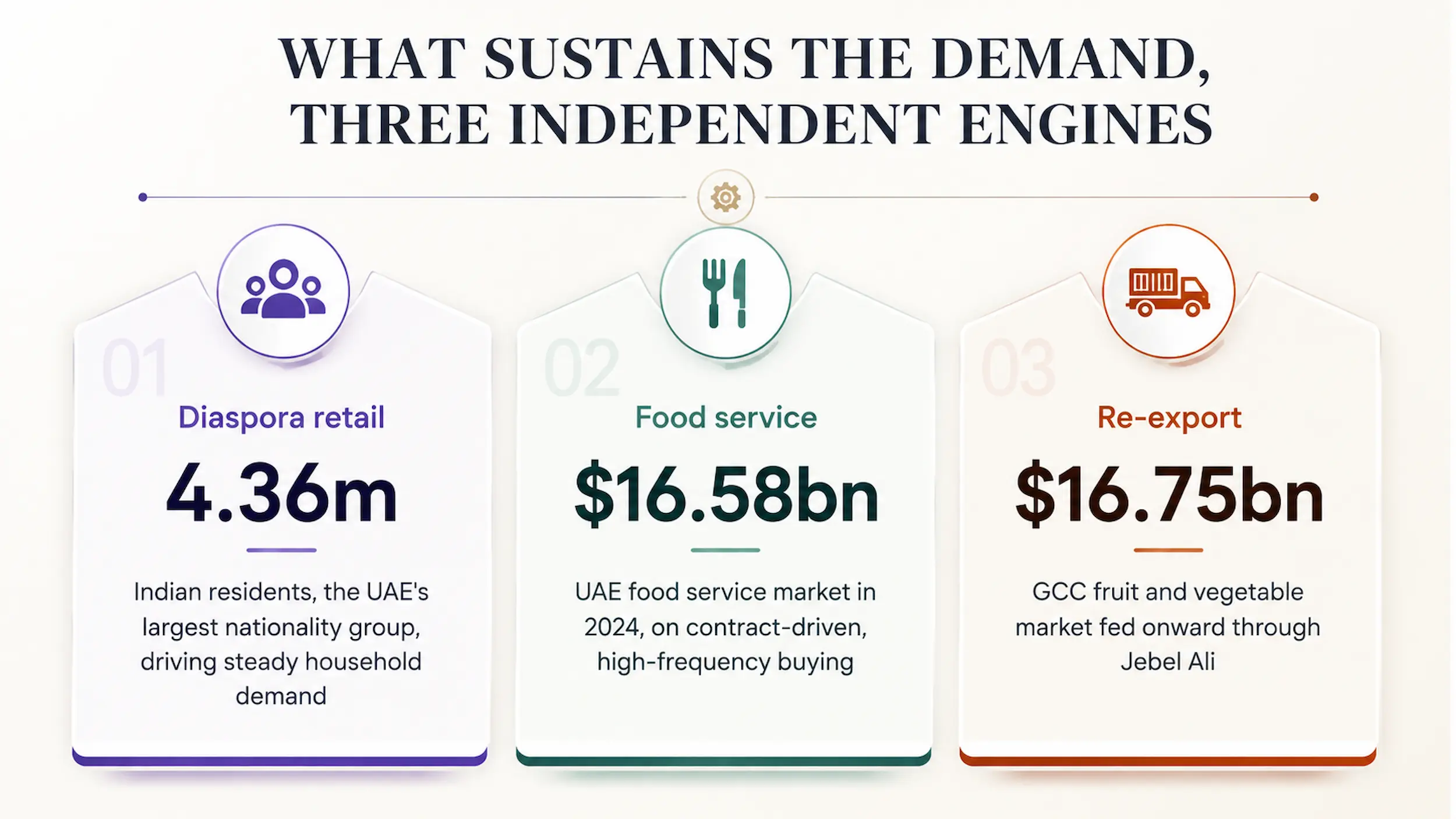
Sources: Gulf News (2025); IMARC Group (2024); Mordor Intelligence (2025).
Three Demand Engines, One Market
The strength of Indian onions demand in the UAE is not just the size of consumption. It is the diversification of that consumption.
The market does not rely on a single buyer class. It runs on three independent demand engines, each responding to different economic signals and each capable of sustaining volume on its own. That layered demand is what keeps annual imports above 400,000 metric tonnes even when pricing fluctuates or policy tightens.
[blockFaqsCategory]
[blockCTACostCalculator]
Why Indian Onions, Specifically
The question of why the GCC buys from India rather than from closer or cheaper suppliers has a straightforward commercial answer, but one that is often stated imprecisely. It is not simply that Indian onions are cheap. It is that Indian onions are available year-round at consistent quality, at competitive price, within a transit window that no European competitor can match.
India has two onion crop cycles annually. The kharif crop harvests between October and January; the rabi crop, which accounts for 70 to 75% of total production, harvests between January and May.
APEDA reports Maharashtra alone, centred on Nashik, contributes 35.45% of national onion production.⁵ This dual-cycle structure means Indian exporters can supply the UAE continuously, without the seasonal gaps that affect Egyptian or Turkish sources.
On transit: sea freight from Nhava Sheva or Mundra to Jebel Ali runs 3 to 5 days. Freshplaza notes Indian red onions, particularly the deep-red, pungent Nashik varieties, currently account for roughly 70% of Dubai's total onion market share.⁶ That share is not coincidental. It reflects the combination of transit advantage, quality consistency, and the cultural specificity of the product for the dominant consumer group in the UAE.
The competitive threat from Egypt, China, and the Netherlands exists but operates in different product segments.
None of these are direct substitutes in the demand channels that Indian red onions occupy.
[blockCTABizActivityList]
What the Demand Structure Means for Exporters
The practical consequence of this three-engine demand model is simple: the UAE onion market is not one conversation. It is three.
- Diaspora retail buyers are driven by product specificity.
- Hospitality procurement teams are driven by volume reliability and invoice consistency.
- Re-export distributors are driven by landed cost and logistics efficiency.
Each transacts differently. Each negotiates differently. Each evaluates suppliers differently.
A single UAE-registered entity, properly licensed and compliant, can engage all three. An Indian exporter selling exclusively through a local distributor engages only one layer — and indirectly at that.
Supermarkets and hotel procurement teams require local invoicing, a UAE-registered counterparty and a compliance record under the Food Import and Re-export System (FIRS). Re-export operators within Jebel Ali Free Zone transact on structured commercial terms with entities that can match their documentation and customs posture.
Without a UAE entity, those relationships remain one step removed.
With one, the exporter controls them directly.
That is where business structure becomes commercially material.
Establishing a UAE trading entity through Meydan Free Zone provides the framework for that control. It offers:
- MoFA-recognised trading licenses accredited by the Dubai Chamber of Commerce
- 100% foreign ownership without a local sponsor
- Fawri license enabling digital incorporation in under 60 minutes once documentation is complete
- Fruit and Vegetable Trading (Activity Code 4721.67) available within the structure
- A guaranteed IBAN pathway through partner banking institutions for local settlement
[blockCTANameCheck]
In Conclusion
Indian onions demand in the UAE is durable because it rests on structure, not sentiment. These demand drivers do not dissolve with short-term price shifts or competitor entry.
The policy cycle between 2023 and 2025 demonstrated that even under export restrictions, Indian onions retained position in the UAE because no alternative supplier satisfies all three engines simultaneously — product specificity, institutional volume reliability and transit efficiency.
For Indian exporters, the question is not whether demand exists. It does. The question is whether the commercial structure — licensing, compliance registration and direct buyer access — is aligned to capture that demand at scale.
Structure determines participation.
Citations
¹ Statista, "Volume of Fresh Onions Exported from India in Financial Year 2023, by Leading Destination," December 4, 2024 (data source: APEDA).
² Gulf News, "Indian expat population in UAE doubles to 4.36 million, more than half live in Dubai: envoys," accessed 2026.
³ IMARC Group, "UAE Food Service Market," accessed 2026.
⁴ Mordor Intelligence, "Analysis of the Fruits and Vegetables Sector in GCC Countries," accessed 2026.
⁵ APEDA, "Fresh Onions," accessed 2026.
⁶ Freshplaza, "India could surpass last year's 1.15 million tonnes of onion exports," accessed 2026.