

Table of Contents
Frequently Asked Questions
1. What is the most common online payment method in the UAE?
Card payments dominate online transactions in the UAE, with Visa and Mastercard accounting for the majority of e-commerce payments.
2. Can Indian e-commerce brands use UAE payment gateways?
Yes. Indian e-commerce brands can use UAE payment gateways once they have a licensed UAE business and meet gateway compliance requirements.
3. Which UAE payment gateway supports multi-currency payments?
Paydo and Telr/TotalPay support multi-currency payment acceptance, depending on merchant configuration.
4. Which payment gateway in the UAE is suitable for subscriptions?
Telr/TotalPay supports recurring billing and subscription-based payment models.
5. Is Ziina suitable for small or early-stage e-commerce businesses?
Yes. Ziina offers simple online gateways and secure business payments, making it suitable for early-stage e-commerce brands.
6. Which payment gateway works best for B2B or wholesale payments in the UAE?
Comfi supports secure person-to-business payment flows, suitable for B2B and wholesale models.
7. Are UAE payment gateways regulated?
Yes. UAE payment gateways operate under regulatory oversight from the Central Bank of the UAE.
8. Why is choosing the right payment gateway important for cash flow?
Because settlement timing, currency handling, and chargeback processes directly affect how quickly and reliably funds reach the business.
Topic Summary
1. Paydo
Paydo is designed for businesses operating across multiple markets, offering multi-currency accounts and payment acceptance capabilities. It allows Indian brands in the UAE to receive, hold, and manage funds in different currencies, helping reduce foreign exchange friction and support international growth.
2. Ziina
Ziina provides a simple and accessible payment solution for startups and growing businesses. With support for online payments and business transactions, it enables Indian entrepreneurs to start accepting payments quickly while maintaining a straightforward user experience.
3. Telr (TotalPay)
Telr, now operating under TotalPay, is a well-established UAE payment gateway that supports recurring billing, subscriptions, instalments, and multi-currency payments. It is particularly suited to businesses with growing transaction volumes and predictable recurring revenue models.
4. Comfi
Comfi focuses on secure and structured business payment workflows, making it a strong fit for B2B, wholesale, and distributor-based operations. Its platform is designed to manage invoice-driven and negotiated payments where payment terms are more complex than standard online checkouts.
Payment Gateway Options For Indian E-commerce Brands In The UAE
In the UAE, a majority of online payments are completed using cards. Per a 2025 Mastercard survey via Khaleej Times¹, 68% of UAE consumers now prefer card or mobile payments for convenience and security, up from 55% in 2023. Card transaction values are projected to reach AED 565.5 billion in 2025, a 10.6% increase from AED 511.4 billion the year before.
Visa and Mastercard together dominate card usage, while digital wallets and other methods make up a significant but secondary share of online payment volume. Cash-on-delivery, once common, has steadily declined as regulators tightened controls and merchants pushed for cleaner settlement cycles.
For Indian e-commerce founders, this is the first real shift. India trains you on UPI, instant settlements, and volume-led optimisation. The UAE trains you on card acceptance, chargebacks, settlement timing, and compliance-first onboarding.
This is why many expansions stall not at licensing, but at payments. The website goes live, traffic starts flowing, and then founders realise the gateway decision determines how quickly money settles, how often it gets held, and how much working capital stays locked.
This guide looks at payment gateway options in the UAE specifically for Indian e-commerce brands operating through Meydan Free Zone.
[blockCTABizSetupRemotely]
Why Payment Gateways Behave Differently in the UAE
Payment gateways in the UAE are regulated financial entities, not just tech integrations. They operate under licensing and oversight from the Central Bank of the UAE, which is why onboarding reviews are detailed and front-loaded.
Cards dominate UAE e-commerce checkout, digital wallets are catching up fast, and cash on delivery is on the way out, the numbers that explain why gateway choice matters more in the UAE than it does in India.
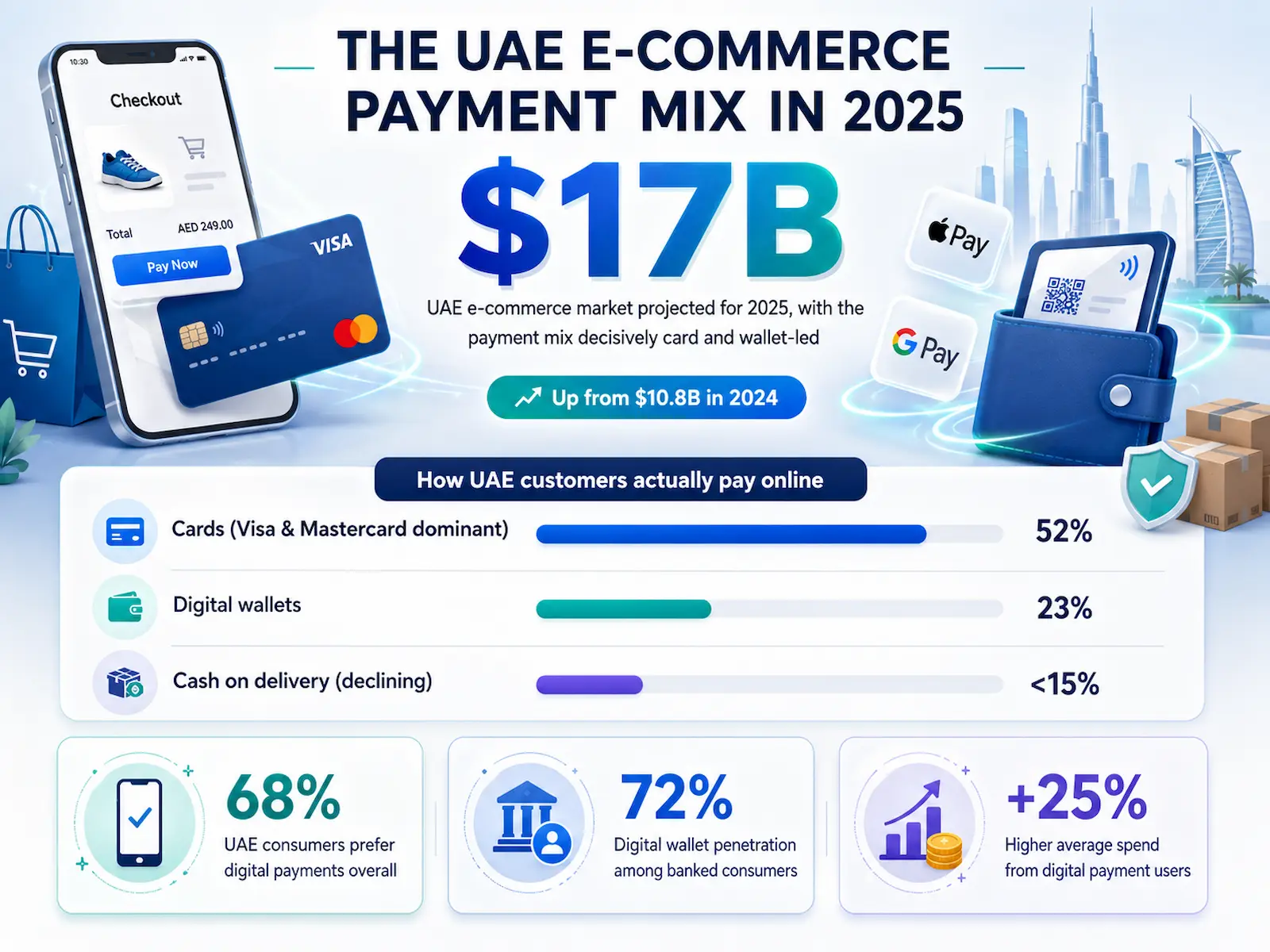
Source: Mastercard UAE Consumer Survey 2025, Statista UAE Payments Outlook, and Dubai Chamber of Commerce, via UAE Fintech Vibes
Before activation, gateways typically assess:
- licensed business activity
- ownership and signatory structure
- website content, refund policy, and terms
- settlement currency and flow of funds
For Indian founders, the adjustment is mental. In the UAE, gateway approval is part of compliance, not a post-launch convenience.
[blockCTACostCalculator]
Paydo: Multi-currency Acceptance for Cross-Border Brands
Paydo is structured for businesses that operate across borders rather than within a single market. Its core strength lies in multi-currency acceptance and account management, allowing merchants to receive, hold, and manage funds in multiple currencies.
This matters for Indian brands that price in AED but pay suppliers in INR, USD, or EUR, or that plan to expand beyond the UAE into other regions without reworking their payment stack.
Paydo’s official business documentation highlights its multi-currency accounts and international payment capabilities.
For founders sensitive to FX timing and conversion costs, this flexibility can materially affect margins.
Ziina: Fast Traction and Simple Online Payments
Ziina is positioned for ease of adoption and everyday use. It supports online payment gateways alongside secure peer-to-peer and business payments, making it particularly useful for early-stage e-commerce, social commerce, and brands testing the UAE market.
Ziina’s own product pages emphasise simplicity, security, and suitability for small and growing businesses rather than complex, high-volume payment architectures.
For Indian founders who want to start collecting payments quickly without over-engineering their setup, Ziina offers a lower-friction entry point into the UAE payments ecosystem.
Telr / TotalPay: Built for Scale and Recurring Billing
Telr (now operating under TotalPay) is one of the UAE’s longer-established payment gateways. It is designed for structured e-commerce operations, particularly those requiring recurring billing, subscriptions, or repeat payments.
Telr’s official solutions documentation confirms support for subscription billing, instalments, and multi-currency acceptance.
For Indian brands running memberships, replenishment models, or SaaS-adjacent commerce, Telr’s stability and recurring payment infrastructure make it suitable once volumes increase and payment predictability becomes critical.
Comfi: Controlled P2B Payment Flows
Comfi focuses on secure person-to-business (P2B) payments, catering to use cases where transactions are structured, invoice-driven, or negotiated rather than impulsive.
According to its official product information, Comfi is designed for controlled business payment flows rather than consumer checkout speed.
This makes it relevant for Indian founders operating B2B, wholesale, or distributor-led models in the UAE, where payment terms and collections differ from standard D2C e-commerce.
Payment Gateway Comparison at a Glance
Here's how the four gateways compare across business model fit, settlement strengths, and merchant profile:
[blockCTATradeLicense]
Choosing a Payment Gateway Is a Cash-Flow Decision
There is no single “best” payment gateway in the UAE. The right choice depends on how your business earns, settles, and redeploys cash.
A cross-border brand optimising FX exposure will prioritise different features than a subscription-led business or a wholesale operator. What matters is alignment between business model, settlement behaviour, and regulatory expectations.
By working with payment gateways already partnered with Meydan Free Zone, founders reduce friction during onboarding and ensure their gateway choice aligns with approved licensing and banking structures.
Payment Gateways Decide How Your Money Moves, Not Just How It’s Collected
For Indian e-commerce brands entering the UAE, payment gateways are not a technical checkbox. They shape settlement speed, chargeback exposure, and how much capital stays liquid.
India rewards transaction velocity. The UAE rewards settlement discipline.
Choosing the right payment gateway, whether that’s Paydo for multi-currency flexibility, Ziina for early traction, Telr for recurring billing, or Comfi for structured collections, determines how smoothly your business operates once customers start paying.
The real question isn’t which gateway integrates fastest. It’s which one lets your cash behave the way your business needs it to.
[blockCTAFawri]
Citations
¹ Mastercard, via Khaleej Times, "UAE card transactions set to surge to Dh565.5 billion," May 2025.