Table of Contents
Frequently Asked Questions
1. Who typically commissions British bespoke tailoring in Dubai?
Demand comes primarily from senior professionals, wedding clients, and GCC residents who commission garments around fixed events such as business seasons, formal occasions, and international travel.
2. Is a physical retail shop required for a tailoring business in Dubai?
Most bespoke tailoring businesses operate from appointment-only studios or private ateliers rather than high-footfall retail locations, which better suits client expectations and cost control.
3. How is a bespoke tailoring business licensed in Dubai?
A bespoke tailoring business is set up under a UAE business license that allows tailoring, made-to-measure services, fittings, design work, and related activities to be carried out.
4. Can fabrics and materials be sourced from the UK?
British fabrics and materials can be imported for use within a licensed tailoring service, provided the imports align with the approved business activity and customs requirements.
5. Do small bespoke ateliers perform well in the Dubai market?
Smaller ateliers often perform strongly due to lower fixed overheads, flexible scheduling, and the ability to deliver personalised service, which is valued in Dubai’s bespoke market.
6. Is UAE residency necessary to operate the business?
While residency is not required to own the business, many founders obtain UAE residency to simplify banking, contract execution, and day-to-day operations.
7. Can a British tailoring business serve clients outside Dubai?
Yes. Many tailoring businesses use Dubai as a base while serving clients across the UAE and internationally, particularly where fittings, reorders, and client management can be handled by appointment or remotely.
Topic Summary
1. Understand the Market Dynamics
Dubai’s clientele places significant value on appearance, especially in professional and social spheres. Tailoring services must cater to clients who demand precision fit, premium fabric quality, and timely delivery to align with their fast-paced, event-driven lifestyles.
2. Emphasize Quality and Craftsmanship
British tailoring is synonymous with meticulous craftsmanship and heritage. Highlighting these qualities will resonate well with Dubai’s discerning customers who prioritize durability and elegance over ephemeral fashion trends.
3. Navigate Legal and Licensing Requirements
Ensure compliance with Dubai’s commercial laws by obtaining the appropriate trade license for bespoke tailoring. Familiarity with local regulations and business setup processes through the Department of Economic Development (DED) is critical for a smooth launch.
4. Invest in Strategic Location and Client Experience
Choose retail or showroom spaces in prestigious commercial districts or luxury malls where target customers frequent. Providing a personalized client experience, including private fittings and consultations, enhances brand prestige and customer loyalty.
5. Build Relationships Through Networking and Marketing
Establish connections within Dubai’s business and social communities. Utilize targeted marketing strategies such as collaborations with luxury brands, attendance at high-profile events, and digital platforms tailored to affluent consumers to build brand recognition and repeat clientele.
Starting a British Tailoring or Bespoke Clothing Business in Dubai
Dubai is a market where appearance carries commercial weight. Business, social life, and mobility overlap here in ways they do less regularly than in the UK. Boardrooms, formal events, weddings, and international travel all sit on tight calendars, and people who want to look put together are prepared to pay for certainty, fit, and delivery on deadline. IMARC Group values the UAE menswear market at USD 3.01 billion in 2024, projected to reach USD 4.58 billion by 2033 at a 4.77% CAGR.¹ This creates demand that is deliberate and repeatable, not trend-led or impulse-driven.
British tailoring fits this environment because it already operates on those principles. With approximately 240,000 British nationals settled in the UAE per CNBC,² the addressable client base for UK-rooted services is substantial. For UK founders, setting up a British tailoring business in Dubai is less about exporting heritage and more about placing a proven service model into a market that values reliability and continuity.
Why British Tailoring Translates to the UAE
In the UK, bespoke clothing is often relationship-led and incremental, built up over years. Dubai compresses that cycle because appearance carries immediate social and professional weight. The city is highly international and heavily calendar-driven. Being well dressed is not about personal style experimentation; but rather about signalling credibility in environments where first impressions are frequent and reputations travel quickly.
As a result, tailoring in Dubai is commissioned around moments where being visibly put together matters: weddings, Ramadan gatherings, winter travel, senior meetings, and formal events. Clients are willing to spend because the cost of looking underprepared or ill-fitting is higher than the cost of getting it right. Fit becomes a form of insurance rather than indulgence.
British tailoring performs well in this environment because clothing is expected to work across long, highly visible days. A suit that fits correctly avoids distraction, travels well between meetings and events, and looks appropriate in formal and social settings where impressions are formed quickly.
Bespoke Clothing Demand in Dubai
A Gulf News summary of consumer spending in the UAE, based on Dubai Chamber / Euromonitor International data, notes that clothing and footwear represented about 7.4% of combined spending among residents.³ This reflects steady, repeat purchasing rather than event-only retail behaviour, supporting a bespoke tailoring market driven by professionals, formalwear clients, and GCC residents commissioning garments around fixed timelines.
Data from The Global Economy, sourced from World Bank data, shows the services sector contributed about 51.6% of UAE GDP in 2023, up from previous years, indicating a majority services-led economy.⁴
UAE menswear is a US$3 billion market climbing toward US$4.6 billion by 2033, with a luxury tier that rewards exactly the precision and quality British tailoring is known for.
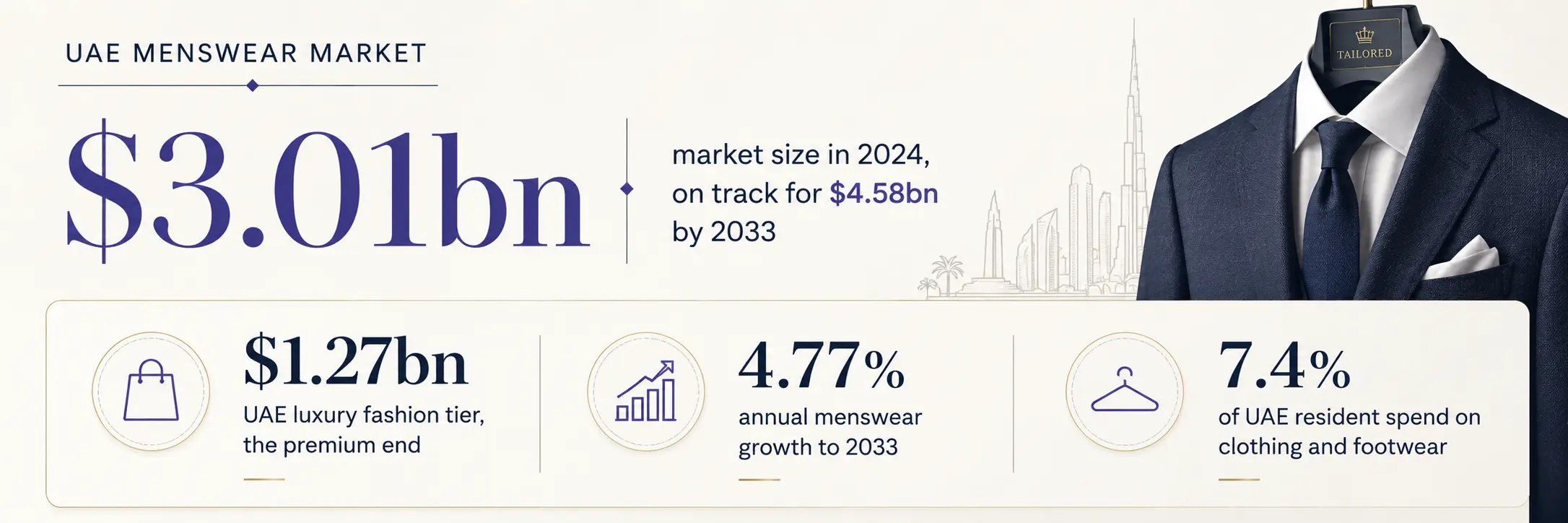
Sources: IMARC Group (2025); Gulf News / Dubai Chamber (2024).
Licensing a Tailoring or Bespoke Clothing Business in Dubai
A British tailoring business in Dubai operating through Meydan Free Zone requires a UAE business license. When setting up, founders can select multiple business activity groups under a single license, rather than applying for separate licenses for each activity. This allows bespoke services, online sales, design work, consulting, and related activities to sit under one structure without unnecessary complexity.
In practical terms, this supports appointment-led bespoke services whilst still allowing flexibility to expand into digital channels or adjacent services as the business develops. The structure reflects how modern tailoring businesses actually operate, particularly when combining client fittings, design, and remote or online delivery.
The distinction matters. A flexible free zone license reduces structural friction and aligns more closely with the operational reality of UK tailoring businesses establishing a presence in the UAE.
Business Activities List
Explore Over 2,500+Atelier Model Versus Retail Tailoring Shops
Many British founders assume a visible retail shop is required. In reality, a large proportion of successful tailoring businesses in Dubai operate from private studios, appointment-only spaces, or shared creative locations.
This model works because Dubai clients are comfortable with discretion. They expect scheduled fittings, not browsing. From a commercial perspective, it also limits fixed overheads and protects margins.
This is where a digital-first free zone structure becomes relevant. Meydan Free Zone is commonly used by service-led businesses that do not need to be confined to a fixed retail location. For tailoring businesses, this allows founders to:
- Operate appointment-led studios
- Meet clients privately
- Run fittings by visit
- Manage orders online without committing to a permanent brick-and-mortar shop from day one
Dubai Trade License from AED 12,500
Get Your LicensePricing and Delivery Expectations in Dubai
Dubai operates on convenience as a baseline. Clear timelines and predictable delivery are expected because business, travel, and formal events run on fixed schedules. Tailoring services are valued for how reliably they fit into those calendars. That expectation shapes both pricing and turnaround. The contrast with UK practice is structural:
| Dimension | UK | Dubai |
|---|---|---|
| Bespoke starting price | £2,500+ | AED 4,000 to AED 10,000+ |
| Bespoke delivery timeline | 4 to 8 weeks | 1 to 2 weeks |
| Commission cycle | Traditional fitting cycles over several weeks | Shorter horizons aligned to fixed events |
Made-to-measure garments in Dubai are often delivered within days, with pricing varying by fabric and specification. Clients are willing to pay because speed and certainty reduce friction. A suit that arrives on time and performs across meetings and events carries more value here than one that is technically refined but operationally inconvenient.
Production, Sourcing, and Staffing Considerations
British tailoring businesses in Dubai typically either retain production in the UK or complete garments locally. Keeping production offshore preserves existing craftsmanship but extends delivery timelines, making it better suited to planned commissions. Local production supports faster turnaround and greater control, which aligns more closely with Dubai’s deadline-led demand.
Most businesses combine the two, keeping specialist work offshore while managing fittings and client delivery locally. Through Meydan Free Zone, founders can sponsor residency for employees where needed, allowing staffing to follow the operating model rather than restrict it.
What matters commercially is delivery. Clients care less about where a garment is made and more about whether it arrives on time and can be reordered consistently.
What This Means for British Founders
A British tailoring business in Dubai succeeds when it is structured for delivery rather than display. Heritage may open the door, but repeat demand is driven by reliable timelines, clear pricing, and the ability to serve clients around fixed events.
For founders, that makes structure the deciding factor. A flexible setup that supports appointment-led services, multiple business activities under one license, and growth without committing to a permanent retail location is better suited to how tailoring businesses actually operate. Meydan Free Zone is commonly chosen for this reason.
The decision is not about location. It is about whether the structure supports repeat, deadline-led commissions and consistent execution as the business scales.
Ready to Launch Your Business in Dubai?
Let's ConnectCitations
¹ IMARC Group, "UAE Menswear Market," 2024.
² CNBC, "Britons are increasingly moving to the UAE," April 2026.
³ Gulf News citing Dubai Chamber / Euromonitor International, "Clothing and footwear share of UAE consumer spending," accessed 2026.
⁴ The Global Economy citing World Bank, "UAE Services Sector Share of GDP," accessed 2026.