Table of Contents
Frequently Asked Questions
1. Why are Turkish SMEs registering in Dubai's Meydan Free Zone?
To access the UAE's growing markets, benefit from tax-free profits on qualifying income, and overcome Türkiye's trade and currency challenges through a stable, scalable business jurisdiction.
2. How fast can Turkish SMEs get a license in Meydan Free Zone?
Company registration can be completed in under 60 minutes through Meydan Free Zone's digital platform, using a 100% digital setup process with minimal documentation.
3. How much does it cost to set up a business in Meydan Free Zone?
Licensing starts from AED 12,500 and includes a flexi-desk office. You can choose from 2,500+ business activities, with up to 3 activity groups on a single license.
4. What tax and currency benefits do Turkish businesses get in Meydan Free Zone?
Businesses pay 0% corporate tax on qualifying income and operate in a stable, US dollar-pegged currency environment at AED 3.67 to USD 1, a rate held steady for decades.
5. How does the UAE-Türkiye CEPA benefit Turkish SMEs?
The CEPA has eliminated or reduced customs duties on 82% of product lines, helping Turkish SMEs in sectors like textiles, food, machinery, and automotive parts export into the UAE at lower cost.
Topic Summary
1. Currency Volatility and Inflationary Pressures
Türkiye’s trade environment remains affected by significant currency fluctuations and persistent inflationary pressures. These factors increase costs for exporters and importers alike, complicating pricing strategies and profit margins, especially for small and medium-sized enterprises (SMEs).
2. Shifting EU Regulatory Landscape
As Türkiye deepens its trade links with the European Union, SMEs face increasing complexity due to evolving EU regulatory standards. Compliance with new customs regulations, sustainability criteria, and product safety standards requires agility and investment, influencing export readiness.
3. SMEs Pivoting Towards Stability and Scalability Abroad
Export-oriented SMEs are actively seeking international hubs offering economic stability, rapid operational processes, and growth potential. Such environments provide vital support to mitigate domestic challenges and ensure sustained export growth.
4. The UAE as a Strategic Trade Hub
The United Arab Emirates, notably through its business-friendly policies and global connectivity, has emerged as a preferred destination for Turkish enterprises. Its facilitated trade procedures, tax incentives, and infrastructure appeal to SMEs looking to expand their international footprint.
5. Meydan Free Zone: Dubai’s Premier Destination for Turkish SMEs
Situated within Dubai, Meydan Free Zone offers Turkish exporters an optimal platform characterised by streamlined company setup, zero corporate tax, and access to key markets across the Middle East and beyond. This free zone supports SMEs in navigating global trade complexities while enhancing operational efficiency.
Türkiye’s Trade Outlook: Challenges and Opportunities
A Turkish manufacturer watching the lira lose value month after month, an exporter tired of navigating EU regulatory complexity to reach the same customers, a founder wanting a stable base to keep serving European clients without the currency risk at home: all three are part of a growing wave of Turkish businesses setting up in Dubai.
This guide covers why Turkish SMEs are looking beyond Türkiye, how fast and simple setup through Meydan Free Zone actually is, and what the tax and currency position looks like once you are here.
Key Stats at a Glance
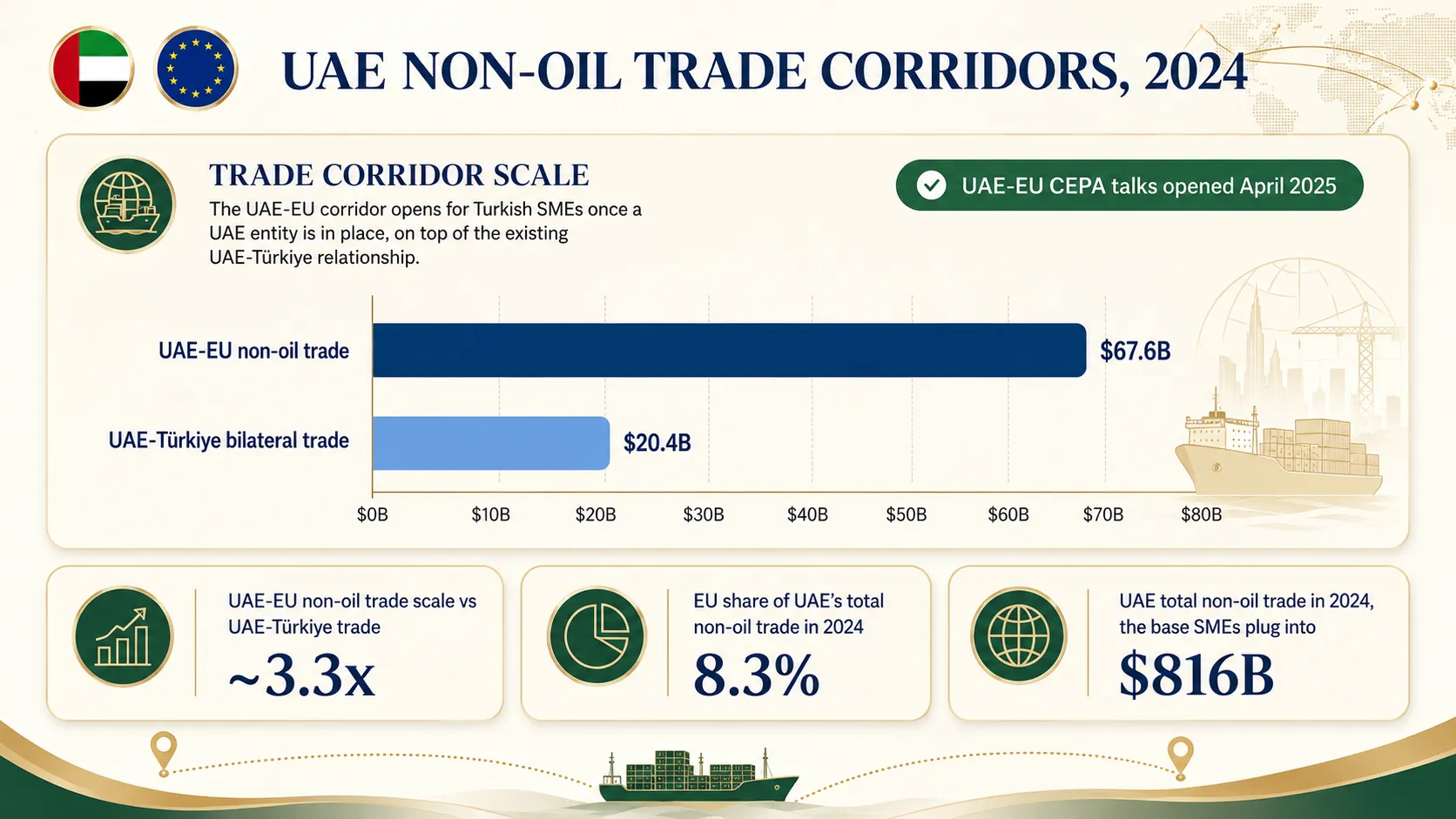
Source: UAE Ministry of State for Foreign Trade, with UAE-Türkiye CEPA figures via Economy Middle East and Anadolu Agency.
Why Turkish Businesses Are Looking Beyond Türkiye
Currency volatility is the biggest driver. With annual inflation at 69.8% in April 2025 and core inflation running above 75%, a Turkish business holding capital or earnings in lira faces real risk that has nothing to do with how well the business itself is run.
Add EU regulatory complexity on top, and a founder trying to trade into Europe from a Turkish base is managing two separate sources of risk at once, currency swings at home and paperwork abroad.
Dubai offers an answer to both. A stable, dollar-pegged currency removes the exchange rate risk that Turkish founders deal with day to day, and the UAE's position as a bridge between East and West gives a Turkish business a base that already speaks the language of international trade.
A Turkish exporter selling into both the Gulf and Europe also gains a practical advantage simply from time zone and travel distance, since Dubai sits within a few hours of both markets rather than requiring the long-haul trips a purely European base would demand.
This proximity matters as much to relationship-driven trade as any tax or currency benefit, since face-to-face meetings still close a large share of cross-border deals in this part of the world.
Setting Up in Meydan Free Zone, Fast and Simple
Meydan Free Zone's Fawri service can get a company licensed in under 60 minutes, a stark contrast to the slower, paperwork-heavy setup processes a Turkish founder may be used to at home.
This speed matters most to a business trying to move quickly to escape currency risk rather than one with the luxury of a long runway to plan around.
Cost-effective operations pair with this fast setup: flexible licensing packages let a founder start lean and scale their visa allocation as the business grows, rather than committing to a large structure before revenue justifies it.
Tax Position and Currency Stability
Meydan Free Zone offers 0% corporate tax and 0% personal income tax, a dramatic shift for a founder used to Türkiye's tax environment on top of its currency instability. Combined with the UAE dirham's stability against major currencies, a Turkish business operating from here removes two of its biggest sources of financial unpredictability in one move.
[blockCTACostCalculator]
Step-by-Step Setup Guide
- Step 1, choose your activity: Confirm the activity code that matches your business before you apply.
- Step 2, apply through Fawri: Use Meydan Free Zone's fast-track service to get licensed in under 60 minutes.
- Step 3, set up your banking: Open a corporate bank account to start operating in a stable currency.
- Step 4, plan your EU market entry: Position your Dubai base to serve European clients as UAE-EU CEPA talks, begun in April 2025, move toward a full trade agreement.
- Step 5, build your local network: Connect with other Turkish and international founders already operating from Meydan Free Zone.
- Step 6, scale your visa allocation: Add visas as your team grows rather than overcommitting from day one.
Compliance and What You Need in Place
Activity code accuracy
Match your business to the right activity code before you apply, since this shapes both your license and your visa allocation.
Corporate banking
Set up a corporate bank account early, since holding revenue in a stable currency is one of the main reasons a Turkish business relocates in the first place.
CEPA developments
Keep an eye on how UAE-EU CEPA talks, begun in April 2025, progress, since a full trade agreement could open further advantages for a Dubai-based business trading into Europe.
Tax position
Meydan Free Zone offers 0% corporate tax and 0% personal income tax, so structure your business to make full use of this position rather than replicating a Turkish tax structure that no longer applies.
Ongoing renewal
Renew your license every year and keep your activity mix current if your business grows into new markets or product lines.
Market Opportunity
A Turkish business relocating to Dubai is not just avoiding currency risk, it is positioning itself at the centre of a trade route that increasingly connects East and West. With UAE-EU CEPA talks underway since April 2025, a Meydan Free Zone company already based in Dubai stands to gain further advantages as that relationship deepens, rather than having to relocate again once a full agreement is signed.
The networking side matters too: a growing community of Turkish founders already operating from Meydan Free Zone gives a new arrival a ready-made network of people who understand both markets, often the fastest route to a first client or a first supplier relationship in a new country.
A founder arriving from Türkiye also brings real sector knowledge, textiles, manufacturing, or trading relationships built over years, that a Dubai base does not erase, it simply gives that knowledge a more stable currency and a wider set of markets to reach from a single location.
Conclusion
Turkish SMEs are choosing Meydan Free Zone for the same reasons: currency stability, a 0% tax position, fast setup, and a strategic base for trade between Türkiye, the UAE, and Europe.
For a founder watching the lira and navigating EU complexity at the same time, a Dubai base backed by all of this removes two of the biggest sources of risk in one move.
[blockCTAContact]




.webp)