
Table of Contents
Frequently Asked Questions
1. What is CEPA between India and UAE?
CEPA is a bilateral trade agreement between India and the UAE. It reduces tariffs, simplifies customs, opens market access, and improves mobility for goods and services since 2022.
2. How does CEPA benefit Indian exporters?
CEPA reduces duties on 80-90% of Indian exports to the UAE. It speeds up customs clearance. It also increases UAE distributor demand for competitively priced Indian goods.
3. Which sectors benefit most from CEPA?
The biggest gains are in textiles and ready-made garments, gems and jewellery, engineering goods, and auto components. Food and FMCG, pharmaceuticals, and heavy machinery have also seen strong tariff and trade gains.
4. Do I need a UAE company to benefit from CEPA?
Not legally, but practically yes. A UAE business presence makes logistics, payments, distributor relationships, and re-export access far more efficient for Indian exporters.
5. What is the easiest way for Indian SMEs to set up in the UAE?
A digital free zone such as Meydan Free Zone is the easiest route. It offers 24/7 digital setup, MoFA-accredited licenses, and trade-ready infrastructure for CEPA-driven business models.
6. How has CEPA affected India-UAE bilateral trade volume?
India-UAE bilateral trade crossed USD 101.25 billion in 2025-26, per India's Ministry of Commerce. Non-oil trade is growing fastest, and SME participation has surged since CEPA.
7. Does CEPA cover services and investment as well as goods?
Yes. CEPA covers trade in services, investment cooperation, intellectual property, digital trade, and SME support. This makes it one of India's deepest bilateral agreements with any country.
Topic Summary
1. Boosting Bilateral Trade Volume
Since the signing of CEPA in February 2022, India and the UAE have seen a sharp increase in trade volumes. The agreement eliminated tariffs on more than 90% of goods traded between the two countries, paving the way for smoother and cost-effective exchanges.
2. Enhancing Market Access for Indian Products
CEPA opened UAE markets to a wide range of Indian products such as textiles, jewelry, pharmaceuticals, and electronics. This enhanced market access has allowed Indian entrepreneurs to expand their customer base and increase exports.
3. Facilitating Services and Investment Flows
The agreement includes provisions to promote trade in services and investment cooperation. Indian companies in sectors like IT, healthcare, and finance have benefitted from reduced regulatory barriers and greater opportunities to invest and establish operations in the UAE.
4. Streamlining Customs and Regulatory Processes
CEPA introduced measures to simplify customs procedures, reduce red tape, and improve transparency. These reforms have significantly cut down clearance times, making it easier for businesses to operate efficiently across borders.
5. Strengthening Strategic Economic Partnership
Beyond trade, CEPA has deepened economic ties through joint initiatives, innovation partnerships, and closer cooperation on technology and infrastructure. This strategic collaboration is setting the foundation for sustained growth and diversification of business opportunities between India and the UAE.
How CEPA Is Transforming India–UAE Business Growth
India and the UAE signed the Comprehensive Economic Partnership Agreement (CEPA) in February 2022. It signalled something far bigger than a tariff cut. CEPA was the first major bilateral trade deal India signed in over a decade. Its impact on India-UAE business growth has been immediate, measurable, and strategic.
The numbers are striking. Per India's Ministry of Commerce via Outlook Business¹, India-UAE bilateral trade crossed USD 101.25 billion in 2025-26. CEPA removed duty on over 97% of UAE tariff lines. That covers 99% of Indian exports by value. The trade corridor has more than doubled since 2022, and non-oil trade is growing fastest.
For Indian entrepreneurs, CEPA cleared long-standing trade bottlenecks. It built a frictionless commercial bridge between two complementary economies. Are you an exporter, startup founder, SME manufacturer, or service provider? CEPA is reshaping how fast you can scale into the UAE. From there, you can reach the wider Middle East, Africa, and Europe.
Here is the growth curve:
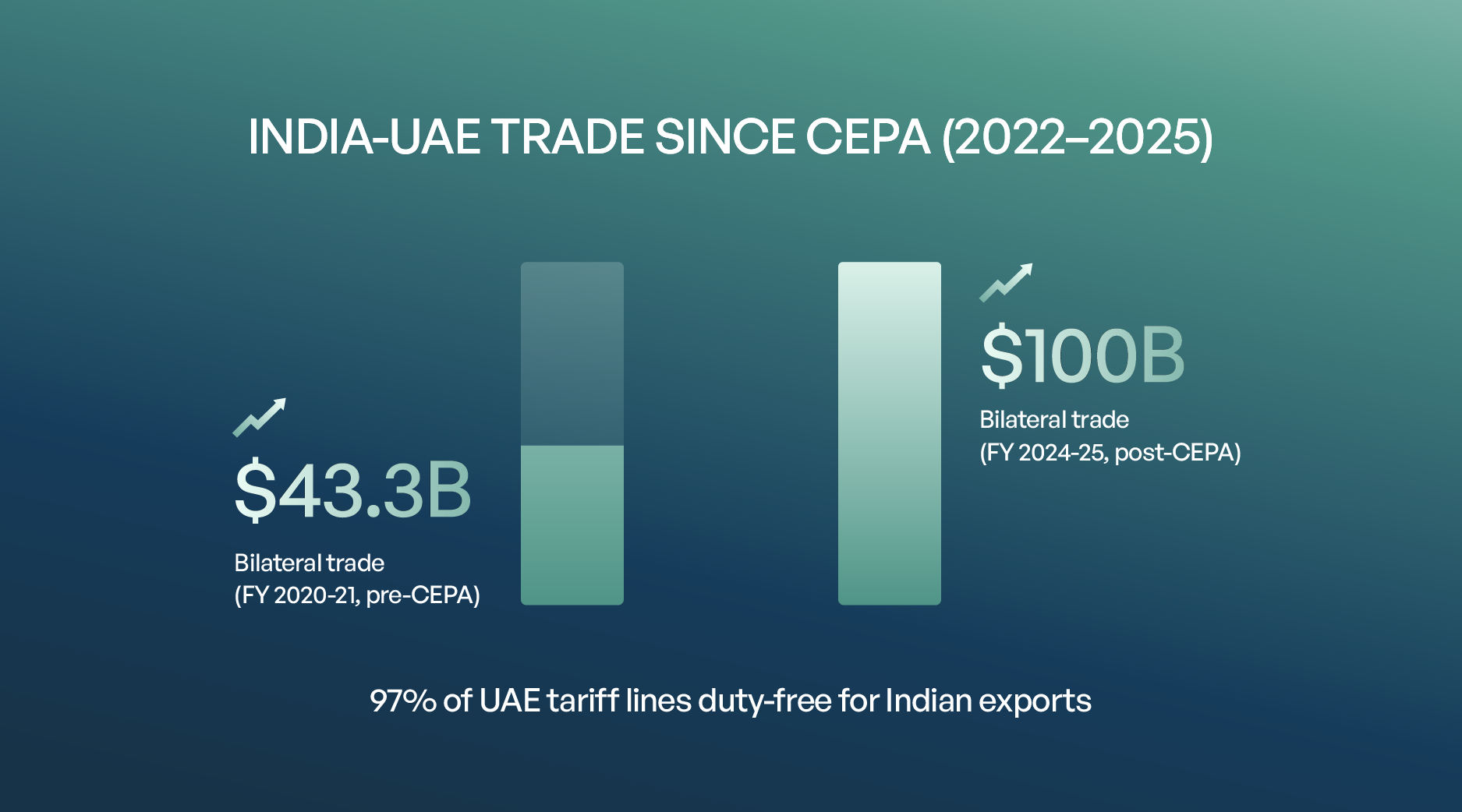
Data sourced from India Ministry of Commerce (2025) and India-UAE CEPA Joint Committee via India Briefing (2025).
Do you want to understand how CEPA benefits Indians, and how to use it? This breakdown gives you the full picture, with clarity and accuracy.
What Is CEPA?
CEPA is the Comprehensive Economic Partnership Agreement. It is a formal, wide-ranging trade pact. It reduces or removes tariffs, simplifies customs, opens new market access, and improves mobility between India and the UAE.
CEPA covers:
- Goods
- Services
- Rules of origin
- Intellectual property
- Investment cooperation
- Customs procedures
- Digital trade
- SMEs
This makes it one of the deepest bilateral agreements India has with any country.
Why CEPA Matters for Indian Entrepreneurs
Most trade agreements benefit governments. CEPA is unusual. It directly accelerates business for Indian SMEs and exporters.
Here is why:
CEPA is not theoretical. It is driving real business outcomes.
India-UAE Trade Growth After CEPA
CEPA did not just increase trade. It changed the structure of India-UAE commerce.
Before CEPA, India-UAE trade was strong but uneven. It was driven mostly by oil, gold, and a few high-volume commodities. SMEs struggled with tariffs, redundant paperwork, and unpredictable logistics. CEPA came into force in May 2022. It rebalanced the corridor.
Within 12 months, the Press Information Bureau reported²:
- Bilateral trade crossed USD 84.5 billion in FY 2022-23. That was up 16% year-on-year from USD 72.9 billion.
- Over 54,000 Certificates of Origin were issued under CEPA in the first 11 months alone.
- The UAE removed duties on 97.4% of its tariff lines, covering 99% of imports from India by value.
- India got immediate duty removal on over 80% of its tariff lines, covering 90% of its exports.
Per the UAE Ministry of Economy via Gulf News³, the UAE became India's third-largest trading partner. It is also the second-largest export destination after the US. It accounts for 40% of India's trade with Arab countries.
The most important shift? SME participation surged.
For years, large conglomerates dominated India's GCC trade. After CEPA, that changed. Small manufacturers in Tiruppur, Surat, Panipat, Moradabad, Rajkot, Ludhiana, and Coimbatore began using tariff benefits. They now ship directly into Dubai's retail and wholesale markets.
The Ministry of Textiles via Press Information Bureau⁴ reports strong textile growth. India's textile exports to the UAE grew 22.3% in FY 2025-26. That was the highest growth among any major textile destination. Zero-duty access on many apparel HS codes supported it. Gems and jewellery is the largest single sector under CEPA. It gained zero-duty access on Indian-crafted gold jewellery, per the Press Information Bureau⁵. Engineering goods and pharmaceutical consumables saw faster clearance across many HS categories.
For India, CEPA's biggest win was clear. It let SMEs compete with global suppliers in the UAE. That was not possible under previous tariff regimes.
Sectors Where Indians Are Benefiting the Most
CEPA affects different sectors differently. Indian exporters benefit most where tariff changes meet Dubai's existing demand. Here is the detailed breakdown.
[blockFaqsCategory]
Why CEPA Helps Indian SMEs the Most
Large conglomerates already had deep UAE networks. CEPA's biggest winners are Indian SMEs. They previously struggled to enter the GCC.
CEPA helps them by:
- Removing price disadvantages
- Reducing documentation
- Speeding up customs
- Increasing distributor interest
- Enabling faster scaling through Dubai
It is rare for an international agreement to be this SME-friendly. But CEPA is engineered exactly for that.
Dubai's Role: The Gateway for CEPA-Driven Growth
Dubai is where the benefits of CEPA come alive. The UAE is far more than a consumer market. It works as a sophisticated distribution ecosystem built for global movement.
From a single base in Dubai, Indian businesses can reach many markets fast. That includes the GCC, Africa, the CIS nations, and Europe. World-class trade finance channels support this. So does seamless logistics through hubs like Jebel Ali Port and Dubai International Airport.
This mix of connectivity, predictability, and scale matters. It is why Dubai is becoming the default global headquarters for Indian entrepreneurs. They want CEPA to work in their actual growth, not just on paper.
Where Meydan Free Zone Fits Into This Growth Story
CEPA is powerful. But to benefit fully, Indian businesses need a UAE commercial presence.
This is why many Indian SMEs and exporters choose Meydan Free Zone. It is one of Dubai's most advanced digital free zones. It sits at the prestigious Meydan Hotel, only 15 minutes from DXB Airport.
Here is why CEPA-driven businesses choose Meydan Free Zone:
- 24/7 fully digital company setup, ideal for India-UAE time zone workflows
- MoFA-accredited business licenses recognised for cross-border trade
- Access to 26+ UAE and international banks, each with guaranteed IBAN availability
- Trade-ready ecosystem, including customs support and logistics partners
- Marketplace integrations for exporters and D2C brands selling across 30+ ecommerce platforms
These features matter. CEPA is not just about lower tariffs. It is about helping Indian businesses scale internationally through Dubai with fewer bottlenecks.
[blockCTABizSetup]
How Indian Businesses Can Start Leveraging CEPA Today
Do you want to take advantage of CEPA? Your roadmap is simple:
[blockAccordionSteps]
A free zone like Meydan Free Zone brings most of these steps into one fully digital process.
CEPA Benefits for Indians
CEPA has transformed India-UAE trade in three major ways:
- It made Indian products more price-competitive.
- It simplified market entry for Indian SMEs.
- It turned Dubai into India's global expansion hub.
For Indian entrepreneurs, CEPA is not a policy on paper. It is a growth engine. Pair it with a modern free zone platform like Meydan Free Zone. It becomes a launchpad for global scale.
[blockCTAContact]
Footnotes
¹ India Ministry of Commerce, via Outlook Business, "India-UAE CEPA Boosts Bilateral Trade Past $100 Billion," May 2026.
² Press Information Bureau, Government of India, "CEPA is the growth engine for India-UAE bilateral trade," May 2023.
³ UAE Ministry of Economy, via Gulf News, "UAE to begin reducing tariffs on India's goods by 90%: Minister of Economy," 2022.
⁴ Press Information Bureau, Ministry of Textiles, "India's Textile Exports Register Growth of 2.1% in FY 2025-26," April 2026.
⁵ Press Information Bureau, Government of India, "India-UAE Comprehensive Economic Partnership Agreement enters into force," May 2022.