
Table of Contents
Frequently Asked Questions
1. What business license do I need to import jewellery into Dubai from India?
You need a trading business license with specific jewellery-related activities such as jewellery trading, precious stones trading or imitation jewellery trading. Business activity choice determines compliance and approvals.
2. Do jewellery trading activities require SIRA approval?
Some do. SIRA approval is required when you physically handle, store, or trade high-value jewellery or stones. Design-only or appraisal activities may not require SIRA.
3. Does CEPA reduce customs duty for Indian jewellery entering Dubai?
Yes. Under the India–UAE CEPA, many jewellery HS codes benefit from reduced or zero customs duty, provided rules of origin and documentation are correctly followed.
4. Can I import jewellery into Dubai using a free zone company?
Yes. Free zones like Meydan Free Zone allow jewellery import/export and offer 100% ownership, digital setup and MoFA-recognised, Dubai Chamber-accredited business licenses.
5. What documents are required for jewellery import into Dubai?
Dubai Customs requires commercial invoices, HS codes, packing lists, authenticity certificates (for stones) and Certificates of Origin if using CEPA benefits.
6. Are jewellery businesses subject to AML requirements in the UAE?
Yes. Dealers in precious metals and stones fall under AML/CFT regulations and must register, conduct customer due diligence and maintain compliance.
Topic Summary
1. Obtain a Trade License
Secure a valid trade license from the Dubai Department of Economic Development (DED) specifically for importing jewellery and precious stones. This license legally authorizes your business operations in Dubai’s trading sector.
2. Register with Dubai Customs
Enroll your business with Dubai Customs to gain importer status, enabling smooth customs clearance and compliance with import regulations for precious metals and stones.
3. Acquire a Certificate of Origin
Obtain an authentic Certificate of Origin from the relevant Indian authorities to certify the provenance of jewellery and stones. This document aids in customs clearance and validates product authenticity.
4. Ensure Compliance with Hallmarking Standards
Verify that all gold jewellery imported from India meets the mandatory hallmarking standards recognized internationally and by Dubai authorities to guarantee quality and purity.
5. Fulfill VAT Registration Requirements
Register for Value Added Tax (VAT) with the Federal Tax Authority (FTA) in the UAE if your business turnover exceeds the mandatory threshold, ensuring compliance with tax regulations on imported goods.
Importing Jewellery and Precious Stones from India to Dubai: Licensing Checklist
India’s jewellery heritage powers a massive global industry - and nowhere is that influence more visible than in Dubai. Walk through Deira Gold Souk, Meena Bazaar, Bur Dubai or even premium retail zones like Dubai Mall, and you’ll see Indian brands that have become icons in the UAE: Malabar Gold & Diamonds, Tanishq, Joyalukkas, Senco Gold, and long-standing community favourites like PB Jewellery.
These businesses represent a sophisticated India -UAE jewellery corridor that’s only getting stronger.
According to the India Brand Equity Foundation (IBEF) citing GJEPC data¹, India's gems and jewellery exports to the UAE reached USD 8.04 billion in FY 2023-24, accounting for 24.57% of India's total gems and jewellery exports and making the UAE India's second-largest destination after the United States.
Dubai isn't called the City of Gold for nothing. Here's the scale of the jewellery market Indian exporters are stepping into.
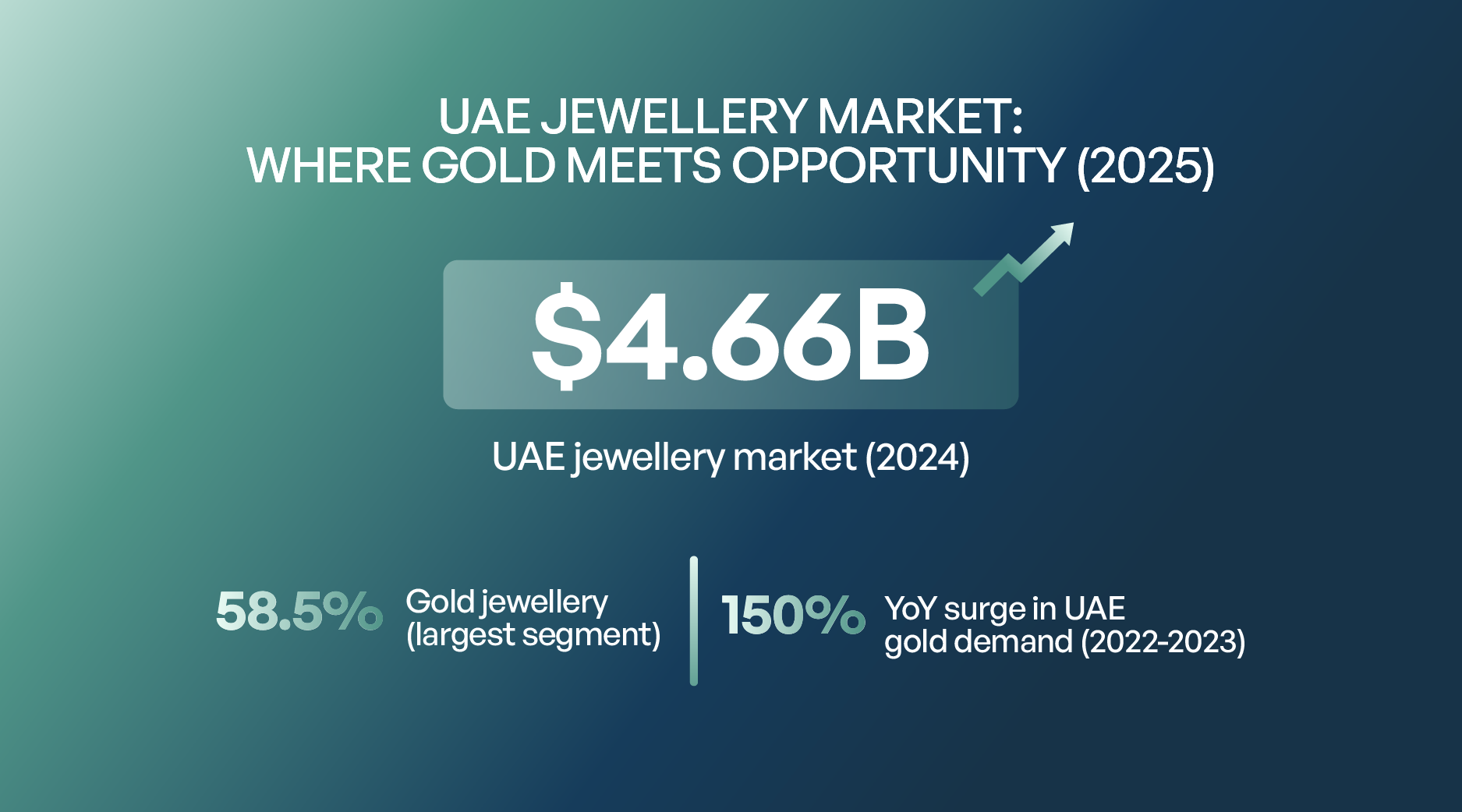
Data sourced from Grand View Research UAE Jewelry Market Report (2025) and Arabian Business (2023).
Dubai isn’t just another export market for Indian jewellers - it’s the world’s most important redistribution hub for gold, diamonds, and finished jewellery. And yet, despite the success stories, setting up a jewellery importing business in Dubai is anything but casual. Jewellery and precious stones sit in one of the UAE’s most regulated, security-sensitive, and AML-controlled sectors.
Which is exactly why your business license, activity selection, third-party approvals, and documentation trail must be precise from day one.
This guide gives Indian entrepreneurs a clear, practical roadmap to legally import jewellery and precious stones from India into Dubai - and explains how a digital free zone such as Meydan Free Zone helps simplify the process.
Why Dubai Is a Magnet for Indian Jewellery Traders
The India - UAE jewellery trade works like a perfectly engineered ecosystem:
- India is the manufacturing and polishing powerhouse (Surat for diamonds, Coimbatore & Thrissur for gold, Jaipur for gemstones)
- Dubai is the distribution, wholesale and re-export hub - sending jewellery into GCC, Africa, Europe, CIS and beyond.
The India - UAE CEPA (Comprehensive Economic Partnership Agreement) accelerated this even further, offering reduced or zero customs duties on many gems and jewellery HS codes.
Dubai’s appeal is built on:
- zero personal income tax
- a vibrant wholesale ecosystem
- fast-moving retail demand within the UAE
- strong re-export infrastructure
- secure logistics and vaulting
- a business-friendly government backed by digital systems
For Indian exporters, Dubai delivers higher margins, faster turnaround, and global reach.
What Business License Do You Need to Import Jewellery Into Dubai?
Jewellery importers must apply for a business license (trade license) and select the precise activities that match their business model.
Free zones such as Meydan Free Zone offer 2,500+ activities, including those related to:
- jewellery trading
- precious stones trading (non-industrial)
- used jewellery trading
- imitation jewellery trading
- jewellery designing
- jewellery repair & alteration
- appraisal of jewellery and antiques
- wholesale/retail sale of watches, clocks and jewellery
Depending on your activity, you may require a third-party approval from SIRA (Security Industry Regulatory Agency), usually required for activities involving:
- handling high-value jewellery
- storing jewellery on premises
- operating showrooms
- certain wholesale or used jewellery categories\
Meydan Free Zone advisors can check this for you before you apply.
[blockCTACostCalculator]
The Licensing Checklist (What Most Indian Traders Miss)
Before applying for any business license, answer these:
[blockFaqsCategory]
AML Regulations: The Most Overlooked Part by Indian Traders
India’s jewellery industry is familiar with BIS hallmarking, DGFT rules, and GJEPC norms - but AML often feels peripheral.
In the UAE, it is central. Dealers in precious metals and stones fall under DNFBP regulations, meaning you must:
- register on the Ministry of Economy’s AML portal
- create internal AML/CFT policies
- conduct customer due diligence (CDD)
- file suspicious transaction reports via goAML when needed
Banks also use AML compliance as a key element in approving jewellery-related accounts - which is why having a clear and compliant business license matters so much.
Documentation Checklist: India-Side and Dubai-Side
Any mismatch between Indian documents and UAE customs declarations (values, HS codes, descriptions) triggers delays.
| India-Side Requirements | Dubai-Side Requirements |
|---|---|
| IEC (Importer-Exporter Code) | Correct HS codes |
| Valid GJEPC membership depending on product category | Clear valuation |
| Commercial invoice and packing list | Accurate commercial invoice |
| Shipping bill | Proper declarations through Dubai Customs |
| Certificate of Origin if you want CEPA benefits | Authenticity certificates where required |
| Stone certifications for diamonds / precious stones (GIA, IGI, etc.) | CEPA-based documentation if claiming tariff benefits |
VAT & Corporate Tax Considerations
Jewellery is subject to VAT (5%), applied only when goods are sold within the UAE. Re-exports are usually zero-rated.
Corporate Tax (9%) applies depending on your taxable income and whether you qualify for free zone incentives.
Banking for Jewellery Importers: What UAE Banks Really Look For
Jewellery businesses often trigger enhanced due diligence. This doesn’t mean rejection - it means banks want clarity.
Typical requirements include:
- Meydan Free Zone trade license + business activity list
- Passport, KYC, proof of residence
- Shareholder CVs
- 6 months of bank statements
- A clear company profile explaining:
- - your India supply chain
- - expected transaction volume
- - who your buyers will be
- - whether goods are for UAE sale or re-export
Meydan Free Zone simplifies onboarding via its guaranteed IBAN issuance pathway, helping jewellery traders avoid common roadblocks.
[blockCTAContact]
In Conclusion
The jewellery trade between India and Dubai is one of the most lucrative bilateral sectors in the world. But high-value industries come with high-precision rules. Your licensing, activity selection, SIRA approvals, AML compliance, customs preparation, and banking narrative must all align.
A digital, MoFA-recognised free zone such as Meydan Free Zone gives Indian jewellery businesses the right foundation:
- 2,500+ business activities, including jewellery categories
- integrated SIRA-linked activity options
- fully digital company formation
- guided IBAN issuance
- tax and customs credibility
- visa flexibility for future scaling
If you're considering launching a jewellery importing company in Dubai, the smartest move is to first get your licensing architecture right.
Start the conversation by booking a Meydan Free Zone Consultation, or calculate your cost with the Meydan Free Zone Cost Calculator.
Citations
¹ India Brand Equity Foundation (IBEF), citing GJEPC, "India's Gems and Jewellery Sector Going Global," 2024.