
Table of Contents
Frequently Asked Questions
FAQs
1. What license do I need to start a textile business in Dubai?
You need a commercial textile or garments trading licence, which allows you to import, sell, distribute, and re-export garments, fabrics and textile products within the UAE and abroad.
2. Can Indian textile traders set up a Dubai company using only a passport?
Yes. Through Meydan Free Zone, many Indian traders can complete company setup remotely using only a passport copy and basic KYC details.
3. Do Indian textile companies get customs or duty benefits in Dubai?
Yes. Under the India–UAE CEPA agreement, many Indian-origin textile products enjoy preferential duty treatment, improving margins for importers and re-exporters.
4. What documents are required to import garments from India to Dubai?
Typically, a commercial invoice, packing list, bill of lading or airway bill, and a certificate of origin. CEPA-related documentation may apply for duty benefits.
5. How do Indian traders open a UAE bank account for textile trading?
If you set up your company through Meydan Free Zone, you receive a guaranteed IBAN opening pathway via partnered banks, reducing documentation and simplifying approvals.
Topic Summary
1. Conduct Market Research and Identify Niche
Understand Dubai’s textile trading landscape, key markets such as the GCC, Africa, and CIS countries, and identify demand trends. Focus on products like synthetic fabrics, knitwear, block prints, or winterwear to leverage India’s strengths.
2. Choose the Right Business Setup
Decide between a mainland company or a free zone entity. Free zones like Dubai Multi Commodities Centre (DMCC) offer benefits such as 100% foreign ownership, tax exemptions, and simplified import/export procedures relevant to textile traders.
3. Obtain Licenses and Permits
Apply for a trading license specific to textiles and garments through the Department of Economic Development (DED) if on the mainland, or the relevant free zone authority. Ensure compliance with Dubai Municipality regulations regarding product standards and labeling.
4. Establish Warehousing and Logistics
Utilize Dubai’s strategic logistics infrastructure by securing warehouse space and partnering with freight forwarders experienced in textile shipments. Efficient logistics ensure timely distribution across key markets and minimize supply chain costs.
5. Build Supplier and Buyer Networks
Leverage existing contacts in Indian textile hubs and attend Dubai trade exhibitions like TEXPO to connect with buyers across the GCC, Africa, and Europe. Building strong B2B relationships is crucial for sustained growth in Dubai’s competitive textile market.
How Indians Can Start a Textile or Garments Trading Company in Dubai
For decades, Indian textiles have powered global fashion supply chains — from Surat’s synthetic fabrics to Tiruppur’s knitwear, Jaipur’s block prints and Ludhiana’s winterwear. Dubai is the natural next step in this journey.
The emirate has become the region’s most influential textile trading hub, connecting India to the GCC, Africa, Europe and CIS countries with unmatched logistics, tax efficiency and speed.
According to India's Ministry of Commerce via the Press Information Bureau¹, the India-UAE Comprehensive Economic Partnership Agreement (CEPA) has eliminated UAE customs duties on 97.4 percent of its tariff lines, covering 99 percent of India's exports, with immediate duty elimination on more than 80 percent of products in labour-intensive sectors such as textiles, clothing, leather and footwear. India is the UAE's second-largest textile supplier, and CEPA is making that gap close faster.
According to UAE trade data via Inlex Partners², UAE textile imports totalled USD 7.08 billion in 2023, with the GCC textile market projected to grow from USD 15.08 billion in 2024 to USD 20.93 billion by 2029. Here's where Indian fabrics sit in that market.
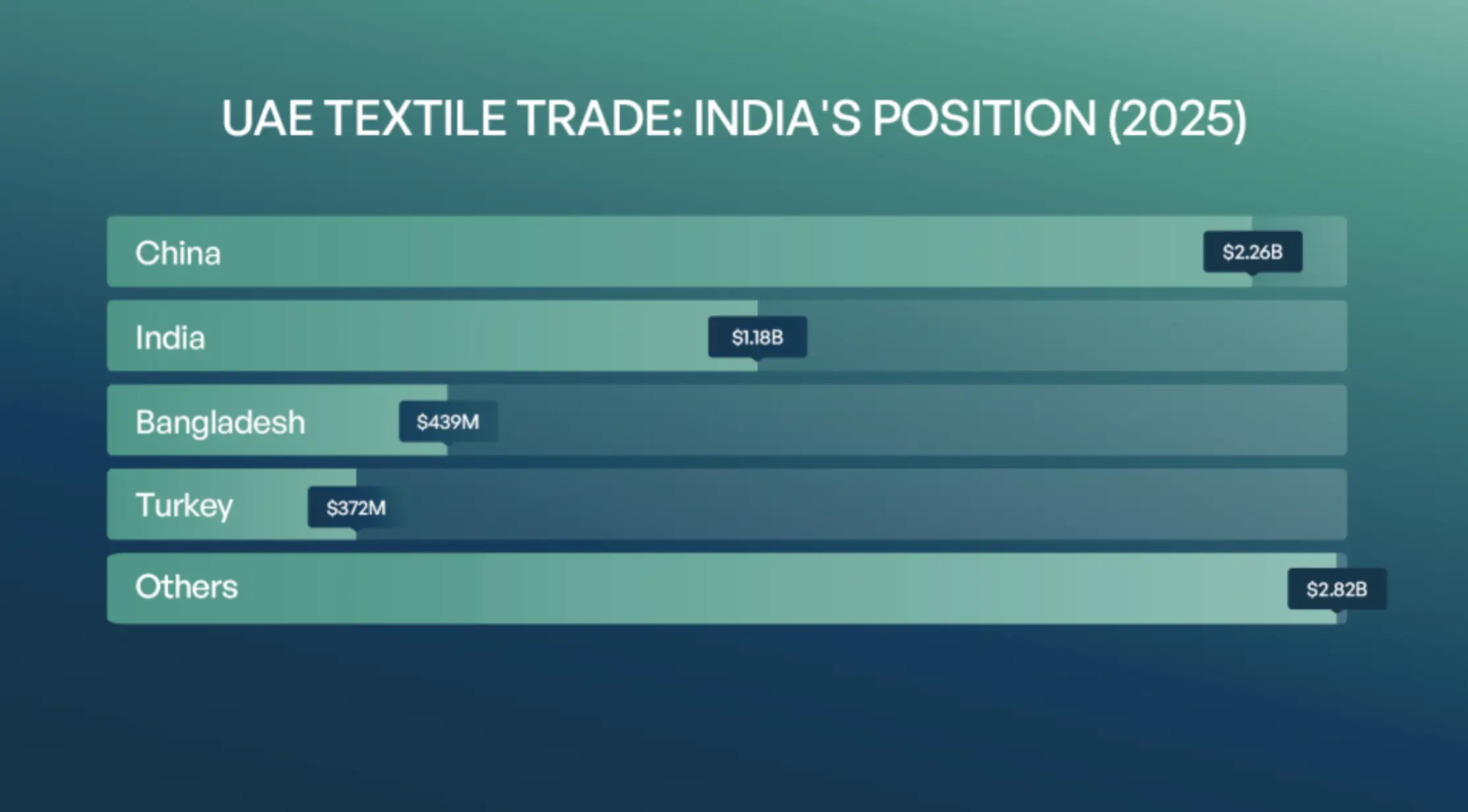
Data sourced from Kohan Textile Journal UAE Textile Market Overview (2025) and Textile Infomedia UAE Trade Data (2025).
For Indian traders who already understand the rhythm of textile business — fluctuating demand cycles, seasonal orders, quick replenishment, and the evergreen appetite for Indian garments — Dubai offers something India cannot: a central trading base that gives global reach without operational friction.
Starting a textile or garments trading company in Dubai is more straightforward than most Indian entrepreneurs expect, especially through a digital-first jurisdiction like Meydan Free Zone.
Why Dubai Works for Indian Textile Traders
Indian textiles dominate shelves and warehouses across Dubai. But the real advantage lies not in selling locally — it lies in re-export. Dubai’s infrastructure makes it easy to ship Indian-origin garments onward to Saudi Arabia, Qatar, Kuwait, Oman, Bahrain, East Africa and the CIS region.
Under the India–UAE CEPA agreement, many textile categories of Indian origin also enjoy preferential duty treatment, improving margins for Indian exporters compared to Western markets where duties on garments can be significantly higher.
The UAE’s trade ecosystem is predictable, paperwork-light and built for speed. For Indian founders who are used to managing DGFT codes, GST returns, e-way bills and port delays, the ease of the Dubai environment is often surprising.
[blockCTAmPlus]
Choosing the Right Trading Activity
“Textile business” in Dubai can take many shapes — from readymade garments and fabric rolls to uniforms, ladieswear, winterwear and home furnishings. Legally, all of these fall under commercial trading activities, but the exact activity you select determines your import permissions, your customs classification and your re-export eligibility.
Dubai follows the same international HS codes Indian exporters already work with, so the transition feels familiar to anyone who has shipped from India before:
- HS 61 for knitted apparel
- HS 62 for woven garments
- HS 63 for home textiles
The key is selecting the activity that best reflects how you intend to trade.
If you set up through Meydan Free Zone, this becomes easier because you can choose from 2,500+ business activities, including multiple textile and garments-related categories.
This gives Indian traders the flexibility to cover multiple product lines — such as apparel, accessories and home textiles — under a single, MoFA-accredited license, without needing a new approval each time you expand your range.
Setting Up Your Company the Smart Way — Why Indians Prefer Meydan Free Zone
For most Indian textile entrepreneurs, the choice of licensing authority directly affects how quickly they can start trading. Many free zones require additional checks, in-person visits or staged approvals. Meydan Free Zone, however, aligns closely with Indian trading realities.
The free zone allows Indian founders to set up a company entirely through a digital workflow, often using nothing more than a passport copy. The free zone’s award-winning 360-degree platform, MoFA-accredited licenses and 24/7 digital environment make incorporation simple and predictable — without the paperwork layers Indian traders are accustomed to.
Because textile trading is activity-heavy and time-sensitive, this setup speed matters. Once the license is issued, you can immediately prepare for imports, open your IBAN through Meydan’s partnered banks, and begin contracting with suppliers and buyers.
[blockCTAmAssist]
Importing Textiles from India to Dubai: A Reality Indian Traders Already Understand
The shipping route between India and Dubai is one of the fastest in the world. Containers leave from Nhava Sheva, Mundra, Cochin and Chennai, arriving at Jebel Ali Port, the largest port in the region. Air freight is the preferred option for fast-fashion cycles, women’s wear restocks, festival collections and high-value items where speed matters more than freight cost.
Documentation is refreshingly straightforward:
- Commercial invoice
- Packing list
- Bill of lading or airway bill
- Certificate of origin (especially important under CEPA)
Most textile imports attract a standard 5% UAE customs duty, though CEPA allows preferential duty for many Indian-origin apparel and fabric lines.
What Indian traders love most is Dubai’s consistency: no sudden rule changes, no multi-step approvals and no last-minute document surprises.
[blockCTABizActivityList]
Operating Your Textile Trading Company in Dubai
Indian textile traders often adopt one of three operational models:
The structure depends on your target markets and margins. Dubai’s geographical location makes it easy to supply multiple countries from a single warehouse, which is why many Indian businesses treat Dubai as a global “distribution centre” rather than just a sales market.
The rise of UAE e-commerce has created new opportunities for Indian fashion brands — especially those in ethnic wear, modest fashion, kidswear and contemporary apparel. With a trading license and an e-commerce approval, Indian brands can sell through their own website or UAE marketplaces, fulfilling orders from Dubai to all GCC countries. Customer acquisition costs in the UAE are often significantly lower than Western markets, making it an attractive expansion route.
[blockCTANameCheck]
Banking for Textile Traders: The Meydan Free Zone Advantage
Banking is usually the most intimidating part of expansion for Indian founders, mainly because Indian banks require exhaustive paperwork. Dubai banks are structured differently. What makes the process smoother with Meydan Free Zone is the guaranteed IBAN pathway. Instead of visiting multiple bank branches or preparing a thick physical file, Meydan Free Zone submits your application digitally to its network of partnered banks. Because these banks already recognise Meydan’s licensing structure, approvals become cleaner and faster.
For time-sensitive textile businesses, access to a working IBAN without heavy paperwork is a major advantage.
Dubai Is the Global Stage Indian Textile Traders Deserve
Indian textile entrepreneurs are some of the most agile businesspeople in the world. They understand margins, sourcing, seasonality and customer psychology better than most. Dubai amplifies these strengths by offering a global logistics hub, transparent rules and a tax-efficient environment that allows Indian traders to scale beyond India’s borders.
With the right license, clear documentation and a strong free zone partner like Meydan Free Zone, Indian textile and garments traders can establish a Dubai company quickly, begin importing from India, and build a regional or global operation with ease. In many ways, Dubai is not just another market — it is the gateway that turns an Indian textile business into an international one.
[blockCTACostCalculator]
Citations
¹ India Ministry of Commerce, via Press Information Bureau, "CEPA is the growth engine for India-UAE bilateral trade," 2023.
² UAE Trade Data, via Inlex Partners, "The Textile Industry in UAE 2026," August 2025.