
Table of Contents
Frequently Asked Questions
1. Can I bring more than one pet with me from the UK to Dubai?
Yes, you can bring up to two pets (cats or dogs) per person each year into the UAE. If you want to bring more, another adult in your household needs to apply under their name. Each pet must meet the UAE’s import guidelines, including vaccinations, microchipping, and holding a valid import permit from MOCCAE.
2. Do I need to quarantine my pet when arriving in Dubai from the UK?
No quarantine is required if you're coming from the UK, a low-risk rabies country. As long as your paperwork is correct, your pet is microchipped, and vaccines (including rabies) are up to date, your pet will be cleared after a quick inspection at customs. Most pets are reunited with their owners within 1–2 hours of landing.
3. What documents do I need to bring my pet to Dubai from the UK?
You'll need an Import Permit from MOCCAE, an Export Health Certificate from a UK government-approved vet, updated vaccination records (rabies, DHPPi/L or FVRCP), microchip information, and a recent parasite treatment record. All documents should match perfectly; even a small typo can delay your pet’s clearance. These documents must be prepared in the weeks leading up to travel.
4. How do pets travel from the UK to Dubai?
Pets must travel as manifest cargo from the UK, not in-cabin or as checked baggage. Book with a pet relocation service or cargo provider like Emirates SkyCargo. Your pet will travel in an airline-approved crate, with vet documents attached. Direct flights are preferred to reduce stress. Upon arrival, customs will verify all records before releasing your pet.
5. Is Dubai a good place to live with pets?
Absolutely. Dubai has pet-friendly neighbourhoods like Jumeirah Village Circle and Arabian Ranches, quality vet care, daycare services, and active pet communities. Just be mindful of leash laws, heat safety in summer, and public areas banned for pets. With some planning, your pet can thrive in Dubai, just like you will with Meydan Free Zone supporting your business launch in Dubai.
Topic Summary
1. Microchip and Identification
Before travel, your pet must be microchipped with an ISO 11784/11785 compliant 15-digit pet microchip. This ensures your pet can be easily identified upon arrival in Dubai.
2. Vaccinations
Your pet must have a valid rabies vaccination administered at least 21 days before entry but not older than 12 months. Additionally, dogs and cats should be vaccinated against common diseases such as distemper and parvovirus.
3. Health Certificate and Rabies Titre Test
A licensed veterinarian must issue a health certificate within 7 days of travel confirming your pet is in good health. For dogs and cats, a rabies antibody titre test is often required, performed between 30 days and 12 months before import.
4. Import Permit
UK expats must apply for an import permit from the Dubai Municipality Veterinary Department prior to arrival. This document authorizes the entry of your pet into Dubai and is essential to avoid quarantine.
5. Quarantine Regulations
If all documentation is in order, pets usually enter Dubai without quarantine. However, if requirements are unmet, your pet may be subject to quarantine at an approved facility, lasting from 7 to 30 days depending on the situation.
Dubai Pet Import Requirements for UK Expats: A Smooth Relocation Guide
Relocating to Dubai isn't just a smart move; it's a complete turnaround of your lifestyle. Think 0% income tax, 0% corporate tax on qualifying income, year-round sunshine, and a community of roughly 240,000 British nationals already settled in the UAE, as CNBC reports.¹ The city itself ranks 6th globally in the 2026 Numbeo Safety Index, per Khaleej Times.²
But before you can settle into that new lifestyle in Dubai, there’s one crucial part of your relocation you can’t ignore: bringing your pet.
Luckily, pet import requirements in Dubai for UK expats are clear and easy to follow. No quarantine if your documents are right. Simple permits. Official pathways that make relocating with your pet not just possible, but entirely practical.
And while you focus on the essentials of your move, Meydan Free Zone streamlines the rest. From obtaining your business license to setting up your bank account and visa, everything is fast-tracked so your UAE residency is completed efficiently and without hassle.
Dubai Trade License from AED 12,500
Get Your LicenseThe infrastructure waiting for your pet in Dubai is not an afterthought; the emirate's pet population has nearly doubled in a decade, and the services around it have grown to match.
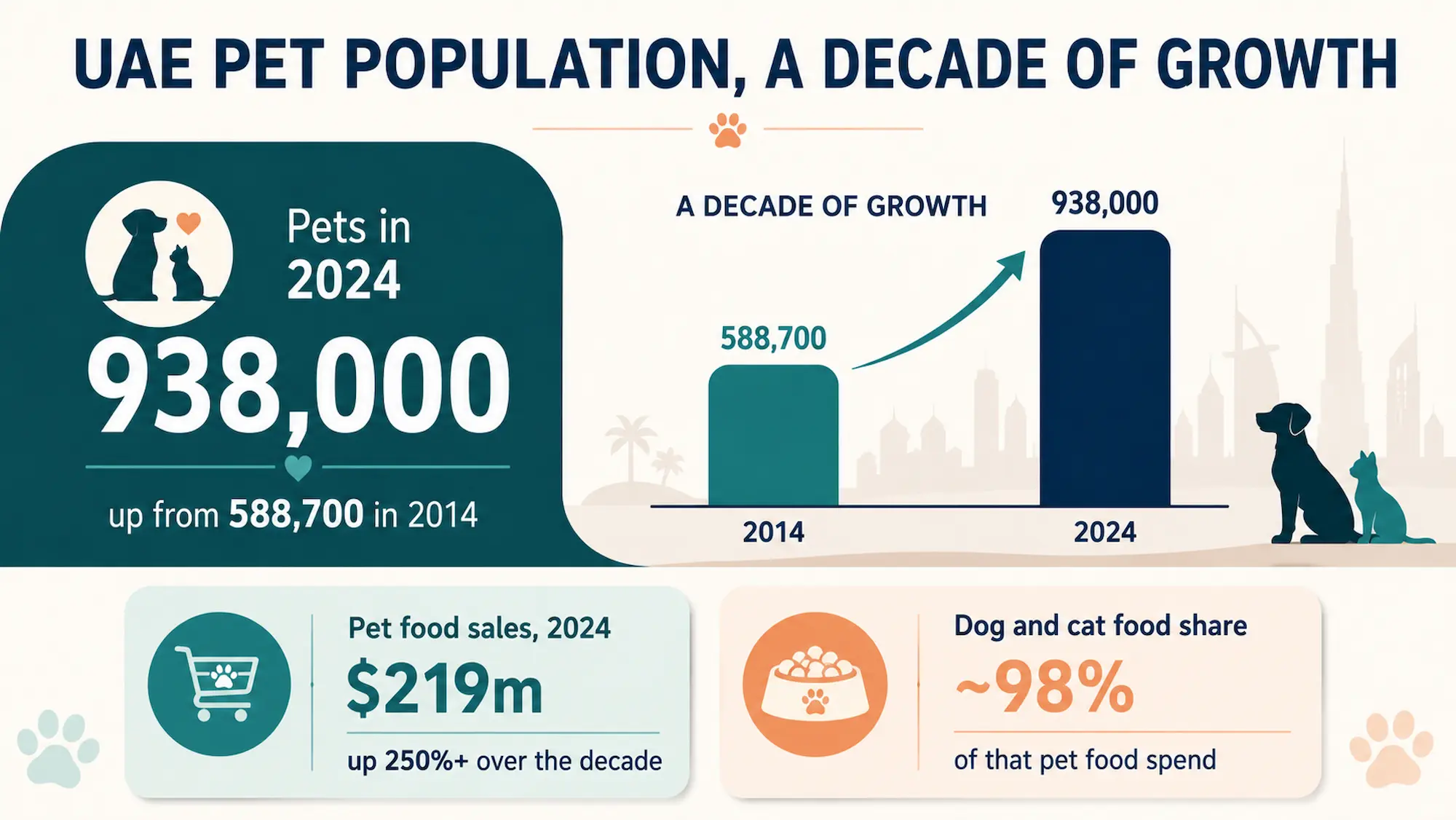
Source: USDA Foreign Agricultural Service (2025).
What It Takes to Bring Pets From the UK to Dubai
For many UK expats relocating to Dubai, bringing their pet is just as important as the move itself. And the good news? Bringing pets from the UK is surprisingly straightforward.
Here are the UK-to-Dubai pet import rules you need to know to get your pet cleared for touchdown in the UAE:
- Types of Pets You Can Bring: You can bring cats and dogs; they are the most common and the easiest to import. Birds and other small pets like rabbits or hamsters might be allowed, but you need to go through more layers of approvals through different UAE authorities. Lastly, exotic or endangered species are typically banned and heavily restricted. It’s advisable to always check with the UAE’s Ministry of Climate Change and Environment (MOCCAE) if you’re unsure.
- Import Limits: You’re allowed to bring in up to two pets per person every year. For example, that means you can either import two dogs, or 2 cats, or 1 cat and a dog. In case you want to bring more of your pets to Dubai, a second adult in a household must apply to bring pets under their name.
- Documents You’ll Need: Dubai’s pet import rules and requirements are thorough because of the intention to safeguard public health and local animal populations. Here’s a close look at the documents you need to have in hand from applying for your import permit to clearing customs when you arrive:
| Document | What You Need to Know |
|---|---|
| Import Permit | You can apply through the MOCCAE portal before you travel to Dubai. This is valid for 90 days, and you need to upload your pet’s photo, a copy of the pet’s vaccination record, your valid passport copy, and your UAE Emirates ID. |
| ISO Microchip | Your pet must be microchipped with a 15-digit ISO-compliant chip. It should be scannable and appear across all docs like vaccination records, health certificates, etc. An important point is that the chip should be implanted prior to vaccines. |
| Vaccination Records or Pet Passport | This is what you must show:
|
| Export Health Certificate (EHC) | This must be issued by an Official Veterinarian (OV) in the UK within 7 days of travel. It confirms that your pet is free of diseases, vaccinated, and fit enough to travel. |
| Parasite Treatment Record | Your pet must be treated and checked for internal and external parasites like fleas, worms, or ticks within 14 days before the flight. This should be signed and stamped by your vet. |
| Bill of Lading | This will be arranged by the airline or cargo service. When it’s time for your pet to be released from customs, this will be required at the Dubai airport. |
- Banned Dog Breeds: There’s a list of dog breeds that are prohibited from entering the UAE. Some of these dog breeds include Pit Bull Terrier, Japanese Tosa, American Bully, Brazilian Mastiff, Dogo Argentino, Fila Brasilero, Presa Canario, wolf hybrids, and more. Check the full list of banned dog breeds for a more comprehensive overview.
- No Rabies Titer Test Needed: The biggest advantage you have when bringing your pet to Dubai is that the UK is classified as a low-risk rabies country. That means no rabies (antibody) titer test is needed, no quarantine test is imposed on arrival, and as long as your documents clear the checks, your pet can relocate with you just fine.
A Step-by-Step Process to Flying Pets In From the UK to Dubai
Once you’re familiar with pet import requirements in Dubai, it’s time to get prepped for the actual journey. This means pre-flight checklists, making the right bookings, finding the perfect crate, and timing to make your pet’s journey as smooth as yours.
[blockAccordionSteps]
What to Expect When Your Pet Arrives in Dubai
Once the flight lands in Dubai, consider it your final checkpoint. Now it’s just the checking of your paperwork – and once confirmed – your pet will be by your side in no time.
This is what the post-arrival process looks like:
- Customs will conduct a scan to check if your pet’s microchip matches the import documents.
- Officials will then do a quick document verification and review your health certificate and import permit.
- A fast, gentle inspection will be performed to confirm your pet is healthy and ready to travel.
- If your documents have no errors, are in order, and you’re arriving from the UK, which is classified as a low-risk rabies country, there’s no holding period (no quarantine involved).
- After clearance, it’s time to register your pet online in the Dubai Municipality or via your local vet to get their official UAE ID tag.
- The turnaround time? Most pets are cleared to go within 1-2 hours of landing.
Settling Into Dubai’s Pet-Friendly Environment
Once you’ve landed in Dubai with your pet, it’s now time to settle in. To make things easy for you, Dubai has evolved into one of the most pet-friendly hubs with designated dog parks, welcoming neighbourhoods, veterinary clinics, and communities of UK expat pet owners.
Here’s a rundown of the standards you’ll be stepping into when you’re in Dubai:
[blockFaqsCategory]
In Conclusion
While you’re chasing new opportunities in Dubai, your pet is part of the plan naturally. And pet import requirements in Dubai are built to support you, not restrict you even further. From vaccinations to microchips, import permits to landing procedures, the pet import requirements in Dubai for UK citizens are structured, transparent, and designed to protect animal welfare while making you and your pet feel right at home from day one.
And while you prepare documentation and health procedures for your pet months ahead of your departure, Meydan Free Zone helps you build your life in Dubai from anywhere in the world. Your business setup happens smoothly - 100% online, your Fawri business license issued in under 60 minutes, with visa and bank account assistance built-in. And the moment you land in Dubai? Your Dubai dream is already in motion.
Fawri - Instant Business License
Setup in 60 MinutesCitations
¹ CNBC, "UK hopes to lure expats back from UAE as war challenges Dubai's appeal," April 21, 2026.
² Khaleej Times, "Four UAE emirates ranked among world's safest in Numbeo 2026 data," January 18, 2026.


%20Startups%20in%20Dubai%20.webp)