Table of Contents
Frequently Asked Questions
1. Do British SMEs need a local company to operate in Dubai?
While it is possible to sell into the UAE remotely, most businesses find that a local entity makes it easier to sign contracts, receive payments, complete vendor onboarding, and access corporate or government opportunities.
2. Can a UK business win work in Dubai without brand recognition?
Yes. In Dubai, clients prioritise responsiveness, local presence, and proven delivery over brand history. SMEs often compete successfully by specialising, moving quickly, and demonstrating clear operational capability.
3. What is the fastest way for a British SME to establish a presence in Dubai?
Digital-first free zone setups like Meydan Free Zone allow British founders to establish a company remotely, often using only passport documentation, without the need for a physical office in the early stages. The Fawri business license allows LLC company formation in under 60 minutes.
4. Why is local banking important for UK businesses in the UAE?
A UAE bank account allows companies to invoice locally, receive payments more efficiently, and meet procurement requirements, which helps build commercial credibility with clients and partners.
5. Which sectors offer the most opportunities for British SMEs in Dubai?
Strong demand exists in professional and technical services, education and training, sustainability and ESG advisory, construction and engineering support, and specialised trading or e-commerce.
6. Is a free zone suitable for service-based British businesses?
Yes. Free zones like Meydan Free Zone are commonly preferred by service and trading SMEs because they allow 100% foreign ownership, provide clear licensing structures, and enable companies to operate and contract locally without a large physical footprint.
7. How can British SMEs build trust with UAE clients quickly?
Trust is built through practical signals such as fast response times, a UAE phone number and address, a local entity and bank account, relevant certifications, and documented case studies demonstrating proven delivery.
Topic Summary
1. Leverage Local Partnerships
Form strategic alliances with established Dubai-based companies to gain market insights, enhance credibility, and accelerate distribution channels.
2. Focus on Speed and Reliability
Emphasize your ability to deliver products and services quickly and consistently, addressing Dubai buyers’ priority on efficiency over brand legacy.
3. Tailor Offerings to Local Preferences
Customize products and services to meet the distinct cultural, legal, and economic needs of Dubai’s market, demonstrating attentiveness and flexibility.
4. Utilize Digital Marketing and Social Media
Engage customers through targeted online campaigns, influencer collaborations, and active social media presence to build brand awareness without relying on heritage.
5. Participate in Trade Shows and Networking Events
Showcase your offerings at local industry events and Dubai’s numerous trade fairs to directly connect with potential clients and establish a trustworthy reputation.
How British SMEs Can Build a Unique Market Presence in Dubai Without Big Brands
In the UK, brand history still does a lot of the selling. Established names such as Rolls-Royce, HSBC, BP, BT, and Arup benefit from long histories and institutional trust, where recognition alone can influence buying decisions and reduce perceived risk. Buyers lean on long references, recognisable names, and "who else uses them?" because switching costs can be political as much as commercial. In Dubai, that bias is weaker.
The first question is usually simpler: Are you here in Dubai, and can you deliver quickly? Buyers are less concerned with legacy and more focused on whether a business is locally reachable, commercially responsive, and able to solve a problem without delay. The market is built on speed, availability, and whether you're locally reachable when something breaks, a shipment is late, or a compliance deadline lands.
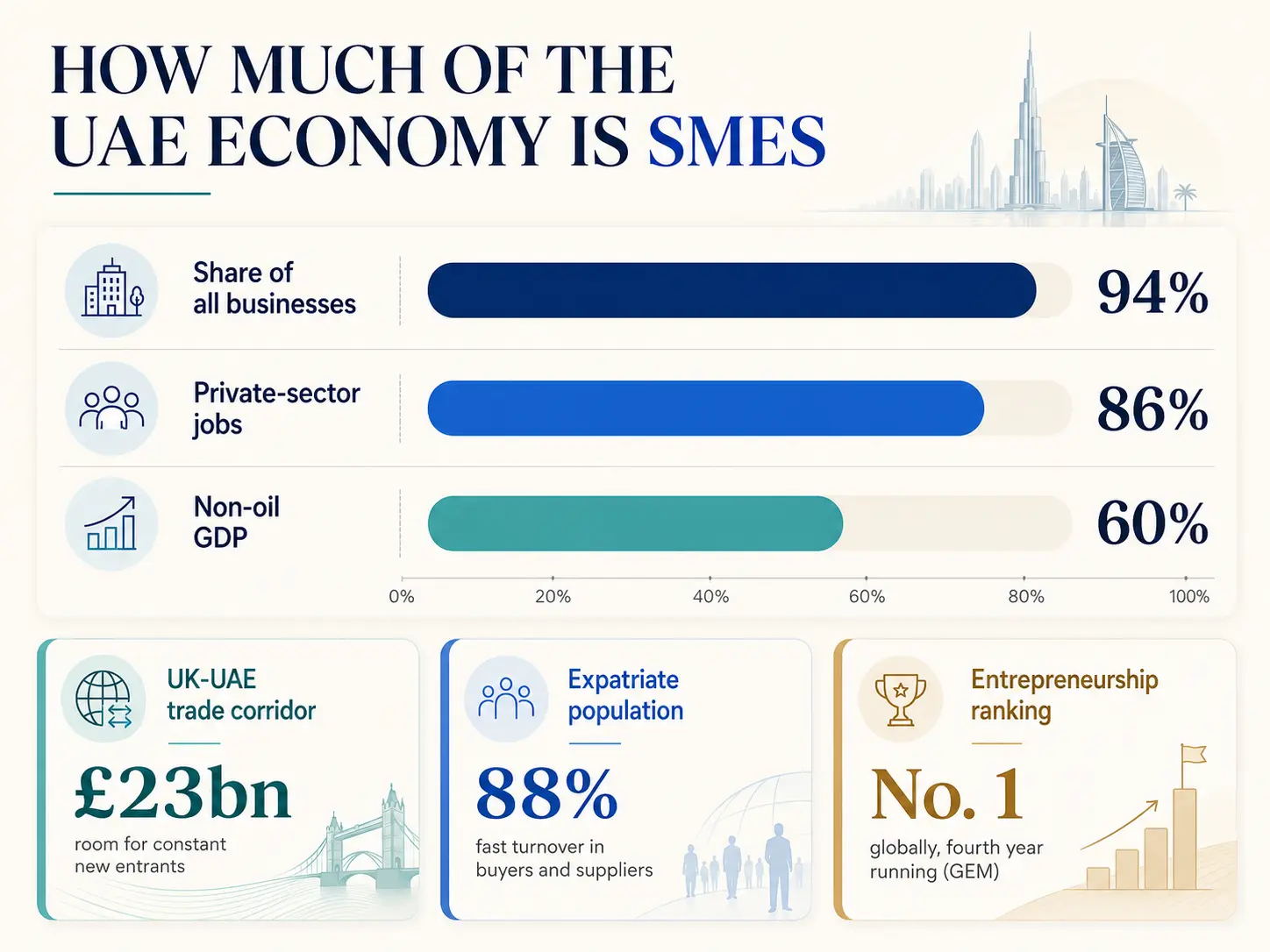
The reason a UK SME does not need a famous name to compete in Dubai is structural: small and medium firms already are the economy, not the exception to it.
Sources: UAE Ministry of Economy, via The National (2025); Global Entrepreneurship Monitor (2025).
The UK-UAE trade relationship is large enough to support constant new entrants. The UK Government reports the UK-UAE trade corridor is worth more than £23 billion annually,¹ while WAM, the UAE state news agency, reports SMEs make up over 90% of companies in the UAE and contribute a large share of private-sector activity.² Add in Global Media Insight's figure of 88% expatriate population,³ and you get fast turnover in buyers, suppliers, and decision-makers.
The challenge is not competing with global brands. The real question is how British SMEs and businesses in Dubai can position themselves where larger competitors are slow, expensive, or inflexible. Dubai rewards specialisation, responsiveness, and operational presence, not brand size.
Why Brand Recognition Matters Less in Dubai Than in the UK
Trading Economics, drawing on the World Bank's final Doing Business report, ranked the UAE 16th out of 190 economies, reflecting a business environment where market entry is relatively straightforward for UK SMEs.⁴ WAM also notes SMEs account for over 90% of businesses,² meaning a lack of local brand history is common and rarely a barrier.
Buyers typically prioritise:
- Availability - can you supply now, or commit to a reliable lead time?
- Response speed - quotes today, not next week
- Local presence - a UAE entity, local number, and someone who can attend if needed
- Commercial flexibility - workable payment terms and local transfer capability
Decision cycles are shorter, and relationships depend on service performance rather than brand familiarity. For a British SME or business in Dubai, responsiveness and local presence matter more than reputation built in the UK.
How British SMEs Compete in Dubai Without Brand Recognition
British firms rarely win in Dubai by competing on brand visibility. They win where larger organisations are slower to respond or less willing to adapt. For a British founder, the advantage is not scale; it is focus, proof, and speed.
[blockFaqsCategory]
Free Company Name Check
Check NowThe Importance of Local Presence for a British SMEs in Dubai
Many UK founders initially try to sell into the UAE remotely and establish locally once revenue builds. In practice, the absence of a UAE entity often slows commercial traction.
Without local presence, British businesses commonly encounter:
- Longer vendor onboarding and approval cycles
- Slower payment processing
- Restrictions on contract eligibility or tender participation
- Practical difficulties opening regional banking relationships
For a British SME, whether a Birmingham engineering specialist, a London training provider for GCEs, or a niche software firm, local establishment is less about appearing established and more about removing operational friction from closing and getting paid for work.
For many firms, a free zone company in a jurisdiction like Meydan Free Zone becomes the practical entry point. It allows 100% ownership, clear licensing, and a UAE contracting entity without committing to a full physical footprint. The structure functions as an operating tool, reducing procurement and banking friction rather than signalling scale.
Choosing the Right Market Entry Model
Your entry structure should reflect how you plan to win work, sign contracts, and get paid in the UAE. The model you choose determines how clients and customers engage with you and how easily you can operate commercially.
| Model | When it works |
|---|---|
| Distributor or agent | Testing product demand or accessing local projects, retail channels, or tenders |
| Representative presence | Early-stage relationship building while developing a pipeline |
| Free zone company | Direct sales, service delivery, and regional contracting through a UAE entity. |
| Mainland entity | Physical operations, onshore service requirements, or certain government contracts |
Ownership, cost, and compliance obligations vary across models. If speed matters, digital-first free zone setups can reduce administrative delays.
Structurally, options such as Meydan Free Zone are designed for service and trading SMEs that need to establish quickly and begin operating without extensive administrative lead times. Through the Fawri business license, British founders can form a company in under 60 minutes, using only their passport, with the entire process completed 100% online.
Meydan Free Zone also supports operational flexibility. More than 2,500 business activities are available, and up to three activity groups can be combined under a single license. For UK SMEs testing adjacent services or planning to expand their offering once local demand is clearer, this reduces the need for early restructuring or additional licenses.
Free Business Setup Cost Calculator
Calculate NowHow Small British Firms Should Position Themselves in the UAE Market
In Dubai, market presence is built through reliability and accessibility rather than brand messaging. Customers and partners are looking for businesses that are easy to reach, quick to respond, and straightforward to engage.
Signals that build confidence include:
- A UAE phone number and local address on proposals and communications
- A UAE-registered entity with a local bank account for payments
- Fast response times, with quotations or follow-ups provided the same day where possible
- Clear documentation such as a trade licence, insurance, certifications, and relevant case studies
Positioning should centre on solving a specific need, whether that is faster turnaround, stronger compliance, cost efficiency, or consistent quality. Broad claims of being “international” carry little weight. The UAE market is competitive and commercially focused, so premium pricing is accepted only when the value is clear and measurable, such as reduced delays, fewer errors, or faster project completion.
Local banking is a key credibility signal. Meydan Free Zone offers a guaranteed IBAN pathway through a network of banking partners, including digital, traditional, Islamic, and neobanks, with support to initiate applications, submit to multiple banks where needed, and arrange bank rep appointments to establish local payment capability early.
Sectors Where British SMEs Are Growing in Dubai
Demand in Dubai tends to concentrate where regulation, infrastructure investment, and cross-border trade create ongoing operational needs. Trends point to consistent growth in several areas:
- Professional and technical services - compliance, risk, engineering support, and specialist consulting
- Education and training - accredited programmes, corporate training, and specialist provision
- Sustainability and ESG advisory - reporting, energy efficiency, and supply chain disclosure
- Construction and engineering support - project delivery, quality assurance, and specialist components
- E-commerce and specialised trading - niche product categories and cross-border fulfilment
In Conclusion
If you’re a British SME planning to build a market presence in Dubai, the advantage rarely comes from brand recognition alone. Growth comes from being locally established, easy to reach, and operationally ready to deliver and invoice without friction. In a market that rewards responsiveness and clarity, early structure and local credibility often determine how quickly opportunities convert into revenue.
For founders who want a straightforward entry, Meydan Free Zone offers a practical setup pathway designed for British service and trading businesses. To plan your move, you can book a consultation with a setup advisor for tailored guidance or use the Cost Calculator to estimate your license, visa, and operational fees before making a commitment.
Ready to Launch Your Business in Dubai?
Let's ConnectCitations
¹ UK Government, "UAE Trade and Investment Factsheet 2026," February 2026.
² Emirates News Agency (WAM), "SMEs play critical role in UAE move towards economic diversification," accessed 2026.
³ Global Media Insight, "UAE Population Statistics 2026," 2026.
⁴ Trading Economics, "United Arab Emirates Ease of Doing Business," accessed 2026.