Table of Contents
Frequently Asked Questions
1. Can a British aromatherapy brand sell into the UAE without a local company?
Yes, but cross-border selling creates friction at every stage — from invoicing and payment collection to product registration and vendor onboarding. Most hospitality and retail buyers in the UAE prefer or require locally registered suppliers.
2. What licenses does a British wellness brand need to operate in Dubai?
A UAE trade license covering the relevant business activities — such as trading in cosmetics, wellness consultancy, or e-commerce. Through Meydan Free Zone, up to three activity groups can be combined under a single license, and the Fawri license is issued in under 60 minutes.
3. Do aromatherapy products need to be registered in the UAE?
Yes. Under Cabinet Decision No. 10 of 2022, aromatherapy products fall under the Emirates Conformity Assessment Scheme (ECAS), which requires compliance with safety, labelling, and quality standards. A UAE-registered entity simplifies this process significantly.
4. How long does it take to set up a wellness business in Dubai?
Through digital-first free zone structures like Meydan Free Zone, a business license can be issued in under 60 minutes. Banking, product registration, and operational setup follow, with timelines depending on the complexity of the product range.
5. Does a British wellness brand need a physical office in Dubai?
No. Free zone structures like Meydan Free Zone allow businesses to operate without a physical office, keeping fixed costs low while maintaining the ability to contract, invoice, and register products locally.
6. Can a Dubai entity support sales across the wider GCC?
Yes. Many UAE-based buyers manage procurement across Saudi Arabia, Oman, Qatar, and other GCC markets. A local entity allows British brands to contract centrally and expand a single client relationship into multi-market distribution.
7. Is the UAE aromatherapy market large enough to justify setup costs?
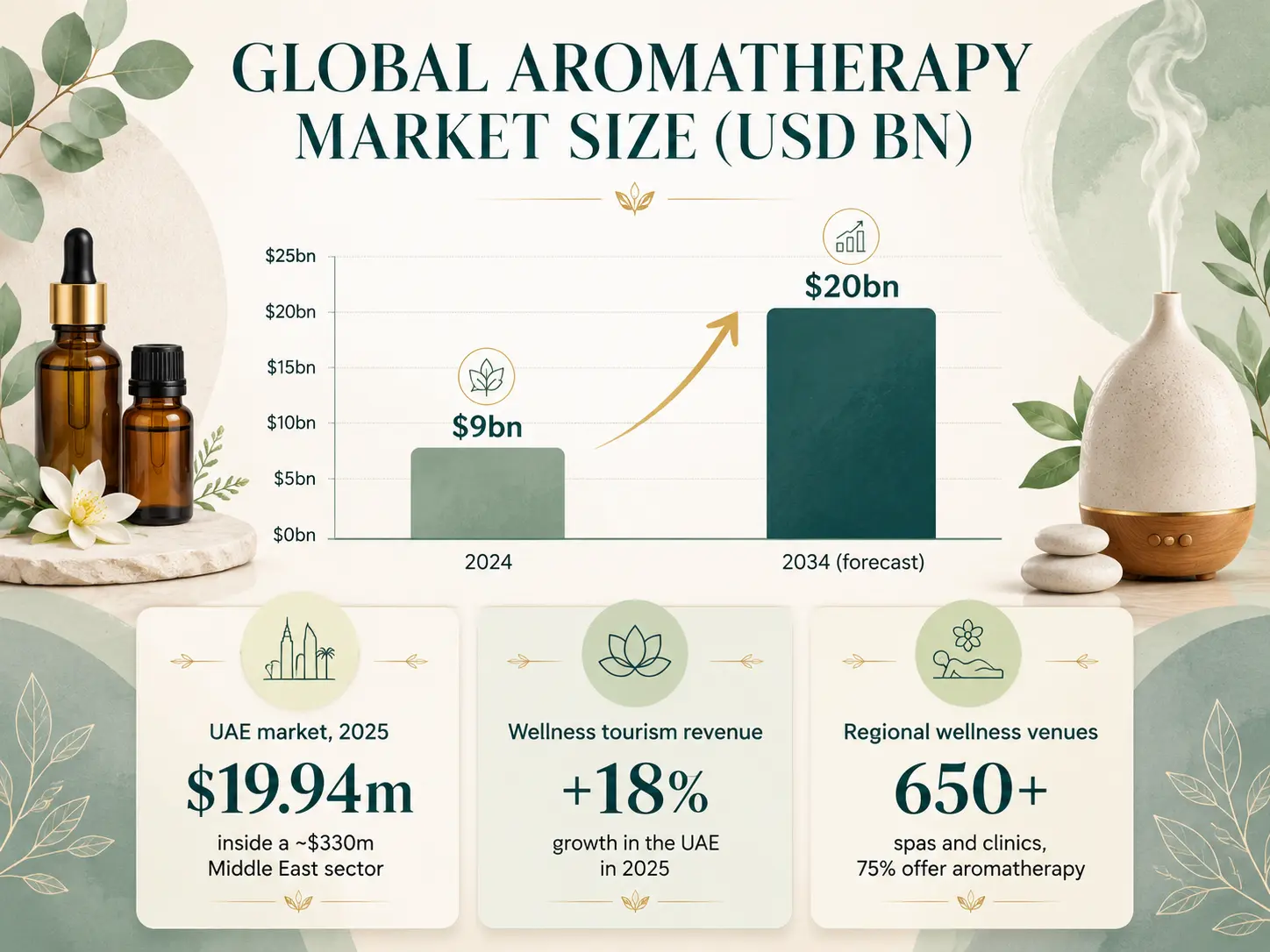
The UAE aromatherapy market is forecast at USD 19.94 million in 2025, within a Middle East sector valued at approximately USD 330 million. With wellness tourism revenue growing 18% in 2025 and over 650 wellness facilities featuring aromatherapy, the demand is established and expanding.
Topic Summary
1. Integrated Role in Hospitality and Wellness Industry
Aromatherapy in Dubai is far from niche; it is a core component embedded within hospitality, medical wellness, and consumer retail sectors. With the UAE and Saudi Arabia collectively operating over 650 wellness resorts and spa clinics in 2023, 75% of these establishments include aromatherapy treatments, underscoring its widespread acceptance and growing demand.
2. Surging Wellness Tourism and Revenue Growth
The wellness tourism market in the UAE is expanding rapidly, with wellness tourism revenue increasing by 18% in 2025. This surge reflects a broader regional commitment to developing high-end wellness experiences, where aromatherapy is a critical element in attracting and retaining discerning international visitors.
3. Investment in World-Class Wellness Facilities
Dubai’s unveiling of the USD 545 million Therme Dubai resort epitomises the city’s dedication to premium wellness infrastructure. Such large-scale investments provide an ideal platform for aromatherapy products and services, aligning with the luxury and therapeutic standards expected by clientele.
4. Strategic Suitability of British Aromatherapy Brands
British aromatherapy brands, renowned for their heritage, quality control, and scientifically-backed formulations, perfectly meet Dubai’s market requirements. Their established reputation and adherence to regulatory standards complement the UAE’s focus on authenticity and efficacy within wellness treatments.
5. Cultural Appreciation and Market Accessibility
British brands benefit from the UAE’s openness to international trade and cultural appreciation for luxury health products. The English language compatibility and shared emphasis on professional standards facilitate smoother market entry and position British aromatherapy products favourably among both consumers and industry professionals in Dubai.
Introducing British Aromatherapy and Wellness Essentials to Dubai
A British essential oils brand gets a message from a five-star spa group in Dubai. They love the range. They want to stock it across three properties. Two emails later, the questions shift. Can you invoice in AED? Are your products registered under ECAS? Do you have a UAE trade license?
The formulations were not the problem. The business structure was.
This is becoming a familiar sequence for British wellness founders. Dubai's demand for aromatherapy is real, growing, and commercially structured. But the market buys from businesses that are locally set up to sell. It does not buy from overseas suppliers who need weeks to figure out how to get paid.
The numbers back this up. Fortune Business Insights forecasts the UAE aromatherapy market at USD 19.94 million in 2025¹. That sits within a Middle East aromatherapy sector worth about USD 330 million, per Ken Research². Globally, Emergen Research reports the market hit USD 9.2 billion in 2024. It projects growth to USD 20.1 billion by 2034³. This is not a trend. It is an established and expanding category. British brands are well positioned to compete in it, provided the commercial setup matches the product.
Why Dubai Is Buying Aromatherapy, and Why British Brands Fit
Dubai's aromatherapy demand is not niche. It is embedded in hospitality, medical wellness, and consumer retail. These three sectors are all scaling at once.
Emergen Research reports strong regional numbers. The UAE and Saudi Arabia together operated over 650 wellness resorts and spa clinics in 2023. Of these, 75% featured aromatherapy on their treatment menus³. Mordor Intelligence reports UAE wellness tourism revenue surged 18% in 2025. The country also unveiled the USD 545 million Therme Dubai resort in 2024. It was built specifically around holistic and therapeutic experiences⁴.
On the hospitality side, brands are building aromatherapy into the core guest experience. MarketDataForecast reports that Young Living partnered with luxury hotel chains in Dubai in June 2023. The goal was to add essential oil-infused amenities to guest rooms⁵. Emergen Research notes that high-end resorts like Talise Spa Dubai and Anantara Spa already feature aromatherapy across their treatments³.
Retail follows the same pattern. Emergen Research reports double-digit sales growth in essential oil products. This spans online portals like Namshi and Carrefour UAE, plus concept boutiques like The Fragrance Kitchen³. Per Bonafide Research, e-commerce plays an increasingly central role in distribution⁶. That matters for UK brands with existing direct-to-consumer infrastructure.
Where does British identity fit? The UAE market values provenance and formulation quality. Emergen Research notes that lavender, frankincense, oud, and sandalwood lead therapeutic use due to cultural resonance³. But buyers also look for more. They want clinical credibility, evidence-based blending, organic certification, and transparent sourcing. British aromatherapy brands built on IFPA standards, organic accreditation, or clinical-grade formulations have a clear edge. Generic international suppliers do not.
The gap is not awareness. It is access.
What the UAE's Regulatory Shift Means for British Aromatherapy Brands
The regulatory environment is tightening. And it does so in a way that actually favours established, standards-driven brands.
In 2023, Emergen Research notes the UAE Ministry of Health and Prevention released a pilot programme. It added aromatherapy and reflexology to alternative medicine licensing³. The same year, Ken Research reports Cabinet Decision No. 10 of 2022 was implemented². It placed aromatherapy products under the mandatory Emirates Conformity Assessment Scheme (ECAS). Essential oil products entering the UAE now face formal compliance requirements. These cover safety, labelling, and quality standards.
Consider a British brand already operating within UK and EU frameworks. It has batch testing, MSDS documentation, and traceable supply chains. For that brand, this is an advantage, not a barrier. The brands that will struggle are those without documentation. The brands that benefit are those that already have it.
But there is a catch. Compliance registration, import documentation, and ongoing regulatory correspondence are much easier through a UAE-registered entity. Managing them from a UK address is harder. A local trade license gives you commercial standing. You can register products, deal with authorities directly, and respond to compliance queries without cross-border delays.
The Commercial Case for Local Establishment
British aromatherapy founders usually approach Dubai one of two ways. They sell remotely and deal with friction as it comes. Or they set up a local entity early and remove that friction before it costs them business.
The remote model works for one-off wholesale orders. It breaks down when the relationship grows. Regular supply, exclusivity agreements, and spa partnerships all require local contracts and AED invoicing. Buyers expect speed and commercial simplicity. Cross-border invoicing, FX delays, and offshore vendor onboarding create enough friction to lose the deal. A locally registered competitor wins it instead.
Local establishment changes the commercial equation:
- Contract eligibility: Many hospitality groups and retail chains require a UAE trade license for vendor onboarding. Without one, you are excluded from procurement systems before the conversation starts.
- Local invoicing: Billing in AED removes FX approvals and international transfer delays. Payment cycles shorten. Cash flow becomes predictable.
- Product registration: A UAE entity simplifies ECAS compliance, import documentation, and direct engagement with regulators.
- Regional reach: UAE-based clients often operate across Saudi Arabia, Oman, and the wider GCC. A single Dubai entity can serve as the contracting hub for multi-market distribution.
The point is not to relocate. It is to create local commercial capability. Then the product can move without the business getting in the way.
How a British Aromatherapy Brand Can Set Up in Dubai
The setup model for a wellness or aromatherapy business follows a familiar structure. It is the same as any service or trading company entering the UAE. But the activity selection and compliance pathway matter more than usual.
Meydan Free Zone vs UK Operation: The Practical Difference
For product and service businesses entering the UAE, the Meydan Free Zone structure is built around low fixed costs and operational flexibility.
| Factor | UK Structure | Meydan Free Zone |
|---|---|---|
| Corporation tax | Up to 25% | 0% on qualifying income (subject to UAE corporate tax rules) |
| Setup timeline | Weeks or months | Business license issued in under 60 minutes through Fawri |
| Office requirement | Typically required | No physical office required to operate (Flexi-desk included) |
| Local invoicing | No | Yes, bill clients in AED |
| Product registration | Complex from overseas | Simplified through local entity (via Dubai Municipality) |
Beyond the structural differences, Meydan Free Zone supports how wellness and trading businesses actually scale:
- Establish a company 100% remotely from the UK, with no travel required
- Choose from 2,500+ licensed activities covering trading, wellness, cosmetics, and e-commerce
- Benefit from 100% foreign ownership and full profit repatriation
- Access local banking pathways to enable AED invoicing and faster collection
- Use mPlus for ongoing operational support, including compliance management, license renewals, accounting, and administrative services
Business Setup in Dubai
Get StartedIn Conclusion
The UAE aromatherapy market is not waiting for British brands to arrive. It is already buying. That happens through spas, hotel chains, retail platforms, and clinical wellness providers. The brands that capture this demand will not necessarily be the ones with the best formulations. They will be the ones that can register products locally, invoice in AED, and show up in a procurement system when a buyer is ready to order.
For British aromatherapy and wellness founders, the capability gap is not product quality. It is structure. A local entity removes the friction between having a product that Dubai wants and being able to sell it there.
Are you looking to bring your British aromatherapy or wellness brand to the UAE market? Book a consultation with a setup advisor at Meydan Free Zone. Together you can identify the most efficient route to local establishment and product registration.
Ready to Launch Your Business in Dubai?
Let's ConnectFootnotes
¹ Fortune Business Insights, "Aromatherapy Market," 2025.
² Ken Research, "Middle East Aromatherapy Market," accessed 2026.
³ Emergen Research, "Aromatherapy Market," accessed 2026.
⁴ Mordor Intelligence, "Aromatherapy Diffuser Market," accessed 2026.
⁵ MarketDataForecast, "Aromatherapy Market," accessed 2026.
⁶ Bonafide Research, "United Arab Emirates Essential Oil Market," accessed 2026.