Table of Contents
Frequently Asked Questions
1. Is there demand for British automation companies in the UAE?
Yes. The UAE robotics system integration market generated USD 258.7 million in 2024, the government has allocated AED 1.5 billion to AI and robotics, and Dubai has targeted deployment of 200,000 robots over the next decade. Demand spans manufacturing, logistics, healthcare, construction, and food service.
2. Do British automation companies need a UAE entity to win contracts?
For most government, semi-government, and large industrial contracts, yes. UAE procurement typically requires a local trade license, AED invoicing capability, and the ability to provide local support. Without a UAE entity, British companies are usually limited to subcontracting or ad hoc project work.
3. Can a robotics company set up in the UAE without relocating?
Yes. Through Meydan Free Zone, British founders can incorporate fully online using only their passport, with a Fawribusiness license issued in under 60 minutes. Engineering and manufacturing stay UK-based, while the UAE entity handles contracts, invoicing, and client relationships.
4. What sectors are driving automation demand in the UAE?
Manufacturing and logistics lead, followed by healthcare, construction, food service, and retail. The UAE’s focus on Industry 4.0 and rising labour costs are accelerating adoption across all sectors.
5. What’s the fastest way to set up a British automation company in the UAE?
Meydan Free Zone offers fully digital company formation with a Fawri business license issued in under 60 minutes. No office, no local partner, and no travel required. Banking, visa, and operational support follow through Meydan’s integrated service model.
6. Does a British robotics company need a physical office in the UAE?
No. Free zone structures like Meydan Free Zone allow companies to operate without a physical office. Most British automation firms start with a commercial entity and add local presence—a commissioning engineer or business development hire — once the contract base justifies it.
Topic Summary
1. Enhancing Warehouse Efficiency
British robotics firms can provide advanced robotic arms and automated sorting systems to streamline parcel handling in UAE warehouses. These systems improve accuracy, reduce labor costs, and enable 24/7 operation, supporting the region’s growing e-commerce and logistics sectors.
2. Optimizing Manufacturing Processes
With expertise in automated guided vehicles (AGVs) and robotic assembly, UK companies can deliver tailored solutions for UAE’s manufacturing hubs like Jebel Ali. Automation reduces human error and increases throughput, boosting competitiveness in the automotive and aerospace industries.
3. Advancing Healthcare Robotics
British innovations in robotic-assisted surgery offer UAE medical facilities cutting-edge technology to enhance precision and patient outcomes. Partnerships with NHS research institutions bring proven solutions suitable for hospitals such as Medcare Royal, improving procedural efficiency.
4. Supporting Construction Automation
Robotics companies from the UK can supply automated machinery for complex tasks on construction sites in areas like Dubai Creek Harbour. Automated plastic molding and robotic material handling reduce project times and improve safety standards amid rapid urban development.
5. Enabling Smart City Development
By integrating AI-driven robotics and automation, British companies can contribute to the UAE’s smart city initiatives. Solutions that incorporate autonomous vehicles, intelligent monitoring, and automated maintenance align with the region’s vision of sustainable and technologically advanced urban environments.
How British Robotics and Automation Companies Can Serve UAE Industries
In a warehouse, robotic arms sort parcels around the clock while a single operator monitors output from a glass-walled control room.
Across town in Jebel Ali, an automated guided vehicle moves engine components between assembly stations without a driver.
At Medcare Royal Hospital, surgical teams are preparing to implement robotic-assisted procedures.
On a construction site in Dubai Creek Harbour, a machine plasters a wall that would have taken a crew of three most of a day.
This is not a vision of what is coming. It is what is already running.
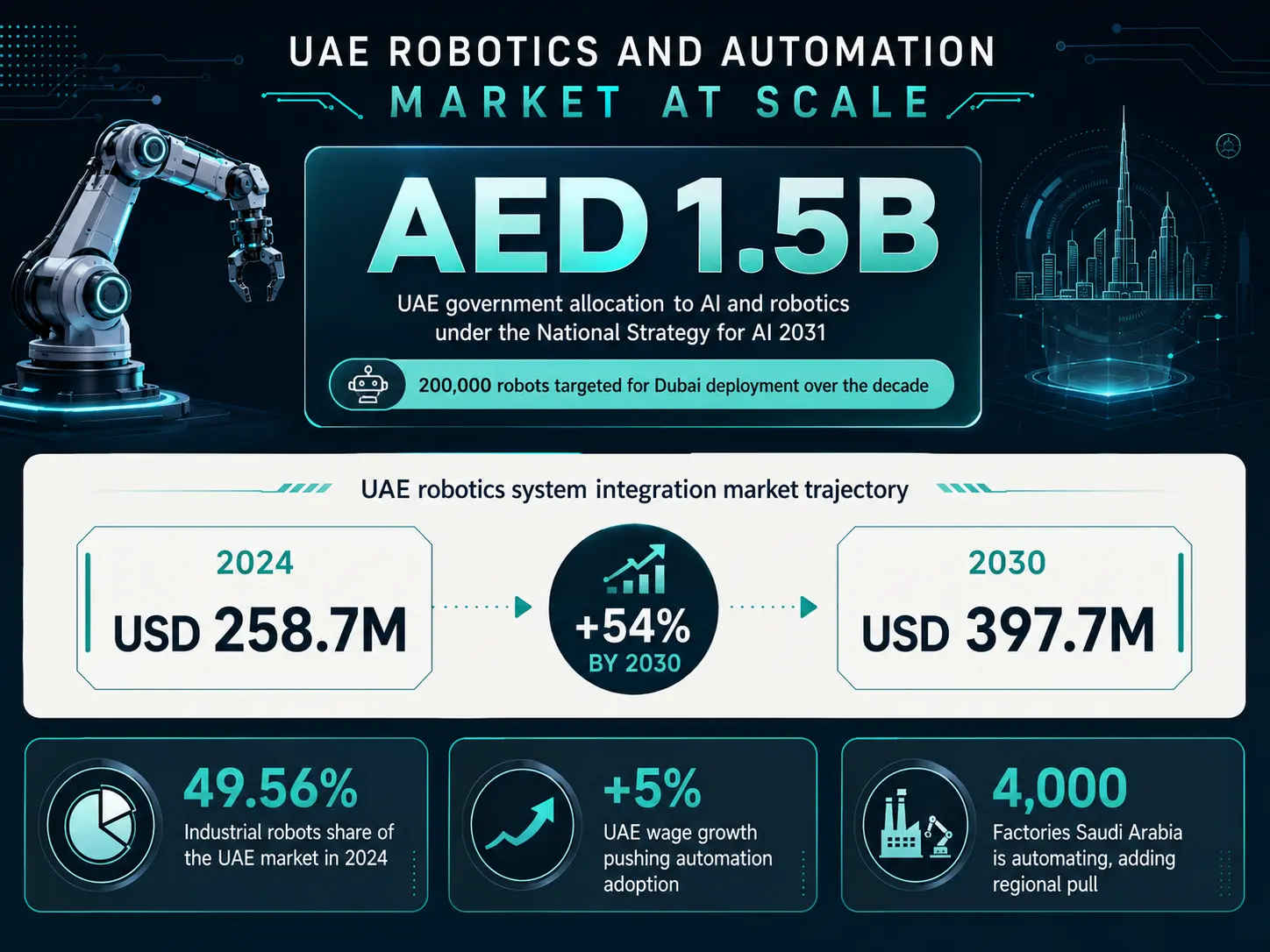
Per Grand View Research¹, the UAE robotics system integration market generated USD 258.7 million in 2024. It is expected to reach USD 397.7 million by 2030. The UAE government has allocated AED 1.5 billion for AI and robotics through its National Strategy for Artificial Intelligence 2031. Dubai has also announced a Robotics and Automation Program. It targets the deployment of 200,000 robots over the next decade. The spending is committed. The programmes are named. And the procurement is active.
British automation companies are already building the systems this market needs. That includes robotic integration, process automation, cobot deployment, warehouse fulfilment, and industrial machining. The UK has deep capability here. It ranges from firms like CKF Systems and CNC Robotics to larger players like Ocado Technology, one of the most advanced robotics companies in retail and e-commerce. Most of these companies do not lack technical capability or a relevant product. What they lack is the commercial structure to contract, invoice, and deliver in the UAE.
Why the UAE Is Automating and Why It Is Accelerating
The drivers behind UAE automation are structural, not cyclical. They are built into the country's economic model. They are not going away.
[blockFaqsCategory]
Where British Automation Capability Meets UAE Demand
Per Grand View Research¹, the industrial robots segment is the largest revenue-generating type in the UAE. It held a 49.56% share in 2024. But the real opportunity for British companies is not selling hardware. It is selling integrated solutions. That means the design, deployment, and support layer that turns a robot into a working system.
[blockFaqsRequirements]
[blockCTABizActivityList]
What It Takes to Win Automation Contracts in the UAE
Robotics and automation procurement in the UAE follows a different rhythm to the UK. Understanding the buying model matters as much as having the right product.
Contracts tend to be project-based at first. That could be a system integration for a new warehouse, a robotic cell for a manufacturing line, or an automation upgrade for a hospital logistics department. The engagements are often high-value. They move faster than UK procurement cycles. But they also require a level of local commercial structure that catches many British companies off guard.
Without a UAE entity, British automation companies usually face:
- Exclusion from government and semi-government procurement portals
- Inability to invoice in AED, which adds FX friction and delays payment
- Difficulty providing local support, maintenance, and warranty coverage
- Longer vendor onboarding cycles with industrial clients who require a UAE trade license
The companies that win, like Swisslog, Geek+, and Myro, all established locally before pursuing contracts.
Getting Your Automation Business Operational in the UAE
For most British robotics and automation companies, entering the UAE does not mean relocating engineers or setting up a workshop. It means creating a commercial entity that can contract, invoice, and support clients locally. Technical delivery stays anchored in the UK until volume justifies expanding.
[blockAccordionSteps]
[blockCTABizSetup]
Operating Through Meydan Free Zone: What Changes
Here is the difference a local entity makes for a British automation company looking to serve UAE industries:
Meydan Free Zone is structured for technology and industrial service companies that need commercial presence without physical infrastructure:
- Full company formation from the UK, passport only, entirely digital, no office lease required
- 2,500+ activity options covering robotics, system integration, technical consultancy, and equipment trading
- Combine up to three activity groups under one license, so integration, consulting, and hardware supply sit in one entity
- 100% foreign ownership with full profit repatriation
- Guaranteed IBAN pathway to get banking operational quickly
- mPlus handles the back-office: license renewals, bookkeeping, compliance, and admin, so the team focuses on engineering and sales
In Conclusion
The UAE is deploying robots at pace. Most British automation companies would recognise this from their own domestic pipeline projections. The difference here is that the budget is committed, the programmes are named, and the procurement is live. Per Ken Research², AED 1.5 billion has been allocated to AI and robotics. Per Business Market Insights³, Dubai targets 200,000 robots over the next decade. Per Grand View Research¹, the system integration market is heading toward USD 397.7 million by 2030. And next door, Saudi Arabia is automating 4,000 factories.
The British companies that win work here will be the ones set up locally to bid, contract, invoice, and support. The technical capability already exists. The missing piece is commercial structure. And that is the part that takes under 60 minutes to fix.
[blockCTAContact]
Citations
¹ Grand View Research, "UAE Robotics System Integration Market Outlook," 2024.
² Ken Research, "UAE Robotic Platform Market Outlook," 2024.
³ Business Market Insights, "Middle East and Africa Industrial Robotics Market," 2024.
⁴ PwC, "Saudi Arabia Robotics and AI Sector Outlook 2030."
⁵ Fast Company Middle East, "Robotics and Automation Will Transform These Industries in the UAE Forever," 2024.