Table of Contents
Frequently Asked Questions
1. Do UK marketing agencies need a UAE company to work with clients in Dubai?
No. Agencies can deliver services remotely. However, many large organisations require a UAE-registered vendor for procurement, local contracts, and AED invoicing. Without a local entity, agencies are often limited to project work rather than long-term retainers.
2. Can a UK agency invoice Dubai clients from the UK?
Yes, but cross-border invoicing typically involves foreign exchange approvals, longer payment cycles, and additional compliance checks. A UAE entity allows billing in AED and usually moves the agency onto standard local payment timelines.
3. When does it make commercial sense for a UK agency to set up in Dubai?
The trigger is usually procurement, not demand. When clients ask for local contracts, AED invoicing, or vendor registration, or when project work starts moving toward retainers, a UAE entity becomes necessary. Setup typically follows revenue visibility, not market speculation.
4. What changes financially once a UAE entity is in place?
The main impact is cash flow predictability. Local contracts and AED billing reduce foreign exchange friction and shorten payment cycles. Instead of managing cross-border collections and approval delays, agencies operate on standard local terms, which becomes critical as retainer revenue grows.
5. How long does it take to set up a UK marketing agency in Dubai?
Setup timelines depend on the structure chosen. Through digital-first free zone models such as Meydan Free Zone, a business license can be issued in under 60 minutes, allowing agencies to establish a local presence quickly and remotely.
6. Do UK agencies need a physical office in Dubai?
Not necessarily. Many free zone structures like Meydan Free Zone allow agencies to operate without a physical office, keeping fixed costs low while maintaining the ability to contract and invoice locally.
7. Can a Dubai entity help agencies win regional GCC work?
Yes. Many UAE-based clients manage marketing across Saudi Arabia, Qatar, and other GCC markets. A local UAE entity allows agencies to contract centrally and expand a single client relationship into multi-market revenue.
Topic Summary
1. Select Your Business Activities
Begin by determining the specific licensed activities that correspond to your services in Dubai. This may include marketing consultancy, advertising, branding, digital marketing, or content production. Choosing the appropriate licence is crucial for regulatory compliance and operational clarity.
2. Establish a Local Presence
Rather than relocating the entire operation, UK agencies typically establish a lean local office or representative entity. This presence meets legal requirements and facilitates client interactions while allowing core delivery teams to remain based in the UK or other locations.
3. Navigate Licensing and Regulatory Requirements
Dubai’s licensing framework demands careful adherence to legal and commercial guidelines. Agencies must register with relevant authorities, including the Department of Economic Development (DED) or free zone authorities, depending on the chosen business model and location.
4. Implement a Scalable, Remote Delivery Model
The operational model emphasises remote work and scalability, enabling the agency to grow alongside increasing revenue. The Dubai entity functions primarily as a commercial capability hub, supporting business development and client engagement without duplicating full service delivery on-site.
5. Leverage Local Market Insights and Networks
Building relationships with local clients, partners, and media is essential. The Dubai setup provides valuable access to regional market intelligence and networking opportunities, enhancing the agency’s ability to tailor offerings to the Middle Eastern market while maintaining established UK standards.
How UK Marketing and Creative Agencies Can Scale in Dubai
A UK agency wins a Dubai client. The first project runs remotely. Then comes the second brief, followed by a procurement request: Do you have a UAE entity? Can you invoice locally? Do you have someone on the ground?
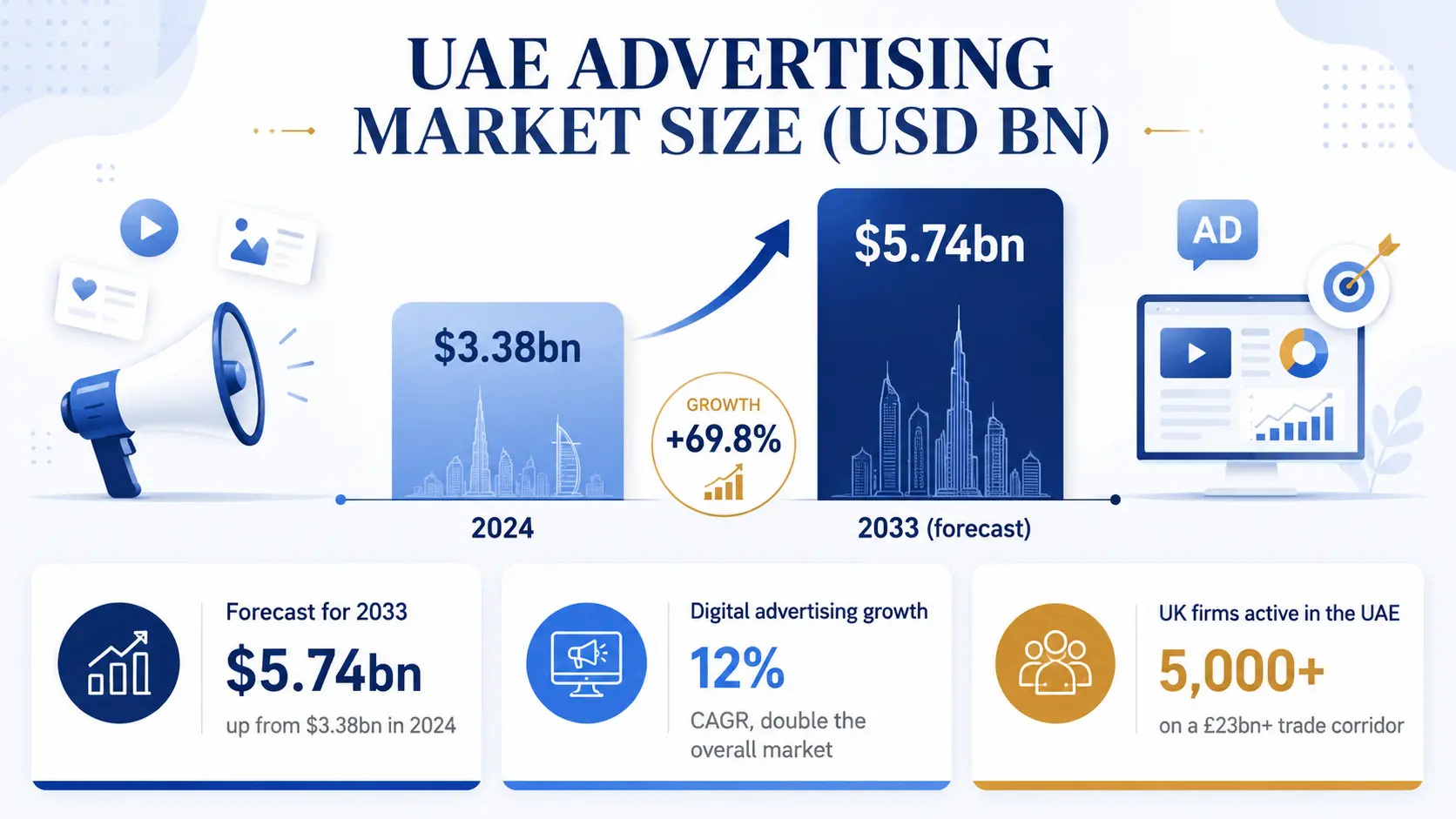
IMARC values the UAE advertising market at USD 3.38 billion in 2024, projected to reach USD 5.74 billion by 2033, driven by continuous investment across real estate launches, tourism, retail, fintech, and government initiatives.¹ Dubai DET reports the city welcomed 18.72 million international overnight visitors in 2024, a 9% year-on-year increase,² while Statista projects the UAE e-commerce market to reach USD 9.2 billion by 2026.³ Each of these sectors operates on constant customer acquisition, which means ongoing demand for performance marketing, content, branding, and creative services.
The UAE advertising market is set to grow from USD 3.38 billion to USD 5.74 billion by 2033, with the digital slice that UK agencies do best growing more than twice as fast as the market overall.
Sources: IMARC Group (2025); UK Government (2026).
The commercial link is already established. The UK–UAE trade corridor is worth more than £23 billion annually, and more than 5,000 UK businesses are active in the UAE. For many agencies, Dubai is not entering a new market; it is following existing clients as they expand.
The constraint is structural. Large developers, hospitality groups, and government-linked entities often require local contracts, AED invoicing, and procurement registration. Remote delivery works at the project level. Retainer revenue usually requires local presence. This is where the UAE's setup model changes the equation. Through a digital-first structure such as Meydan Free Zone, founders can establish a UK marketing agency in Dubai fully online and remotely, with a business license issued in under 60 minutes.
Business Activities List
Explore Over 2,500+Why Dubai Works for UK Marketing and Creative Agencies
Dubai's advantage for UK agencies isn't just demand; it's how that demand is structured. Marketing here is tied to sectors that grow continuously and spend accordingly.
Where the demand sits
- Real estate: constant project launches and sales cycles
- Hospitality and tourism: Dubai welcomed 18.72 million international overnight visitors in 2024, a 9% year-on-year increase, per Dubai DET²
- Retail and e-commerce: ongoing customer acquisition and performance spend
- Fintech and government-led initiatives: growth backed by capital and long-term programmes
- Creative industries:The Dubai Media Office reports Dubai ranked first globally for greenfield FDI projects in cultural and creative industries in 2024 for the third consecutive year, surpassing London and Singapore⁶
Per the UAE Government, the country has over 99% internet penetration and some of the highest social media usage rates globally, meaning UK performance, content, and creative models transfer with minimal localisation.⁷
Dubai also operates as a regional hub, not a single market. Many UAE-based clients manage campaigns across Saudi Arabia and the wider GCC. Agencies with a local entity can support regional mandates, invoice in AED, and enter procurement systems.
In practice, local structure shifts agencies from project suppliers to long-term partners, which is where revenue scales.
What Changes When You Establish Locally in the UAE?
Opening a UAE entity is not about office space or relocation. It changes how clients treat you commercially, and that shifts the type of work you can win. In the UK, agencies know this dynamic well. A London-based brand is far more likely to retain a partner that invoices locally, sits within procurement, and can be contracted on standard terms. Dubai works the same way.
Local invoicing removes immediate friction. Billing in AED avoids FX approvals, cross-border compliance checks, and international transfer delays, moving agencies onto standard local payment cycles instead of waiting 45–60 days for overseas collections, which is essential as retainer revenue grows.
Contract access also changes. Many developers, hospitality groups, and government-linked organisations require a UAE trade license to onboard vendors. Presence influences perception as well. In a relationship-driven market, local structure signals commitment, shifting agencies from external suppliers to regional partners, even if delivery remains UK-based.
This matters because many UAE clients manage activity across Saudi Arabia and the wider GCC. With a UAE entity, a single Dubai relationship can expand into multi-market revenue.
Free Business Setup Cost Calculator
Calculate NowHow a UK Marketing Agency Dubai Setup Actually Works
For most UK agencies, expansion into Dubai is not about relocation. It’s about creating local commercial capability while keeping delivery where the team already operates. The model is lean, remote, and built to scale with revenue.
[blockAccordionSteps]
Meydan Free Zone vs UK Operation: The Practical Difference
For service businesses, the Meydan Free Zone structure is designed around low fixed costs and operational flexibility, allowing agencies to establish local presence without committing to the overhead typically associated with international expansion.
| Factor | UK Structure | Meydan Free Zone |
|---|---|---|
| Corporation tax | Up to 25% | 0% on qualifying income (subject to UAE corporate tax rules) |
| Payroll costs | High fixed overhead | Optional hiring — scale only when revenue exists |
| Set up timeline | Weeks or months (entity setup, hiring, premises) | Business license issued in under 60 minutes through Fawri |
| Office requirement | Typically required for presence | No physical office required to operate (includes flexi-desk/smart office) |
| Local invoicing | No | Yes — bill clients in AED |
Beyond the structural differences, Meydan Free Zone is designed to support how service agencies actually scale:
- Establish a company 100% remotely from the UK, with no travel required
- Choose from 2,500+ licensed activities covering marketing, advertising, and creative services
- Select up to three business activity groups under one license, allowing multiple service lines and revenue pathways
- Benefit from 100% foreign ownership and full profit repatriation
- Access local banking pathways to enable AED invoicing and faster collection
- Connect to a full marketing ecosystem, providing access to payment, e-commerce, and operational partners relevant to digital and growth-focused clients
- Use mPlus for ongoing operational support, including compliance management, license renewals, accounting, bookkeeping, and administrative services
In Conclusion
The agencies that win retainers in Dubai aren't always the most creative ones in the room. They're the ones that can sign a local contract, issue an AED invoice, and show up in a procurement system when the brief comes in. For UK agencies, the capability gap isn't creative. It's structural. A local entity removes the friction that turns project work into recurring revenue and keeps that revenue from going to a competitor who simply had the paperwork in order.
The model is straightforward: establish presence first, and scale people and overhead only when revenue justifies it. Strategy and delivery stay anchored in the UK. What changes is your ability to operate in a market that is already spending, already familiar with British agencies, and already asking the question: do you have a UAE entity?
If you’re looking to position your agency for long-term growth in the region, book a consultation with a setup advisor at Meydan Free Zone to identify the most efficient way to establish your UK marketing agency in Dubai.
Ready to Launch Your Business in Dubai?
Let's ConnectCitations
¹ IMARC Group, "UAE Advertising Market," 2024.
² Dubai Department of Economy and Tourism, "Dubai Welcomes 18.72 million International Visitors in 2024 (+9% YoY)," February 2025.
³ Statista, "E-commerce in the UAE," accessed 2026.
⁴ UK Government, "UAE Trade and Investment Factsheet 2026," February 2026.
⁵ UK Government, "Export from UK to United Arab Emirates," accessed 2026.
⁶ Dubai Media Office, "Dubai Retains Top Global Position," May 2025.
⁷ UAE Government, "Bridging the Digital Divide," accessed 2026.