Table of Contents
Frequently Asked Questions
Do I need to relocate to Dubai to start an e-commerce business in Meydan Free Zone?
No. The setup is fully digital with passport-only onboarding and no physical office lease. You can set up remotely and operate from anywhere. Visas can be added later if you decide to relocate.
What is the minimum cost to start an e-commerce business in Meydan Free Zone?
The standard trade license starts at AED 12,500, which includes company registration, license issuance, flexi-desk access, and up to three business activity groups. The Fawri option is AED 15,000 for issuance in under 60 minutes.
What is the E-Commerce Starter Add-On, and how long does it take?
The E-Commerce Starter Add-On costs AED 1,000. It covers setting up seller accounts on two marketplaces (Amazon.ae and Noon.com) and listing one SKU on each. Once your license is issued, marketplace onboarding can begin right away, subject to platform verification timelines.
When do I need to register for VAT or corporate tax?
VAT registration becomes a must once taxable supplies pass AED 375,000 in a 12-month period. Free Zone Persons fall under the UAE corporate tax regime and must register. Meydan Free Zone is a designated free zone, so qualifying businesses may be eligible for the 0% corporate tax rate if the conditions are met.
Can I combine multiple business activities under one e-commerce license?
Yes. Meydan Free Zone lets you combine up to three business activity groups under one trade license, chosen from over 2,500 activities. This is how founders pair an online-selling code with the specific product trading codes they need, without setting up multiple entities.
Topic Summary
Dubai's E-commerce Market Is Booming Fast
Dubai's e-commerce market reached AED 32.3 billion in 2024 and is projected to surpass AED 50.6 billion by 2029. This rapid growth makes it one of the most attractive digital retail environments in the region.
Three Activity Codes Cover Online Selling
Codes 4790.00, 4791.00, and 4799.00 each describe a distinct way of selling online, from standard storefronts to distance selling and unconventional non-store formats. Choosing the right code depends on how your sales actually happen day to day.
Get Licensed in Under 60 Minutes
Meydan Free Zone's Fawri process can issue a commercial e-commerce license in under 60 minutes, compared to two to four weeks for mainland approvals. Costs start from AED 12,500 per year, which includes a flexi-desk and up to three activity groups.
Combine Up to Three Activity Groups
Meydan Free Zone allows founders to bundle up to three activity groups under a single trade license, drawn from over 2,500 available activities. This means you can cover both how you sell and what you sell without overcomplicating your license structure.
Your Customer Base Can Be Surprisingly Diverse
An e-commerce license supports retail consumers, GCC and MENA regional buyers, wholesale B2B clients, subscription customers, and even corporate hospitality buyers. The fully digital structure keeps fixed costs low while allowing the business to scale from a solo founder to a full team.
Mainland vs. Free Zone: Let Clients Decide
The most important setup decision is jurisdiction, and it should be driven by who your customers are rather than upfront cost. Mainland licenses allow direct sales to UAE consumers and government buyers, while free zones offer faster setup and lower starting costs.
No Mandatory Share Capital or Third-Party Approvals
Commercial e-commerce licenses in most free zones carry no mandatory minimum share capital requirement. No third-party approvals are needed at the license stage, though regulated product categories may require additional clearances.
Setting Up An E-commerce Business in Dubai with Meydan Free Zone
Dubai's e-commerce market hit AED 32.3 billion in 2024, and Dubai's Department of Economy and Tourism projects it will pass AED 50.6 billion by 2029. Founders can spin up a Shopify store or a marketplace listing before lunch, but the structure behind the store is what banks, payment providers, and regulators actually look at. Activity code 4790.00 is the license that gives you that structure.
This guide covers what the code permits, the boundary you cannot cross, the jurisdiction choice, and how to get set up.
Key Stats at a Glance
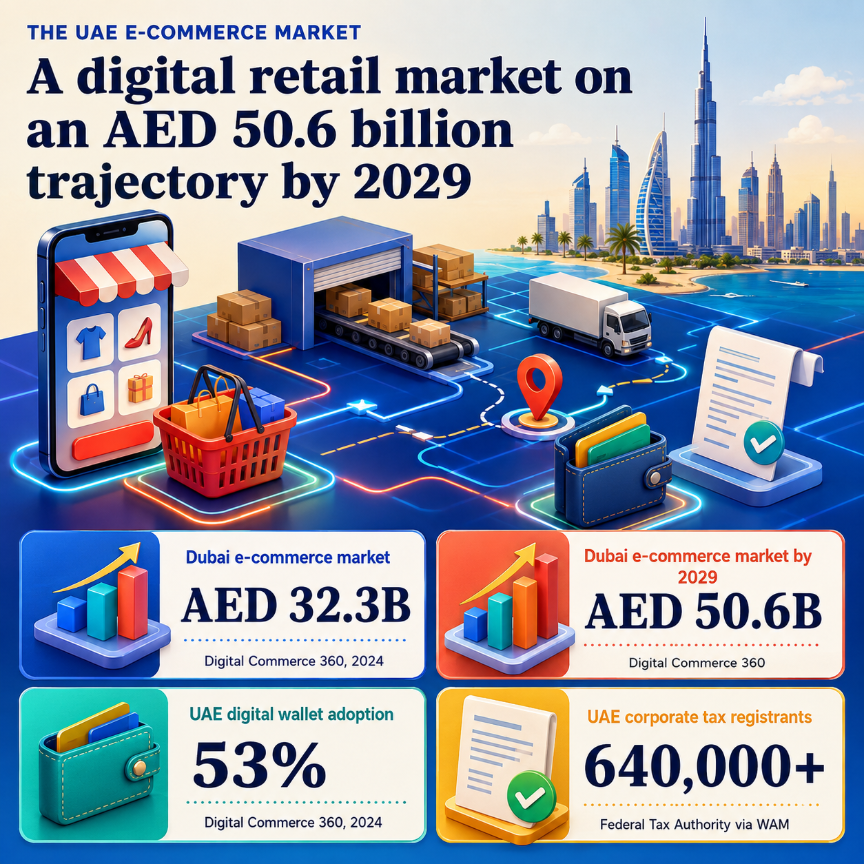
Sources: Digital Commerce 360, Federal Tax Authority via WAM, Deloitte
What This License Covers
E-commerce is not treated as one single catch-all label. Three codes describe how you sell online, and picking the right one comes down to how your sales actually happen day to day.
4790.00 - E-commerce
Standard online retail through a digital shopfront or marketplace. Covers Shopify D2C brands, Amazon and Noon storefronts, TikTok Shop-style shopfronts, and defined-category dropshipping stores. The store is your main sales asset.
4791.00 - Retail sale via mail order houses or via the Internet
Distance selling where customers order remotely and you ship. Covers order-online-and-ship retail, catalogue-style selling, WhatsApp and phone order flows that convert to delivery, and internet retail auctions. Digital-delivery models can fit here too.
4799.00 - their retail sale not in stores, stalls or markets
Non-store selling models that do not fit a typical online shopfront or standard distance-selling definition. Covers direct selling structures, vending-machine retail concepts, and other unconventional non-store retail formats.
These codes describe how you sell. Product businesses usually pair them with specific trading or retail codes that describe what you sell. Meydan Free Zone lets you combine up to three activity groups under one trade license, from over 2,500 activities, so you can cover both without overbuilding the license.
Who Your Clients Will Be
- Retail consumers buying through your D2C Shopify store or WooCommerce site
- Marketplace shoppers finding your listings on Amazon.ae, Noon.com, and TikTok Shop
- Regional buyers across GCC, wider MENA, and international shipping destinations
- Wholesale buyers ordering in bulk through your B2B online catalogue
- Subscription customers renewing on monthly or quarterly cycles
- Dropshipping resellers pulling your inventory into their own storefronts
- Hotel, spa, and hospitality corporate buyers using online B2B ordering flows
Work is a mix of retail-transaction volume, marketplace algorithm-driven sales, and repeat purchases. That is a large part of why this license is workable: fully digital operations, low fixed costs, and the ability to scale from a solo founder to a full team without changing the license structure.
Mainland or Free Zone
This is the biggest choice you will make when setting up. Let your clients decide it, not the price.
[blockCTACostCalculator]
Step-by-Step Setup Guide
- Step 1, book your trade name: Submit up to three proposed company names. Meydan Free Zone runs a name check tool for instant results. The name is checked against your selected activities to avoid restricted wording.
- Step 2, confirm your activity scope: Pick the right online-selling code (4790.00, 4791.00, or 4799.00) and pair it with the trading or retail codes for your product categories. You can bundle up to three activity groups under one license.
- Step 3, choose your jurisdiction: Free zone for online-first and international selling with a fast approval track and no office lease, mainland for on-shore B2B, tender, or government contract work.
- Step 4, submit your application: A valid passport copy is usually enough to start. The digital portal handles shareholder details, UBO declarations, compliance screening, and business activity confirmation. No physical office lease is needed at this stage.
- Step 5, collect your license: Fawri issues eligible licenses in under 60 minutes. Regular route issuance usually takes one working day. Once the license is live, everything else can start in parallel.
- Step 6, open a bank account and payment gateway: Start bank onboarding through the guaranteed IBAN pathway. Activate payment providers like Stripe, Telr, PayTabs, or Checkout.com, and set up marketplace seller accounts on Amazon.ae, Noon.com, and any others you plan to use.
- Step 7, sort visas and Emirates ID (if you need one): Use mResidency to run the entry permit, medical fitness test, Emirates ID, and dependent visas. You do not need a visa on day one if you plan to operate remotely.
- Step 8, set up bookkeeping and tax: Register for VAT once turnover crosses AED 375,000 in a 12-month period, and register for corporate tax as a Free Zone Person. mAccounting covers VAT filing, corporate tax reporting, and ongoing bookkeeping.
Compliance and What You Need in Place
VAT registration
VAT registration becomes a must once your taxable supplies pass AED 375,000 in a 12-month period. Voluntary registration is available from AED 187,500. Fast-scaling e-commerce brands hit these thresholds sooner than expected, so monitor turnover from day one. Once registered, you must charge VAT correctly, file returns on time, and keep clean records of invoices and imports.
Corporate tax
Free Zone Persons fall under the UAE corporate tax regime. A Qualifying Free Zone Person may benefit from the 0% rate on qualifying free zone income, as long as conditions are met and records are clean. Meydan Free Zone is a designated free zone. The Federal Tax Authority already has over 640,000 corporate tax registrants on file, so this is not optional. Keep operational documentation, accounting records, and any split between qualifying and non-qualifying income clear.
Product-based regulation
The e-commerce channel itself does not usually need extra approval. The product category might. Cosmetics and health-related goods often need Dubai Municipality and MoIAT registration under the Emirates Conformity Assessment Scheme (ECAS). Regulated food items and safety-certified electronics have their own rules. Check the product side before you list, not after.
E-invoicing
The UAE is rolling out mandatory e-invoicing in phases. From 1 July 2026, businesses can adopt it voluntarily. By 1 January 2027, businesses with revenue of AED 50 million or more must comply, and the rest by July 2027. Factor this into your accounting and ERP plans now, because retrofitting later is more expensive than building it in from the start.
Operational hygiene
Beyond the formal thresholds, banks and payment providers look at practical compliance. Keep invoices clear and matched to your declared activities. Make sure product descriptions line up with your license scope. Keep supplier documents for imports. Publish clear refund and returns policies. Use consistent transaction descriptors when you onboard payment providers. These small things add up when your bank or Stripe rep asks questions.
Renewal
Annual and mandatory. Non-renewal brings fines and can lead to blacklisting, which then complicates banking and any future application.
Market Opportunity
Demand is tied to the UAE's fast-growing digital consumer base. Dubai's e-commerce market hit AED 32.3 billion in 2024 and is projected to pass AED 50.6 billion by 2029. Digital wallet adoption jumped from 41% in 2020 to 53% in 2024, which means the buyer base expects speed, flexible payment, and clean checkout flows.
The cost structure is the other big draw. There is no fixed premises, no stock if you run dropshipping or print-on-demand, and no site equipment. A solo founder can be trading within a week of getting the license, then scale by adding SKUs, channels, and staff as the revenue comes in. Meydan Free Zone's setup route reflects that: fully digital, passport-only, and priced to keep the barrier low.
Conclusion
An e-commerce license under 4790.00, 4791.00, or 4799.00 is a well-defined commercial category suited to D2C brands, marketplace sellers, dropshippers, and non-store retail operators working in one of the region's fastest-growing digital markets.
Three decisions shape your setup: jurisdiction, scope clarity across channel and product codes, and how tightly you keep your tax and payment provider paperwork from day one. Settle those at the outset and the rest follows a predictable path.
Use the cost calculator for an estimate, or speak to the Meydan Free Zone team to confirm the right activity code combination before you commit.
[blockCTAContact]
References