

Table of Contents
Frequently Asked Questions
What is the difference between a general trading license and an e-commerce license in Dubai?
A general trading license is built for multi-category trading and distribution. An e-commerce license shows online selling as a channel, usually within a defined product scope.
Is general trading better because it covers more activities?
Not necessarily. A broader scope can trigger broader clarification during sign-up and compliance reviews. The better choice is the one that matches how the business actually earns today.
If I sell products online, do I only need an e-commerce activity?
E-commerce describes the selling channel. You should still pick the relevant trading or retail activity that matches the product category you sell, then pair it with e-commerce if you sell online.
When should I pick specific trading or retail activities instead of general trading?
If your business sells a defined product category, especially through online retail, pick specific trading or retail activities that match that category and pair them with an e-commerce activity for the selling channel. This keeps the license scope precise and aligned with how the business operates.
Why does activity specificity affect banking and payment sign-up?
Banks and payment providers look at your declared activity scope and expected transaction patterns. A more specific activity is easier to map to predictable payment flows.
Can I combine trading and e-commerce under one Meydan Free Zone license?
Yes. Meydan Free Zone lets you select up to three business activity groups under one trade license, with access to over 2,500 business activities, so hybrid models can be structured under one entity when needed.
Topic Summary
General Trading Covers Multiple Unrelated Product Categories
A General Trading license (activity code 4690.97) lets businesses import, export, and distribute across diverse, unrelated goods like electronics, household items, and consumer products. It is designed for companies that genuinely operate across multiple product classes under one umbrella.
E-commerce Licenses Are Built Around a Sales Channel
An e-commerce license (activity code 4790.00) is structured for businesses that sell online through websites, marketplaces, or direct-to-consumer platforms. It suits clearly defined product lines rather than broad multi-category trading.
Dubai's E-commerce Market Is Growing Fast
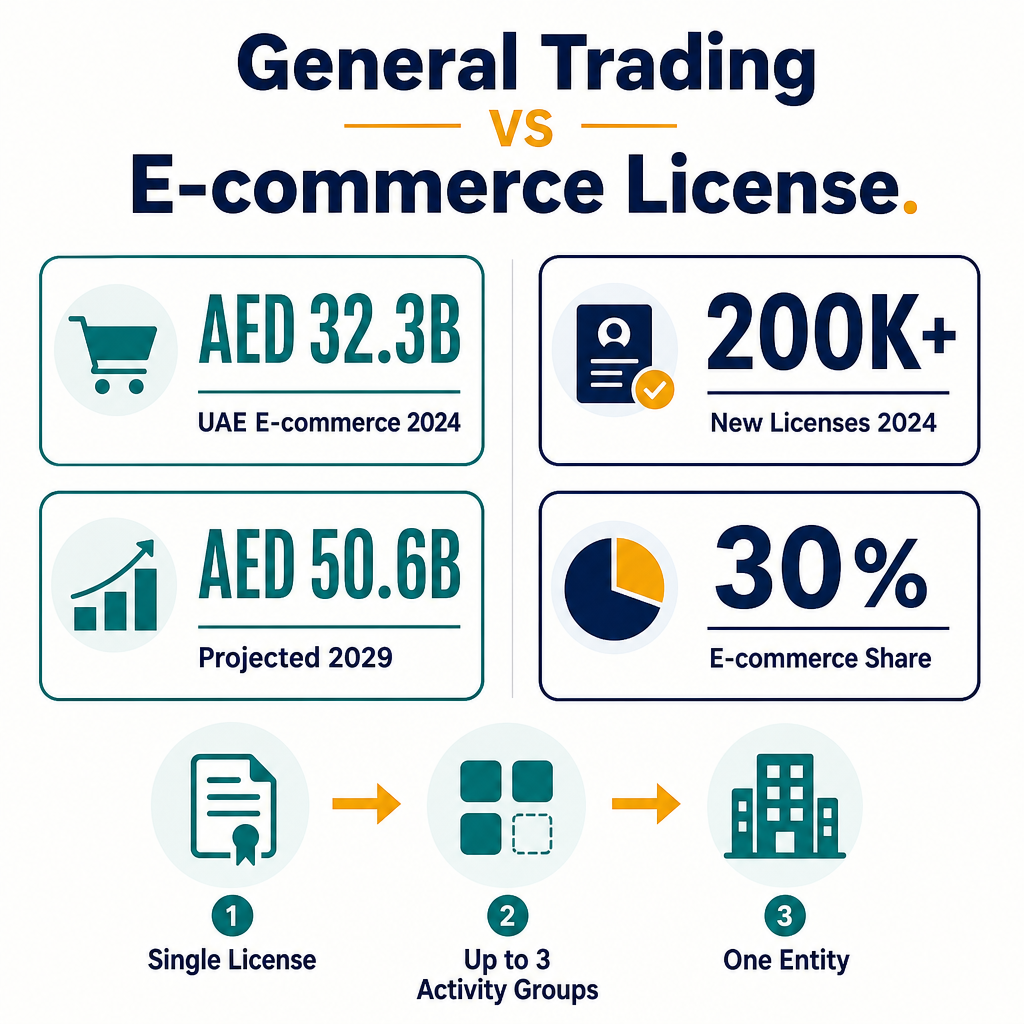
Dubai's e-commerce sector reached AED 32.3 billion and is projected to exceed AED 50.6 billion by 2029. E-commerce registrations already account for roughly 30% of all new UAE economic license filings in 2024.
License Type Affects How Banks Read Your Business
A General Trading license signals a multi-category operation to banks and compliance teams, which can trigger extra scrutiny during onboarding and periodic reviews. A more specific e-commerce license with a defined product scope tends to present a cleaner, easier-to-verify business model.
Setup Costs and Timelines Are Competitive for Both
Free zone licenses start from AED 12,500 per year and can be issued in under 60 minutes through platforms like Meydan's Fawri system. Mainland approvals typically take two to four weeks regardless of which license type you choose.
You Can Combine Activities Under One License
Free zones like Meydan allow up to three activity groups under a single trade license, giving founders flexibility without needing separate entities. Both General Trading and e-commerce licenses are classified as commercial licenses with no mandatory minimum share capital in most free zones.
Activity Selection Shapes More Than Just Your License
In the UAE, your chosen business activity code directly influences compliance checks, bank sign-up processes, and how payment providers assess your business. Picking the activity that matches how your business actually earns prevents overbuilding scope and reduces friction down the line.
General Trading vs E-commerce License In Dubai: What’s the Difference?
In 2024, over 200,000 new economic licenses were issued across the UAE, with e-commerce registrations leading all sectors at roughly 30% of new filings. Dubai's e-commerce market hit AED 32.3 billion, with projections above AED 50.6 billion by 2029. General trading still sits in the top five categories, but plenty of founders confuse a broader scope with a better one.
This guide covers what each license permits, where the two overlap, how they read to banks and payment providers, and how to pick the one that matches how your business actually earns.
Key Stats at a Glance
What a General Trading License Covers
A General Trading license is built for businesses that trade across multiple product categories, often across unrelated goods. It is commonly structured under activity code 4690.97 (General Trading).
The scope usually supports:
- Import and export of goods
- Wholesale and distribution
- Multi-category product trading
- Regional supply chain operations
- Inventory movement and warehousing
This works when a company genuinely deals with different classes of goods under one umbrella, for example, electronics, household products, and consumer goods. It gives you breadth. But breadth comes with trade-offs.
When your license scope is wide, banks and compliance teams have to look at it that way. The company is not read as a single-category retailer. It is read as a multi-category trading business, which can bring extra questions during sign-up and periodic reviews.
What an E-commerce License Covers
An e-commerce license is built around a sales channel, selling online, rather than broad multi-category trading authority. It is commonly structured under activity code 4790.00 (E-commerce).
It usually fits businesses that sell through:
- Online retail via a website or marketplace
- Direct-to-consumer digital sales
- Platform-based selling models
- Defined product categories with a clear retail model
If you sell a defined product line online, an e-commerce activity matches that operating model more accurately than a broad trading code.
A few common structures that sit cleanly under an e-commerce setup:
Single-brand D2C store, one defined category
A modestwear label, athleisure brand, or skincare line selling via Shopify and Instagram, with delivery handled by a courier partner.
Marketplace-first seller with a focused catalogue
An Amazon or Noon seller in one niche such as phone accessories, kitchen organisers, or pet products, with marketplace payouts and predictable retail settlement cycles.
Dropshipping store with a defined product class
A fitness accessories or home organisation store where products ship from suppliers, but the business runs the shopfront, checkout, customer support, and returns policy.
The thread across all of these is the same. The business is retail-led, the sales channel is online, and the product scope is clearly defined. That specificity keeps licensing clear and stops you from overbuilding scope upfront. E-commerce shows the selling channel. The product category still needs to be defined through the relevant trading or retail activity.
Why Specific Business Activity Selection Matters in Dubai
In the UAE, your business activity selection is not just a licensing formality. It shapes how your company is read across compliance and sign-up.
It affects:
- AML risk profiling
- Compliance monitoring expectations
- Sign-up review depth for banking and payment providers
- How easily your transaction patterns can be mapped to your declared scope
After the UAE was removed from the FATF grey list in February 2024, regulatory scrutiny has only got tighter. The UAE Central Bank has issued nearly AED 350 million in AML fines in recent months against non-compliant institutions, a clear signal that enforcement is now a priority, not a formality.
A broadly defined General Trading scope shows multi-category trading and wider transaction behaviour, so banks and institutions may ask for more clarification during sign-up. A more specific e-commerce activity shows a defined retail model, which is often easier to map to predictable payment flows.
The same logic applies to corporate tax. A clearer activity scope makes it easier to keep:
- Clean documentation on what the business does
- Clear income categories tied to how you operate
- A consistent story across invoices, contracts, and financial records
That is why Meydan Free Zone recommends picking the most accurate, specific activity scope that matches your real model today, and expanding step by step when the business earns the added complexity.
A worked example
A founder launches a single-brand skincare business, Korean skincare only, selling online through a website or marketplace with card payments and a simple fulfilment flow. The company imports only that product range. If the founder picks 4690.97 (General Trading) because it looks more flexible, the scope reads like a business that may trade across multiple unrelated categories. During sign-up, banks and payment providers apply a broader review lens and ask extra questions: will the company trade in one category or many, is it retail-only or wholesale-mixed, what are the sourcing locations and expected flows. Structure the same business under a skincare or cosmetics retail activity paired with 4790.00 (E-commerce), and the license reads exactly like the model runs from day one.
The Difference in Practice
General Trading is a trading scope. It shows you may trade across multiple product categories, often through wholesale and distribution channels. E-commerce is a selling model. It shows you sell online, usually within a defined product scope.
The rule of thumb: for most founders, the better approach is picking specific trading or retail activities that match the product category you actually sell, then pairing that with an e-commerce activity to reflect the online selling model.
That structure keeps the license scope accurate and cuts unnecessary breadth in the way it reads. General Trading remains the right tool when the business genuinely trades across multiple unrelated product categories, but it is rarely the most efficient default for defined-category online retail businesses.
[blockCTACostCalculator]
How Meydan Free Zone Helps You Structure the Right License
The goal is picking the right activity mix so the trade license reads the way the business will operate from day one.
Meydan Free Zone helps founders through:
- Business activity selection guidance, mapping the right scope based on how the business will invoice, sell, and trade
- Up to three business activity groups under one trade license, with access to over 2,500 business activities, so you get real room for specificity rather than vague activity choices
- Structuring the right activity combination under one license, including hybrid models that mix trading, e-commerce, and service activities
- Regulatory mapping, identifying where sector-specific conditions or third-party approvals apply before the license is finalised
- Coordination of third-party approvals where needed, so founders are not chasing multiple approval touchpoints alone
The outcome is a trade license that is issued efficiently and structured correctly. Specific enough to stay clear and compliant. Flexible enough to expand as the business grows.
Key Takeaways
- A General Trading license covers multi-category trading across unrelated goods. An e-commerce license shows an online retail selling model. They are not swappable, and picking the wrong one creates friction downstream.
- Business activity selection directly affects AML risk profiling, banking sign-up depth, and how easily your transactions map to your declared scope. This matters more in the UAE's post-FATF grey list environment.
- Over-engineering a license with a broad General Trading scope, when your business is really a defined-category online retailer, can trigger extra compliance questions that a more specific classification would avoid.
- For most online retail founders, the strongest structure is a specific trading or retail activity that matches the product category, paired with an e-commerce activity to reflect the sales channel. Not a catch-all General Trading classification.
- Meydan Free Zone lets you select up to three business activity groups under a single license, with access to over 2,500 activities, so the license can be built to match your real operating model from day one.
Conclusion
The founders who move fastest are the ones whose paperwork tells the same story as their operations.
That alignment is what makes sign-up smoother, compliance cleaner, and amendments simple when growth actually asks for them. The General Trading vs e-commerce question is not really about which one is stronger. It is about which one matches how you actually earn.
Over-engineering a license upfront does not buy flexibility. It buys friction. The smarter play is starting with precision and expanding step by step. A license structured around your real model today is easier to defend, easier to explain, and easier to build on. In a market where regulators and banks are paying closer attention than ever, clarity is not a constraint. It is a competitive edge.
Use the cost calculator for an estimate, or speak to the Meydan Free Zone team to confirm the right activity combination before you commit.
[blockCTAContact]