Table of Contents
Frequently Asked Questions
1. Is a Meydan Free Zone company bank-friendly?
Yes, it is. What matters most is whether the company has a clear licensed activity, transparent ownership structure, sensible transaction logic, and complete supporting documents. Meydan Free Zone helps founders build a more bank-ready file, and final approval still depends on the bank's internal review.
2. What do banks usually check for when approving a business bank account?
Banks typically review the licensed activities, shareholder and UBO structure, authorised signatory details, source of funds, expected transaction profile, and the overall consistency of the company file. The clearer and more commercially coherent the business looks, the easier it usually is for a bank to assess.
3. What documents are commonly needed for bank account opening?
Most banks will usually ask for the trade license, shareholder passport copies, company formation documents, proof of address, and a short business profile or activity summary. Visa and Emirates ID documents may also be requested where available.
4. Why does business activity selection matter for bank approval?
Because banks want the licensed activity to reflect what the business will actually do. If the activity is too broad or does not match the real commercial model, the bank may ask more questions. More specific activity selection usually makes the file easier to understand.
5. How do 2,500+ business activities help with bank readiness?
Meydan Free Zone's 2,500+ business activities give founders more room to choose options that match the real business model more accurately. That helps reduce activity mismatch, which is important because banks are generally more comfortable when the licensed activity and expected transactions clearly align.
6. What is Meydan Free Zone's Bank Account Assistance service under mCore?
Through mCore’s Bank Account Assistance, Meydan Free Zone supports founders in selecting a suitable bank, initiating an application with one or multiple banks, and scheduling an appointment with a bank relationship manager. The service fee is AED 1,500, with a one-business day-initiation timeline. Bank account opening remains subject to bank approval.
7. What does Meydan Free Zone require for Bank Account Assistance under mCore?
The usual authorised signatory requirements for the service would be an Emirates ID, proof of residence, six months of personal bank statements, and a CV. Payment and a company profile are a part of the setup journey for this service.
Topic Summary
1. Complete and Accurate Documentation Is Key
Over 60% of SME bank account rejections in the UAE result from incomplete or insufficient documentation. Banks require thorough paperwork detailing company registration, shareholder information, and business activity to proceed confidently.
2. Clarity of Business Purpose and Activity
Banks prefer companies with clearly defined and legitimate business activities. Meydan Free Zone companies must clearly outline their trade licenses and operational plans to meet bank requirements.
3. Compliance with UAE Regulatory Standards
Banks assess companies based on adherence to anti-money laundering (AML) and know-your-customer (KYC) regulations. Meydan Free Zone ensures full compliance, which can make banking smoother.
4. Financial Stability and Transparency
Banks look for evidence of financial stability, including initial capital and projected cash flows. Presenting a credible business plan enhances the chances of bank approval for Meydan Free Zone companies.
5. Choice of Bank Matters
Not all banks have the same criteria or appetite for free zone companies. Researching and approaching banks experienced in dealing with Meydan Free Zone entities can improve the likelihood of successfully opening a corporate bank account.
Is a Meydan Free Zone Company Bank-Friendly? What Banks Actually Look For
According to the PwC Middle East Banking Compliance Report 2024¹, over 60 percent of SME bank account rejections in the UAE stem from a single issue: insufficient documentation. Not fraud. Not extremely high-risk activity. Just gaps in how the business was presented to the bank. When you are setting up your business, that statistic might sit somewhere in the back of your mind: What if banking is where this falls apart?
The benchmark is tighter than most founders realise. According to the Central Bank of the UAE Rulebook², licensed financial institutions are expected to complete corporate account opening within just 3 business days when an applicant's profile presents low money-laundering risk, a standard set under the SME Market Conduct Regulation, but one that requires a clean, low-risk file from day one to actually unlock. According to the UAE Ministry of Economy and Tourism³, the country added approximately 250,000 new companies during 2025 alone, meaning the volume of fresh banking applications competing for that low-risk classification has rarely been higher.
You have chosen Meydan Free Zone. You know the setup is fast. But you have also heard the broader stories across the UAE: applications stuck in limbo, accounts rejected without clear reasons, and founders waiting weeks while a fully licensed company sits unable to invoice a single client.
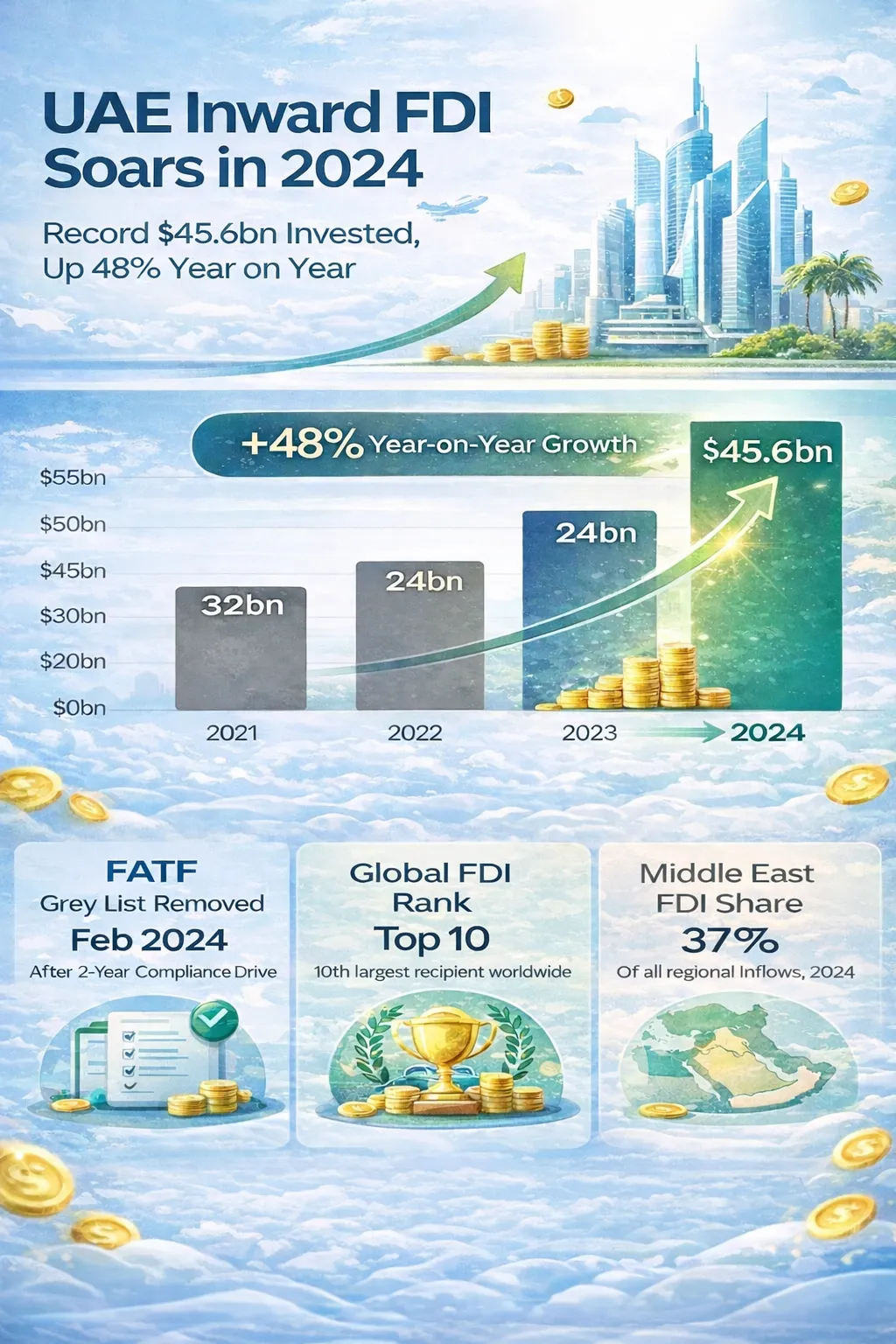
Sources: FATF Plenary, February 2024; Kroll citing FATF Follow-Up Report 2025 and UAE National Risk Assessment 2025
Understanding bank requirements for Meydan Free Zone company setup means knowing what compliance teams actually look for: clear business activity, verifiable structure, and a coherent commercial profile. Meydan Free Zone is built around this. With guaranteed IBAN access, 26+ banking partners, and dedicated bank account support, most founders secure a working corporate bank account within days.
Free Business Setup Cost Calculator
Calculate NowBank Requirements for Meydan Free Zone Company Setup
What founders usually mean by "bank-friendly" is simple: will the company meet normal UAE banking expectations without unnecessary friction?
In practice, banks assess whether the business makes sense on paper and whether the people behind it are easy to verify. That means reviewing the license, business activity, ownership structure, authorised signatory, expected source of funds, and likely transaction pattern. According to the PwC Middle East Banking Compliance Report 2024, Over 60% of SME account rejections in the UAE stem from insufficient source-of-funds documentation alone.
Banks are usually looking for clarity on a few core points:
- Whether the licensed activity clearly reflects what the business will actually do
- Whether the shareholder and UBO structure is straightforward
- Whether the expected inflows and outflows make commercial sense
- Whether the founder can show a credible source of funds
- Whether the company profile, documents, and transaction story all align
Since the UAE was removed from the FATF grey list in February 2024, compliance scrutiny has remained high. Banks cross-check details across forms, supporting documents, and onboarding discussions, and even minor inconsistencies can cause delays.
For founders setting up in Meydan Free Zone, the more useful question is not whether the free zone is bank-acceptable in theory. It is whether the company file is clear, consistent, and complete enough for a bank to review comfortably.
Free Company Name Check
Check NowWhat Banks Actually Look For After Trade License Issuance
After a Meydan Free Zone company is licensed, the bank’s review becomes much more specific. After trade license issuance, the bank focuses on whether the company is clear, credible, and properly supported for onboarding.
Banks will generally look at:
- who owns the company and whether the ownership structure is easy to verify
- whether the selected Meydan Free Zone activity or activity mix clearly reflects what the business will actually do
- whether the authorised signatory has the documents and background needed for KYC review
- whether the expected source of funds is straightforward
- whether the planned transaction flow matches the licensed activity
- whether the business profile, supporting documents, and commercial story all point in the same direction
- whether the company looks easy to onboard and monitor from a compliance perspective
This is why two founders with a similar setup route can have very different banking outcomes. One may present a tightly defined service business, a simple ownership structure, and a clear payment model. Another may submit a file with loosely connected activities, vague operating plans, or documents that leave the bank with more questions than answers.
Business Activities List
Explore Over 2,500+Documents Banks Commonly Ask For After Meydan Free Zone Setup
The exact list varies from bank to bank, but most founders should expect a standard mix of company and KYC documents.
These commonly include:
- valid trade license
- shareholder passport copies
- visa page and Emirates ID copy, where available
- company formation documents, such as the MOA
- proof of address
- short business description or business activity summary
- company stamp, if required by the bank
Depending on the business activity, ownership structure, or transaction profile, some banks may also request additional documents or conduct a due diligence discussion before moving the application forward.
What Banks Actually Look at Before Opening a Business Account
Banks move more comfortably when the file is commercially tidy.
That usually means:
- the activity selection is specific rather than overly broad
- the business can be explained clearly
- the source of funds is easy to evidence
- the expected transaction flow is realistic
- the documents all support the same commercial story
Meydan Free Zone offers 2,500+ business activities, which helps founders match the trade license more closely to what the business actually does.
| Activity choice | What banks see |
|---|---|
| General Trading | A wide commercial scope that may not match the company's actual trading model. The bank may flag this as a mismatch, raising questions about what the business actually sells. |
| Specific activity (e.g., Electric Conductors and Semiconductors Trading) | A defined product line with a clear commercial use case. The bank can connect the licensed activity to the expected transaction pattern, making the file easier to assess. |
The advantage of having 2,500+ activities is not breadth for its own sake. It is accuracy, and that is what makes a banking file easier for a bank to assess.
How Meydan Free Zone Makes a Company More Bank-Friendly
A Meydan Free Zone company is bank-friendly because the setup supports the things banks care about most: clear business activity, ownership transparency, clean compliance documentation, and operational readiness.
In practice, that shows up in a few key ways:
That is what makes Meydan Free Zone more bank-friendly in practice. While account approval remains subject to the bank’s internal review, the setup helps founders build a company file that is easier to understand, verify, and onboard.
What Still Depends on the Bank
Meydan Free Zone helps founders approach banking in a more structured and better-prepared way. However, account approval, onboarding timelines, and final processing remain subject to the bank’s internal review, compliance checks, and timelines. This includes the bank’s assessment of the company activity, source of funds, ownership structure, transaction profile, and KYC documents.
That said, Meydan Free Zone gives founders a stronger starting point through clearer activity matching, faster setup options, and dedicated banking support, helping the company reach the bank in a more bank-ready form.
Bank-Friendly Meydan Free Zone Company Setup in Practice
In practice, a Meydan Free Zone company is highly bank-friendly.
The important point is why. Banks respond best when the company’s business activity is clear, the ownership structure is easy to verify, the documents are in order, and the overall business profile makes commercial sense. Meydan Free Zone helps founders build towards that standard from the start.
A more bank-ready setup does not come from the trade license alone. It comes from choosing the right activities, keeping the structure clean, preparing the file properly, and making sure the business story is consistent across the application.
Citations
¹ PwC Middle East, "Banking Compliance Report 2024," via The Startup Zone, 2024.
² Central Bank of the UAE, "Account Opening," CBUAE Rulebook, Section 3.20 (under SME Market Conduct Regulation, 2021).
³ UAE Ministry of Economy and Tourism, "UAE adds 250,000 more companies in 2025 as LLC rules simplified," via The National, January 2026.