
Table of Contents
Frequently Asked Questions
Can I transfer my mainland company to Meydan Free Zone?
Yes. Re-domiciliation allows your company to move from the mainland to a free zone while retaining its legal identity. The company continues to exist; what changes is the licensing authority and regulatory framework. It's a legal migration, not a fresh setup.
Do visas transfer when moving from the mainland to Meydan free zone?
No. Residence visas and establishment cards cannot be transferred between jurisdictions. All active visas must be cancelled before the migration and new visas issued under Meydan Free Zone after re-domiciliation. mResidency handles this process end-to-end, covering entry permits, medical appointments, Emirates ID, and visa stamping. Founders can track each stage from a single dashboard, with dedicated support throughout.
Can I restructure my company during re-domiciliation?
No. Business activities, ownership, and capital structure must align with Meydan Free Zone's requirements before the process begins. Any structural changes need to happen either before the migration starts or after it's fully completed.
How long does re-domiciliation take?
There's no fixed timeline. The duration depends on how quickly the mainland authority issues the exit certificate after all exit procedures, including visa cancellations, are completed. Re-domiciling companies are not eligible for Fawri.
Will my bank account transfer automatically?
Not necessarily. Some banks may continue an existing corporate account after migration; others may require fresh onboarding and KYC. Founders should speak with their bank early to understand what documentation or re-verification will be needed.
What happens to my existing contracts after re-domiciliation?
Existing contracts can continue, provided counterparties are informed and any necessary novation or assignment is handled properly. Re-domiciliation doesn't automatically void commercial agreements; you're updating the legal details, not rebuilding relationships from scratch.
Topic Summary
1. Ownership Structure
Mainland companies typically require a local sponsor or partner holding 51% ownership, whereas free zones allow 100% foreign ownership, granting full control to the founder.
2. Business Activities Allowed
Mainland licenses permit business operations anywhere within the UAE market, including government contracts. Free zones restrict activities to within the zone or internationally, limiting direct trade in the UAE mainland without a local distributor.
3. Office Space Requirements
Mainland setups mandate physical office space with varying size requirements, often leading to higher rental costs. Free zones offer flexible office solutions including virtual offices, reducing overhead for leaner operations.
4. Client Base and Market Access
Mainland companies have unrestricted access to the UAE market and government projects. Free zone companies primarily engage in export or international trade, with limited direct access to mainland customers without partnerships.
5. Regulatory and Licensing Procedures
Mainland businesses adhere to local Department of Economic Development regulations, often facing more complex licensing processes. Free zones provide streamlined, one-stop-shop registration services with faster approvals tailored to specific industry sectors.
Switching From Mainland To Free Zone: What Changes and What Doesn’t
The business has changed. The clients are different, the operations are leaner, and the office you're paying thousands of dirhams for sits empty most days. The mainland setup got you here, but it might not be what takes you forward.
You're not the only one reassessing this choice. According to Gulf News¹, the UAE issued nearly 200,000 new economic licenses in 2024, bringing the total number of active commercial licenses to over 1.5 million.
According to the UAE Ministry of Economy and Tourism², the country offers more than 40 multidisciplinary free zones in which expatriates and foreign investors can have full ownership of companies. Businesses are making the switch, trading mainland overheads for leaner setups, lower renewal costs, and in many cases, better tax positioning under the UAE corporate tax framework.
[blockCTACostCalculator]
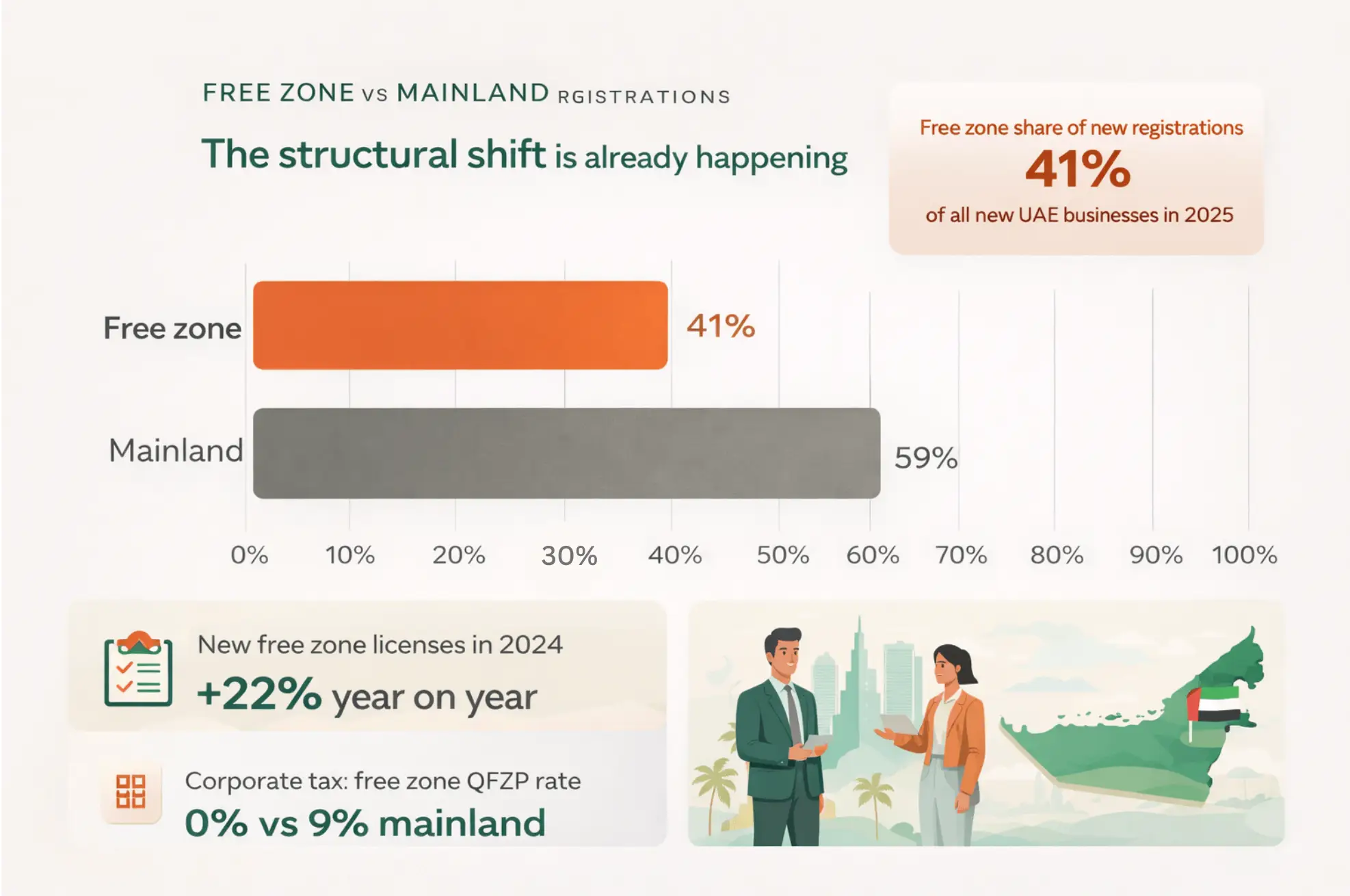
According to the Federal Tax Authority³, the UAE corporate tax regime applies a 0 percent rate on taxable profits up to AED 375,000 and a 9 percent basic rate above that threshold.
But switching isn't as simple as changing your address. Transferring from the mainland to a free zone is a structured transition called re-domiciliation. During the process, some things change immediately when you move, while others stay exactly where they are.
The Numbers Show Which Way Founders Are MovingYou are not bucking a trend by reconsidering your structure; you are joining a shift that is already reshaping how businesses register across the UAE.
Meydan Free Zone supports founders making this move, with a fully digital setup process, over 2,500 business activities, 60-minute licensing through Fawri, and integrated support for visas through mResidency. This guide breaks down what actually changes, what doesn't, and how to make the switch without losing momentum.
Why Move from the Mainland to a Free Zone in Dubai?
The decision rarely comes from one thing. It's usually a stack of factors that builds over time:
[blockFaqsCategory]
What Is Re-Domiciliation in the UAE?
This is the first point founders need to understand.
"Switching" from mainland to free zone is not just a license amendment or a simple address update. It is a regulated process in which the company moves from one authority to another. The company continues to exist, but the licensing authority changes and the business becomes governed by the framework of the new jurisdiction.
That is why this process should be treated as a legal migration rather than a fresh setup.
It also explains why founders need to think carefully about what they are trying to preserve:
- If the goal is to keep the same company alive while changing its regulatory home, re-domiciliation may be the right route
- If the goal is to restructure the business more deeply, a different route may be needed
[blockCTAFawri]
What Changes When Moving from Mainland to Meydan Free Zone
This is where expectations need to be clear from the outset.
[blockFaqsRequirements]
What Doesn't Change When Moving from Mainland to Free Zone
This is the part many founders don't realise until they look at re-domiciliation more closely.
The company continues to exist
Re-domiciliation is not liquidation and restart. The company retains its legal identity and continues as the same entity, just under a new licensing jurisdiction. That continuity is one of the main reasons founders explore this route in the first place.
A UAE marketing agency incorporated in 2019, for example, keeps its 2019 incorporation date. Client-facing materials, company history, and contractual track record stay intact.
Existing contracts can continue
Re-domiciliation doesn't automatically void your commercial agreements. Existing contracts and engagements can continue after the move, provided counterparties are informed, and, where necessary, novation or assignment is handled properly.
If you have a two-year retainer with a client or an ongoing supplier agreement, you're not necessarily rebuilding those relationships from scratch. You're updating the legal details, not starting over.
Renewal remains part of the operating cycle
The company will still need to renew its business license annually. What changes is the renewal framework and authority, not the fact that the business remains subject to ongoing operational obligations. After migration, renewals follow Meydan Free Zone's cycle.
The need for the right business activity still matters
Moving into a free zone doesn't remove the need for your business activity to align with what you actually do. If your existing structure doesn't match Meydan Free Zone's business activity list, that issue needs to be addressed around the migration. Re-domiciling companies may hold up to three business activity groups under one trade license, where permitted.
At a Glance: What Changes vs What Doesn't
| Topic | What's changed | What Doesn't Change |
|---|---|---|
| Legal status | Licensing authority shifts to Meydan Free Zone | The company itself, its legal identity, and incorporation date stay intact |
| Compliance | VAT and UBO must be re-filed under the new jurisdiction | The need for the right business activity still applies |
| Visas | All mainland visas must be cancelled and reissued | —— |
| Banking | Some banks require fresh onboarding; others continue | —— |
| Contracts | —— | Existing client and supplier agreements can continue |
| Renewals | Now follow Meydan Free Zone's renewal cycle | Annual license renewal is still required |
How Re-Domiciliation from Mainland to Meydan Free Zone Works
Re-domiciliation is not an instant conversion. It happens in sequence, and the order matters.
[blockAccordionSteps]
What Needs to Be Done After Re-Domiciliation
Once the Certificate of Re-domiciliation and new Meydan Free Zone trade license are issued, founders usually need to complete a few practical next steps:
- re-file required compliance registrations under the new jurisdiction
- issue new visas under Meydan Free Zone, where needed
- confirm whether the existing bank account can continue or whether fresh onboarding is required
- update clients, suppliers, and counterparties with the company’s new jurisdiction details
- continue renewals and ongoing compliance under Meydan Free Zone’s framework
Common Mistakes Founders Make When Re-Domiciling to Meydan Free Zone
Founders usually run into problems when they treat re-domiciliation like a simple license switch rather than a structured migration.
Some of the most common mistakes include:
- assuming the company can be restructured during the migration
- waiting too late to check whether the current business activities align with Meydan Free Zone requirements
- assuming visas, establishment cards, and compliance registrations will transfer automatically
- leaving banking conversations until after the legal move is already underway
- treating the move as an administrative update rather than a legal and operational transition
The smoother moves usually happen when founders prepare for the sequence properly, rather than trying to solve each issue after the migration has already started.
[blockExpertOpinion]
In Conclusion
Most founders don't switch jurisdictions because something went wrong. They switch because the business outgrew the structure it started with.
Re-domiciliation isn't a shortcut, but for the right business, it's one of the cleanest ways to change your regulatory home without losing what you've built. The UAE now has more than 45 free zones and over 1.5 million active commercial licenses. That growth isn't slowing. And with corporate tax now part of the equation, structure matters more than it used to.
If your mainland setup no longer matches how you operate, who you serve, where you work, or what you actually need, it might be time to look at what a move could unlock. Meydan Free Zone supports founders through the full transition, end-to-end.
[blockCTABizSetupRemotely]
Citations
¹ Gulf News, "Emirati-run home businesses soar: Force behind these 5 UAE startups," 2025.
² UAE Ministry of Economy and Tourism, "Free Zones," 2026.
³ Federal Tax Authority, "FTA launches 2nd phase of Corporate Tax awareness campaign with workshop for SMEs in Abu Dhabi," 2024.
⁴ Gulf News, "Free zones account for 41% of new UAE business registrations 2025," December 2025, citing Dubai Economy and Tourism.