
Table of Contents
Frequently Asked Questions
What is the Communication Engineering Services licence activity code in Dubai
The Communication Engineering Services licence in Dubai is registered under activity code 7110.29, which falls within ISIC Division 71 — Architectural and Engineering Activities. This classification covers engineering activities and related technical consultancy.
Under this code, licensed firms are authorised to provide design, planning, installation oversight, and consultancy for communication systems including telecom networks, fibre optic systems, wireless networks, broadcast infrastructure, and signal distribution systems.
Who needs a Communication Engineering Services licence in Dubai
Any firm providing professional services related to telecom network design, fibre optic deployments, broadcast infrastructure consultancy, wireless network planning, or signal distribution systems in Dubai requires this licence to operate legally and access formal tendering.
The typical client base includes government entities running smart city programmes, real estate developers integrating building communication systems, telecom operators requiring independent engineering input, and EPC contractors needing specialist subcontractors for network infrastructure projects.
It is important to note this is a distinct activity from a general IT services or IT consultancy licence, as communication engineering carries a technical scope that may trigger additional regulatory requirements.
What is the difference between a mainland and free zone licence for communication engineering in Dubai
A mainland licence issued by Dubai Economy and Tourism (DET) allows unrestricted work across UAE government and private sector contracts. It is the more practical route for firms intending to bid on public tenders or work directly with federal entities.
A free zone licence — such as one issued through Meydan Free Zone — offers faster incorporation, 100% foreign ownership, and lower initial overhead. It suits firms with an internationally oriented client base or those operating primarily in an advisory capacity rather than on-site delivery.
The key caveat is that free zone entities working on UAE mainland projects typically require either a local service agent arrangement or a separately registered mainland branch, which should be factored into cost and structure planning from the outset.
Which regulatory bodies oversee Communication Engineering Services licences in Dubai
The primary licensing authority for business setup is Dubai Economy and Tourism (DET) for mainland entities, or the relevant free zone authority for free zone entities such as Meydan Free Zone.
In addition, the Telecommunications and Digital Government Regulatory Authority (TDRA) has a separate oversight role for firms involved in telecom network design or spectrum-related work. TDRA registration is a distinct obligation regardless of whether a firm is set up on the mainland or in a free zone.
Firms should review current TDRA licensing categories directly at tdra.gov.ae before finalising their activity scope to ensure full compliance.
How long does it take to set up a Communication Engineering Services licence in Dubai
The typical setup timeline is 5 to 15 working days, depending on the chosen jurisdiction and whether any external regulatory approvals are required.
Delays most commonly arise from incomplete documentation or from skipping the external approvals stage — particularly where TDRA registration is required for telecom network design or spectrum-related activities. Sequencing the process correctly from the outset significantly reduces the risk of delays.
Is there a minimum share capital requirement for a Communication Engineering Services licence
For most free zone structures, there is no mandatory minimum share capital requirement for a Communication Engineering Services licence in Dubai. This makes free zone incorporation a cost-accessible option for consultancy-focused operations.
Requirements can vary depending on the specific legal structure chosen — such as a sole establishment, LLC on the mainland, or a free zone entity (FZE or FZCO) — so it is advisable to confirm current requirements with the relevant authority or a business setup specialist before proceeding.
Can I obtain investor or employee visas under a Communication Engineering Services licence
Yes. Investor and employee visas are available under a Communication Engineering Services licence in Dubai, regardless of whether the entity is set up on the mainland or in a free zone.
The number of visas available is typically linked to the size of the office space and the legal structure of the entity. Free zone authorities generally have their own visa allocation frameworks, while mainland entities are governed by DET and relevant immigration authority guidelines.
Does a Communication Engineering Services licence cover spectrum-related or telecom network design work
Activity code 7110.29 does authorise firms to provide design and consultancy for telecom networks and related communication systems. However, where a firm's scope specifically touches telecom network design or spectrum-related services, a separate registration with the Telecommunications and Digital Government Regulatory Authority (TDRA) is required.
This TDRA obligation applies regardless of jurisdiction — whether the firm is mainland or free zone registered. Firms should consult the TDRA's current licensing categories at tdra.gov.ae to determine the precise registration category applicable to their planned activities before finalising their business setup.
Apply for a Communication Engineering Services License in Dubai
Dubai's infrastructure buildout and smart city agenda keep demand for communication engineering services firmly in growth territory. New districts, transport networks, and data infrastructure all need specialists who can design, install, and maintain the systems that connect them.
This guide covers what the license covers, where to set up, and the steps to get trading fast. Whether you are coming in as a solo engineer or building a team, the path is clear once you know which jurisdiction fits your client base.
Key Stats at a Glance
| Item | Detail |
|---|---|
| Activity code | Communication Engineering Services – confirm the exact code with your chosen jurisdiction before filing |
| Licensing authority | Dubai Department of Economy and Tourism (DET) for mainland; Meydan Free Zone for free zone setup |
| Foreign ownership | 100% available – both mainland and free zone |
| Typical setup timeline | 3 to 7 working days for a free zone license; mainland takes longer depending on approvals |
| Minimum share capital | Varies by jurisdiction – confirm with DET or Meydan Free Zone |
What a Communication Engineering Services License Covers
This license lets you operate as a professional services business in the design, installation, testing, and maintenance of communication systems and networks. It is a technical activity license, which means the work you do must stay within the permitted scope. Going outside it without an extra license creates compliance problems.
Permitted activities
The core activities covered under a communication engineering services license include:
What is not covered
This license does not cover licensed telecoms operations, meaning you cannot run a network or sell connectivity services to end users. That falls under a separate TDRA operator license. You also cannot provide broadcast transmission services or operate radio spectrum without extra approvals. If your work touches those areas, you need to check whether a second license is needed before you start.
TDRA oversight
TDRA sets the rules for any business working with telecoms infrastructure in the UAE. Even if you hold a valid trade license, TDRA registration is a separate step and it is not optional. Day to day, this means keeping your TDRA credentials current, making sure your staff hold the right technical certifications, and using approved equipment where standards apply. TDRA also oversees contractor approvals for work on public telecoms networks, so if you plan to bid for those contracts, factor that into your setup timeline.
You can review the full scope of Meydan Free Zone business activities to see how communication engineering sits alongside related technical and engineering categories.
Mainland vs Free Zone: Which Setup Works for You
This is the biggest choice you will make when setting up. Let your clients decide it, not the cost.
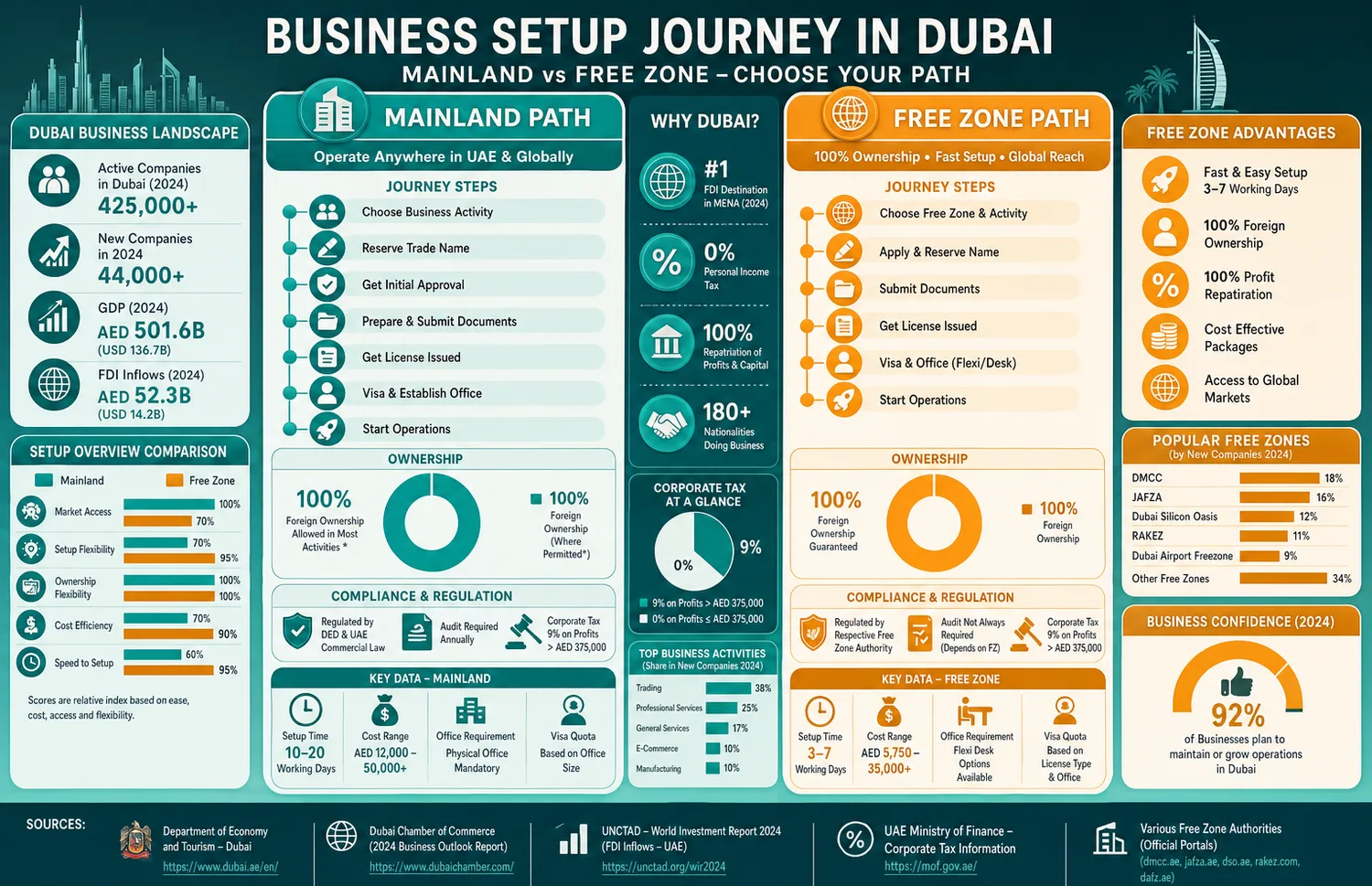
| Factor | Mainland (DET) | Free Zone (Meydan Free Zone) |
|---|---|---|
| Client access | Open UAE market, including government contracts | Mainly international clients and free zone entities |
| Foreign ownership | 100% available in most activities | 100% always |
| Office requirement | Physical office required | Flexi-desk options available |
| Setup speed | Slower – multiple government touchpoints | Faster – typically 3 to 7 working days |
| Currency restrictions | None | None |
| TDRA registration | Required | Required |
Mainland via DET
A mainland license from DET lets you work directly with UAE government bodies, municipalities, and private sector clients anywhere in the country. If your pipeline includes government infrastructure projects, public sector fit-outs, or large developer contracts, mainland is the right base. You will need a physical office address, and the setup process involves more government touchpoints, so allow extra time.
Free zone via Meydan Free Zone
Meydan Free Zone gives you 100% foreign ownership, no currency restrictions, and a faster setup process. It suits businesses focused on international clients, private sector projects, or those who want to get operational quickly while building their UAE client base. A flexi-desk arrangement keeps overhead low in the early months. If you later need to work directly with government clients, you can add a mainland presence or appoint a local commercial agent.
If you are not based in the UAE yet, you can also handle the entire process through remote business setup, which means no flights required to get your license issued.
Free Business Setup Cost Calculator
Compliance and What You Need in Place Before You Start
Getting the license is step one. Staying compliant is the ongoing job. For communication engineering services, there are several duties that sit on top of the standard trade license requirements.
TDRA registration
Any business that touches telecoms infrastructure in the UAE needs to register with TDRA. This is separate from your trade license and must be done before you start work on any telecoms-related project. TDRA also approves contractors who want to work on public network infrastructure, so if that is part of your plan, build the approval timeline into your setup schedule. Check the TDRA website for current registration requirements and fee structures.
Staff qualifications
TDRA and project clients will expect your engineers to hold relevant technical certifications. These vary depending on the type of work, but typically cover structured cabling standards, fibre optic installation, and network testing. Make sure your team's credentials are documented and current before you bid for contracts. Some government projects also need proof of staff clearances before site access is granted.
VAT registration
If your annual taxable turnover reaches AED 375,000, you must register for VAT with the Federal Tax Authority. Registration is voluntary between AED 187,500 and AED 375,000. Most communication engineering businesses cross the mandatory threshold quickly once they are active. Get your VAT registration done early rather than scrambling when a contract comes in. The Federal Tax Authority (FTA) portal handles registration online. You can also use VAT registration support services through mAccounting if you want guidance through the process.
| Annual taxable turnover | VAT registration status |
|---|---|
| Below AED 187,500 | Not required |
| AED 187,500 to AED 375,000 | Voluntary |
| AED 375,000 and above | Mandatory |
Corporate tax
The UAE corporate tax rate of 9% applies to taxable income above AED 375,000. Free zone businesses that meet the qualifying income conditions may be eligible for a 0% rate on qualifying income. Check with a tax adviser to confirm your position before you file. mAccounting also covers corporate tax services in Dubai for businesses that need ongoing support.
Annual license renewal
Trade licenses in Dubai are valid for one year and must be renewed before they lapse. A lapsed license means you are technically not authorised to trade, which can void contracts and create problems with visa renewals. Set a reminder 60 days before your renewal date. If your business has grown or changed, renewal is also the right time to add or adjust activity codes.
Bookkeeping and audit
Keeping clean financial records is a legal duty, not just good practice. Free zone companies are generally required to maintain audited accounts. Bookkeeping services in Dubai through mAccounting keep your records in order year-round, so audit preparation is not a last-minute exercise.
Market Opportunity
Dubai's smart city programme, the expansion of 5G infrastructure, and continued growth in commercial real estate all drive demand for communication engineering specialists. Large-scale projects such as new metro extensions, data centre builds, and smart building fit-outs all need engineers who can handle the full scope from design to commissioning.
The client base is broad. It covers property developers, main contractors, government entities, hospitality groups, healthcare operators, and logistics facilities. Each has different procurement processes, but all of them need qualified communication engineers on their approved vendor lists before they will award work.
Getting on those lists takes time, so the earlier you get your license and TDRA registration in place, the sooner you can start the vendor approval process with target clients. Many engineers who come to Dubai underestimate how long the commercial pipeline takes to build and overestimate how quickly projects move. Plan for a six to twelve month ramp-up period before revenue is consistent.
International firms looking to access Dubai's project market without a full local setup sometimes use a free zone entity to test the market before committing to a mainland presence. That is a workable approach, provided you understand the client access limitations and plan for the transition if the market responds well.
Conclusion
A communication engineering services license in Dubai is workable to get, provided you pick the right jurisdiction for your client base and sort TDRA registration early. The free zone route is faster and suits businesses focused on private sector and international clients. The mainland route gives you direct access to government contracts but takes more time and needs a physical office.
Either way, the compliance duties are the same: TDRA registration, VAT obligations once you cross the threshold, corporate tax filing, and annual license renewal. Get these in place from day one and they become routine. Leave them until a contract demands it and they become a problem.
Speak to the Meydan Free Zone team to confirm your activity code and get a cost estimate before you commit.
Ready to Launch Your Business in Dubai?
Compliance
THIRD-PARTY APPROVAL
This activity requires pre-approval from the DM (Dubai Municipality) before a business license can be issued by Meydan Free Zone.
ANTI-MONEY LAUNDERING COMPLIANCE
This business activity is exempt from AML compliance requirements.