
Table of Contents
Frequently Asked Questions
What is activity code 7410.99 and what does it permit in Dubai
Activity code 7410.99 falls under ISIC Division 74 — Other Professional, Scientific and Technical Activities. It is the designated licence code for calligraphers and painters operating in Dubai.
In practical terms, the licence permits Arabic and decorative calligraphy, fine art painting, commissioned murals, artwork for commercial clients, and related studio services. It is broad enough to cover both private commissions and corporate contracts, making it suitable for sole practitioners and larger studio setups alike.
Can a foreign national own 100% of a calligraphy or painting business in Dubai
Yes. 100% foreign ownership is permitted for calligraphy and painting businesses across both mainland and free zone structures in Dubai. There is no requirement for a local Emirati sponsor or partner to hold a share of the business.
This applies whether you set up under a Dubai Department of Economy and Tourism (DED) mainland licence or through a free zone such as Meydan Free Zone. The removal of the local sponsorship requirement has made Dubai significantly more accessible for international creative professionals.
What is the difference between a mainland and a free zone licence for artists in Dubai
A mainland licence issued by the Dubai Department of Economy and Tourism (DET) allows you to work directly with government entities, retail clients, and operate a physical studio in any commercially zoned location. It typically takes 5–10 working days to process and is the stronger choice if your client base is primarily UAE-based businesses or government bodies.
A free zone licence — with Meydan Free Zone being a popular option for creative professionals — offers lower setup costs, faster processing of around 3–7 working days, and no mandatory office space at entry level. The key trade-off is that free zone operators working directly with mainland clients may need a commercial agency arrangement or branch structure to do so compliantly.
What is the VAT threshold for calligraphy and painting businesses in Dubai
If your annual turnover exceeds AED 375,000, VAT registration becomes mandatory under rules governed by the Federal Tax Authority (FTA). This threshold applies to calligraphy and painting businesses just as it does to other commercial activities in the UAE.
It is strongly advisable to factor this into your pricing model from the outset rather than retrofitting VAT compliance later. Businesses approaching the threshold should monitor turnover closely and register proactively to avoid penalties.
What is the Dubai Culture and Arts Authority freelance permit and who is it suitable for
The Dubai Culture and Arts Authority (DCAA) issues freelance permits for individual artists as a lighter-touch alternative to a full trade licence. These permits cover calligraphy, painting, and visual arts, and are renewable annually.
However, the limitations are important to understand. A freelance permit does not allow you to hire staff or operate a studio under the permit alone. It is best suited to sole practitioners with modest, individual-focused practices. If you intend to scale your operation, hire employees, or run a formal studio, a full trade licence is the correct route from the beginning.
Do I need additional approvals from the Dubai Culture and Arts Authority if I open a studio or gallery
Yes, potentially. While the 7410.99 trade licence covers a broad range of calligraphy and painting services, a studio or gallery setup may require additional approvals or registration with the Dubai Culture and Arts Authority (DCAA), which oversees visual arts infrastructure and artist licensing across the emirate.
Beyond DCAA requirements, opening a physical space also involves tenancy registration (Ejari), fit-out approvals, and any sector-specific requirements tied to the location. These steps add both cost and time, and are a common source of delays for first-time applicants who do not plan for them in advance.
How long does it take to get a calligraphers and painters licence in Dubai
Processing times vary depending on the structure you choose. A free zone licence — such as one through Meydan Free Zone — typically takes 3–7 working days. Free zones are generally faster because approvals are handled within a single authority.
A DED mainland licence typically takes 5–10 working days, though this can extend if additional activity approvals, physical inspections, or sector-specific sign-offs are required. Neither timeline accounts for the additional time needed to register a physical studio space, which involves separate Ejari and fit-out processes.
Why is Dubai considered a strong market for calligraphers and painters to set up a business
Dubai's creative economy is expanding rapidly, supported by deliberate government policy. Creative and cultural activities are confirmed as a priority sector under the Dubai Economic Agenda D33, signalling long-term institutional support for the arts and creative industries.
The Middle East art market is projected to maintain steady growth through 2028, driven by institutional and private commissions according to IMARC Group. Combined with 100% foreign ownership rights, competitive free zone costs, and a structured licensing pathway, Dubai offers a commercially viable and well-regulated environment for professional artists and calligraphers looking to establish or expand their practice.
Calligraphers & Painters License in Dubai
Dubai's creative economy is expanding fast — and if you work in calligraphy or painting, there is a structured, legitimate path to operating as a licensed professional or studio in the emirate. This guide covers what the Calligraphers & Painters licence (activity code 7410.99) covers, where to set up, the step-by-step process, and what it realistically costs.
What the Calligraphers & Painters Licence Covers
Activity code 7410.99 sits under ISIC Division 74 — Other Professional, Scientific and Technical Activities — which captures specialised creative services not classified elsewhere in the standard industrial taxonomy. In practical terms, this licence permits a wide range of visual art and calligraphy services.
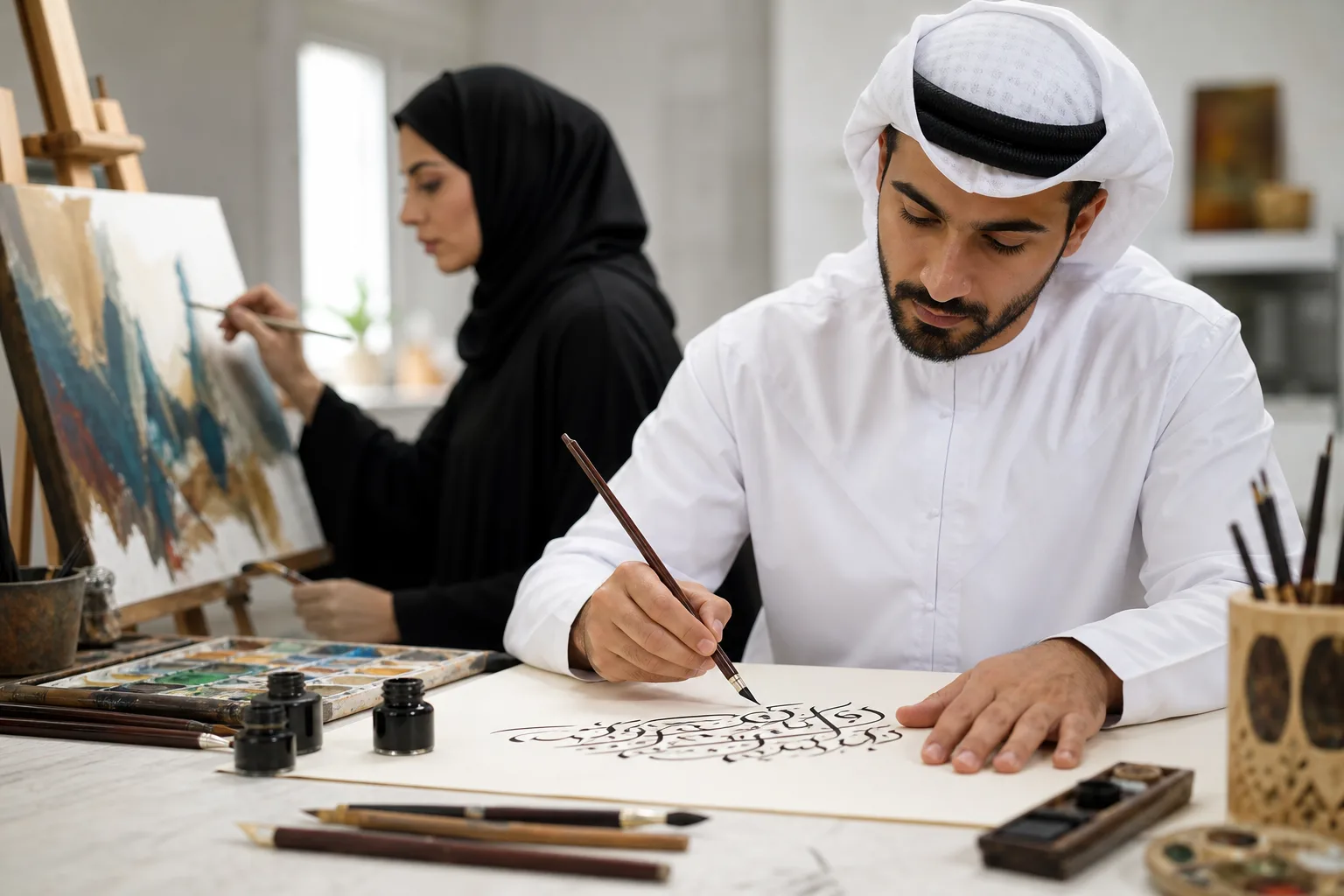
Permitted activities typically include Arabic and decorative calligraphy, fine art painting, commissioned murals, artwork produced for commercial clients, and related studio services. The licence is broad enough to cover both private commissions and corporate contracts.
There is a meaningful distinction between a sole practitioner licence and a studio or gallery setup. The latter may require additional approvals or registration with the Dubai Culture and Arts Authority, which oversees visual arts infrastructure and artist licensing across the emirate.
If your annual turnover exceeds AED 375,000, VAT registration becomes mandatory under rules governed by the Federal Tax Authority. Factor this into your pricing model from day one.
Business Activities List
Explore Over 2,500+Key Stats at a Glance

Creative Business in Dubai — Key Figures
- 100% foreign ownership permitted for calligraphy and painting businesses across mainland and free zone structures
- AED 375,000 annual turnover threshold for mandatory VAT registration
- 3–7 working days typical free zone licence processing time
- 5–10 working days typical DED mainland licence processing time
- Middle East art market projected to maintain steady growth through 2028, driven by institutional and private commissions, per IMARC Group
- Creative and cultural activities confirmed as a priority sector under Dubai Economic Agenda D33 via Invest in Dubai
- Meydan Free Zone licence fees among the most competitive in Dubai for creative professionals — no mandatory office space at entry level
Free Business Setup Cost Calculator
Calculate NowMainland vs Free Zone: Choosing Your Setup
A mainland licence issued by the Dubai Department of Economy and Tourism (DED) permits direct work with government entities, retail clients, and allows you to operate a physical studio in any commercially zoned location. If your client base is predominantly UAE-based businesses or government bodies, mainland is the more practical structure.
A free zone licence — Meydan Free Zone being a strong option for creative professionals — suits freelancers and small studios. Setup costs are lower, processing is faster, and no local sponsor is required. The trade-off is that free zone operators working directly with mainland clients need to consider commercial agency arrangements or a branch structure.
| Factor | Mainland (DED) | Free Zone (e.g. Meydan) |
|---|---|---|
| Local sponsor required | No (100% foreign ownership permitted) | No |
| Work directly with government clients | Yes | Requires branch or agency arrangement |
| Physical studio location | Any commercially zoned space | Flexi-desk or virtual office acceptable at entry level |
| Licence processing time | 5–10 working days | 3–7 working days |
| Setup cost | Higher | Lower |
If you intend to open a physical studio or gallery, factor in tenancy registration (Ejari), fit-out approvals, and any sector-specific requirements before committing to a space. These add cost and time that catch many first-time applicants off guard.
Dubai Trade License from AED 12,500
Get Your LicenseFreelance Artist Permit
The Dubai Culture and Arts Authority issues freelance permits for individual artists — a lighter-touch option for sole practitioners who do not require a full trade licence. These permits cover calligraphy, painting, and visual arts, and are renewable annually. The limitation is clear: a freelance permit does not allow you to hire staff or operate a studio under the permit alone. If you plan to scale, a full trade licence is the correct route from the outset.
Step-by-Step Licence Setup Guide
The process is logical and well-defined. Here is how it runs in practice:
| Step | Action | Key detail |
|---|---|---|
| 1 | Define your activity scope | Confirm 7410.99 covers all intended services; identify supplementary codes if selling commercially or operating a gallery |
| 2 | Choose your jurisdiction | Mainland (DED) or free zone (Meydan or equivalent) — compare costs, visa quotas, and client access against your actual business model |
| 3 | Reserve your trade name | Check availability via the DED e-Services portal; names referencing political or religious bodies, or containing offensive terms, will be rejected |
| 4 | Submit initial approval application | Provide passport copies, proposed activity list, and business plan summary if required |
| 5 | Secure tenancy | Ejari-registered commercial space required for mainland; flexi-desk or virtual office acceptable for most free zone creative licences |
| 6 | Pay licence fees and receive trade licence | Free zone: 3–7 working days; mainland: 5–10 working days under normal conditions |
| 7 | Apply for UAE residence visa and Emirates ID | Complete medical fitness test and biometrics through the standard GDRFA process |
| 8 | Open a business bank account | Have trade licence, tenancy contract, and shareholder documents ready; allow at least 2–4 weeks |
Conclusion
A Calligraphers & Painters licence in Dubai is straightforward to obtain. The key decisions are jurisdiction, whether you need physical studio space, and whether a freelance permit or full trade licence better fits your commercial model. Costs are manageable, foreign ownership is unrestricted, and the regulatory environment is clear. There is no structural reason to delay.
If you want to confirm the right activity codes, compare mainland and free zone costs, or get your licence processed without delays, speak to the Meydan Free Zone setup team directly.