
Table of Contents
Frequently Asked Questions
What is a Fine Arts Consultancy licence in Dubai and what does it cover
A Fine Arts Consultancy licence in Dubai operates under Activity Code 7020.78, classified within ISIC Division 70 — Management Consultancy Activities. It is a professional services licence, not a trading licence, meaning it authorises advice, curation, and management rather than commercial art transactions.
Permitted services include advisory on art acquisition and disposition, private and corporate collection management, artist representation, exhibition curation, art valuation and authentication advisory, and cultural project consulting for developers, hotels, and institutions.
It is important to note that this licence does not cover art dealing or retail sales. If you intend to buy and sell artworks commercially, a separate trading licence is required alongside or instead of this consultancy licence.
Who are the typical clients of a licensed fine arts consultant in Dubai
Licensed fine arts consultants in Dubai typically serve a broad range of private and institutional clients. Common client categories include private collectors, corporations building workplace or hospitality art programmes, and real estate developers seeking to integrate art into their projects.
Hotels, government-linked cultural institutions, and organisations commissioning public or site-specific art programmes also represent a significant portion of the client base. The breadth of Dubai's commercial and cultural ecosystem — from DIFC galleries to Alserkal Avenue — means demand spans both local and international clients.
Should I set up a Fine Arts Consultancy on the mainland or in a free zone
The right jurisdiction depends primarily on where your revenue comes from. A mainland licence issued by the Dubai Department of Economy and Tourism (DET) allows direct contracts with UAE government bodies and unrestricted client access across all seven Emirates — a practical commercial advantage if your pipeline includes government-adjacent entities.
A free zone licence — such as through Meydan Free Zone — offers 100% foreign ownership as standard, faster incorporation, and lower initial costs. It is better suited to consultants working regionally, internationally, or with private sector clients who are not government-linked.
Following the 2021 amendments to the UAE Commercial Companies Law, 100% foreign ownership is now permitted for most professional activities on the mainland as well, removing the previous requirement for a local partner in many cases.
What are the advantages of setting up a Fine Arts Consultancy in Meydan Free Zone
Meydan Free Zone offers a single-window setup process with no mandatory physical office requirement at the flexi-desk tier, making it particularly cost-efficient for solo consultants and boutique advisory firms.
Visa allocation is available from day one of licence issuance, which is a meaningful advantage if you need to sponsor staff or dependants quickly. The free zone's central Dubai location and straightforward professional licence structure further reduce administrative friction for those entering the market.
100% foreign ownership is standard in the free zone, and the overall setup is well-suited to internationally facing advisory practices that do not require direct government contracting access.
How long does it take to get a Fine Arts Consultancy licence in Dubai
Setup timelines vary by jurisdiction. A free zone licence can typically be issued within 3–7 working days, provided all documentation is prepared correctly from the outset. This makes free zone incorporation the faster route for consultants who need to begin operating quickly.
A mainland licence through the Dubai Department of Economy and Tourism generally takes 2–4 weeks, reflecting the additional regulatory steps involved in DET processing. In both cases, having complete and accurate documentation ready before submission is the most effective way to avoid delays.
Is there a minimum share capital requirement for a Fine Arts Consultancy licence
For most free zone setups, there is no mandatory minimum share capital requirement for a Fine Arts Consultancy licence under Activity Code 7020.78. This lowers the barrier to entry for independent consultants and small advisory firms.
Requirements can vary between jurisdictions and authority-specific rules, so it is advisable to confirm the current capital requirements directly with the relevant free zone or mainland authority at the time of application, as policies can be updated.
Can a Fine Arts Consultancy licence holder sponsor visas in Dubai
Yes. A Fine Arts Consultancy licence in Dubai carries visa eligibility for both investor and employee visas. This applies whether the licence is issued on the mainland or through a free zone such as Meydan Free Zone.
In Meydan Free Zone specifically, visa allocation is available from day one of licence issuance, making it straightforward to sponsor staff or dependants without waiting for a secondary approval stage. The number of visas available typically depends on the office tier or package selected at the time of incorporation.
Does a Fine Arts Consultancy licence allow me to sell artworks in Dubai
No — Activity Code 7020.78 is a professional consultancy licence and explicitly does not cover art dealing or retail sales. The licence authorises advice, curation, collection management, and related professional services, but not the commercial transaction of buying and selling artworks.
If your business model includes commercially trading artworks — purchasing and reselling pieces for profit — you would need to obtain a separate trading licence that covers that activity. Many practitioners in the Dubai art market hold both a consultancy and a trading licence to cover the full scope of their services.
Fine Arts Consultancy License in Dubai
Dubai's art market has grown into a serious commercial sector. Galleries, collectors, developers, and cultural institutions all pay for expert guidance on acquisitions, curation, and collection management. That demand is real and it is growing.
A fine arts consultancy license lets you run that advisory business legally in Dubai, whether you work with private collectors, hotels, or public bodies. This article covers what the license covers, who your clients will be, how to choose the right jurisdiction, and what you need to stay compliant once you are up and running.
Key Stats at a Glance
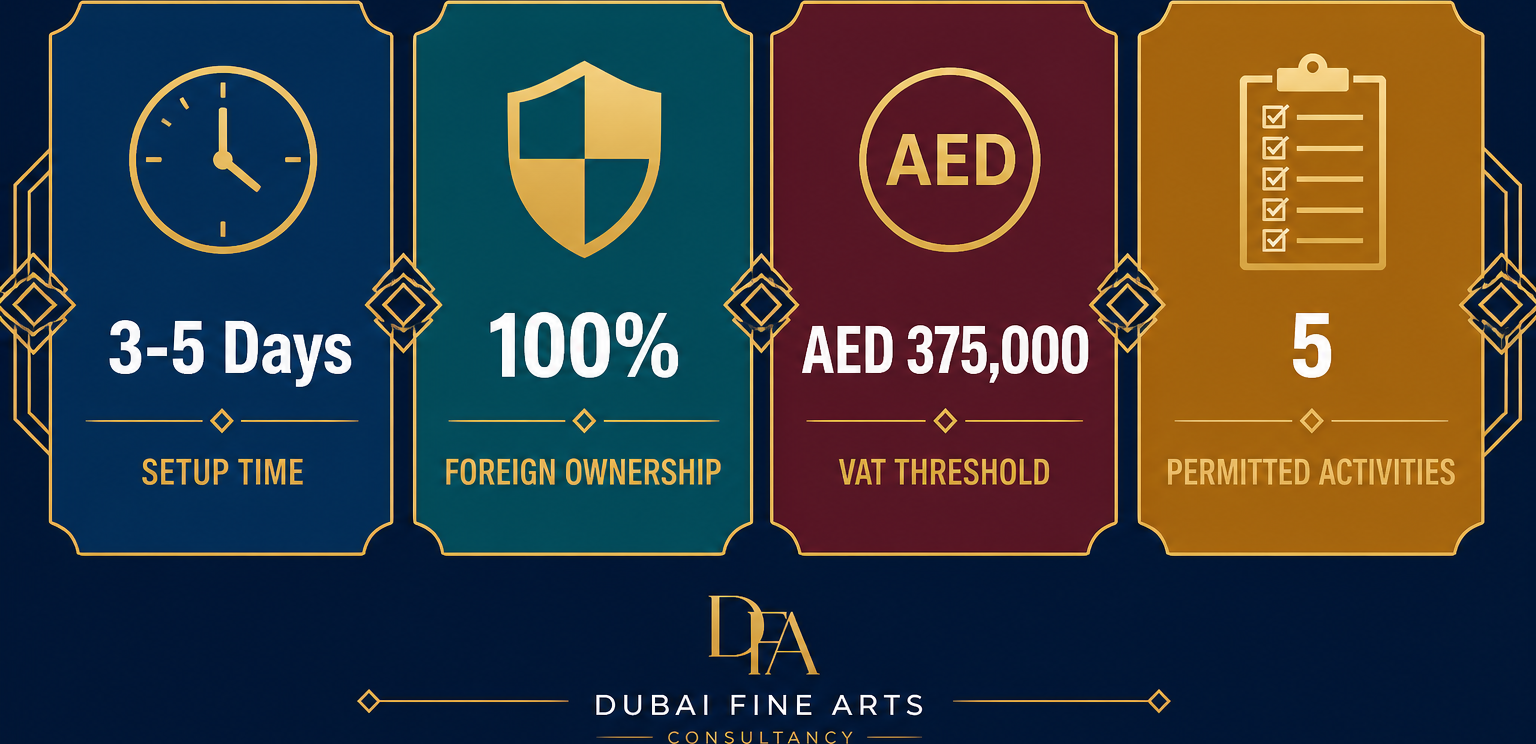
| Activity | Fine Arts Consultancy |
|---|---|
| Licensing authority | Meydan Free Zone (free zone) or Dubai Department of Economy and Tourism – DET (mainland) |
| Foreign ownership | 100% permitted in free zone and on mainland following 2021 reforms – Invest in Dubai |
| Typical setup timeline | 3 to 5 working days at Meydan Free Zone |
| Relevant regulatory body | Dubai Culture and Arts Authority |
| VAT registration threshold | AED 375,000 annual revenue – Federal Tax Authority (FTA) |
What a Fine Arts Consultancy License Covers
The fine arts consultancy license covers advisory work. That is the core of it. You are paid to give expert guidance, not to buy and sell art on your own account.
Permitted activities under this license typically include:
- Advisory on art acquisition, including sourcing, provenance checks, and pricing guidance
- Collection management for private and corporate clients
- Curation services for exhibitions, public spaces, and hospitality projects
- Valuation guidance, working alongside certified appraisers where formal valuations are needed
- Artist representation and liaison between artists and buyers or institutions
Getting the activity code right at setup matters more than most founders expect. Banks check it when you open an account. Clients check it when they review contracts. If your stated activity does not match what you actually do, you create problems on both fronts.
What this license does not cover
Physical art dealing, auction operations, and gallery retail sales all need separate activity codes. Do not assume the consultancy license stretches to cover those. If you plan to buy and resell artworks, or run a gallery space with retail transactions, you need the right code from the start. Adding activities later is possible, but it takes time and costs money.
Dubai Culture and Arts Authority
The Dubai Culture and Arts Authority oversees cultural activity in the emirate. If your consultancy involves exhibiting physical artworks, handling pieces on behalf of clients, or running events in public spaces, you may need to register with them separately. This is not automatic when you get your trade license. Check what applies to your specific scope of work before you start.
The Meydan Free Zone Business Activities List covers fine arts consultancy and a wide range of related advisory activities. Confirm the exact code that fits your work before you submit your application.
Who Your Clients Will Be
Dubai's art consultancy market is not one client type. It is several, and they each buy differently.
Private collectors and family offices
High-net-worth individuals and family offices in the UAE are active buyers. They want acquisition advice, provenance research, and help managing collections that span multiple properties and jurisdictions. They pay for discretion and expertise, and they refer within their networks when they trust you.
Hotels, developers, and hospitality groups
Dubai's hospitality and real estate sectors commission significant public art programs. Developers want art integrated into residential and commercial projects. Hotels want curated collections that reinforce their brand. These are project-based contracts, often with long lead times, but the budgets are substantial.
Corporate clients
Companies building workplace art collections are a growing segment. The motivation is partly brand, partly ESG, and partly the genuine belief that well-chosen art changes how a workspace feels. Corporate clients tend to have procurement processes, so you need to be set up properly to get on their vendor lists.
Cultural institutions and government bodies
Dubai and the wider UAE have invested heavily in cultural infrastructure. Public art initiatives, museum acquisitions, and government-commissioned projects all create demand for specialist advisory input. Working with these clients from a free zone structure needs careful thought, which is covered in the next section.
Mainland vs Free Zone: Which Setup Works for You
This is the most important decision you make at setup. Let your client base drive it, not the price.
| Factor | Mainland (DET) | Free Zone (Meydan Free Zone) |
|---|---|---|
| Client access | Direct contracts with UAE government and mainland companies | Mainly international clients and private individuals; mainland work needs a local agent or branch |
| Foreign ownership | 100% permitted post-2021 reforms | 100% permitted |
| Office requirement | Physical office required | Flexi-desk options available |
| Setup speed | Typically 1 to 2 weeks | 3 to 5 working days |
| Visa allocation | Based on office space | Packages available; varies by plan |
| Best suited for | Consultants working with UAE government bodies or local companies | Consultants working internationally, with private clients, or building a lean operation |
Mainland via DET
A mainland license from the Dubai Department of Economy and Tourism lets you work directly with UAE government bodies and sign contracts with local companies without needing a commercial agent. If your client base includes public institutions or large UAE-based corporates with formal procurement processes, mainland is worth considering seriously.
Free zone via Meydan Free Zone
Meydan Free Zone gives you 100% foreign ownership, no physical office requirement, and a faster setup process. It suits consultants who work with private collectors, international clients, or hospitality groups that do not require a mainland contracting structure. You can also start a business remotely through Meydan Free Zone without needing to be in the UAE during setup.
The trade-off is real. Free zone companies that want to contract directly with UAE mainland entities need a local commercial agent or a mainland branch. That adds cost and complexity. If most of your work is with private clients or international buyers, that trade-off rarely matters in practice.
Banking works well from either structure. Visa allocation in a free zone depends on your chosen package. Flexi-desk options keep overhead low while you build your client base.
Free Business Setup Cost Calculator
Calculate NowHow to Set Up and Stay Compliant
Setup is straightforward once you have confirmed your activity code and chosen your jurisdiction. Here is how it runs at Meydan Free Zone.
- Step 1, check your company name: Use the Company Name Check tool to confirm your preferred trade name is available before you apply.
- Step 2, confirm your activity code: Make sure the fine arts consultancy code covers your actual scope of work. If you plan to add activities later, flag them now.
- Step 3, submit your application: Apply through the Meydan Free Zone portal. Documents needed include a passport copy, a completed application form, and payment.
- Step 4, pay your license fee: A Dubai Trade License from AED 12,500 is available at Meydan Free Zone. Use the cost calculator to get a figure specific to your setup.
- Step 5, get your license issued: Meydan Free Zone typically issues licenses within 3 to 5 working days.
- Step 6, apply for your visa and Emirates ID: Once the license is issued, you can apply for your investor visa and Emirates ID. Medical fitness screening and biometrics are part of this process.
- Step 7, open your business bank account: Your license and company documents are what banks need. Meydan Free Zone's business banking support can help you navigate the process.
VAT registration
Once your annual revenue crosses AED 375,000, you must register for VAT with the Federal Tax Authority. Registration below that threshold is voluntary. The FTA expects accurate records from the date you start trading, not from the date you register. Keep clean books from day one. Meydan Free Zone's VAT registration support can handle the process if you do not want to manage it yourself.
Corporate tax
The UAE introduced a 9% corporate tax rate on taxable income above AED 375,000. Free zone entities that meet the qualifying conditions can benefit from a 0% rate on qualifying income. Check the Federal Tax Authority guidance on what qualifies, and make sure your accountant understands the distinction between qualifying and non-qualifying income for your specific activities.
Trade license renewal
Licenses renew annually. Missing the renewal window leads to fines and can affect your visa status. Set a reminder well before the expiry date.
Dubai Culture and Arts Authority registration
If your consultancy involves handling physical artworks, exhibiting pieces, or running public art events, check whether you need to register with the Dubai Culture and Arts Authority. This is separate from your trade license and applies depending on the nature of your activity.
Adding activities later
If you decide to add art dealing or gallery retail to your business, you need separate activity codes. The consultancy license does not cover those. Apply to add the codes before you start those activities, not after.
Market Opportunity
Dubai has positioned itself as a regional hub for the art market, with Art Dubai, the Dubai Design District, and a growing number of permanent gallery spaces attracting international collectors and institutions. The Dubai Culture and Arts Authority has been active in supporting that growth through policy and programming.
Demand for professional advisory services follows that growth. Collectors buying in a new market want guidance. Developers integrating art into large-scale projects need someone who understands both the creative and commercial sides. Corporate clients want collections that hold value and reflect well on their brand.
The market rewards specialists. Generalist advice is easy to find. Deep knowledge of a particular period, medium, or region commands real fees. If you have that expertise, Dubai gives you access to a client base that can afford to pay for it and that is actively looking for it.
According to IMARC Group, the global art advisory market continues to expand, driven by growing high-net-worth wealth in the Gulf and increased institutional investment in cultural assets. Dubai sits at the centre of that regional growth.
Conclusion
A fine arts consultancy license in Dubai is a workable, well-defined structure for advisors who want to operate professionally in a market that takes art seriously as both culture and commerce. The setup process is clear, the costs are manageable, and the client base is real.
Get your activity code right from the start. Choose your jurisdiction based on who your clients are, not on setup cost alone. Register with the Dubai Culture and Arts Authority if your work touches physical artworks or public exhibitions. And keep your records clean from day one, because the FTA expects that whether or not you have crossed the VAT threshold yet.
Speak to Meydan Free Zone to confirm your activity code and get a cost breakdown before you commit to a jurisdiction. The cost calculator gives you a starting figure in minutes.
Ready to Launch Your Business in Dubai?
Let's Connect