Table of Contents

Frequently Asked Questions

What is a Real Estate Registration Trustee in Dubai

A Real Estate Registration Trustee is a licensed intermediary authorised to process formal property transactions on behalf of buyers, sellers, and the Dubai Land Department (DLD). The role is procedural and compliance-driven rather than advisory or brokerage-based.

Core functions include title deed transfers, mortgage registrations, Oqood off-plan registrations, and ownership amendments. Trustees verify documents, collect fees on behalf of the DLD, and submit completed applications through the DLD system.

This activity is classified under activity code 7490.9 — Professional and Technical Services (Other) — and is legally distinct from real estate brokerage or valuation services.

Is DLD accreditation mandatory to operate as a Real Estate Registration Trustee

Yes. DLD accreditation is mandatory and is separate from your trade licence. A free zone trade licence establishes your legal commercial entity, but you cannot process any registrations without the DLD operational permit.

The accreditation process is applied for after the trade licence is issued. DLD applies fit-and-proper criteria that include qualified and trained staff, a compliant physical office location, and adequate professional indemnity insurance.

Operating without DLD accreditation — even with a valid trade licence — would mean you are not legally permitted to process property registrations in Dubai.

What activity code applies to a Real Estate Registration Trustee business

The applicable activity code is 7490.9 — Professional and Technical Services (Other). This classification places the trustee role within the professional services category rather than real estate brokerage or sales.

The distinction is significant for licensing purposes. A trustee is processing legal transfers, not selling property, which means a RERA brokerage licence is not required for this specific activity. Each licence type covers a different function within the property transaction chain.

What is an Oqood registration and why does it matter for this business

Oqood is the DLD's registration system for off-plan property sales. When a developer sells an off-plan unit, the transaction must be registered via Oqood before a title deed can ultimately be issued to the buyer.

This creates a two-stage trustee requirement per off-plan transaction: an Oqood registration at the point of sale and a title deed transfer upon completion. With off-plan sales accounting for over 60% of residential transactions in 2023, this is a significant and recurring source of workflow for trustee businesses.

Developers with high off-plan volumes represent some of the most commercially attractive institutional clients, as they generate consistent, repeatable registration requirements rather than one-off transactions.

What is the scale of demand for trustee services in Dubai

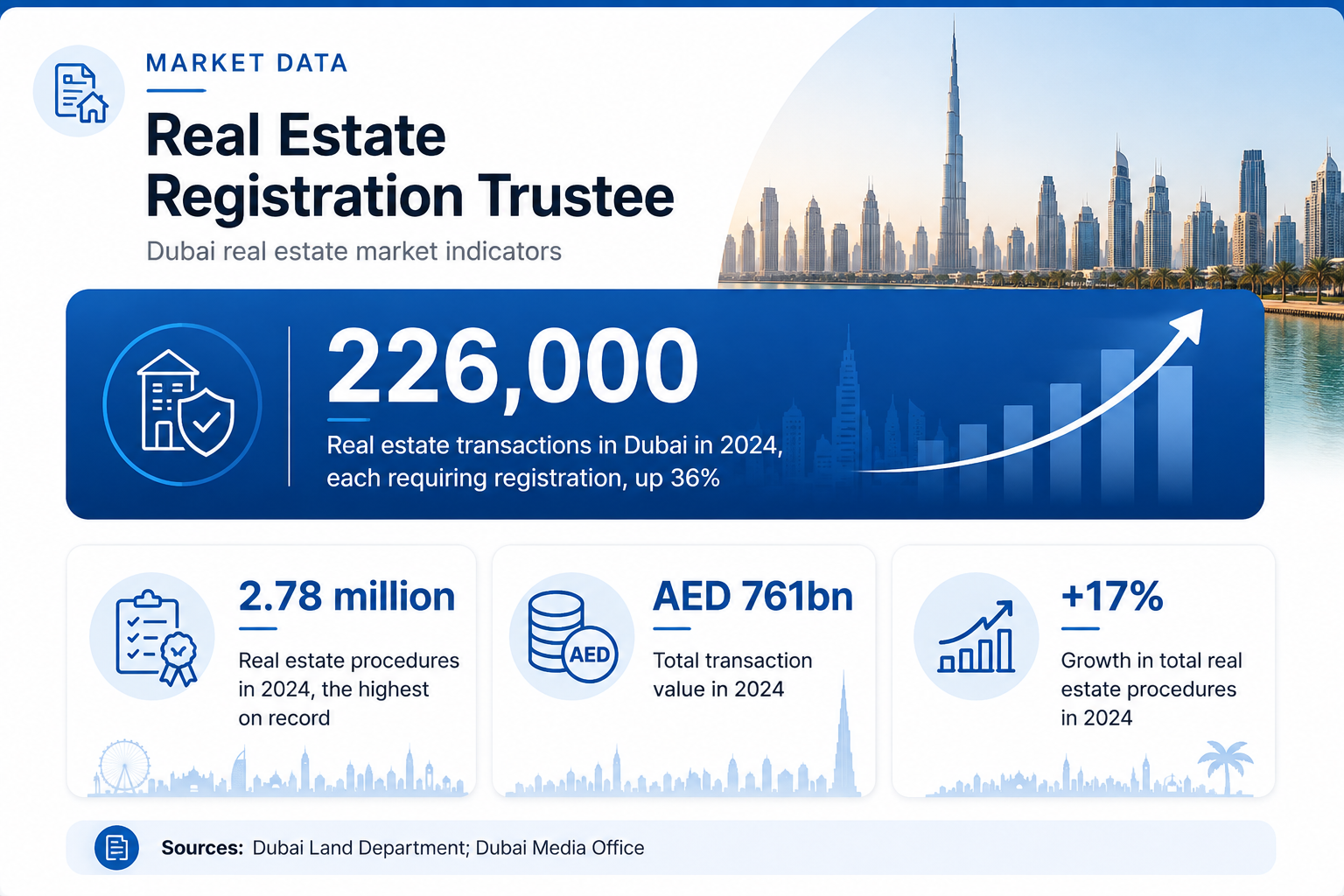
Dubai recorded 133,134 individual property transactions in 2023, with total transaction value exceeding AED 528 billion, according to the Dubai Statistics Center and Invest in Dubai. Every one of those transactions required formal registration through a licensed trustee.

Demand has been growing, driven by off-plan sales growth, new developer launches, master community expansions, and increased foreign buyer participation. Each of these trends sustains high registration volumes across both Oqood and title deed categories.

Institutional clients — including mortgage lenders, property developers, and conveyancing law firms — provide the most commercially consistent pipeline, generating volume-based workflow rather than individual transactions.

Who are the typical clients of a Real Estate Registration Trustee

Clients span both institutional and private categories. Institutional clients include property developers registering bulk off-plan sales, mortgage lenders registering charges against properties, and conveyancing law firms routing completed sales through trustee offices.

Private clients include individual buyers and sellers completing ownership transfers. While private transactions are numerous, institutional relationships are generally more commercially attractive due to the volume and repeatability of the work they generate.

Building strong relationships with developers and mortgage lenders early is a common strategy for establishing a consistent and scalable workflow.

What are the VAT obligations for a Real Estate Registration Trustee business in Dubai

VAT registration with the Federal Tax Authority (FTA) is required once annual turnover reaches the mandatory threshold of AED 375,000. Given the fee-based revenue model of trustee services, most active operators are likely to reach this threshold relatively quickly.

Trustee businesses collect fees on behalf of the DLD as part of their processing function, so it is important to understand which revenue streams are VAT-applicable and how fee pass-throughs are treated under UAE VAT regulations. Professional tax advice specific to this activity is recommended during setup.

Why use a free zone licence such as Meydan Free Zone to set up this business

A free zone trade licence serves as the commercial vehicle — the legal entity through which the business operates. Meydan Free Zone is one of the routes available for licensing this activity under code 7490.9 in Dubai.

The free zone licence provides the formal business structure required before applying for DLD accreditation. Without an established legal entity, the DLD accreditation process cannot be initiated. The two steps — licence issuance and DLD accreditation — are sequential rather than simultaneous.

Free zone structures can also offer advantages in terms of setup speed, ownership flexibility, and administrative processes, making them a practical starting point for professional services businesses entering the Dubai market.

How to Start a Real Estate Registration Trustee Business in Dubai

Dubai's property market transacted over AED 528 billion in 2023, and every title deed, mortgage registration and ownership transfer runs through a licensed Real Estate Registration Trustee. This is not a peripheral role. It is a mandatory step in the transaction chain, governed directly by the Dubai Land Department.

This guide covers what the activity involves, why the trade license is only half the picture, who instructs the work, and how to license it correctly through Meydan Free Zone.

Key Stats at a Glance

Activity code7490.9, Professional and Technical Services (Other)
What it coversTitle deed transfers, mortgage registrations, Oqood off-plan registrations and ownership amendments
Nature of the roleProcedural and compliance-driven, not advisory or brokerage
Second approvalDLD accreditation is mandatory and separate from the trade license
SequenceTrade license first, DLD accreditation second, applied for after issuance
Market sizeOver AED 528 billion in Dubai real estate transactions recorded in 2023 – Invest in Dubai
Transaction volume133,134 individual property transactions registered in Dubai in 2023 – Dubai Statistics Center
Off-plan shareOff-plan sales accounted for over 60% of residential transactions in 2023
VATMandatory once annual turnover reaches AED 375,000 – Federal Tax Authority
Anti-money launderingProperty transactions are a designated non-financial business category – UAE Government Portal

What This License Covers

Infographic: How to Start a Real Estate Registration Trustee Business in Dubai

A Real Estate Registration Trustee acts as an authorised intermediary between buyers, sellers and the Dubai Land Department. The role is procedural and compliance-driven rather than advisory or brokerage-based: trustees process the formal paperwork that turns a sale agreement into a legally registered ownership transfer.

Core functions are title deed transfers, mortgage registrations, Oqood off-plan registrations and ownership amendments. Each one requires the trustee to verify documents, collect fees on behalf of the DLD, and submit completed applications through the DLD system.

Activity code 7490.9 sits within professional and technical services, distinct from real estate brokerage, which needs a RERA license, and from valuation services. The distinction matters for licensing: you are not selling property, you are processing its legal transfer.

Who Your Clients Will Be

The work splits between institutional and private, and the two behave very differently.

  • Property developers registering bulk off-plan sales
  • Mortgage lenders registering charges against properties
  • Conveyancing law firms routing completed sales through trustee offices
  • Private buyers and sellers completing ownership transfers

Private transactions are numerous but arrive one at a time. Institutional relationships are the commercially attractive ones because they generate volume-based workflow rather than individual jobs, which is why building relationships with developers and mortgage lenders early is the standard route to a scalable pipeline.

Off-plan work is the clearest example. Oqood is the DLD's registration system for off-plan sales, and when a developer sells an off-plan unit the transaction must be registered through Oqood before a title deed can eventually be issued to the buyer. That creates a two-stage trustee step on every off-plan transaction: an Oqood registration at the point of sale and a title deed transfer on completion. Developers with high off-plan volumes therefore generate consistent, repeatable registration work rather than one-off instructions.

Mainland or Free Zone

FactorMainland (DET)Free Zone (Meydan Free Zone)
Role of the licenseCommercial vehicleCommercial vehicle under activity code 7490.9
DLD accreditationStill needed to process registrationsStill needed to process registrations
Physical officeSet by DETNot mandatory at license stage, but DLD wants a compliant location
Setup speedStandard DET routeTypically a few business days, completable remotely
OwnershipSet by DET rules for the activityFree zone ownership flexibility

Let your clients decide it, not the price. The point to grasp is that neither route is enough on its own. The trade license establishes the legal entity, and DLD accreditation is the operational permit that lets you actually process registrations. The two steps are sequential rather than simultaneous, because the DLD accreditation process cannot begin until a legal entity exists.

[blockCTACostCalculator]

Step by Step Setup Guide

  • Step 1, select the professional services category: Register under activity code 7490.9 and specify the Real Estate Registration Trustee activity.
  • Step 2, book your trade name and send in documents: Passport copies for all shareholders and directors, Emirates ID if you are already a UAE resident, a no-objection letter if you are currently employed under a UAE visa, and a business plan setting out your trustee services scope and intended client base.
  • Step 3, take your license: Issuance is typically within a few business days, and the process can be completed remotely. No physical office is mandatory at this stage, which keeps the opening capital down.
  • Step 4, apply to DLD for trustee accreditation: Submit the issued license, staff credentials, office details and indemnity insurance documentation.
  • Step 5, wait on DLD timelines: DLD processing runs to its own schedule and cannot be accelerated by the free zone, so build that into your launch plan rather than assuming the license date is your start date.

Compliance and What You Need in Place

DLD accreditation is not optional

You cannot operate as a trustee on a trade license alone. Accreditation is the operational permit, and DLD applies fit-and-proper criteria to applicants covering qualified and trained staff, a compliant physical office location, and adequate professional indemnity insurance. Note the tension worth planning around: no physical office is needed to get the license, but DLD will want one, so budget for premises even though the license stage does not force it.

Anti-money laundering

Property transactions are a designated non-financial business category under UAE AML frameworks. Trustees must run customer due diligence, keep transaction records and file suspicious transaction reports where applicable. Given that you are handling ownership transfers and collecting fees, this is central to the operation rather than peripheral.

VAT and fee pass-throughs

Registration with the Federal Tax Authority is required once annual turnover reaches the AED 375,000 threshold, which most active operators will pass within their first operating year given the fee-based model. There is a wrinkle specific to this activity: trustees collect fees on behalf of the DLD as part of the processing function, so work out which revenue streams are VAT-applicable and how those pass-throughs are treated before you start invoicing. Take tax advice specific to trustee work at setup.

Staff and insurance

Because DLD assesses staff credentials and indemnity cover as part of accreditation, hiring and insurance are regulatory matters here, not just operational ones. Get both in place before you submit the accreditation pack.

Market Opportunity

The baseline demand is unusually easy to quantify. Dubai recorded 133,134 real estate transactions in 2023, and every one required formal registration through a licensed trustee. Total transaction value exceeded AED 528 billion. That is not a forecast or a market estimate, it is a count of work that had to pass through somebody holding this accreditation.

The direction of travel adds to it. Off-plan sales growth is the particular driver, with new developer launches, master community expansions and increased foreign buyer participation all sustaining high Oqood registration volumes, and off-plan accounting for over 60% of residential transactions in 2023. Because each off-plan unit needs both an Oqood registration and a later title deed transfer, that share of the market generates roughly double the trustee touchpoints of a completed-property sale. Institutional clients sit on top of that: mortgage lenders registering charges, developers registering bulk sales, and conveyancing firms routing completed transactions all produce volume rather than one-off work.

Conclusion

A Real Estate Registration Trustee license puts you at the operational core of Dubai's property market. Every transaction needs one, volumes are rising, and institutional clients provide predictable recurring revenue.

The regulatory path is clear and strictly ordered: Meydan Free Zone license first, DLD accreditation second. Three things decide how well it goes: premises and indemnity insurance arranged for the accreditation stage rather than the license stage, developer and lender relationships built early for volume work, and a VAT position that handles DLD fee pass-throughs correctly from the first invoice.

[blockCTAContact]

References

On-Demand Video
Live Chat
Call Us
WhatsApp