
Table of Contents
Topic Summary
UAE Securities Market Has Grown Beyond Shares
UAE exchanges now list equity and bond ETFs, real estate investment trusts, derivatives, green bonds, and Shariah-compliant instruments alongside traditional company stocks. This product diversity gives local securities brokers a far wider range of instruments to execute orders across.
ETF Market Signals Strong Brokerage Opportunity
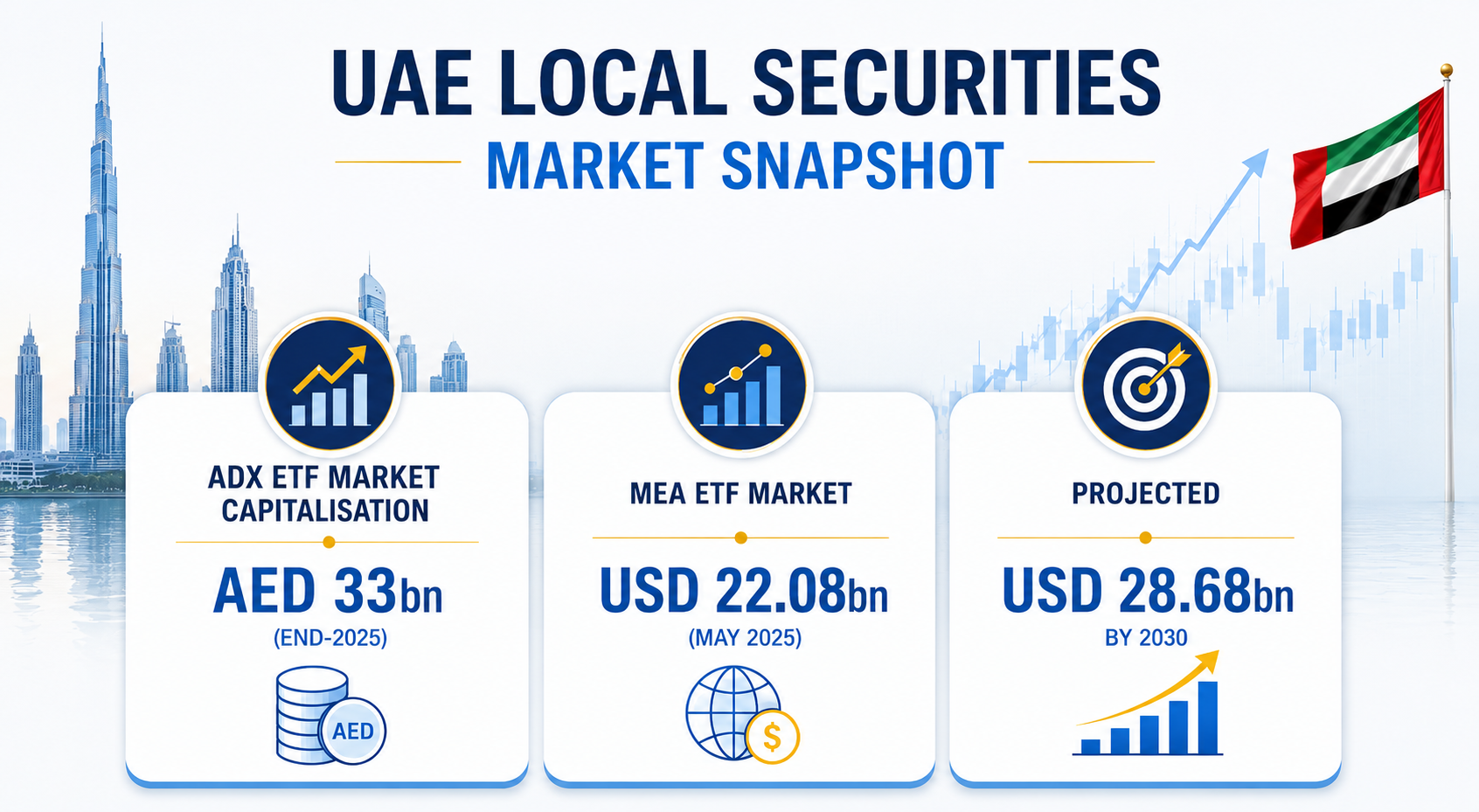
The Middle East and Africa ETF market reached USD 22.08 billion by May 2025 and is projected to grow to USD 28.68 billion by 2030. On the Abu Dhabi Securities Exchange alone, ETF market capitalisation climbed to AED 33 billion by the close of 2025.
A Widening Buyer Base Drives Demand
UAE investors now include first-time retail participants, institutional asset managers, and family offices building multi-instrument portfolios. This broadening demand creates sustained need for brokers capable of serving diverse client types and investment goals.
Shariah-Compliant Brokerage Is a Distinct Niche
A dedicated segment of UAE investors, funds, and institutions requires execution exclusively in Shariah-compliant listed instruments. Brokers specialising in this area serve a principled and growing client base that mainstream bank-affiliated brokers may not fully address.
Bank Brokers Dominate, Leaving Room for Specialists
Most order flow in the UAE currently routes through a small cluster of bank-affiliated brokers. This concentration leaves the specialist and multi-instrument execution layer with meaningful room to grow for independent entrants.
Meydan Free Zone Offers a Cost-Efficient Base
Meydan Free Zone provides 100% foreign ownership, zero percent corporate tax on qualifying income, full profit repatriation, and a fully digital licensing process. These conditions make it a practical and regulated starting point for launching a local securities brokerage.
Activity Code 6612.99 Covers the Full Instrument Range
Under business activity code 6612.99, a licensed broker can execute client buy and sell orders across UAE-listed equities, ETFs, listed funds, REITs, derivatives, and Shariah-compliant instruments. The broker acts as a regulated intermediary earning commissions, not trading on its own account.
How to Start a Local Securities Brokerage Business in Dubai
By the end of 2025, the exchange-traded funds listed on the Abu Dhabi Securities Exchange were worth AED 33 billion between them. A decade ago, that segment barely existed.
UAE exchanges today list far more than company shares: index funds, real estate trusts, listed derivatives, and Shariah-compliant products all trade alongside them, and local securities brokerage is the activity that connects clients to the full range.
The exchange-traded funds market across the Middle East and Africa reached USD 22.08 billion by May 2025 and is projected to grow to USD 28.68 billion by 2030, according to Standard Chartered¹. On the Abu Dhabi Securities Exchange alone, ETF market capitalisation climbed to AED 33 billion by the close of 2025, according to Policybazaar².
The growth runs in parallel with rising listed product variety: UAE exchanges now host equity and bond ETFs, real estate investment trusts, derivatives, green bonds, and a deep roster of Shariah-compliant instruments.
Free Business Setup Cost Calculator
Calculate NowA Local Market That Is No Longer Just Shares
The instruments listed on UAE exchanges have multiplied. What was once a market of company stocks now carries funds, trusts, and derivatives, and the brokers who serve it have a far wider product set to work with.
Sources: Standard Chartered (2025); Policybazaar (2026).
The demand is broadening, not just growing. UAE investors are no longer only buying company shares; they want index funds for diversification, real estate trusts for property income, and Shariah-compliant instruments that match their principles.
The buyer base is widening alongside the product set: a large and growing resident population, retail investors entering the market for the first time, institutional treasuries and asset managers tracking local indices, and family offices building multi-instrument portfolios. The exchange-traded fund segment alone grew into a multi-billion dirham market in only a few years².
Most order flow still routes through a small cluster of bank-affiliated brokers, leaving the specialist and multi-instrument execution layer with real room to grow.
From index funds and real estate trusts to listed derivatives and Shariah-compliant products, the UAE local securities market rewards brokers built to serve a widening instrument range.
Free Company Name Check
Check NowWho is this for?
- Multi-instrument securities brokers: Firms executing client orders across the full range of UAE-listed securities, including shares, exchange-traded funds, listed funds, and real estate investment trusts.
- ETF and index product brokers: Brokers focused on connecting clients to UAE-listed exchange-traded funds and index products tracking local and regional benchmarks.
- Shariah-compliant securities brokers: Operators executing client orders in Shariah-compliant listed instruments, serving Islamic investors, funds, and institutions seeking compliant local exposure.
Meydan Free Zone offers 100% foreign ownership, zero percent corporate tax on qualifying income, full profit repatriation, and a fully digital licensing process, providing a regulated and cost-efficient base from which to operate as a securities broker on the UAE's growing local exchanges.
Business Activities List
Explore Over 2,500+6612.99 - Brokerage in Local Securities
Under this activity, you are licensed to execute buy and sell orders across the range of securities listed on UAE exchanges, on behalf of clients. The activity covers locally listed equities, exchange-traded funds, listed investment funds, real estate investment trusts, listed derivatives, and Shariah-compliant instruments.
The broker is the regulated intermediary connecting clients with UAE exchanges, earning commissions and execution fees, not dealing on its own account.
| Service | Description |
|---|---|
| Listed Equity and Fund Brokerage | Execution of client orders in equities and listed investment funds traded on UAE exchanges, providing investors with access to local company shares and pooled vehicles. |
| Exchange-Traded Fund Brokerage | Execution of client orders in UAE-listed exchange-traded funds tracking local, regional, and sector indices, giving clients diversified exposure through a single listed instrument. |
| REIT and Listed Derivatives Brokerage | Brokerage in UAE-listed real estate investment trusts and exchange-traded derivatives, on behalf of investors seeking property income and risk management exposure. |
| Shariah-Compliant Securities Brokerage | Execution of client orders in Shariah-compliant listed instruments, including compliant exchange-traded funds and listed investment products, for Islamic investors and institutions. |
| Category | Details |
|---|---|
| Market Growth | ETF market capitalisation on the Abu Dhabi Securities Exchange reached AED 33 billion by the end of 2025², part of a Middle East and Africa ETF market worth USD 22.08 billion¹. |
| Who Is Buying | Retail investors entering the market, a large resident population, institutional treasuries and asset managers tracking local indices, and family offices building multi-instrument portfolios. |
| Regulatory Anchor | The Securities and Commodities Authority (SCA) licenses all brokers operating in UAE-listed securities, requiring trading membership, capital adequacy, and audited compliance. This sub-activity is exempt from AML registration. |
| Instrument Breadth | UAE exchanges now list equities, exchange-traded funds, real estate investment trusts, listed derivatives, green bonds, and a deep roster of Shariah-compliant instruments. |
There are clear boundaries on this activity. Local securities brokerage does not cover dealing in securities on own account, which falls under a separate financial intermediation classification. It excludes portfolio management on a fee or contract basis. It also excludes brokerage in commodities and currencies, and brokerage in securities listed on foreign markets, each of which is licensed separately.
The line is precise. If your business executes client orders in securities listed on UAE exchanges, you are in. If you deal with your own book, manage discretionary portfolios, or broker foreign-listed securities, commodities, or currencies, you are not.
Compliance
THIRD-PARTY APPROVAL
This activity requires Initial approval from the Capital Market Authority (CMA) before a business license can be issued by Meydan Free Zone.
ANTI-MONEY LAUNDERING COMPLIANCE
This business activity is exempt from AML compliance requirements.
Footnotes
¹ Standard Chartered. Your Guide to Investing in Exchange-Traded Funds in the UAE. Standard Chartered, 2025.
² Policybazaar. Exchange Traded Funds: Meaning, Best ETFs 2026 and How to Invest from UAE. Policybazaar, 2026.