
Table of Contents
Frequently Asked Questions
What activity code covers a first aid training center in Dubai
First aid training centers in Dubai operate under activity code 8549.90, which covers education and training not classified elsewhere under standard industry classifications. It sits within the specialised vocational instruction category rather than academic education.
Despite being a training business, it is regulated more tightly than general skills training because of its direct health and safety implications, triggering both commercial licensing and health authority oversight.
Which regulatory bodies must approve a first aid training center in Dubai
Two primary bodies are involved. The Dubai Health Authority (DHA) must accredit any health-related training entity operating in Dubai — this includes programme registration, curriculum submission, and a physical facility inspection. The Ministry of Health and Prevention (MOHAP) sets the federal standards that your curriculum and instructor qualifications must meet before the DHA application can proceed.
On the commercial side, you also need a trade licence from either the Department of Economic Development (DED) for mainland operations or the relevant free zone authority if you choose a free zone structure.
What instructor qualifications are required to operate a first aid training center
Instructors must hold recognised international certifications such as PHTLS (Pre-Hospital Trauma Life Support), BLS (Basic Life Support), or equivalent internationally accredited programmes. These qualifications must align with MOHAP federal standards.
Because accepted qualifications can be updated by the DHA, it is strongly recommended that you verify the current accepted list directly with the DHA before making any hiring decisions to avoid delays in your accreditation application.
What physical premises requirements does DHA impose on a first aid training center
Your facility must include a dedicated training room with adequate space for practical simulations, such as CPR and AED operation exercises. This is not a paper requirement — the DHA conducts a physical inspection of the premises before granting clearance to operate.
Founders should factor fit-out costs and inspection timelines into their setup plan, as you cannot begin trading until the facility inspection is passed and DHA approval is issued.
Should a first aid training center be set up on the mainland or in a free zone
Mainland licensing through the DED allows direct contracts with government entities and corporates across the UAE without restrictions, making it the stronger commercial position for a centre targeting large B2B clients such as construction companies, hospitals, and hotel groups.
Free zones such as Meydan offer cost-efficient setup and 100% foreign ownership, but DHA approval pathways for health-adjacent activities and the breadth of client access must be confirmed before committing. A free zone licence does not automatically provide the same market access as a mainland licence. Some founders start in a free zone and add a mainland branch as revenue scales.
What are the main revenue streams for a first aid training center in Dubai
The core revenue model includes per-head training fees, group corporate contracts, and annual retainer agreements. Key training programmes cover CPR, AED operation, and paediatric first aid, among others.
A particularly durable commercial feature is that first aid certifications expire every one to two years, meaning every client trained becomes a renewal prospect. This creates compounding recurring revenue from an existing client base without constant new business acquisition.
Who are the typical clients for a first aid training center in Dubai
Demand is primarily institutional and compliance-driven. Target clients include construction firms, hospitality groups, schools, retail businesses, healthcare facilities, and government entities — any sector with regulatory obligations under UAE occupational safety frameworks.
Dubai's mandatory workplace safety regulations mean corporate and government clients must train staff on a recurring basis, providing consistent, predictable demand rather than discretionary spending.
When does a first aid training center in Dubai need to register for VAT
VAT registration with the Federal Tax Authority (FTA) becomes mandatory once annual turnover reaches AED 375,000. Given the institutional client base and group contract model typical of this business, many centres will reach this threshold relatively quickly.
Founders should account for VAT obligations in their pricing and contract structures from the outset, particularly when negotiating multi-year corporate or government retainer agreements.
Open a First Aid Training Center in Dubai
Dubai's rapid population growth, mandatory workplace safety rules, and a construction sector that never stops mean demand for accredited first aid training is structural, not seasonal. Every new building site, school, hotel, and hospital needs certified staff. That need does not go away.
This guide covers the license you need, how to choose between mainland and free zone setup, and what compliance looks like once you are operating.
Key Stats at a Glance
| Regulator | Dubai Health Authority (DHA) for local approval; Ministry of Health and Prevention (MOHAP) for national standards |
|---|---|
| Core activities covered | CPR, basic life support, workplace first aid, paediatric first aid |
| License issuing authority | Dubai Department of Economy and Tourism (DET) for mainland; Meydan Free Zone for free zone |
| DHA approval required | Yes – mandatory before you deliver any accredited course |
| Trainer qualification standard | Internationally recognised instructor certification (Red Cross, HABC, or equivalent) |
| Renewal cycle | Annual – DHA approval and trade license |
What the License Covers and Who Regulates It
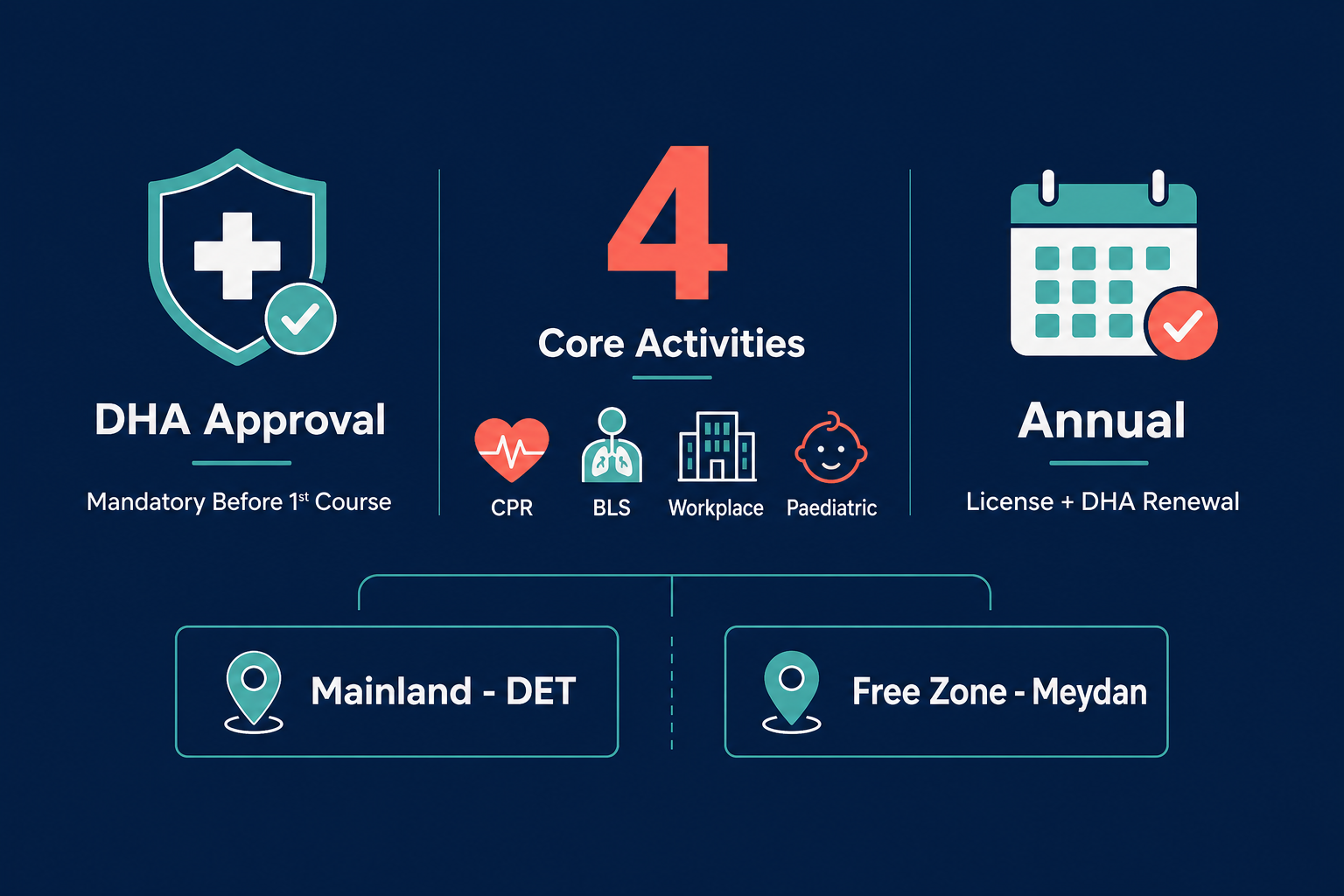
The Dubai Health Authority is the gate you must pass through before you deliver any accredited first aid course in Dubai. Without DHA approval, your certificates carry no legal weight, and employers will not accept them. Getting your trade license sorted first and DHA approval second is the right order. Reversing it wastes time.
The permitted scope under a first aid training center license covers CPR, basic life support, workplace first aid, and paediatric first aid. You can also add advanced resuscitation modules if your trainers hold the right credentials. What you cannot do under this license is supply first aid kits, AED units, or medical equipment as a commercial activity. That is a separate trade activity with its own code. If you want to sell equipment alongside training, you need both codes registered from the start.
Who sets the rules
MOHAP sets national training standards for health-related education across the UAE. DHA enforces those standards locally in Dubai. In practice, DHA is the body you deal with for approvals, inspections, and renewals. MOHAP matters when you are aligning your curriculum to nationally recognised benchmarks, which affects whether your certificates are accepted outside Dubai.
Accreditation and curriculum
DHA wants to see a documented curriculum before it approves your center. That means lesson plans, assessment methods, pass criteria, and evidence that your instructors hold valid, internationally recognised qualifications. Red Cross, HABC, and Resuscitation Council UK are all accepted. Generic in-house certificates are not. Build your curriculum around a recognised framework from the beginning. Retrofitting it later is slow and expensive.
Mainland vs Meydan Free Zone: Which Setup Works for You
This is the biggest choice you will make when setting up. Let your clients decide it, not the cost.
A mainland license from DET lets you work directly with UAE government bodies, public schools, government hospitals, and construction companies on government contracts. If your target market is corporate Dubai, including large employers with legal compliance duties, a mainland setup gives you the widest access. Most first aid training businesses serving the B2B Dubai market choose mainland for exactly this reason.
A Meydan Free Zone setup works well if you are targeting corporate clients who do not require government-approved vendor status, delivering internationally certified programmes, or running online and hybrid training for regional markets. Free zone companies can still serve private sector clients in Dubai, but direct government contracting needs a mainland entity or a local commercial agent arrangement.
| Factor | Mainland (DET) | Free Zone (Meydan Free Zone) |
|---|---|---|
| Client access | Open UAE market including government | Mainly private sector and international clients |
| Office requirement | Physical premises required for DHA approval | Flexi-desk options available for admin; training space still needed for DHA |
| Foreign ownership | 100% in most activity categories | 100% |
| DHA approval pathway | Direct application through DHA portal | Same DHA process applies regardless of jurisdiction |
| Visa allocation | Based on office space and activity | Package-based; scales with your plan |
| Setup cost | Typically higher due to office requirements | Lower entry cost; trade license from AED 12,500 |
One thing both jurisdictions share: DHA approval is mandatory whatever your license structure. The authority does not distinguish between mainland and free zone operators when it comes to health facility standards. Your training room, your kit, and your trainers all need to meet the same criteria.
Free Business Setup Cost Calculator
Calculate NowStep-by-Step Setup Guide
- Step 1, book your trade name: Use the DET e-Services portal for a mainland company, or the Meydan Free Zone portal for a free zone one. Check your company name availability before you go further. Names with medical or health terminology sometimes need pre-approval.
- Step 2, select your activity code: Confirm the code covers first aid training specifically. If you plan to supply equipment as well as deliver training, add the relevant supply activity at this stage. Changing codes after initial approval adds time and cost.
- Step 3, get initial approval: Submit your application to DET or Meydan Free Zone. This is the trade license approval, not the DHA approval. Both are needed. Neither replaces the other.
- Step 4, apply to DHA for health facility or training center approval: Submit trainer credentials, your full curriculum, and your premises details. DHA will review the documentation before it inspects the physical space. Incomplete submissions are the main reason this step takes longer than expected.
- Step 5, sign your lease and fit out the training room: DHA sets minimum space requirements. Your room needs adequate floor area for practical exercises, proper ventilation, and the right kit including AED training units and manikins. Check the current DHA fit-out guidelines before you commit to a space.
- Step 6, register with MOHRE before hiring staff: The Ministry of Human Resources and Emiratisation (MOHRE) registration must be in place before you bring on any employees. Trainers need valid, internationally recognised first aid instructor qualifications. Verify each trainer's credentials against DHA's accepted list before you hire.
- Step 7, pass the DHA inspection: An inspector visits your premises to check the space, the kit, and your documentation. If everything is in order, DHA issues its approval and you can begin operating.
- Step 8, get your trade license issued and start marketing: Once DHA approval is confirmed, your trade license is finalised. You can now market courses, issue certificates, and sign corporate training contracts.
If you are setting up from outside the UAE and want to manage the early stages remotely, Meydan Free Zone supports remote business setup so you can get the trade license sorted before you arrive in person for the DHA inspection.
Compliance, Staffing, and Ongoing Duties
Getting the license is the start. Keeping it is the ongoing work.
DHA renewal
DHA approval runs on an annual cycle. If your trainer credentials expire or your curriculum falls out of line with current standards, DHA can lapse your approval. That means you cannot issue valid certificates until it is reinstated. Build credential renewal dates into your internal calendar. Do not wait for a reminder from the authority.
Trainer qualifications
Every instructor delivering accredited courses must hold a current, internationally recognised first aid instructor qualification. DHA checks this at renewal as well as at the initial inspection. If a trainer's certification lapses, they cannot deliver courses until it is renewed. Keep copies of all trainer certificates on file and set renewal alerts at least three months out.
Record-keeping
DHA can audit your records at any point. You need to keep participant registers, assessment results, and certificate logs in a format that can be produced on request. Digital records are fine as long as they are complete and backed up. Missing or incomplete records are treated as a compliance failure, not an administrative oversight.
Emiratisation
MOHRE rules on Emiratisation apply once your headcount crosses the relevant threshold. Check the current rules for your business size before you hire. The threshold and the quota percentage are updated periodically, so check the MOHRE portal for the current figures rather than relying on older guidance.
VAT and corporate tax
If your annual turnover reaches the registration threshold, you need to register for VAT with the Federal Tax Authority. Educational services have specific VAT treatment in the UAE, so check whether your courses qualify for zero-rating or standard-rating. The Federal Tax Authority publishes guidance on this. Corporate tax at 9% applies to taxable income above AED 375,000. Get your accounting set up properly from the start. Meydan Free Zone's mAccounting service can handle VAT registration support and ongoing compliance if you do not want to manage it in-house.
Market Opportunity and Your Client Base
UAE labour law requires employers across construction, hospitality, and healthcare to maintain first aid provision on site. That is not a preference. It is a legal duty. Every company in those sectors needs trained staff, and most of them need refresher training every one to two years. That creates a recurring corporate market that does not depend on economic cycles.
Sectors with the highest demand
Construction is the largest single market. Dubai's infrastructure pipeline keeps site numbers high, and each site needs a minimum number of trained first aiders relative to its workforce. Hospitality is close behind. Hotels, restaurants, and event venues all need certified staff. Healthcare facilities need first aid training for non-clinical staff. Schools and nurseries need certified teachers and support staff to meet Knowledge and Human Development Authority (KHDA) requirements. Sports clubs and fitness facilities need certified coaches and trainers to meet Dubai Sports Council standards.
Corporate vs individual training
Group corporate sessions are your most efficient revenue model. A single booking covers ten to twenty participants, and the employer pays for the whole group. Individual certification courses have lower revenue per session but build your public profile and feed referrals. Many operators run both. Price corporate sessions per head with a minimum group size, and price individual courses as open enrolment.
Online and hybrid delivery
DHA permits blended learning for the theoretical components of first aid training, provided the practical assessment is done in person. That opens up a hybrid model where you deliver theory online and run practical sessions at your center or at the client's premises. This is particularly useful for large employers who want to train staff across multiple sites without moving everyone to a central location.
Community and public health programmes
Dubai has active public health targets around community CPR awareness. Government-backed campaigns periodically create demand for mass training events. Positioning your center as a delivery partner for these programmes builds visibility and generates volume bookings outside your normal corporate pipeline.
Conclusion
A first aid training center in Dubai is a regulated but workable business with steady demand from employers who have no choice but to comply. The DHA approval process is the part that takes time. Plan for it, prepare your documentation properly, and the rest of the setup is manageable.
The most common mistake is treating DHA approval as something to sort out after the trade license is issued. Start both processes in parallel. Make sure your activity code and jurisdiction are aligned before you approach DHA, so there are no surprises when the inspector arrives.
Talk to Meydan Free Zone about the right license structure before you approach DHA. Getting the setup right from day one saves time and avoids the cost of correcting it later. You can also use the cost calculator to get a clear picture of your setup costs before you commit.
Ready to Launch Your Business in Dubai?
Let's ConnectCompliance
THIRD-PARTY APPROVAL
This activity requires pre-approval from the Dubai Corporation for Ambulance Services (DCFAS) / Dubai Health Authority (DHA) before a business license can be issued by Meydan Free Zone.
ANTI-MONEY LAUNDERING COMPLIANCE
This business activity is exempt from AML compliance requirements.