
Table of Contents
Topic Summary
Understand What Activity Code 4711.95 Covers
This license authorizes the retail sale of whole and ground food products — including spices, grains, coffee beans, and herbs — with customer-facing grinding operations on the premises. The defining feature is the combination of product and service at the same counter, such as grinding cumin to a customer's preferred coarseness on the spot.
Know Your Three Core Operating Models
Traditional grinding shops serve multicultural households in established commercial areas, while modern specialty formats use branded positioning in malls and premium locations. Multi-location operations standardize quality across several catchments and can serve restaurants and wholesale buyers alongside walk-in trade.
Target the Right Customer Segments Early
Households from Indian subcontinent, Arabic, Iranian, East African, and Southeast Asian communities each have specific grinding and spice needs that packaged supermarket products cannot easily satisfy. Restaurants buying ground spice in volume to their own specification become high-value repeat accounts rather than one-off transactions.
Get Dubai Municipality Approval After Licensing
Unlike most regulated activities, the required third-party approval for a grinding shop comes after the trading license is obtained, not before. This Dubai Municipality approval applies to the retail operation regardless of whether you set up on the mainland or in a free zone.
Weigh Mainland Against Meydan Free Zone Setup
A mainland setup through DET allows direct shopfront retail to the public but applies a 9% corporate tax above AED 375,000 in taxable income and may limit foreign ownership. Meydan Free Zone offers 100% foreign ownership and zero corporate tax on qualifying income, making it better suited to wholesale, sourcing, or online models rather than walk-in retail.
Capitalize on a Growing UAE Retail Market
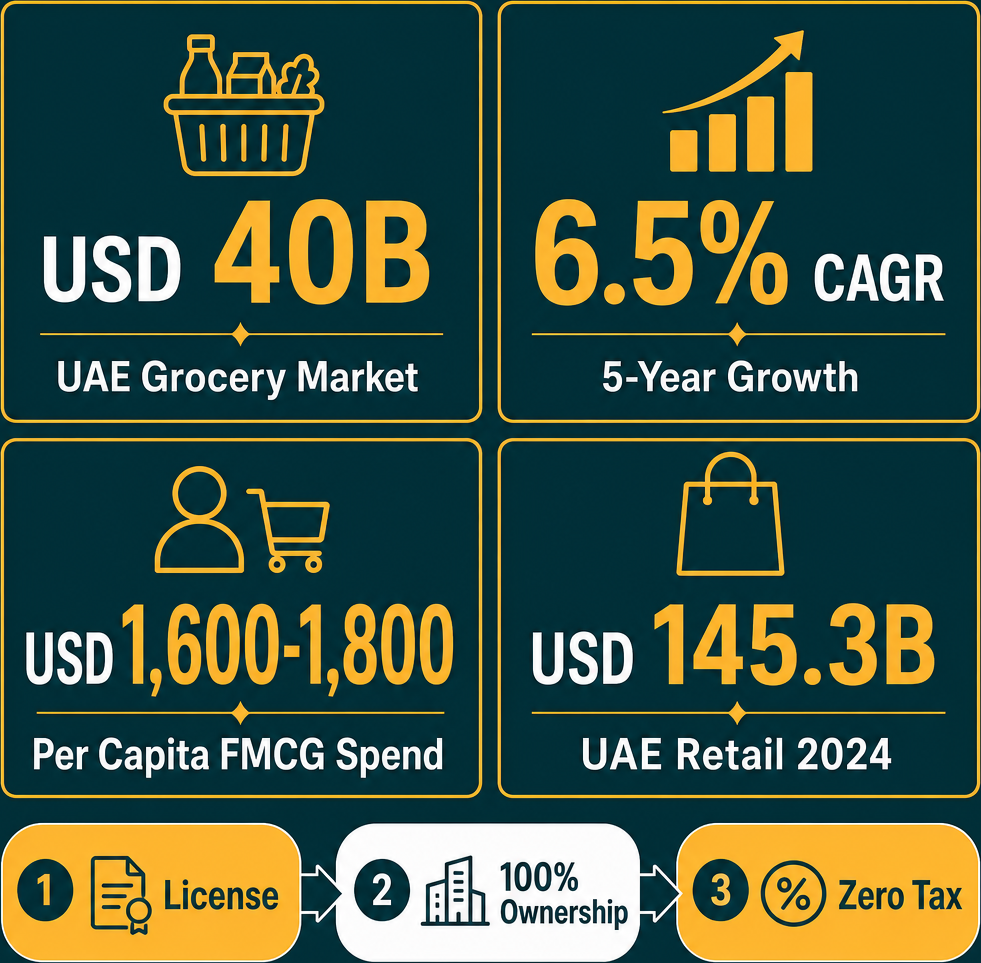
UAE grocery retail is valued at around USD 40 billion and growing at a 6.5% CAGR over the next five years, while the broader retail market is projected to reach USD 227.1 billion by 2033. Per capita FMCG spend is estimated at USD 1,600 to USD 1,800 in 2026, signaling strong and sustained consumer demand.
Plan Premises and Scaling Strategy from Day One
A grinding shop is a physical retail business requiring a counter, grinding equipment, and registered commercial premises — a mainland retail unit with an Ejari tenancy is the standard setup. Building toward wholesale buyers and multiple locations is what converts a single shop into a scalable business.
How to Start a Grinding Shop Business in Dubai with Meydan Free Zone
Walk through Deira or Meena Bazaar and you pass shops where cardamom, cumin and coffee beans are ground to order while the customer waits. It is one of the UAE's most distinctive retail formats. Activity code 4711.95 is the license for running one.
This guide covers what the license allows, who shops with you, the approval you need, and the steps to get set up. One approval applies here, and unusually it comes after the license rather than before it.
Key Stats at a Glance
What This License Covers
Code 4711.95 covers grinding shop retail: the sale of whole and ground food products, including spices, grains, coffee beans and herbs, with customer-facing grinding operations on the premises.
The format sits within food-predominant non-specialised retail, and its defining feature is the combination. You are selling a product and a service at the same counter, because a customer buying whole cumin and having it ground to their preferred coarseness is buying both. Three operating models sit inside the code. Traditional grinding shops work from established commercial areas serving multicultural households.
Modern specialty formats use branded positioning and curated ranges in malls, residential districts and premium locations. Multi-location operations run standardised grinding and product quality across several catchments, serving restaurants and wholesale buyers alongside walk-in trade.
One thing sits outside: retail sale of fuel combined with food and beverages where fuel dominates, which falls under retail sale of automotive fuel.
Who Your Customers Will Be
Households first, and the UAE's demographic mix is the whole commercial argument.
Indian subcontinent, Arabic, Iranian, East African and Southeast Asian communities each bring cooking traditions with specific needs, and those needs are not interchangeable. The coarseness of a coffee grind, the freshness of a spice blend and the availability of a particular grain all matter to a cook who knows what they are doing. That is demand a supermarket aisle cannot easily serve, because packaged pre-ground product is a compromise for all of these customers at once.
Restaurants are the second group and the higher-value one. A kitchen buying ground spice in volume, to its own specification, becomes a repeat account rather than a transaction. Wholesale buyers form a third stream that suits operators with multiple locations or larger grinding capacity, and building toward them is what turns a single shop into a business that scales.
Mainland or Free Zone
A grinding shop is a physical retail business with a counter, a machine and customers walking in, so a mainland license from the Department of Economy and Tourism is the practical route for the shop itself.
Meydan Free Zone gives you full foreign ownership, zero corporate tax on qualifying income and a digital setup. It suits a sourcing arm, a wholesale operation supplying other shops, or an online business selling ground-to-order product for delivery.
Location does more of the work than the license does. Traditional commercial areas bring footfall from exactly the communities that buy this way, while a premium mall or residential position brings a different customer at a different price point. Decide which of those you are building before you sign a lease, because the two need different ranges, different fit-outs and different pricing.
[blockCTACostCalculator]
Step by Step Setup Guide
- Step 1, choose your format and location: Traditional commercial area, modern specialty position, or multi-location. This decision drives your range, your fit-out and your customer.
- Step 2, choose your jurisdiction: Mainland through DET for the retail shop, or Meydan Free Zone for sourcing, wholesale or online.
- Step 3, book your trade name: Check availability through the DET portal or the Meydan Free Zone portal, following UAE naming conventions.
- Step 4, submit your setup documents: Passport copies for every shareholder and director, a business plan summary, and an NOC if you hold a UAE residence visa under another sponsor.
- Step 5, secure premises and grinding equipment: The machine is the business. Capacity, noise, dust extraction and cleaning all matter in a customer-facing space.
- Step 6, collect your trading license, then apply to Dubai Municipality: The approval follows the license rather than preceding it, so build that sequence into your opening date.
- Step 7, arrange sourcing and register for VAT: Register with the Federal Tax Authority once taxable turnover passes AED 375,000.
Compliance and What You Need in Place
Dubai Municipality approval
The approval order here is unusual and worth noting. Dubai Municipality approval applies after you get the trading license, not before it. That means the license comes first, but you should not plan an opening date until the municipality step is cleared.
Food handling
You are selling food and processing it on the premises in front of customers. Hygiene standards, equipment cleaning and cross-contamination control are operational conditions rather than paperwork. Grinding chilli and then coffee on an uncleaned machine is a quality failure a customer will notice immediately.
Sourcing breadth
The commercial strength of this format is range. Serving several cultural communities means sourcing across Indian subcontinent, Arabic, East African and Iranian product lines, and a narrow range makes you a worse version of a supermarket rather than a specialist.
Equipment
Grinding machinery is the core asset. Capacity determines whether you can serve restaurant volumes alongside walk-in customers, and dust extraction matters in a space where people are standing and waiting.
AML
This activity is exempt from AML compliance duties.
VAT
Register with the Federal Tax Authority once taxable turnover passes AED 375,000.
Market Opportunity
The grocery backdrop is strong. UAE grocery retail sits at around USD 40 billion and is growing at 6.5% CAGR over the next five years, with specialty and cultural formats continuing to serve the country's diverse demographic base alongside modern trade.
The wider retail picture supports it. UAE retail was valued at USD 145.3 billion in 2024 and is projected to reach USD 227.1 billion by 2033 at 5.1% CAGR, while FMCG per capita spend at USD 1,600 to USD 1,800 in 2026 shows consumers willing to pay for quality rather than simply buying the cheapest option.
What makes this format durable is that it solves a problem scale cannot. Freshness and custom specification are the product, and neither survives a supply chain built around packaged goods. A grinding shop competes on something a hypermarket structurally cannot offer, which is a better defensive position than most small retail formats enjoy.
Conclusion
A grinding shop under code 4711.95 sits in a specialty retail niche that the UAE's demographic mix supports naturally and that large-format grocery cannot easily copy.
The licensing is simple, with one point of sequence to get right: Dubai Municipality approval follows the trading license rather than preceding it, and your opening date depends on it.
The business itself is won on range, freshness and the machine. Sourcing across several culinary traditions, keeping equipment clean between products, and building restaurant accounts alongside walk-in trade are what turn a shop into something that grows. Speak to the Meydan Free Zone team to confirm the right structure for your model.
[blockCTAContact]