
Table of Contents
Topic Summary
Secure Dubai Police Approval Before Anything Else
Several industrial solvents like acetone and toluene fall under controlled-substance monitoring, requiring Dubai Police pre-approval before your trade license is issued. Build this clearance into your timeline early to avoid costly delays in your setup process.
Understand Exactly What License Code 4669.82 Covers
This code authorizes wholesale trading of acetone, toluene, xylene, alcohol solvents, and specialty industrial solvents to UAE manufacturers and formulators. It does not cover blending or manufacturing solvents, retail sales to walk-in buyers, or bulk fuel and petroleum distribution.
Target Paint and Coatings Plants for Volume Business
Paint and coatings manufacturers represent the largest and most consistent customer base, purchasing solvents like acetone, MEK, toluene, and xylene on repeating schedules rather than one-off orders. The UAE paints and coatings market is valued at USD 601 million in 2025 and is projected to reach USD 885 million by 2032.
Pursue High-Purity Grades for the Best Margins
Electronics and pharmaceutical formulators buy high-purity, specification-certified solvents and offer the strongest profit margins of any customer segment. Be prepared for rigorous vetting — these buyers will audit your source documents, grade certificates, and handling chain before placing a first order.
Choose Meydan Free Zone for Ownership and Tax Benefits
Setting up in Meydan Free Zone gives you 100% foreign ownership and zero corporate tax on qualifying income, advantages not available on the mainland. The trade-off is that selling directly to UAE factories requires working through a mainland distributor or agent rather than selling across the local market directly.
Tap Into a Rapidly Expanding UAE Industrial Market
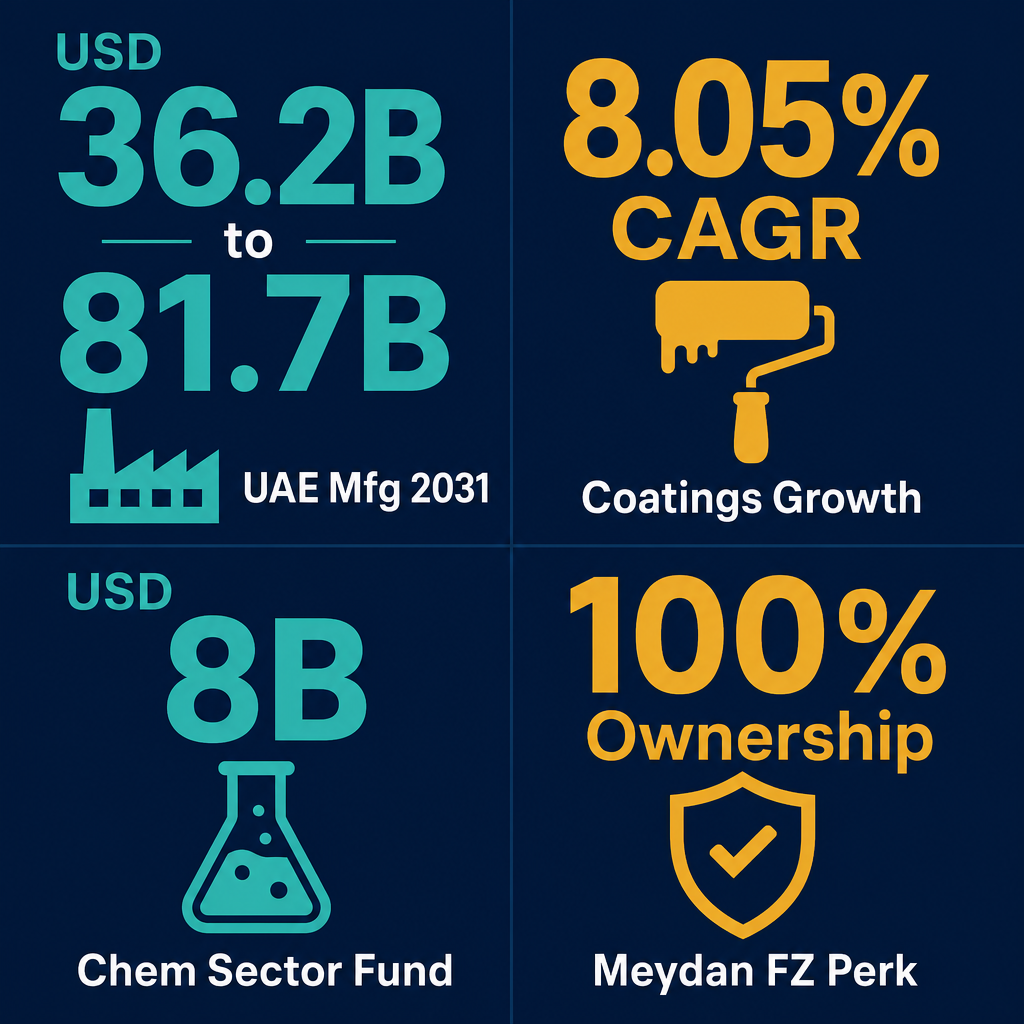
UAE advanced manufacturing is projected to grow from USD 36.2 billion toward USD 81.7 billion by 2031 under Operation 300bn, while the government's Economic Development Board has allocated USD 8 billion specifically to chemical industry firms. These figures signal strong and sustained demand for industrial solvent supply chains.
Treat Purity Grade as a Core Part of Your Offer
The same license code covers both industrial-grade and high-purity electronic or pharmaceutical-grade solvents, meaning your grade specifications are a competitive differentiator, not a minor detail. Controlled solvents must always be handled with full compliance regardless of order size, as Dubai Police oversight attaches to the product itself.
How to Start an Industrial Solvents Trading Business in Dubai with Meydan Free Zone
Every paint batch mixed in a UAE coatings plant and every drum of industrial cleaning chemical starts with solvents. Acetone, toluene, xylene and alcohol solvents pass through traders before they reach the manufacturers who use them as carriers, diluents and reaction media. Activity code 4669.82 is the license for that trading layer.
This guide covers what the license allows, who buys from you, the approval you need and the steps to get set up. One point matters more than the rest. Dubai Police clear this activity before your license is issued, because several of the solvents sit under controlled-substance monitoring. Build that into your timeline early.
Key Stats at a Glance
What This License Covers
Code 4669.82 covers wholesale trading of industrial solvents. You import, stock and distribute acetone, toluene, xylene, alcohol solvents and specialty industrial solvents to manufacturers and formulators across the UAE. Supplying acetone to a coatings plant, moving toluene to an adhesive formulator in Sharjah, or wholesaling high-purity solvents to an electronics manufacturer all sit inside the code.
The boundary that matters is the line between trading and making. Blending or manufacturing solvents yourself is a separate industrial activity with its own license and approvals. Retail sale to walk-in buyers sits outside the code too, because this activity is wholesale to business customers. Bulk fuel and petroleum distribution is a different trading class again, even though the handling looks similar from the outside.
Purity grade is part of what you trade rather than a detail you settle later. The same code carries industrial grade solvents and electronic or pharmaceutical grade material where the buyer audits the specification. What you cannot do is treat a controlled solvent as ordinary stock, because the Dubai Police position attaches to the product, not the order size.
Who Your Clients Will Be
Coatings and paint manufacturers
This is the volume base. Paint and coatings plants pull acetone, MEK, toluene, xylene and alcohol solvents as carriers and diluents, and they buy on a repeating schedule rather than one-off lots. Specialty coatings producers sit in the same group with tighter grades and smaller volumes.
Adhesives, printing inks and cleaning chemicals
Adhesive manufacturers in Sharjah and Ajman, printing ink producers and cleaning chemical blenders form the second block. Volumes per customer are smaller than paint, but the customer count is higher and the buying is steadier across the year.
Electronics and pharmaceutical formulators
The third group buys high-purity material: electronic-grade solvents for electronics manufacturing and pharmaceutical-grade solvents for formulators. Margins are the best of the three, and so is the scrutiny. These buyers check your source documents, grade certificates and handling chain before a first order.
Mainland or Free Zone
Where you license depends on who you sell to. A mainland license from the Department of Economy and Tourism suits a business selling direct to UAE factories.
Meydan Free Zone gives you full foreign ownership and a lower cost base, and it suits an import, hold and re-export operation or a trading arm that reaches UAE buyers through a distributor. Many traders run both, with the free zone company holding the international supply relationships.
What does not change is the approval position. Dubai Police clear this activity whichever authority issues your license, because the clearance follows the product. Storage is the other constant: solvents call for approved premises with the right fire, ventilation and containment kit.
[blockCTACostCalculator]
Step by Step Setup Guide
- Step 1, fix your product list: Decide which solvents you will carry and at which grades. This drives the Dubai Police conversation, so settle it first.
- Step 2, start the Dubai Police pre-approval: This clearance comes before the license. Expect questions about storage, handling and your buyer base.
- Step 3, choose your jurisdiction: Mainland through DET for direct sales to UAE factories, or Meydan Free Zone for import, holding and re-export with 100% foreign ownership.
- Step 4, book your trade name: Check availability through the DET or Meydan Free Zone portal, following UAE naming rules.
- Step 5, line up storage and handling: Approved premises with fire, ventilation and spill containment. Storage is inspected on what is in place, not what the plan says.
- Step 6, build your supplier base: Producers across Asia, Europe and the region. Grade certificates matter as much as price.
- Step 7, collect your license and open a bank account: Banks want the license, shareholder papers and a clear account of the trading model.
- Step 8, register for VAT: Register with the Federal Tax Authority once taxable turnover passes AED 375,000.
Compliance and What You Need in Place
Dubai Police pre-approval
This activity calls for Dubai Police clearance before the trade license is issued. Several solvent categories, acetone and toluene among them, fall under controlled-substance monitoring, and that is what puts the police in the approval chain. Treat it as the gating item rather than a form to file at the end.
Storage and handling
Solvents are flammable and volatile. Approved premises, correct fire and ventilation kit, spill containment and trained staff are the working conditions of the license, and they are checked.
Record keeping on controlled stock
Keep clean records of what you bring in, what you hold and who you sell to. Controlled-substance monitoring works on traceability, and a gap in the records surfaces first in any review. Blending or repackaging into new formulations moves you into manufacturing and a different license.
AML and VAT
This activity is exempt from AML duties. Register with the Federal Tax Authority once taxable turnover passes AED 375,000.
Market Opportunity
Solvent demand is downstream demand, so the picture starts with the factories that buy. The UAE paints and coatings market is forecast to grow from USD 601 million in 2025 to USD 885 million by 2032 at 8.05% CAGR, and coatings plants pull solvent volume on every batch they mix.
Behind that sits national industrial policy. Operation 300bn is lifting advanced manufacturing, including chemicals, from USD 36.2 billion toward USD 81.7 billion by 2031, with the Emirates Development Bank allocating USD 8 billion to chemical industry firms. More chemical manufacturing here means more solvent buyers on the ground rather than across a border.
The third piece is the spread of end uses. Adhesives, printing inks, cleaning chemicals and specialty blending draw on the same product set, with electronics and pharmaceutical formulation adding a high-purity tier above. A trader serving two or three blocks is not tied to any single one.
Conclusion
Industrial solvents trading under code 4669.82 puts you between international chemical producers and a UAE manufacturing base that policy is actively growing. The demand repeats, because solvents are consumed rather than installed.
The licensing needs planning. Dubai Police clear you before the license is issued, and approved storage is a working condition rather than a paperwork step. Both are easier if you start early.
The commercial work is the supplier base and the grade discipline behind it. High-purity buyers choose on documentation as much as price. Speak to the Meydan Free Zone team to confirm the right structure for the products you plan to carry.
[blockCTAContact]