
Table of Contents
Topic Summary
Understand Exactly What License 4662.99 Covers
Activity code 4662.99 permits wholesale trading across four product families: ferrous and non-ferrous ores, primary metals, semi-finished metal products, and gold and precious metals. Notably, metal scrap trading and actual mining or smelting fall under separate licenses, so clarify your product scope before applying.
Know Your AML Obligations From Day One
Unlike most trading licenses, 4662.99 carries mandatory anti-money laundering duties, particularly because it covers gold and precious metals. Registering in a free zone does not remove these obligations, so compliance infrastructure must be built into your business setup from the start.
Identify the Right Buyers for Each Product Type
Ore trading targets regional steel plants and smelters where volumes are high and margins are thin, while primary metals attract industrial fabricators and cable manufacturers on more predictable cycles. Gold and precious metals buyers offer the strongest margins but also the heaviest regulatory scrutiny.
Weigh Mainland vs. Meydan Free Zone Carefully
A mainland DET license gives direct access to UAE industrial buyers but comes with 9% corporate tax above AED 375,000 and foreign ownership restrictions. Meydan Free Zone offers 100% foreign ownership, zero tax on qualifying income, and a structure well suited to regional re-export flows, though local sales require a mainland distributor.
Tap Into a Market Worth Over a Trillion Dollars
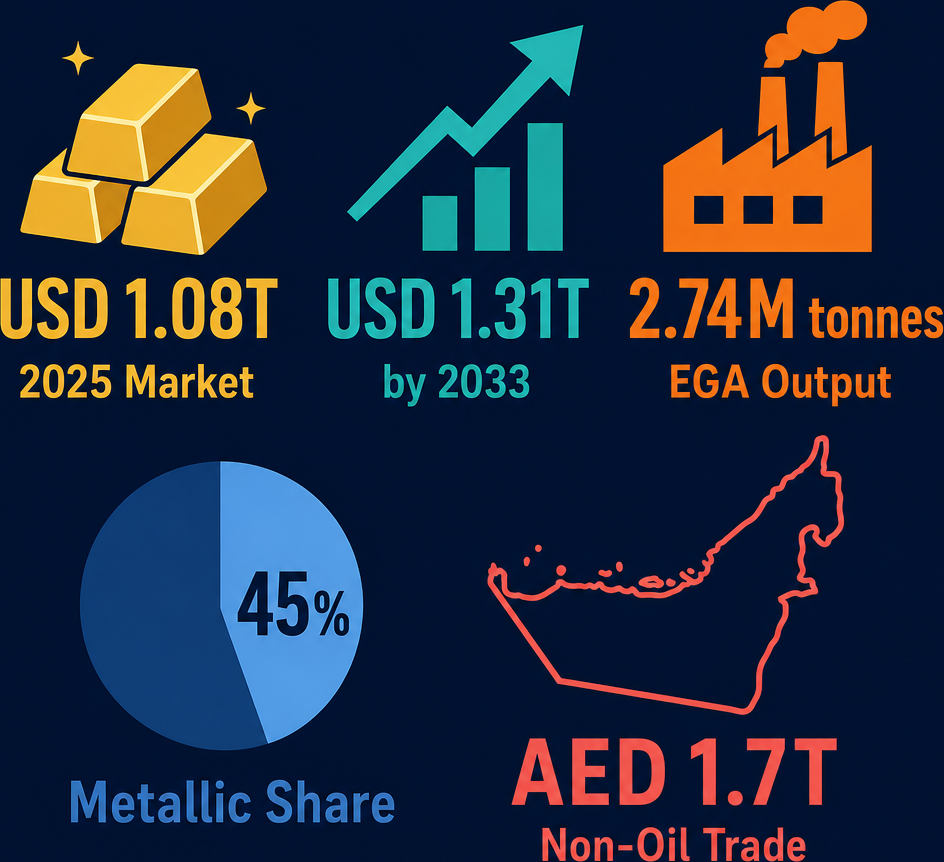
The Middle East metal ores mining market is valued at USD 1,082 billion in 2025 and projected to reach USD 1,311 billion by 2033. The UAE alone targets AED 300 billion in industrial GDP by 2031 under Operation 300bn, creating sustained demand across the metals supply chain.
Position Around the UAE's Aluminium Advantage
Emirates Global Aluminium produced 2.74 million tonnes of cast metal in 2024, with Al Taweelah recognised as the world's largest single-site primary aluminium producer at 1.3 million tonnes per year. This makes the UAE a natural hub for aluminium ingot and billet trading across regional and global markets.
Factor in Lithium and Battery Metals as Growth Lines
Lithium-rich spodumene, once a specialist product, has become a mainstream trading line as battery supply chains scale globally. Adding non-ferrous battery metals to your portfolio positions your business to capture demand from the fast-growing electric vehicle and energy storage sectors.
How to Start a Metal Ores Trading Business in Dubai with Meydan Free Zone
Behind every steel beam in a Dubai tower, every aluminium panel in a rail coach and every copper cathode routed to a cable maker sits a trading layer moving ores, primary metals and semi-finished products at wholesale scale. Activity code 4662.99 is the license for that layer.
This guide covers what the license allows, who buys from you, the approval and AML position, and the steps to get set up. Note one point early: unlike most trading codes, this activity is subject to AML duties, and that shapes how you set up from day one.
Key Stats at a Glance
What This License Covers
Code 4662.99 covers wholesale trading in metal ores and related metals products. That runs across four product families: ferrous and non-ferrous ores, primary metals in ingot, billet, cathode, slab and powder form, semi-finished metal products, and gold and precious metals.
The ore side spans iron, manganese and chrome on the ferrous list, and copper, bauxite, zinc, nickel, cobalt and lithium-rich spodumene on the non-ferrous side. That last one has moved from a specialist line to a mainstream one as battery supply chains scale.
The stated exclusion is narrow and worth knowing precisely: wholesale of metal scrap falls under a separate class. Scrap looks adjacent to ore and primary metal on a trading desk, but it is a different license. Mining or smelting the material yourself is also a separate activity, since this code covers trading rather than extraction or processing.
Who Your Clients Will Be
Ore buyers
Regional steel plants, smelters and aluminium producers buying iron ore, bauxite and non-ferrous ores in bulk. Volumes are large, margins are thin, and the trade lives on price, freight and hedging rather than service.
Primary and semi-finished metals buyers
Industrial fabricators, cable and circuit manufacturers and construction suppliers buying aluminium ingots, copper cathode and certified steel billets. More predictable than ore, and tied to project and production cycles you can forecast.
Gold and precious metals buyers
Jewellery manufacturers, certified industrial users and institutional buyers taking gold, silver, platinum and palladium. Margins are strongest here and so is the regulatory load, because this is the segment that puts you squarely inside the AML framework.
Mainland or Free Zone
Metals trading is a re-export business as much as a domestic one, which makes the free zone route a natural fit. Meydan Free Zone gives you 100% foreign ownership and a low fixed cost base for what is largely a desk, a balance sheet and a set of relationships.
A mainland license from the Department of Economy and Tourism suits a trader selling mostly into UAE fabricators and manufacturers, or one that wants to hold physical stock and sell locally without an intermediary.
Neither choice changes the compliance load. Customs documentation, AML duties and conflict-minerals due diligence follow the goods and the counterparties, not the licensing authority. Trade finance is the other constant: letters of credit and banking relationships decide how large a position you can actually carry.
[blockCTACostCalculator]
Step by Step Setup Guide
- Step 1, pick your product family: Ore, primary metals, semi-finished, or precious metals. Each has a different capital profile, and precious metals brings the heaviest compliance load.
- Step 2, choose your jurisdiction: Meydan Free Zone for import, holding and re-export with 100% foreign ownership, or mainland through DET for direct local supply.
- Step 3, book your trade name: Check availability through the DET or Meydan Free Zone portal, following UAE naming conventions.
- Step 4, build your AML programme before you trade: Policies, customer due diligence, record keeping and a compliance officer. This is a condition of operating, not a later refinement.
- Step 5, set up trade finance: Letters of credit and a bank that understands commodity flows. Banks look hard at metals traders, so prepare a clear account of your counterparties and routes.
- Step 6, arrange hedging capability: London Metal Exchange positions to manage price swings. An unhedged book is a bet, not a business.
- Step 7, sort storage and logistics: Bonded warehousing for bulk, secure vault arrangements for precious metals.
- Step 8, collect your license and register for VAT: Register with the Federal Tax Authority once turnover passes AED 375,000.
Compliance and What You Need in Place
AML duties apply to this activity
This is the point that separates metals from most other trading codes. Precious metals dealers sit inside the regulated framework overseen by the Ministry of Economy under Cabinet Decision No. 10 of 2019. Customer due diligence, record keeping, suspicious transaction reporting and a named compliance officer are all part of operating, and they are examined.
Conflict minerals and source documentation
Buyers and banks both ask where the material came from. Responsible sourcing documentation is now a commercial condition on ore and precious metals, and a gap in the chain can stall a shipment or a payment.
Price risk
Metals move. Without hedging discipline, a single unhedged cargo can undo a year of trading margin. Set the policy before the first position, not after the first loss.
VAT
Register with the Federal Tax Authority once turnover passes AED 375,000. Note that specific rules apply to gold and precious metals supplies, so take advice on treatment rather than assuming the standard position.
Market Opportunity
The regional backdrop is large. The Middle East metal ores mining market was valued at USD 1,082.12 billion in 2025 and is projected at USD 1,311.21 billion by 2033 at 2.43% CAGR. Closer to home, UAE mining and minerals stood at USD 10.8 billion in 2025 and is forecast at USD 14.4 billion by 2032 at 4.2% CAGR, with the metallic category holding 45% share.
The demand driver is industrial policy. Operation 300bn targets a lift in industrial GDP from AED 133 billion to AED 300 billion by 2031, with manufacturing the fastest-growing application segment for metals.
The UAE also produces at scale, which gives traders a domestic anchor rather than pure transit business. Emirates Global Aluminium produced 2.74 million tonnes of cast metal in 2024, and its Al Taweelah smelter is the world's largest single-site primary aluminium producer at 1.3 million tonnes a year, roughly one tonne in every 25 made worldwide.
Conclusion
Metal ores trading under code 4662.99 puts you in a market with real domestic production, a large regional demand base and a re-export role that reaches Asia, Africa and Europe.
It is also the most compliance-heavy trading code in this family. AML duties apply, sourcing documentation is expected and precious metals brings a regulated framework with named duties. Build that capability first.
What decides success is balance sheet and discipline: trade finance to carry positions, hedging to survive price moves, and counterparty checks that hold up. Speak to the Meydan Free Zone team to confirm the right structure for the product family you plan to trade.
[blockCTAContact]