Table of Contents
Topic Summary
Understand What Activity Code 4721.07 Covers
This license covers specialised retail of food products not assigned their own code, including dates, nuts, spices, organic ranges, and gourmet imports. The defining word is 'specialised' — your store should offer depth in a focused category rather than broad convenience shopping.
Know the Clear Boundaries of This License
On-premises baking, non-specialised multi-line grocery retail, and wholesale supply to hotels or caterers all fall outside this code. Review these exclusions carefully before applying, since the wrong activity class can delay or invalidate your license.
Identify Your Most Likely Customer Groups
Gift buyers during Ramadan and Eid, health-conscious households seeking organic or free-from products, and multicultural shoppers looking for ethnic specialty ranges are your core audiences. Tourism adds an additional gifting and souvenir layer that can meaningfully boost seasonal revenue.
Choose Between Mainland and Free Zone Setup
A mainland DET license suits walk-in retail premises but comes with foreign ownership restrictions and a 9% corporate tax above AED 375,000 taxable income. Meydan Free Zone offers 100% foreign ownership and zero corporate tax on qualifying income, making it better suited to e-commerce, import, or holding operations.
Factor In Food Handling Approvals Early
Registering with Meydan Free Zone does not replace the food handling and storage approvals required by relevant authorities. Whether you operate on the mainland or in a free zone, confirm the full approval position in writing with the licensing authority before you begin trading.
Tap Into a Fast-Growing UAE Retail Market
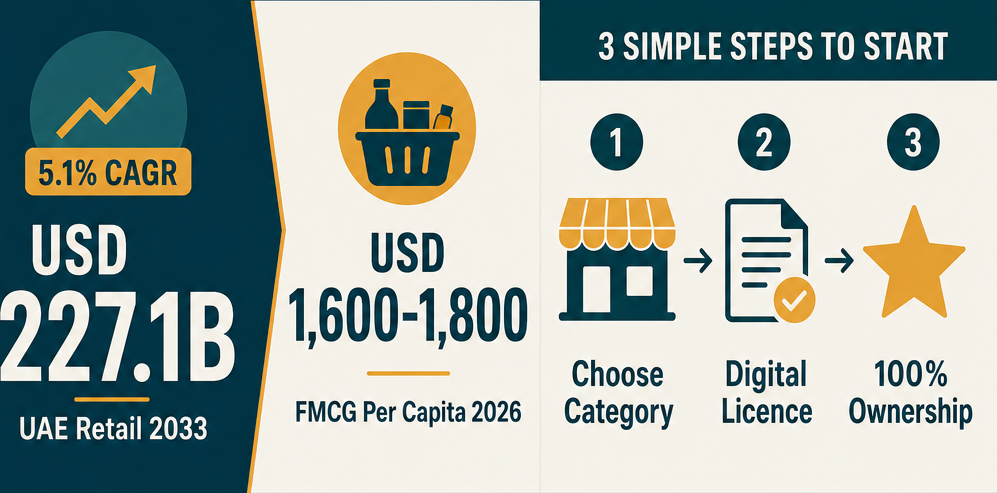
The UAE retail market is projected to reach USD 227.1 billion by 2033, growing at a 5.1% CAGR, with per-head FMCG spend estimated between USD 1,600 and USD 1,800 in 2026. Health and wellness trends, a multicultural population, and strong gifting traditions are key demand drivers for specialty food retail.
How to Start an Other Food Products Retail Business in Dubai with Meydan Free Zone
Bakery, dairy, seafood and confectionery each have their own retail code. Everything else specialised sits here: dates and dried fruits, nuts and seeds, organic and free-from ranges, oils and condiments, honey, spices and herbs, ready-to-eat meals, ethnic specialty foods and gourmet imports. Activity code 4721.07 is the license for that layer.
This guide covers what the license allows, who shops with you, the approval position and the steps to get set up. Read the boundary section closely, because this code is defined by what it is not as much as by what it is.
Key Stats at a Glance
What This License Covers
Code 4721.07 covers specialised food retail in categories that do not have their own code. A dates and dried fruits shop, a nuts and seeds specialist, an organic and free-from store, a spice and condiment merchant, a gourmet or ethnic specialty grocer: all of them sit here.
The word doing the work is specialised. This code is for a store built around a focused category, where the customer comes for depth rather than convenience. Counter service, sampling and product knowledge are part of the format rather than extras.
Three things sit outside it. Baking on the premises is manufacturing of bakery products, a separate activity. Retail of food in non-specialised stores, where many product lines sell under one roof, is a different class.
And wholesale trading to other businesses is excluded, which deserves a check before you apply: if your plan is to supply hotels, caterers or other retailers in volume rather than sell to shoppers, that exclusion points to a wholesale class instead.
Who Your Clients Will Be
Gift and occasion buyers
Dates, nuts and premium dried fruit sold for Ramadan, Eid, corporate gifting and hospitality. Presentation is a large part of the product, and demand is sharply seasonal, which shapes both stockholding and cash flow.
Health and wellness shoppers
Organic, gluten-free and free-from ranges bought by households managing diet by choice or by need. These customers are loyal, they read labels closely, and they will travel for a store that reliably carries what they need.
Multicultural and gourmet shoppers
Arabic, South Asian, East Asian, African and Western specialty ranges, plus curated gourmet imports. The UAE's mix of residents supports several of these formats at once, and tourism adds a gift and souvenir layer on top.
Mainland or Free Zone
A specialty food shop is a physical store, and that means a mainland license from the Department of Economy and Tourism for the retail operation itself. Location does most of the work in this format, because the customer has to find you.
Meydan Free Zone fits the other half of the model. It gives you 100% foreign ownership and a low cost base, which suits an online specialty store, a subscription or gifting operation, or an import arm bringing in ranges that a mainland shop then sells.
Many specialty food businesses now run both, because the online and gifting side smooths out the seasonality that hits a single store. Whichever you choose, food storage standards apply to wherever the stock actually sits.
[blockCTACostCalculator]
Step-by-Step Setup Guide
- Step 1, choose the category before the location: Dates and gifting, organic and free-from, or gourmet and ethnic. Each has a different customer, margin and seasonality.
- Step 2, confirm the food approval position in writing: Ask the licensing authority and the municipality what applies to your premises, storage and imported ranges.
- Step 3, check the retail and wholesale line: If you plan to supply businesses in volume, confirm whether that sits under this code or a wholesale one.
- Step 4, choose your jurisdiction: Mainland through DET for the shop, or Meydan Free Zone for e-commerce, gifting and import.
- Step 5, book your trade name: Check availability through the DET or Meydan Free Zone portal, following UAE naming conventions.
- Step 6, build sourcing: Growers, importers and specialty suppliers. In this format the range is the brand, and buyers can tell the difference.
- Step 7, plan for the seasonal peak: Ramadan and Eid can carry a large share of annual gifting revenue. Stock, packaging and staffing all have to be ready well in advance.
- Step 8, collect your license, open a bank account and register for VAT: Register with the Federal Tax Authority once turnover passes AED 375,000.
Compliance and What You Need in Place
Food approvals: confirm rather than assume
The source page states no third-party approval is needed. Do not act on that alone. This is food retail, and storage, handling, labelling and import of food are regulated in Dubai. Get the position confirmed in writing by the licensing authority and Dubai Municipality before you trade, and keep it on file.
Labelling and claims on specialty ranges
Organic, gluten-free and free-from claims carry real weight with these customers and real risk if unsupported. Certification for organic lines and accurate allergen declarations are part of the product, and imported ranges need Arabic labelling.
Storage for open and loose goods
Dates, nuts and loose dry goods sold from counters need pest control, humidity management and stock rotation. Open display is part of the appeal of the format and the main source of its hygiene risk.
AML and VAT
This activity is exempt from AML duties. Register with the Federal Tax Authority once turnover passes AED 375,000.
Market Opportunity
The backdrop is a UAE retail market expected to reach USD 227.1 billion by 2033 at 5.1% CAGR, with specialty stores holding a meaningful share alongside hypermarkets and supermarkets. FMCG spending per head sits at USD 1,600 to USD 1,800 in 2026, which supports premium and curated positioning rather than price-led competition.
Four demand currents feed this code specifically. Health and wellness spending drives organic and free-from. The UAE's multicultural population supports ethnic specialty ranges across several cuisines at once.
Date and gifting traditions create a category with cultural depth and reliable seasonal peaks. And tourism adds gift and gourmet purchases on top of resident demand.
The UAE is also one of the world's largest date producers, which gives dates specialty retail something rare: a premium category with a local supply chain rather than an imported one.
Conclusion
Code 4721.07 covers the specialty end of food retail, where customers choose on range and knowledge rather than on price or convenience. That is a defensible position in a market where the big formats compete on scale.
Two things need settling first. Confirm what food approvals apply to your premises and imports, and check that a specialised retail code fits your customer mix rather than a wholesale one.
After that the business runs on sourcing and seasonality. The range is what brings people in, and the gifting peaks are where much of the year's margin is made. Speak to the Meydan Free Zone team to confirm the right structure for the format you plan to run.
[blockCTAContact]