

Table of Contents
Topic Summary
Understand What Activity Code 5629.00 Covers
This license covers contracted food service delivered at a client's premises for a defined period, including industrial canteens, institutional cafeterias, and remote-site messing. It does not cover walk-in restaurants, one-off event catering, or the retail of perishable food.
Know Your Target Client Segments
Your primary clients will fall into three categories: industrial and energy operators, institutions like hospitals and schools, and transport or remote-site operators. Each segment has distinct priorities, from hygiene records and consistency for industrial clients to allergen control and formal tender processes for institutions.
Plan for a Central Production Kitchen First
Contract catering is the most infrastructure-heavy format in food service, requiring a commissary kitchen capable of serving multiple sites before the first meal is delivered. Multi-year client commitments and upfront capital investment must be secured well ahead of operations.
Register Separately for Dubai Municipality Food Safety
There is no third-party pre-approval required as a condition of obtaining the license itself. However, Dubai Municipality food safety registration and certification apply separately and must be addressed before operations begin.
Clarify Venue Concession Sub-Codes Before Applying
Food concessions at sports and entertainment venues fall under sub-code 5629.02, which has a different boundary from the parent class 5629.00. Confirm in writing with the licensing authority which code applies if venue concessions are part of your business plan.
Consider Free Zone Setup for Full Foreign Ownership
Meydan Free Zone allows 100% foreign ownership with zero corporate tax on qualifying income, making it an attractive option for international operators entering the UAE contract catering market. The Middle East and Africa region accounts for 11% of the global contract catering market, signalling meaningful regional demand.
Size the Opportunity With Current Market Data
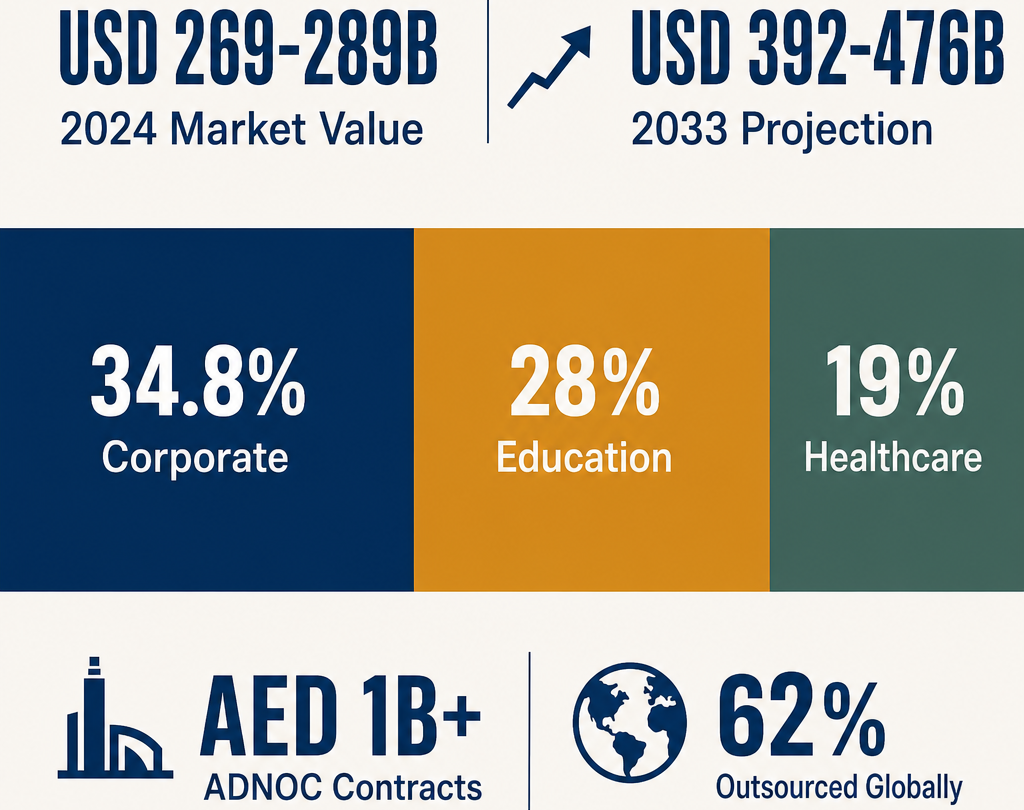
The global contract catering market was valued between USD 269 billion and USD 289 billion in 2024 and is projected to reach up to USD 476 billion by 2033 to 2034. More than 62% of organisations globally have already moved to outsourced catering, reflecting a structural shift that continues to drive new contract opportunities.
How to Start an Other Food Service Activities Business in Dubai
This is contract catering: the factory canteen running six days a week, the hospital cafeteria under a multi-year agreement, the offshore platform mess, the airline meal production contract. Food service delivered at somebody else's facility, for a fixed period, under a contract. Activity code 5629.00 covers it.
This guide covers what the license allows, who your clients are, the approval position and the steps to get set up. The format is the most infrastructure-heavy in food service, because central production kitchens and multi-year commitments come before the first meal is served.
Key Stats at a Glance
What This License Covers
Code 5629.00 covers food service delivered under contract, for a defined period, at a client's premises. Three formats sit inside it. Industrial canteens and workforce cafeterias for factories, plants, oil and gas facilities and construction sites.
Institutional catering for hospitals, schools and corporate campuses. And transport and remote-site catering for airlines, maritime and rail operators, offshore platforms and worker camps.
The common thread is the contract and the central kitchen. You are not opening to the public and hoping for footfall. You are feeding a known population, every day, to an agreed specification, often from a commissary kitchen that serves several sites at once.
The exclusions are clear. Making perishable food for resale and retailing perishable food are both outside the code. One-off event catering for a specific occasion is 5621.00. Fixed-premises restaurants open to walk-in customers are 5610.00.
Bar and beverage service without a food component is 5630. One further point is worth settling before you apply: food concessions at sports and entertainment venues have their own sub-code at 5629.02, and the boundary between that sub-code and this parent class is drawn differently in different places, so confirm in writing with the licensing authority which code covers them if venue concessions are part of your plan.
Who Your Clients Will Be
Industrial and energy operators
Factories, plants, oil and gas facilities and construction sites needing daily meals for a resident workforce. Contracts are long, volumes are predictable, and the buyer cares about consistency and hygiene records above menu creativity.
Institutions
Hospitals, schools and corporate campuses. Dietary needs, allergen control and cost per head are all scrutinised, and procurement runs through formal tenders with detailed specifications.
Transport and remote sites
Airlines, maritime and rail operators, offshore platforms and remote camps. These clients have no kitchen of their own, so everything is produced centrally and moved. The logistics are harder than the cooking.
Mainland or Free Zone
The clients here are mostly UAE industrial, institutional and government-linked organisations, and they contract locally. A mainland license from the Department of Economy and Tourism is the familiar route, and large tenders often expect it.
Meydan Free Zone gives you 100% foreign ownership and a lean cost base, and it works well as a holding or management entity over a catering group, or for an operator whose contracts sit with private clients rather than public tenders.
The central kitchen sits outside that choice. Contract catering runs on licensed food production premises with the capacity, cold storage and transport to serve every site you hold, and that facility is the real capital commitment in this business.
[blockCTACostCalculator]
Step-by-Step Setup Guide
- Step 1, pick your contract type: Industrial, institutional or transport and remote-site. They need different kitchens, different certifications and different sales cycles.
- Step 2, confirm the venue concession question: If sports or entertainment concessions are in scope, settle whether they fall under this code or 5629.02 before you apply.
- Step 3, choose your jurisdiction: Mainland through DET for public and large corporate tenders, or Meydan Free Zone for a holding, management or private-contract structure.
- Step 4, book your trade name: Check availability through the DET or Meydan Free Zone portal, following UAE naming conventions.
- Step 5, secure your production kitchen: Capacity, cold storage, and distance to the sites you plan to serve. This is the largest single cost and the longest lead time.
- Step 6, get food safety certification in place: Dubai Municipality registration and certification for Dubai operations, and the relevant authority for other emirates.
- Step 7, build the tender capability: These contracts are won on documented systems, traceability and references. Assemble that evidence before you bid, not during.
- Step 8, collect your license, open a bank account and register for VAT: Register with the Federal Tax Authority once turnover passes AED 375,000.
Compliance and What You Need in Place
Approval position
No third-party pre-approval attaches to the license itself. Food safety compliance is a separate and continuous obligation, covering Dubai Municipality registration and certification for Dubai operations and the equivalent regime in other emirates, under the federal food safety framework.
Scale raises the stakes
Feeding thousands of people daily from a central kitchen concentrates risk. A single failure in cold chain or cross-contamination reaches an entire workforce at once, which is why clients audit systems rather than trusting inspections.
Contract terms carry the margin
Multi-year agreements at a fixed cost per head expose you to food inflation across the term. Indexation clauses and supply agreements are where the profitability of a contract is decided, long before the kitchen opens.
AML and VAT
This activity is not a Designated Non-Financial Business or Profession, so AML registration and reporting do not apply to this category. Register with the Federal Tax Authority once turnover passes AED 375,000.
Market Opportunity
Contract catering is large and steadily growing. The global market was valued between USD 269 billion and USD 289 billion in 2024 depending on scope, and is projected to reach USD 392 billion to USD 476 billion by 2033 to 2034 at 4.1% to 5.3% CAGR.
More than 62% of organisations globally have moved to outsourced catering, which is the structural driver behind those numbers.
The segment mix favours the UAE. Corporate and office catering is the largest application at 34.8%, education follows at 28% and healthcare at 19%. Middle East and Africa accounts for 11% of the global market.
Locally the anchor is energy and construction. ADNOC awarded food catering contracts worth over AED 1 billion across its group companies for the period 2022 to 2027, covering onshore and offshore operations and a workforce drawn from more than 100 nationalities. Contracts of that scale set the standard the market operates at.
Conclusion
Code 5629.00 covers the least glamorous and most dependable corner of food service. Contracts run for years, volumes are known in advance, and the client cannot easily switch mid-term.
Entry is harder than in most food businesses. A central production kitchen, documented food safety systems and credible references are needed before you can bid seriously, and none of them is quick to assemble.
Settle two things early: which contract type you are built for, and whether venue concessions in your plan sit here or under 5629.02. Speak to the Meydan Free Zone team to confirm the right structure before you commit to a kitchen.
[blockCTAContact]