
Table of Contents
Topic Summary
Choose the Right License Activity Code
A petrochemicals trading license covers buying and selling crude derivatives, polymers, solvents, and specialty chemicals, but specific product categories fall under different business activity codes. Picking the wrong code can block your bank account opening or import permit applications, so verify your codes against the official Business Activities List before submitting.
Understand What the License Does Not Cover
A trading license under Meydan Free Zone authorizes sourcing, contracting, and logistics management, not blending, processing, or repackaging chemicals. If you plan any form of physical product handling beyond pure trading, you need a separate industrial or processing activity added to your license first.
Know Your Buyers Before You Set Up
Petrochemicals traders in the UAE sell to industrial operators such as plastics processors, construction material suppliers, and regional distributors covering South Asia, East Africa, and CIS markets. These buyers prioritize reliable documentation, clean compliance trails, and counterparties with established banking relationships, all of which a UAE-registered entity provides.
Leverage the UAE's Re-Export Advantage
The UAE's port infrastructure, managed through DP World and PCFC, makes Jebel Ali one of the most efficient terminals in the world for moving chemical products. Buyers in markets like Karachi or Nairobi actively prefer UAE-registered suppliers because letters of credit are easier to approve and customs clearance is straightforward.
Free Zone Setup Suits International and Re-Export Models
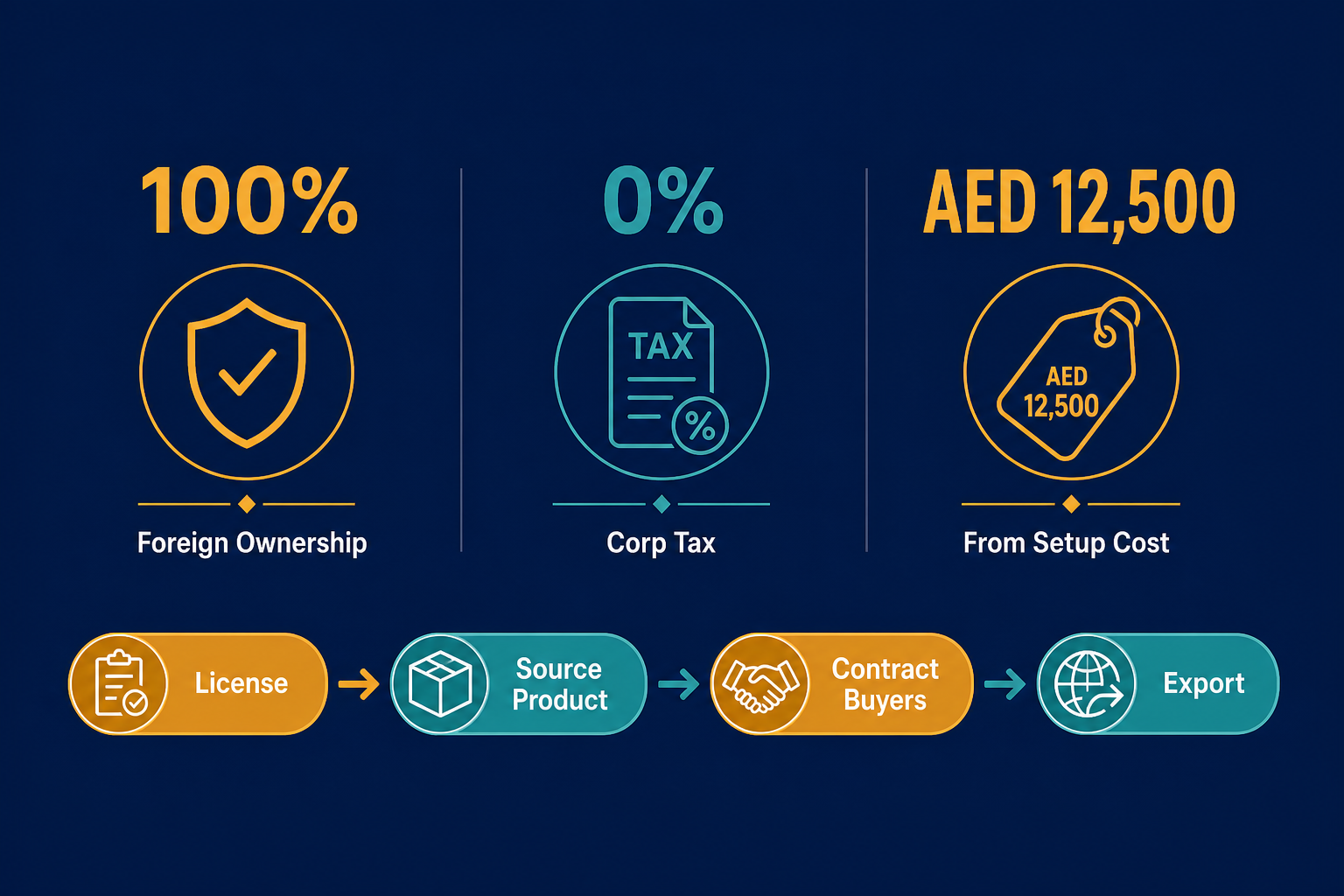
A Meydan Free Zone license offers 100% foreign ownership, 0% corporate tax on qualifying income, and flexible office options including flexi-desks, making it well suited for traders focused on international clients and re-export. The trade-off is that selling directly to UAE mainland clients typically requires going through a local distributor or agent.
Mainland Setup Is Better for Direct UAE Sales
If your primary clients are UAE-based manufacturers or government buyers, a mainland license issued through DET gives you direct commercial access without intermediaries. Physical office space is required, and standard UAE corporate tax rates apply rather than the free zone qualifying income exemption.
Factor In Realistic Setup Costs and Timelines
A Meydan Free Zone petrochemicals trading license starts from AED 12,500, with visa allocation tied to the office package you select. License issuance typically takes only a few working days once documents are submitted, making it one of the faster jurisdictions to get operational.
How to Start a Petrochemicals Trading Business in Dubai
The UAE sits at the centre of global petrochemicals trade. A Meydan Free Zone license puts you inside that market with 100% foreign ownership and no corporate tax on qualifying income. The infrastructure is here, the trade routes are established, and the regulatory framework is clear.
This guide covers what the license covers, who your clients will be, how to choose the right setup, and the steps to get trading.
What a Petrochemicals Trading License Covers
A petrochemicals trading license lets you buy and sell a wide range of chemical products derived from oil and gas. That includes crude derivatives, polymers, solvents, feedstocks, and specialty chemicals used across manufacturing, construction, and industrial processing.
Under Meydan Free Zone, the license covers trading activity, not manufacturing. You source product, contract with buyers, arrange logistics, and manage the commercial relationship. If you want to blend, process, or repackage chemicals, that needs a separate industrial or processing activity added to your license before you start.
Check the Business Activities List to confirm which specific codes apply to your product range. Some specialty chemical categories sit under different codes, and picking the wrong one can create problems when you open a bank account or apply for import permits.
Key Stats at a Glance
| Jurisdiction | Meydan Free Zone, Dubai |
|---|---|
| Foreign ownership | 100% – no local sponsor needed |
| Corporate tax on qualifying income | 0% for free zone qualifying income |
| Visa allocation | Based on office package selected |
| Setup cost | From AED 12,500 – see current pricing |
| Setup timeline | A few working days for license issue once documents are submitted |
| Office requirement | Flexi-desk available; physical office options also offered |
Who Buys from Petrochemicals Traders in the UAE
Your buyers are not retail customers. They are industrial operators who need consistent supply, reliable documentation, and counterparties they can trust for payment terms and compliance.
The main buyer categories are:
- Plastics processors and polymer manufacturers
- Construction material suppliers who use chemical inputs
- Industrial cleaning and maintenance companies
- Logistics intermediaries buying for re-export
- Regional distributors covering South Asia, East Africa, and CIS markets
The UAE's position as a re-export hub is a real commercial advantage here. DP World and the Ports, Customs and Free Zone Corporation (PCFC) manage port and customs infrastructure that makes moving product through Jebel Ali and other UAE terminals fast and well-documented. Buyers in South Asia and East Africa actively prefer UAE-registered counterparties because the paperwork is clean, the banking relationships are established, and the compliance trail is easy to follow.
That last point matters more than most new traders expect. A buyer in Karachi or Nairobi choosing between a UAE-registered supplier and one based in a less familiar jurisdiction will almost always go with the UAE entity. It is easier to get letters of credit approved, simpler to clear customs, and lower risk for their own compliance teams.
If your model is primarily re-export, you are in the right place. If you want to supply UAE-based manufacturers directly, read the next section carefully.
Free Zone vs Mainland: Which Setup Works for Petrochemicals Trading
This is the biggest choice you will make when setting up. The right answer depends on where your clients are, not on cost alone.
| Factor | Mainland (DET) | Free Zone (Meydan Free Zone) |
|---|---|---|
| Foreign ownership | 100% in most activities | 100% |
| Direct UAE client access | Yes, including government buyers | Via a local distributor or agent |
| Re-export and international trade | Yes | Yes, well suited |
| Office requirement | Physical office needed | Flexi-desk options available |
| Corporate tax on qualifying income | Standard rate applies | 0% on qualifying income |
| Customs handling | Standard UAE import & export rules | Free zone customs benefits apply |
A free zone setup is the right base if most of your trading is international: sourcing from producers and selling to buyers outside the UAE, or moving product through UAE ports to other markets. Meydan Free Zone gives you the ownership structure, the tax position, and the administrative simplicity to run that kind of business efficiently.
If you need to sell directly to UAE-based factories or industrial buyers, a mainland license from the Dubai Department of Economy and Tourism (DET) lets you work directly with those clients without going through an intermediary. Some traders run both: a free zone entity for international flows and a mainland entity for UAE domestic supply. That dual structure is workable but adds cost and compliance overhead, so make sure the volume justifies it before you start.
Free Business Setup Cost Calculator
Calculate NowHow to Set Up a Petrochemicals Trading Company with Meydan Free Zone
The process is straightforward if you have your documents ready before you start. Here is what the setup looks like in practice.
- Step 1, book your trade name: Check your company name availability using the Meydan Free Zone portal. The name must not duplicate an existing registered entity and must not include restricted words.
- Step 2, pick your activity code: Confirm the petrochemicals trading code is correct for your specific product range. If you are trading across multiple chemical categories, you may need more than one activity listed on your license.
- Step 3, submit your application: Complete the Meydan Free Zone application online. You will need passport copies for all shareholders and directors, a brief business plan summary, and a No Objection Certificate (NOC) if you are currently sponsored by another UAE employer.
- Step 4, choose your office package: Select a flexi-desk or physical office option based on your visa needs and operational requirements. Your visa allocation is tied to the package you choose.
- Step 5, get your license issued: Once documents are approved and fees are paid, Meydan Free Zone issues your trade license. This typically takes a few working days.
- Step 6, process your visa: Apply for your investor or employee residence visa. You will need to complete a medical fitness test and get your Emirates ID. mResidency covers the full visa and residency process if you want support with this.
- Step 7, open your corporate bank account: This is where petrochemicals traders sometimes hit delays. Read the next section before you get to this step.
If you want to handle the entire setup without being in Dubai, Meydan Free Zone supports remote business setup, so you can get your license issued and your structure in place before you travel.
mAssist covers document support, translation, and administrative tasks if you need help managing the paperwork side of the process.
Compliance, Banking, and What You Need Before You Start Trading
Getting the license is the easy part. What takes more preparation is getting your compliance and banking in order so you can actually trade from day one.
Corporate tax registration
The UAE introduced a federal corporate tax in 2023. Free zone companies can qualify for a 0% rate on qualifying income, but you still need to register with the Federal Tax Authority (FTA). Registration is mandatory once you meet the relevant threshold. Do not wait until you are generating revenue to look at this. Get registered early and make sure your accounting records are set up to separate qualifying and non-qualifying income from the start.
VAT duties
If you sell into the UAE domestic market, VAT at 5% applies to those transactions. International and re-export sales are generally zero-rated, but the documentation needs to be correct. You must register for VAT once your taxable turnover hits the mandatory threshold. VAT registration support is available through mAccounting if you need help with this.
Opening a corporate bank account
Petrochemicals trading is a sector that UAE banks look at carefully. It sits in a category where compliance teams want to understand your supply chain, your counterparties, and your source of funds. That is not a reason to avoid it, but it does mean you need to arrive at the bank with a clear business plan, named suppliers and buyers where possible, and a realistic explanation of your trading model.
The better prepared your file, the faster the process moves. Business banking support through mCore can help you put that file together and approach the right institutions for your profile.
Substance and record-keeping
To maintain your free zone qualifying income status, your company needs to show real economic substance in the UAE. That means your core income-generating activities should be directed and managed from your free zone base. Keep board meeting records, maintain proper books, and make sure your contracts and invoices reflect the actual flow of business. Bookkeeping services through mAccounting can keep this in order from day one.
Market context
According to IMARC Group, the UAE petrochemicals sector continues to grow, supported by the country's position as a major re-export hub and its proximity to high-growth demand markets in South Asia and Africa. Traders who are set up correctly, with clean compliance and strong banking relationships, are well placed to capture a share of those flows.
Conclusion
Petrochemicals trading from a Meydan Free Zone base gives you full ownership, access to major Gulf and re-export routes, and a clear license structure. The market is real and the infrastructure is there. What makes or breaks the business is how well you plan your client base and compliance setup before you start, not after.
Get your activity code right, choose your setup based on where your clients are, and sort your banking and tax registration before your first transaction. Those three things done well will save you a lot of time later.
Speak to the Meydan Free Zone team to confirm your activity code and get a cost estimate for your specific trading structure.
Ready to Launch Your Business in Dubai?
Let's ConnectCompliance
THIRD-PARTY APPROVAL
This activity requires pre-approval from the DP (Dubai Police) before a business license can be issued by Meydan Free Zone.
ANTI-MONEY LAUNDERING COMPLIANCE
This business activity is exempt from AML compliance requirements.
References
- Invest in Dubai
- Federal Tax Authority (FTA)
- Ports, Customs and Free Zone Corporation (PCFC)
- DP World
- IMARC Group