Table of Contents
Topic Summary
Understand What Activity Code 4711.02 Covers
This license is for large-format retail where food and beverages are the main sales line, with apparel, furniture, appliances, hardware, and cosmetics sold alongside. The food-anchor requirement is what defines this code, not floor size alone.
Know the Third-Party Approvals Required
Both Dubai Municipality and the Security Industry Regulatory Agency (SIRA) must approve your business. The source documentation describes the approval timing inconsistently, so confirm in writing whether approvals are pre-establishment or post-license before committing to a site.
Identify Your Core Customer Segments Early
The format serves single-trip household shoppers, mall destination visitors, and fixed local community catchments, each with different basket sizes and shopping frequencies. Tuning your product range and location to one primary segment will shape every other business decision.
Choose Between Mainland and Free Zone Setup
A mainland DET license is the practical route for walk-in large-format retail, while Meydan Free Zone suits holding, sourcing, management, or e-commerce operations. Free zone registration does not replace Dubai Municipality or SIRA approval regardless of which route you choose.
Take Advantage of Free Zone Ownership and Tax Benefits
Meydan Free Zone allows 100% foreign ownership with zero corporate tax on qualifying income, compared to the 9% corporate tax applied above AED 375,000 taxable income on the mainland. Confirming which income qualifies for the exemption with a tax adviser before launch is strongly recommended.
Tap Into a Fast-Growing UAE Retail Market
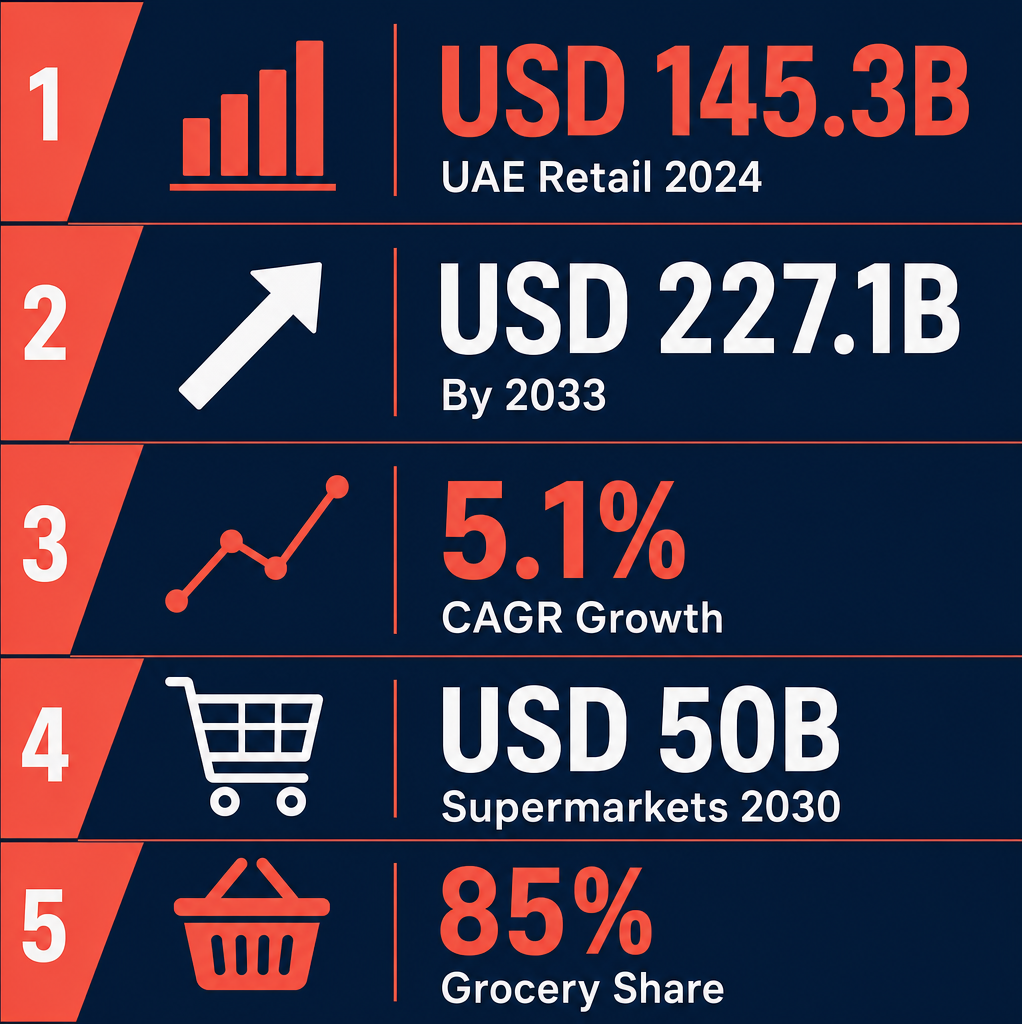
The UAE retail market was valued at USD 145.3 billion in 2024 and is projected to reach USD 227.1 billion by 2033 at a 5.1% CAGR. The large-format and supermarket segment alone is forecast to reach around USD 50 billion by 2030, driven by urbanisation, rising incomes, and single-trip shopping behaviour.
Confirm Your Format Fits This Specific License Code
Smaller food-led formats, department stores without a food anchor, and fuel forecourts with attached shops each fall under different activity codes. Verifying your floor area, sales mix, and format against the code definitions before applying prevents costly reclassification later.
How to Start a Retail Sale General Stores Business in Dubai with Meydan Free Zone
A general store in the UAE sense is not a corner shop. It is a large format anchored by a full grocery operation, with apparel, furniture, appliances, hardware and cosmetics arranged around it like a small city of categories. Activity code 4711.02 is the license for that format.
This guide covers what the license allows, who shops with you, the approvals you need and the steps to get set up. Note one thing early: the source page states the approval timing two different ways, so that point needs confirming before you commit to a site.
Key Stats at a Glance
What This License Covers
Code 4711.02 covers general store retail where food and beverages are the main sales line, sold alongside several other merchandise types: wearing apparel, furniture, appliances, hardware, cosmetics and general goods.
Food share is what defines this code rather than floor area. A store where grocery is the anchor and non-food sits around it belongs here. A department store where food is absent or a minor part of the floor belongs to a different class, and that single distinction decides which activity you hold.
The stated exclusion is narrow. Retail of fuel combined with food and beverages, where fuel is the dominant sale, sits under retail sale of automotive fuel instead. A forecourt with a large shop is still a fuel business.
Size matters within the family too: smaller food-led formats have their own codes further down the scale, so confirm where your floor area and range place you before applying rather than assuming this code covers every food-led shop.
Who Your Clients Will Be
Single-trip household shoppers
The core of the format. Families who would rather do the weekly grocery run and buy a kettle, school uniforms and cosmetics in one stop. Hypermarkets and supermarkets already take 85% of grocery spending, and convenience of that kind is why.
Destination and mall shoppers
Mall-anchor stores draw a wider catchment than a neighbourhood site, with larger baskets and more non-food in them. Rent is higher, and the store has to justify the trip.
Community catchments
Residential-area general stores serving a fixed local population. Smaller baskets, higher frequency, and a range tuned to what the surrounding community actually buys rather than to the widest possible selection.
Mainland or Free Zone
This is large-format physical retail, so the store itself sits on the mainland. A mainland license from the Department of Economy and Tourism is the route for the trading operation.
Meydan Free Zone plays a supporting role that is worth structuring deliberately. With 100% foreign ownership and a low fixed cost base, it suits a holding company above a multi-site group, a management or sourcing entity, or the e-commerce arm operating alongside the stores.
The lease drives the timetable either way. Large retail units in strong catchments are scarce and slow to secure, and the site you can get usually shapes the range rather than the other way round.
[blockCTACostCalculator]
Step-by-Step Setup Guide
- Step 1, confirm the approval sequence in writing: The source page says pre-establishment in one place and post-license in another. Ask Dubai Municipality and SIRA directly, because fit-out spend depends on the answer.
- Step 2, settle your food share: Grocery-anchored places you in this code. A largely non-food floor puts you elsewhere. Fix this before applying.
- Step 3, secure the site: Large-format units are the binding constraint. Catchment, parking and access decide viability more than merchandising does.
- Step 4, choose your structure: Mainland through DET for the store, with Meydan Free Zone as a holding, sourcing or e-commerce entity alongside.
- Step 5, book your trade name: Check availability through the DET or Meydan Free Zone portal, following UAE naming conventions.
- Step 6, build the supply chain across food and non-food: These are two different buying operations with different terms, margins and stock cycles. Running both well is the core skill in this format.
- Step 7, plan security infrastructure: SIRA clearance reflects the security conditions attached to a large public retail space, so design it into the fit-out rather than adding it later.
- Step 8, collect your license, open a bank account and register for VAT: Register with the Federal Tax Authority once turnover passes AED 375,000, which this format crosses immediately.
Compliance and What You Need in Place
Two approvals, and an unclear sequence
Dubai Municipality and SIRA both clear this activity. The source page describes the approval as pre-establishment in its opening text and as coming after the trading license in its structured section. Those are materially different timetables, and the difference determines whether you can sign a lease and fit out before clearance.
Get it confirmed in writing before you commit money.
Food handling across a large floor
Grocery anchoring means full food safety compliance: storage temperatures, chiller and freezer performance, pest control, staff hygiene and layout. On a large floor with fresh, frozen and ambient sections running at once, this is a continuous operation rather than an opening inspection.
Security is a licensing matter here
SIRA involvement reflects the scale of a large public retail space and its transaction volumes. Treat the security specification as part of the store design, since it is part of the approval.
AML and VAT
This activity is exempt from AML duties. Register with the Federal Tax Authority once turnover passes AED 375,000.
Market Opportunity
The market is large and expanding. UAE retail was valued at USD 145.3 billion in 2024 and is expected to reach USD 227.1 billion by 2033 at 5.1% CAGR, with department stores and general-line retail taking a meaningful share alongside dedicated supermarkets.
The large-format segment specifically is projected at around USD 50 billion by 2030 at 7% CAGR, faster than retail as a whole, driven by urbanisation, rising incomes and e-commerce integration rather than by store openings alone.
Consumer behaviour is what favours this format. Hypermarkets and supermarkets already account for 85% of grocery sector spending, and shoppers consistently prefer destinations that combine grocery with wider merchandise so that one trip does several jobs.
That preference is the entire commercial logic of the general stores code, and it has held up better than most retail predictions of the last decade.
Conclusion
Code 4711.02 covers a format built on a simple advantage: people would rather make one trip than four. In a market growing toward USD 227.1 billion by 2033, that advantage is worth a lot of floor space.
It is also a capital-heavy business. Large units, dual food and non-food supply chains and real security infrastructure all come before the first sale, and the lease is usually the constraint that sets the timetable.
Settle the approval sequence first, because it determines when you can spend. Speak to the Meydan Free Zone team about the right structure for a holding, sourcing or e-commerce entity alongside your store operation.
[blockCTAContact]