
Table of Contents
Topic Summary
Understand Exactly What the License Covers
Activity code 4773.f1 permits retail of corrective spectacles, prescription eyewear, contact lenses, frames, and optical accessories. It does not cover eye examinations, clinical refraction, or high-volume wholesale supply to trade buyers, so clarify where your business falls before trading.
Confirm Health Authority Approvals Before Trading
The source page leaves the third-party approval requirement blank, which is a significant gap for health-regulated products like prescription lenses and contact lenses. Get written confirmation from both the licensing authority and the relevant health authority before you open for business.
Tap Into a Fast-Growing UAE Eyewear Market
The UAE eyewear market was valued at USD 877.8 million in 2024 and is projected to reach USD 1.40 billion by 2030 at a 7.7% CAGR. High myopia prevalence among students and a 62.6% dry eye prevalence in Dubai signal strong, recurring clinical demand.
Target Three Distinct Customer Segments
Your customer base spans people with refractive errors buying on prescription, fashion-conscious buyers seeking designer frames and premium lens technologies, and trade buyers such as independent opticians and clinics. Each segment has different purchasing drivers and compliance implications.
Leverage Meydan Free Zone's Ownership and Tax Benefits
Setting up through Meydan Free Zone gives you 100% foreign ownership and zero corporate tax on qualifying income. This structure is particularly attractive for international eyewear brands or investors looking to enter the UAE market without a local partner.
Know the Difference Between Retail and Wholesale
Supplying opticians, clinics, and hospital optical departments in volume is classified as wholesale and falls outside the 4773.f1 retail code. If trade buyers form a core part of your business model, verify the correct activity code before building that sales pipeline.
Position for Both Medical and Fashion Demand
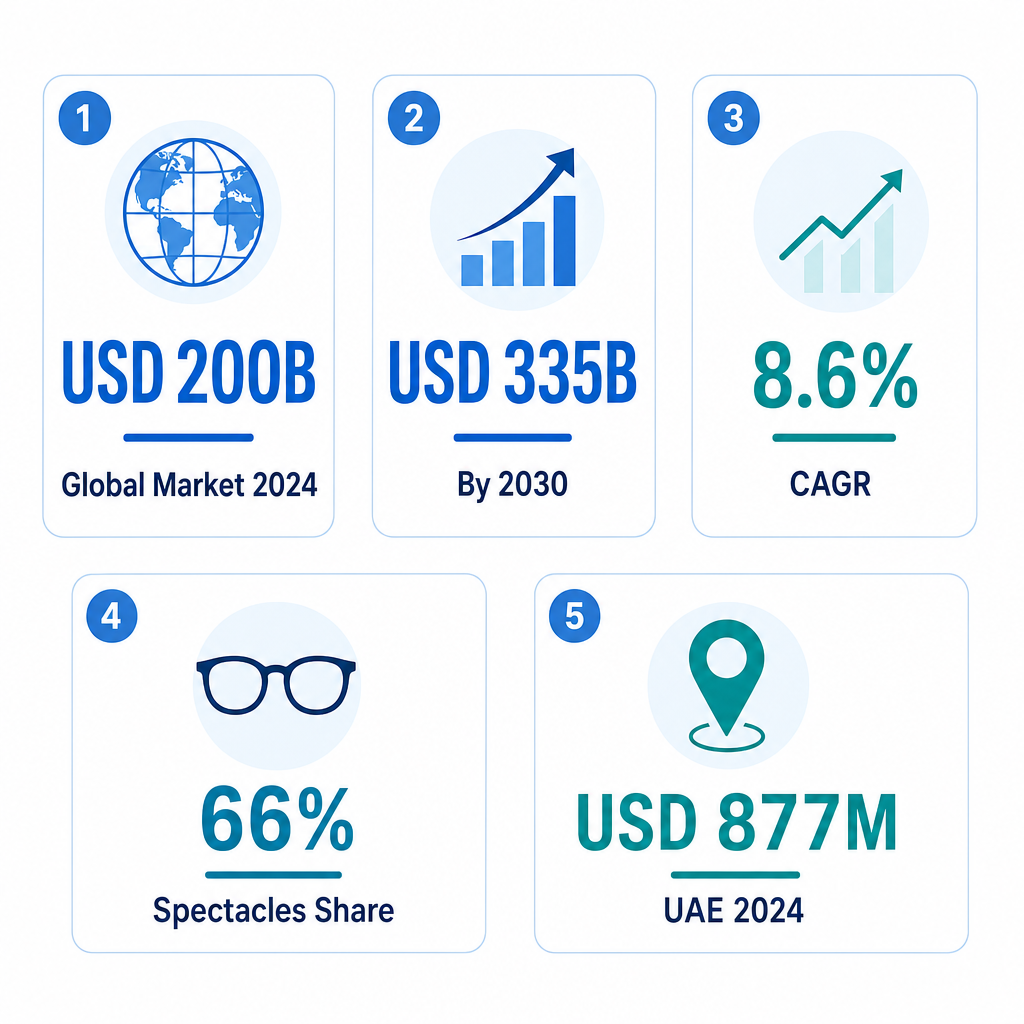
Eyewear is uniquely dual-purpose: spectacles alone account for 66% of the global market, driven by medical necessity, while Dubai's luxury retail environment supports strong demand for premium frames and coatings. A well-structured product mix can serve both needs profitably.
How to Start a Spectacles and Contact Lenses Trading Business in Dubai with Meydan Free Zone
Eyewear is unusual in retail: it is a medical necessity and a fashion purchase at the same time. Corrective lenses are prescribed, frames are chosen, and the same customer returns every year or two for both reasons. Activity code 4773.f1 covers selling spectacles, contact lenses, frames and optical accessories.
This guide covers what the license allows, who buys from you, the approval position and the steps to get set up. Read the compliance section first. The source page leaves its approval section blank, and on prescription eyewear and contact lenses that gap matters more than on almost any other retail category.
Key Stats at a Glance
What This License Covers
Code 4773.f1 sits inside ISIC class 4773, a broad retail class that includes the activities of opticians alongside retail of photographic, optical and precision equipment. This sub-code is designated for spectacles and contact lenses: corrective spectacles, prescription eyewear, contact lenses, frames and associated optical accessories.
The exclusions are the other categories in class 4773, none of which overlap with optical goods. The boundaries that actually matter are different, and the source page does not set them out.
Three are worth settling. Selling non-prescription eyewear, meaning sunglasses and plain frames, is ordinary retail. Dispensing prescription lenses and fitting contact lenses is a clinical act performed against a prescription, and that is regulated differently.
Eye examinations and refraction are healthcare services rather than retail at all. And supplying opticians, clinics and hospital optical departments in volume is business-to-business wholesale, which sits outside a retail class.
Where your business falls across those lines determines what you need beyond this license. A frames-only fashion retailer is in a very different position from a dispensing optician.
Who Your Clients Will Be
Corrective eyewear customers
People with refractive errors buying prescription spectacles and contact lenses, returning as prescriptions change. Spectacles hold 66% of the global market, and this is recurring, needs-driven demand rather than discretionary spending.
Fashion and premium buyers
Customers treating eyewear as a style choice, buying designer frames, premium coatings and lens technologies such as blue-light filtering and photochromic lenses. Dubai's position as a luxury retail destination supports this tier strongly.
Trade buyers
Independent opticians, clinics, hospital optical departments and retail chains buying stock. Note that supplying these buyers in volume is wholesale, so check which code covers it before building a pipeline around them.
Mainland or Free Zone
A dispensing optical store is a physical retail unit with a fitting area and qualified staff, and that sits on the mainland. A mainland license from the Department of Economy and Tourism is the route for that operation.
Meydan Free Zone gives you 100% foreign ownership and a low cost base, and it suits an import and distribution business, an online eyewear operation selling non-prescription products, or a holding entity above several stores.
The dividing question is not the jurisdiction but the prescription. Selling frames and sunglasses is a retail decision. Putting a corrective lens or a contact lens on a customer is a clinical one, and it brings conditions that no trade license alone satisfies.
[blockCTACostCalculator]
Step-by-Step Setup Guide
- Step 1, confirm the approval position in writing: The source page states nothing. Ask the licensing authority and the health authority what applies to prescription eyewear and contact lenses before anything else.
- Step 2, decide prescription or non-prescription: Frames and sunglasses only, or full dispensing. This single choice drives staffing, premises and regulatory load.
- Step 3, plan for qualified staff if dispensing: Fitting corrective lenses and contact lenses is done by qualified people. Recruitment and professional licensing take time.
- Step 4, choose your jurisdiction: Mainland through DET for a dispensing store, or Meydan Free Zone for import, distribution or non-prescription online retail.
- Step 5, book your trade name: Check availability through the DET or Meydan Free Zone portal, following UAE naming conventions.
- Step 6, check product registration: Contact lenses and some lens products are registered products in many markets. Confirm what applies to each line you import.
- Step 7, secure brand agreements: Designer frame houses and lens manufacturers appoint by territory, and the brands you carry define your positioning.
- Step 8, collect your license, open a bank account and register for VAT: Register with the Federal Tax Authority once turnover passes AED 375,000.
Compliance and What You Need in Place
The blank approval section is the main issue on this page
Third-party approval, AML and references are all empty on the published activity page, and no approval position appears anywhere in its text. That is a significant gap here. Prescription spectacles and contact lenses are health-regulated products, contact lenses in particular are treated as medical devices in most jurisdictions, and dispensing corrective lenses is a clinical activity carried out by qualified people.
Get written confirmation from the licensing authority and the relevant health authority covering both your product range and whether you intend to dispense, before you trade.
Contact lenses carry the highest care
Poorly fitted or unsuitable contact lenses cause real harm, and the source page itself notes dry eye prevalence in Dubai estimated at 62.6%, a condition associated with extended lens wear. Supply, fitting and aftercare all carry responsibility that goes beyond ordinary retail.
Prescription handling
Working from a customer's prescription means holding health information and matching product to specification accurately. Both the record keeping and the accuracy are matters of patient safety rather than customer service.
VAT
Register with the Federal Tax Authority once turnover passes AED 375,000.
Market Opportunity
The global eyewear market was valued at USD 200.46 billion in 2024 and is projected to reach USD 335.90 billion by 2030 at 8.6% CAGR, with spectacles the dominant segment at 66% of the market in 2025.
The UAE picture is growing faster than most. UAE eyewear generated USD 877.8 million in 2024 and is expected to reach USD 1.40 billion by 2030 at 7.7% CAGR, inside a UAE eye care market valued at USD 1.2 billion.
Underneath that sits a clinical driver that is not going to reverse. A 2024 meta-analysis in JAMA Network Open found a dose-response association between digital screen time and myopia risk, rising sharply at one to four hours of daily use. UAE university research found myopia prevalence near 50% among students, with 92.8% reporting at least one digital eye strain symptom. In a young, highly connected population that translates into a structurally expanding customer base, with the fashion and premium tier layered on top of it.
Conclusion
Code 4773.f1 covers a category with both recurring medical demand and real fashion margin, in a market heading toward USD 1.40 billion by 2030.
The regulatory question is the one to answer first, because the source page does not. Selling frames is retail; dispensing prescription lenses and fitting contact lenses is something else, and the difference determines your premises, your staff and your approvals.
Get that confirmed in writing, then decide which side of the line your business sits on. Speak to the Meydan Free Zone team about structure once you know.
[blockCTAContact]