Table of Contents
Topic Summary
Understand Exactly What the License Covers
Activity code 4669.76 permits trading, sorting, and baling waste plastic for onward sale to recyclers and processors. It does not cover waste collection as a service, waste treatment for disposal, or processing plastic into secondary raw material through transformation.
Resolve the Collection Boundary Before You Apply
The source documentation contradicts itself on whether collection sits inside this activity code. Confirm in writing with the licensing authority whether your business model needs a separate collection permit or whether offtake agreements with licensed collectors are sufficient.
Know the Four Plastic Grades That Drive Revenue
PET, HDPE, LDPE, and polypropylene are the main tradeable grades, each with distinct buyer pools and pricing benchmarks. PET buyers are the most specification-sensitive, while HDPE, LDPE, and polypropylene regrind buyers offer broader tolerance and steadier volume.
Match Your Buyer Type to Your Supply Stream
Bottle-to-bottle recyclers buy clean PET to tight colour and grade specs, while regrind producers form the volume base for most traders. Mixed-grade and chemical recyclers accept lower-quality streams others reject, giving you an outlet for difficult material.
Choose Meydan Free Zone for Export-Focused Models
A Meydan Free Zone license gives you 100% foreign ownership and suits businesses built around export and re-export flows to regional recyclers. Mainland DET licensing is the better route if you need direct collection arrangements from UAE sites.
Market Conditions Make the Timing Favorable
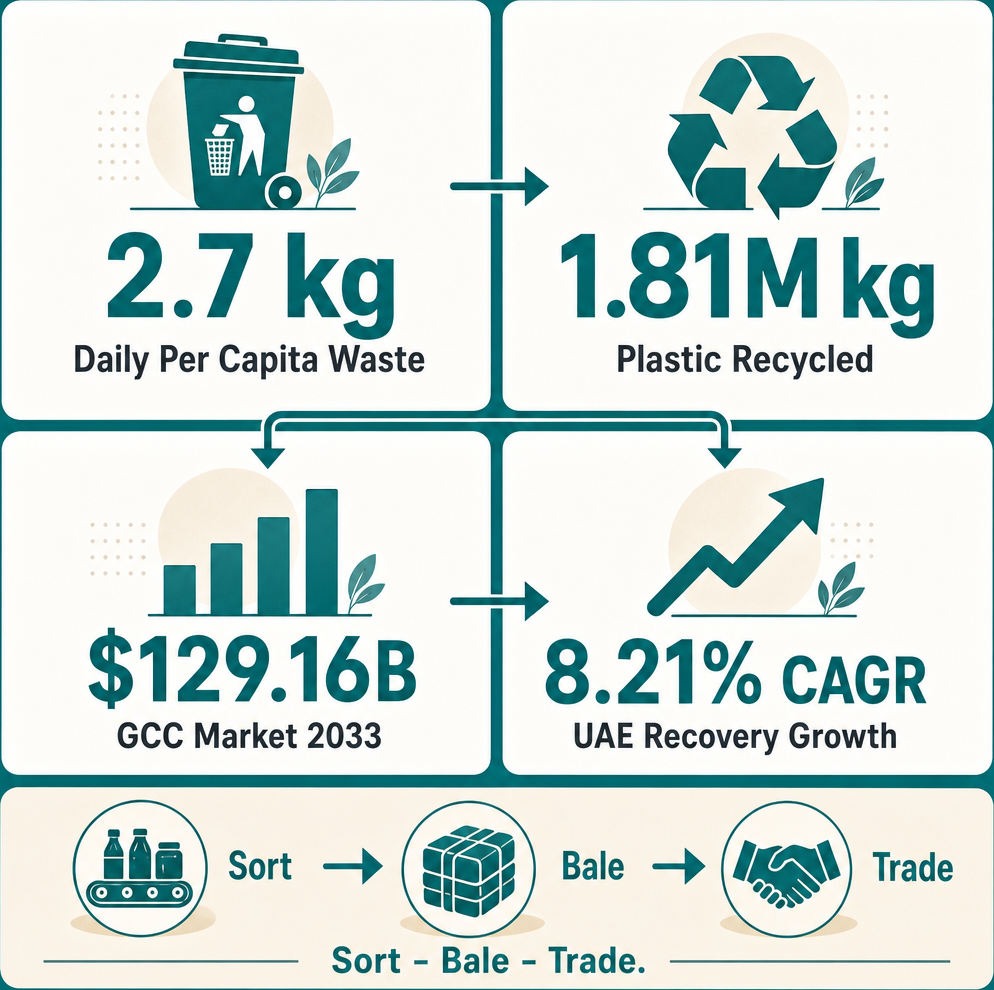
The UAE generates 2.7 kg of waste per person per day, and the GCC waste management market is growing at 7.41% CAGR toward USD 129 billion by 2033. Policy drivers including Dubai's Waste Management Strategy 2041 and phased single-use plastic bans are pushing more material into tradeable commodity streams.
AML Exemption Reduces Compliance Overhead
Waste plastic trading under code 4669.76 is listed as exempt from AML compliance obligations, which simplifies onboarding and ongoing reporting requirements. Waste handling regulations in Dubai still apply operationally, so confirm the regulatory position in writing before you begin trading.
How to Start a Waste Plastic Trading Business in Dubai with Meydan Free Zone
Water bottles, food packaging, industrial film and offcuts from polymer converters all end up in the same place: a sorted, baled commodity stream that recyclers buy by grade. Activity code 4669.76 covers trading in it.
This guide covers what the license allows, who buys from you, the approval position and the steps to get set up. One point needs settling before you apply, and it is covered in the boundary section: the source page is not consistent about whether collection sits inside this activity.
Key Stats at a Glance
What This License Covers
Code 4669.76 covers trading in waste plastic: taking polymer waste, sorting it by grade, baling it and selling it on to recyclers and processors. PET bottle waste to bottle-to-bottle and fibre recyclers, HDPE containers for regrind, LDPE film scrap from industrial sources, polypropylene from converters and consumer collection.
The exclusions are substantive here rather than generic. Collecting household and industrial waste is a waste collection service in its own class. Treating waste for disposal rather than onward industrial use is waste treatment.
Processing waste into secondary raw material through a real transformation process is materials recovery, which is closer to manufacturing than to trading. Dismantling vehicles and equipment, shredding cars, ship-breaking and retail of second-hand goods all sit elsewhere.
There is a contradiction to resolve first. The source page describes the activity as including collection, then lists collection of household and industrial waste among the exclusions. Both cannot be right.
The safe working assumption is that trading, sorting and baling sit inside this code while running a collection service is separately licensed, but confirm in writing with the licensing authority whether your model needs a collection permission alongside this license, or offtake agreements with licensed collectors instead.
Who Your Clients Will Be
Bottle-to-bottle and fibre recyclers
Buyers of PET bottle waste producing recycled PET and polyester fibre inputs. The most specification-sensitive customers in the trade, buying to colour and grade, and pricing against virgin PET benchmarks.
Regrind and resin producers
Recyclers taking sorted HDPE, LDPE and polypropylene to produce regrind and recycled resin. Broader tolerance than PET buyers, steady offtake, and the volume base for most traders.
Mixed-grade and chemical recyclers
Regional mechanical recyclers taking mixed loads and film scrap, plus chemical recycling operators handling streams that mechanical recycling cannot. Lower prices per tonne, but they take material others reject.
Mainland or Free Zone
Plastic waste is bulky and low density until baled, so a yard with baling capacity is the operating asset, and that sits on the mainland. A mainland license from the Department of Economy and Tourism is the route for that.
Meydan Free Zone gives you 100% foreign ownership and a low fixed cost base, and it suits a trading and export operation buying baled material and selling to regional recyclers without running collection or a yard yourself.
The choice between those two models is also the answer to the licensing question above. A trading desk that buys baled stock has a much simpler position than an operation collecting material from sites.
[blockCTACostCalculator]
Step-by-Step Setup Guide
- Step 1, decide whether you collect or buy: Running collection and buying baled material are different regulatory positions. Settle this before applying.
- Step 2, confirm the approval position in writing: Ask the licensing authority and the relevant municipality what permissions your model needs beyond the trade license.
- Step 3, pick your grades: PET, polyolefins, or mixed and specialty. Each has different sorting demands, buyers and price behaviour.
- Step 4, choose your jurisdiction: Mainland through DET for collection and a yard, or Meydan Free Zone for trading and export.
- Step 5, book your trade name: Check availability through the DET or Meydan Free Zone portal, following UAE naming conventions.
- Step 6, secure feedstock: Offtake agreements with collectors, converters, beverage collection points or industrial sources. Supply is the constraint, not demand.
- Step 7, set up sorting and baling: Polymer separation and contamination control determine whether your bales sell at grade or get discounted.
- Step 8, collect your license, open a bank account and register for VAT: Register with the Federal Tax Authority once turnover passes AED 375,000.
Compliance and What You Need in Place
Settle the collection question
The page states no third-party approval, yet describes collection as part of the activity while excluding waste collection in the same breath. Waste handling is regulated in Dubai, and picking material up from sites is materially different from buying baled stock. Get written confirmation of what your model needs before you begin.
Contamination is the commercial risk
Plastic buys and sells on polymer purity. Mixed polymers, food residue, labels and moisture all downgrade a load, and PET buyers in particular reject on colour and contamination. Sorting discipline is what protects your margin.
Export documentation
Waste plastic moving across borders attracts documentation and, in many destination markets, restrictions on what can be imported. Confirm what each destination allows before you commit to a shipment.
AML and VAT
This activity is exempt from AML duties. Register with the Federal Tax Authority once turnover passes AED 375,000.
Market Opportunity
The feedstock side is unusually strong. UAE waste generation runs at 2.7 kg per person per day, among the highest rates anywhere, and plastics are a major component of it.
The Emirates Environmental Group reports 1.81 million kg of plastic recycled cumulatively through its Plastic Collection Campaign, which reflects sorting discipline already established in the collection system.
Regulation is actively redirecting that material. Phased single-use plastic restrictions in Dubai and Abu Dhabi push both consumer and industrial plastic into sorted recycling streams, while UAE recycling and material recovery grows at 8.21% CAGR through 2030 under the Dubai Waste Management Strategy 2041 and Abu Dhabi's 80% landfill diversion target.
The buyer side is established. GCC waste management is projected at USD 129.16 billion by 2033 at 7.41% CAGR, and recyclers across the GCC, Asia and Europe already buy sorted UAE waste plastic as feedstock for both mechanical and chemical recycling.
Chemical recycling in particular is opening outlets for grades that mechanical processors will not take.
Conclusion
Code 4669.76 sits in front of a real structural shift. Single-use restrictions and landfill diversion targets are moving polymer waste out of landfill, and it has to go somewhere.
Resolve the collection question first, because trading baled plastic and operating a collection service are different businesses with different permissions, and the source page treats them as one.
Commercially, the discipline is in the sorting. Clean, correctly graded bales sell at benchmark; contaminated ones get discounted or rejected. Speak to the Meydan Free Zone team to confirm the right structure for the model you plan to run.
[blockCTAContact]