
Table of Contents
Topic Summary
Understand Exactly What the License Covers
This commercial trading license allows you to buy, sell, aggregate, and export scrap metals, plastics, paper, and glass for recycling. It does not cover processing activities like smelting or shredding, which require a separate license category.
Choose Meydan Free Zone for Full Foreign Ownership
Setting up through Meydan Free Zone in Dubai allows 100% foreign ownership of your wholesale scrap and recycling business. This removes the need for a local Emirati partner, giving international entrepreneurs full control of their operation.
Know Your Two-Sided Client Base
Your suppliers will typically be construction firms, demolition contractors, and industrial manufacturers generating consistent scrap volumes. Your buyers will largely be overseas smelters and foundries in South Asia, East Africa, and South-East Asia.
Leverage Dubai's World-Class Port Infrastructure
Dubai handled over 14 million TEUs through its ports in 2023, making it one of the best-connected re-export hubs in the world. Proximity to Jebel Ali port gives scrap wholesalers direct access to major shipping routes serving key recycling markets.
Get Your Activity Code Right From the Start
The correct trade activity code affects customs clearance, freight documentation, and buyer due diligence checks. Registering the wrong code upfront can cause costly delays at borders and raise compliance concerns with larger international buyers.
Check Environmental Rules Before You Trade
The UAE government applies specific environmental controls to certain hazardous waste and industrial scrap categories. Reviewing the Official UAE Government Portal's regulatory framework before launching is essential, especially if your supply chain includes chemical or industrial waste streams.
Track the VAT Registration Threshold Carefully
Businesses in the UAE must register for VAT once annual turnover reaches AED 375,000, as set by the Federal Tax Authority. Planning for this threshold early ensures your pricing and invoicing structure stays compliant as your trading volumes grow.
How to Start a Wholesale of Metal and Non-Metal Waste and Scrap and Materials for Recycling Business in Dubai with Meydan Free Zone
The UAE's push toward a circular economy has turned scrap and recycling wholesale into a serious commercial opportunity. There is real infrastructure, real demand, and a regulatory framework that rewards operators who set up correctly. This is not a niche activity. It sits at the intersection of construction, manufacturing, logistics, and export trade, and the UAE's geography makes it one of the best places in the world to run it.
This guide covers what the license covers, who your clients will be, how to choose between mainland and free zone setup, and the exact steps to get your business running through Meydan Free Zone.
Key Stats at a Glance
| Activity | Wholesale of Metal and Non-Metal Waste, Scrap, and Materials for Recycling |
|---|---|
| License type | Commercial trading license |
| Foreign ownership | 100% through Meydan Free Zone – Foreign Ownership details here |
| UAE waste & recycling sector | The UAE waste management market is growing steadily, driven by national recycling targets and construction activity – IMARC Group |
| Setup jurisdiction | Meydan Free Zone, Dubai |
| VAT registration threshold | AED 375,000 annual turnover – Federal Tax Authority (FTA) |
| Key port infrastructure | Dubai ports handled over 14 million TEUs in 2023 – DP World |
What This License Covers

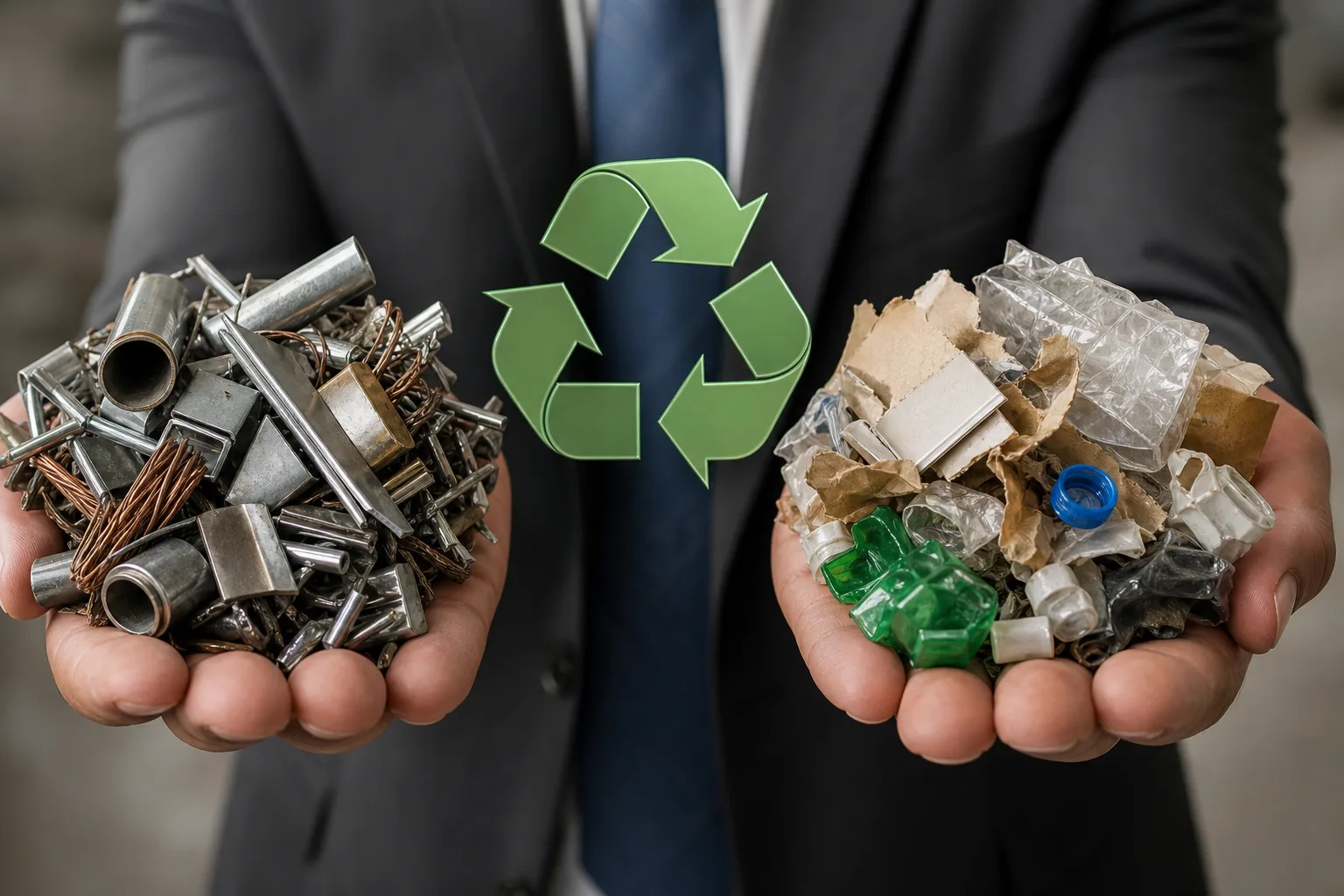
This license lets you trade wholesale in a broad range of scrap and waste materials. That covers ferrous metals such as steel and iron, non-ferrous metals such as aluminium, copper, and brass, industrial scrap from manufacturing and demolition, non-metal waste streams including plastics, paper, and glass, and recyclable raw materials destined for reprocessing.
What you can do under this license is buy, sell, aggregate, and export these materials. What you cannot do is process or manufacture them. Smelting, shredding, or converting scrap into new products falls under a different activity code and needs a different license. If you plan to do both, you need to structure your licenses accordingly from the start.
The activity code matters beyond just the license itself. Customs authorities, freight forwarders, and international buyers all look at your trade activity code when clearing shipments or running due diligence. Getting the right code upfront avoids delays at the border and questions from compliance teams at larger buyers. You can review the full Business Activities List to confirm the exact code that fits your operation before you apply.
The Dubai Municipality, Waste Department sets out the broader regulatory framework for waste and scrap trading in the UAE, including environmental controls that apply to certain hazardous material categories. Make sure you read those rules before you start, particularly if your supply chain includes industrial or chemical waste streams.
Who Your Clients Will Be
This business has two sides: the people who supply you with scrap, and the people who buy it from you.
On the supply side, your main sources will be construction firms, demolition contractors, industrial operators, and manufacturers. Dubai's ongoing construction activity generates large volumes of ferrous and non-ferrous scrap on a consistent basis. These firms want to offload material quickly and cleanly. A licensed wholesale operator with the right logistics and documentation makes that simple for them.
On the buying side, your customers will mostly be smelters, foundries, and manufacturers who use recycled feedstock in their production processes. Many of these buyers are outside the UAE, in South Asia, East Africa, and South-East Asia. Dubai's port infrastructure, particularly through DP World, makes it a natural re-export hub for scrap metals heading to these markets. Proximity to Jebel Ali gives you access to one of the world's most connected container ports.
Government and municipal waste programs are also a growing source of supply contracts in the UAE, as national recycling targets push public bodies to work with licensed commercial operators rather than manage waste streams directly.
Mainland vs Free Zone: Which Setup Works for You
The choice between a mainland license and a free zone license comes down to where your customers are and how you want to work.
A mainland license from the Dubai Department of Economy and Tourism (DET) lets you work directly with UAE-based buyers, including government entities and local manufacturers. If your main business is sourcing scrap locally and selling it into the domestic market, mainland is the right fit. You will need a physical office, and you will deal with more regulatory touchpoints, but you get full access to the UAE market.
A Meydan Free Zone license suits traders who are focused on international buyers, re-export, or who want a lower-cost setup to start. You get 100% foreign ownership, a flexi-desk option instead of a full office, and a simpler setup process. If most of your revenue comes from export sales rather than domestic transactions, a free zone structure is usually more workable.
| Factor | Mainland (DET) | Free Zone (Meydan Free Zone) |
|---|---|---|
| Client access | Open UAE market, including government tenders | Mainly international and re-export clients |
| Foreign ownership | 100% in most activities | 100% |
| Office requirement | Physical office needed | Flexi-desk options available |
| Setup cost | Generally higher | Lower starting cost – Trade License from AED 12,500 |
| VAT registration | Mandatory above AED 375,000 turnover | Mandatory above AED 375,000 turnover – Federal Tax Authority (FTA) |
| Customs handling | Direct UAE customs access | Imports and exports via free zone customs channels |
Free Business Setup Cost Calculator
Calculate NowHow to Set Up Through Meydan Free Zone
The setup process through Meydan Free Zone is well-defined. Here is what it looks like in practice.
- Step 1, book your trade name: Use the Meydan Free Zone portal to check availability and reserve your company name. You can also check your company name for free before you start the application.
- Step 2, confirm your activity code: Make sure the wholesale of metal and non-metal waste and scrap code is approved for your chosen jurisdiction before you go further. This avoids delays later.
- Step 3, submit your application: Complete the online application through the Meydan Free Zone portal. You can do this from anywhere. Meydan Free Zone supports remote business setup for founders who are not yet in the UAE.
- Step 4, prepare your documents: You will typically need passport copies for all shareholders and directors, proof of address, and a basic business plan. Meydan Free Zone will confirm the exact list at application stage.
- Step 5, complete document review: The free zone team reviews your submission and may ask for additional information. Respond quickly to keep the process moving.
- Step 6, receive your license: Once approved, your trade license is issued. Keep a copy accessible at all times for customs clearance and buyer due diligence purposes.
- Step 7, open a business bank account: You will need a UAE corporate bank account to operate. Meydan Free Zone's mCore service includes business banking support to help you navigate the account opening process.
- Step 8, apply for visas if needed: If you or your team are relocating to the UAE, mResidency covers the full visa and residency process. This includes medical fitness tests, Emirates ID, and dependent visas if you are bringing family.
For founders who want support beyond the license itself, mCore covers the core setup services, mAssist handles ongoing administration, and mAccounting supports bookkeeping and tax compliance. These are available as standalone services or as part of a package.
Compliance and What You Need in Place
Running a scrap and recycling wholesale business in the UAE comes with specific compliance duties. Know these before you start.
Customs and trade documentation
Every import and export of scrap and waste materials needs the correct trade documentation. This includes accurate commodity codes, certificates of origin where required, and weight and quality certifications that buyers and customs authorities expect. The Ports, Customs and Free Zone Corporation (PCFC) oversees customs compliance for trade moving through Dubai's ports and free zones. Errors in documentation cause shipment holds and damage relationships with buyers quickly.
VAT registration
Once your annual turnover crosses AED 375,000, you must register for VAT with the Federal Tax Authority (FTA). Scrap metal exports are typically zero-rated, but domestic sales are subject to standard VAT rules. Get this set up correctly from the start. Meydan Free Zone's mAccounting service includes VAT registration support if you need help with the process.
Staff and Emiratisation
If you operate on the mainland and hire staff, the Ministry of Human Resources and Emiratisation (MOHRE) sets the rules on employment contracts, work permits, and Emiratisation quotas. Free zone companies have different requirements, but you still need to follow MOHRE rules on any UAE-based employees.
Environmental and hazardous material rules
Not all waste is treated the same. Certain categories, including electronic waste, chemical containers, and materials contaminated with hazardous substances, are subject to additional environmental controls. Check the relevant rules on the Dubai Municipality, Waste Department before you source or trade these categories. Operating outside these rules carries real risk, including license suspension and customs holds.
Corporate tax
The UAE's corporate tax regime applies to businesses earning above AED 375,000 in net profit. Make sure your accounts are in order from day one. Meydan Free Zone's corporate tax services can help you stay compliant without building an in-house finance team.
Market Opportunity
The UAE is not just a convenient place to set up this business. It is one of the best-positioned markets in the world for scrap and recycling wholesale, for several reasons.
The UAE has committed to national recycling targets as part of its circular economy agenda. That creates demand for licensed wholesale operators who can aggregate, certify, and move material efficiently. Government and municipal programs are actively looking for commercial partners, and a properly licensed wholesale business is well-placed to win those supply contracts.
Dubai's construction sector continues to generate large volumes of ferrous and non-ferrous scrap. Steel, aluminium, copper, and mixed metals come off construction sites, fit-out projects, and demolition works at scale. This is consistent, predictable supply that a well-run wholesale operation can build a sourcing network around.
On the export side, Dubai's position as a regional re-export hub is a real commercial advantage. Scrap metals moving from the UAE to South Asia, East Africa, and South-East Asia pass through some of the world's most efficient port infrastructure. Buyers in these markets are active, price-competitive, and looking for reliable UAE-based suppliers with clean documentation.
According to IMARC Group, the UAE waste management and recycling sector is on a sustained growth trajectory, driven by urbanisation, industrial expansion, and government policy. For a licensed wholesale operator with the right setup, that trajectory creates real and durable commercial opportunity.
Conclusion
Wholesale trading in metal and non-metal waste and scrap is a well-defined, regulated activity with genuine commercial depth in the UAE. The demand is there from both the supply side and the buyer side. The infrastructure exists to move material efficiently. And the regulatory framework, while specific, is manageable once you understand it.
Getting the license right, choosing the correct jurisdiction, and understanding your compliance duties before you start will save you time and money. A free zone setup through Meydan Free Zone gives you 100% ownership, a lower-cost entry point, and the flexibility to scale as your trade flows grow.
Speak to the Meydan Free Zone team to confirm your activity code, get a cost estimate, and start the application process. Use the Cost Calculator to get an initial figure before you make any commitments.
Ready to Launch Your Business in Dubai?
Let's ConnectReferences
- IMARC Group
- Federal Tax Authority (FTA)
- DP World
- Ports, Customs and Free Zone Corporation (PCFC)
- Dubai Municipality, Waste Department
- Ministry of Human Resources and Emiratisation (MOHRE)